This week at the Spiritual Life Center:

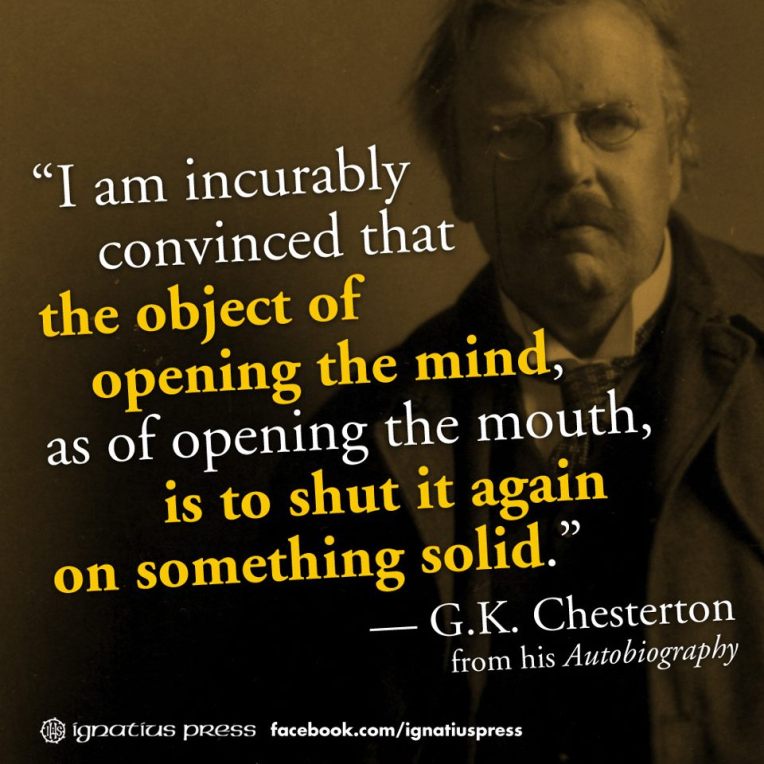
If you’re in or near south-central Kansas, I encourage you to attend the Summer Symposium this Thursday and Friday at the Spiritual Life Center in Wichita. The theme this year is “Conversion & Conscience”. Each year, the theme is tackled from four perspectives: Doctrine, Spirituality, Literature, and Catholic Living. I’m offering the Literature talks, focusing upon G. K. Chesterton, the great 20th c. British journalist and apologist. No less a figure than C. S. Lewis credited Chesterton’s book The Everlasting Man with moving him from agnosticism to Christian orthodoxy. Chesterton himself was a convert, so his approach to the Roman Catholic Faith is especially interesting for those who want to know how to encourage others along the roads that lead across the Tiber to Rome.

Click on the image of Chesterton below to link to the SLC’s Symposium page:

Quote GKC 001

Saint Benedict of Norcia

St. Benedict, Abbot
Genesis 32:23-33  +  Matthew 9:32-38
July 11, 2017

“‘…the harvest is abundant, but the laborers are few….’”

We usually associate the cry that Jesus utters in today’s Gospel passage with the need for vocations in the Church.  But Jesus also speaks through these words about the harvest of one’s own heart, and the fruits of one’s individual soul.  In each person is a soul created by God, and each soul is capable of being completely filled, as much as its capacity allows:  to be “perfected” by God’s grace. Continue reading →

July 10, 2017

Monday of the Fourteenth Week in Ordinary Time [I]
Genesis 28:10-22  +  Matthew 9:18-26
July 10, 2017

“‘Courage, daughter!  Your faith has saved you.’”

In today’s Gospel passage are two people who see how God wants to be in their lives in time of need.  So many people turn to Christ in need.  When we are honest with ourselves, we know that we would like to ask Christ’s help for so many things in our lives.  It’s true that petitionary prayer—in which we ask for something from God—is not as selfless a form of prayer as adoration.  But God wants us to present our petitions to Him. Continue reading →

10th Anniversary of Summorum Pontificum

10th Anniversary of Summorum Pontificum
July 7, 2017

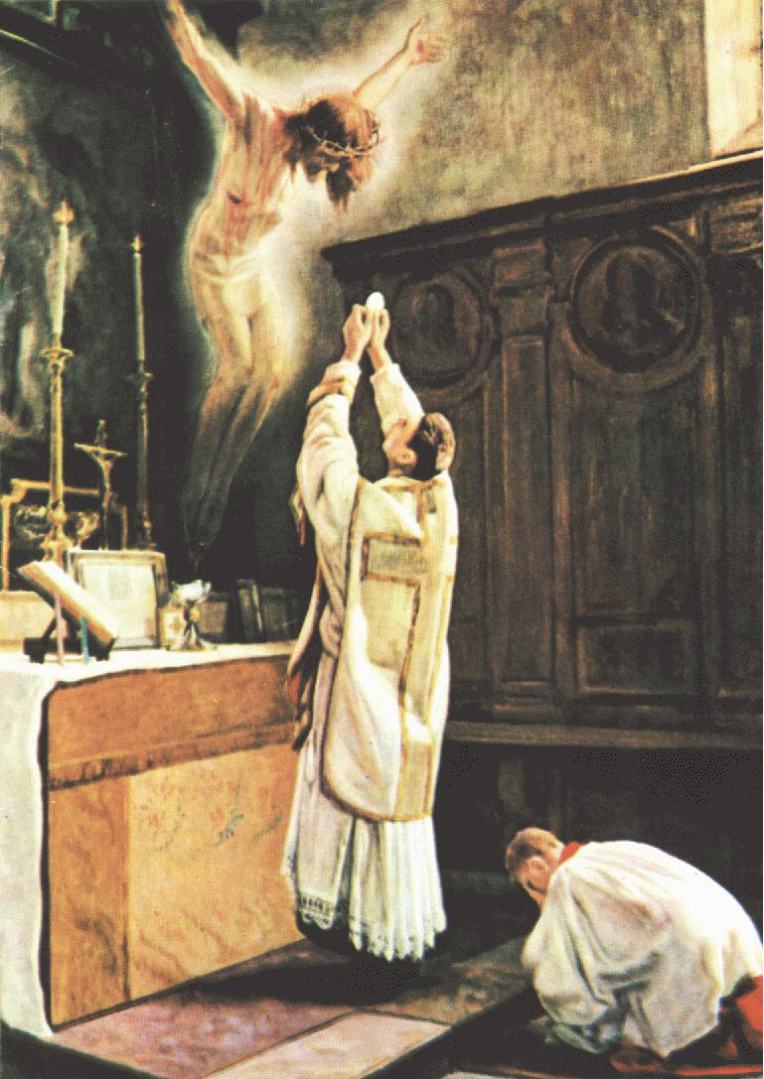
“Nemo dat quod non habet.”  Nowhere is this more true than in regard to the Sacred Liturgy.  The Church’s liturgy, of course, includes both the Divine Office and the Holy Sacrifice of the Mass.  However, as the Church reiterated at the Second Vatican Council and in the Catechism of St. John Paul the Great, it is specifically the Eucharistic Sacrifice that is the source and summit of the Church’s life.

“No one gives what he does not have.”  This saying is one way of summing up one of the most famous narratives in the four Gospel accounts:  that of Jesus in the home of Martha and Mary.  There is, of course, a tension in this story.  Jesus is not teaching that only the contemplative dimension of the Christian life is good, and that the apostolic dimension is bad.  Instead, Jesus is teaching us that there must be a right ordering of the Christian’s life.  The apostolic must flow from the contemplative, and the apostolic life of the Christian can be no more fruitful than her contemplative life.  To the degree that we want our apostolic works to be fruitful, to that extent we will devote time and energy to the Sacred Liturgy.

Of course, every baptized Christian, no matter her or his particular vocation, must be mindful of how to live out the tension illustrated in the story of Martha and Mary.  Martha and Mary, we might say, were as different from each other as were Peter and Paul.  Despite their differences, however, the Lord had to explain to Martha what Mary already understood and was already living out:  only one thing is necessary, and that one thing is the better part.

That this one thing is the better part is illustrated even by the structure of the Catechism of St. John Paul the Great.  Familiar as you undoubtedly are with the works of Dr. Peter Kreeft, you’ll recognize his summary of the pillars of the Christian Faith as being three-fold:  Creed, Code and Cult; Words, Works and Worship.  Yet the Catechism has four pillars.  The last of Kreeft’s pillars—which he calls Cult or Worship—is given two pillars in the Catechism:  the second and the fourth, the Sacred Liturgy, and personal prayer.

One reason that the Church’s official Catechism places such great emphasis on the Cult and Worship of Christians is that this “better part” has both a communal and a personal dimension.  We might be tempted to think of the sacraments and other forms of the Sacred Liturgy as communal, while private prayer is personal.  But that distinction is too simple, because participation in the Sacred Liturgy is intensely personal, and all individual prayer—if it is authentic—takes place within the Communion of Saints.

A more convincing reason why the Catechism has two pillars dedicated to Cult/Worship is very simple.  The Church has always taught that the Eucharistic Sacrifice of Holy Mass, the culmination of the Sacred Liturgy, is the source and summit of the Christian life.  Everything else, including Creed and Code, Words and Works, must serve this source and summit.

In that case, all Christians need—if they want to grow in the Christian life as the Church teaches—to give priority to Cult and Worship, above all in the Eucharistic Sacrifice of Holy Mass, as the Catechism does, proportionate to their vocations.  It does no good to evade this truth by stating:  “I’m not a Benedictine.”  The Church does not say that only for Benedictines is the Eucharistic Sacrifice the source and summit of the Christian life.  The Eucharistic Sacrifice is the source and summit of the Christian life for each and every Christian.  May we recognize Christ calling us to union with Him through His Eucharistic Sacrifice not only as the better part, but as the measure of the efficacy of all our labors, and the measure of our fidelity as His People.
Holy Sacrifice of the Mass 2

The 14th Sunday in Ordinary Time [A]

The Fourteenth Sunday in Ordinary Time [A]
Zech 9:9-10  +  Rom 8:9,11-13  +  Mt 11:25-30
July 9, 2017

“… we are not debtors to the flesh, to live according to the flesh.”

In last Sunday’s Second Reading, St. Paul preached to the Romans about the contrast between life and death.  He explained that Christian life is found within the experience of death:  not just the death that occurs at the end of our earthly days, but daily death.  In today’s Second Reading, St. Paul explores a related contrast:  between the flesh and the spirit.

What does St. Paul mean when he states to the Romans:  “You are not in the flesh”?  Of course, no one would deny that Christians, as they make pilgrimage through life on this earth, journey within a human body.  We all live with flesh and blood.  The human body is an essential part of being human.

But when St. Paul insists that “You are not in the flesh”, he’s referring to the principle by which the pilgrim focuses his life.  That is to ask, is gratification of the flesh’s five senses the motivating principle for the pilgrim’s choices?  Or does that pilgrim live “in the spirit”, meaning that his choices seek to allow the Holy Spirit to rule—to give order and aim—to the pilgrim’s journey? Continue reading →

July 8, 2017

Saturday of the Thirteenth Week in Ordinary Time [I]
Genesis 27:1-5,15-29  +  Matthew 9:14-17
July 8, 2017

“‘Can the wedding guests mourn as long as the bridegroom is with them?’”

It’s the disciples of St. John the Baptist—and not the saint himself—who appear and speak in today’s Gospel passage.  Nonetheless, today’s passage offers us similarities and contrasts between John and Jesus:  one of them the voice of the Word, and the other the Word made Flesh. Continue reading →

July 7, 2017

Friday of the Thirteenth Week in Ordinary Time [I]
Genesis 23:1-4,19; 24:1-8,62-67  +  Matthew 9:9-13
July 7, 2017

“‘I did not come to call the righteous but sinners.’”

Today’s Gospel passage presents to us the vocation of Saint Matthew.  The word “vocation” literally means a “calling”.  A vocation is something “vocal”, which comes from the Voice of God (or perhaps better, the Word of God).  That might not seem earth-shattering news.  But what we sometimes forget is that a Christian vocation is not announced by Christ to a Christian at a single initial moment. Continue reading →

July 6, 2017

Thursday of the Thirteenth Week in Ordinary Time [I]
Genesis 22:1-19  +  Matthew 9:1-8
July 6, 2017

“‘…but where is the sheep for the burnt offering?’”

Today’s First Reading is one of the more famous and more moving passages of the Old Testament.  The Church Fathers comment upon this passage at length and to great depth.  But consider just one idea from among the many that this passage holds.  Reflect on the notion of liberty. Continue reading →

July 5, 2017

Wednesday of the Thirteenth Week in Ordinary Time [I]
Genesis 21:5,8-20  +  Matthew 8:28-34
July 5, 2017

“…when they saw him they begged him to leave their district.”

Demonic possession is an extremely serious matter.  While some in our day dismiss it, suggesting that reported cases of possession are in fact only psychological disorders, the Church takes today’s Gospel passage at its word. Continue reading →