
The Twentieth Sunday in Ordinary Time [A]

The Twentieth Sunday in Ordinary Time [A]
Isaiah 56:1,6-7  +  Romans 11:13-15,29-32  +  Matthew 15:21-28
August 16, 2026

The woman in today’s Gospel Reading represents you and me inasmuch as we are sinners.  She is a Gentile.  Up to Jesus’ day, God had promised salvation only to the Jews.  Gentiles were—by definition—outsiders.  Even though we have been adopted by God through our baptism, when we sin, we move outside of God’s grace.  So when we sin, we are like the woman in today’s Gospel Reading.  However, whenever anyone finds himself outside of God’s grace, the first step towards God is always the virtue of faith.

Faith is the doorway through which all of God’s other gifts find their true meaning in our lives.  Nonetheless, faith is always a gift, which some people do not accept.  Perhaps some days when you wake up, you’re not sure whether you do either.  Nonetheless, it’s a gift that’s always “on offer” from God.

The fact is, though, that you cannot make someone believe in God.  Jesus preached in public for three years, but He did not spend His time offering to people proofs of God’s existence.  Today’s Gospel Reading shows just how down-to-earth Jesus could be regarding the faith of others.

More to the point, today’s Gospel Reading shows us how God can test our faith.  This dialogue—we might almost call it “banter”—between Jesus and the Gentile woman shows how God relates to us.  It also shows how He wants us to relate to Him in our daily lives, and over the long course of many years.

+     +     +

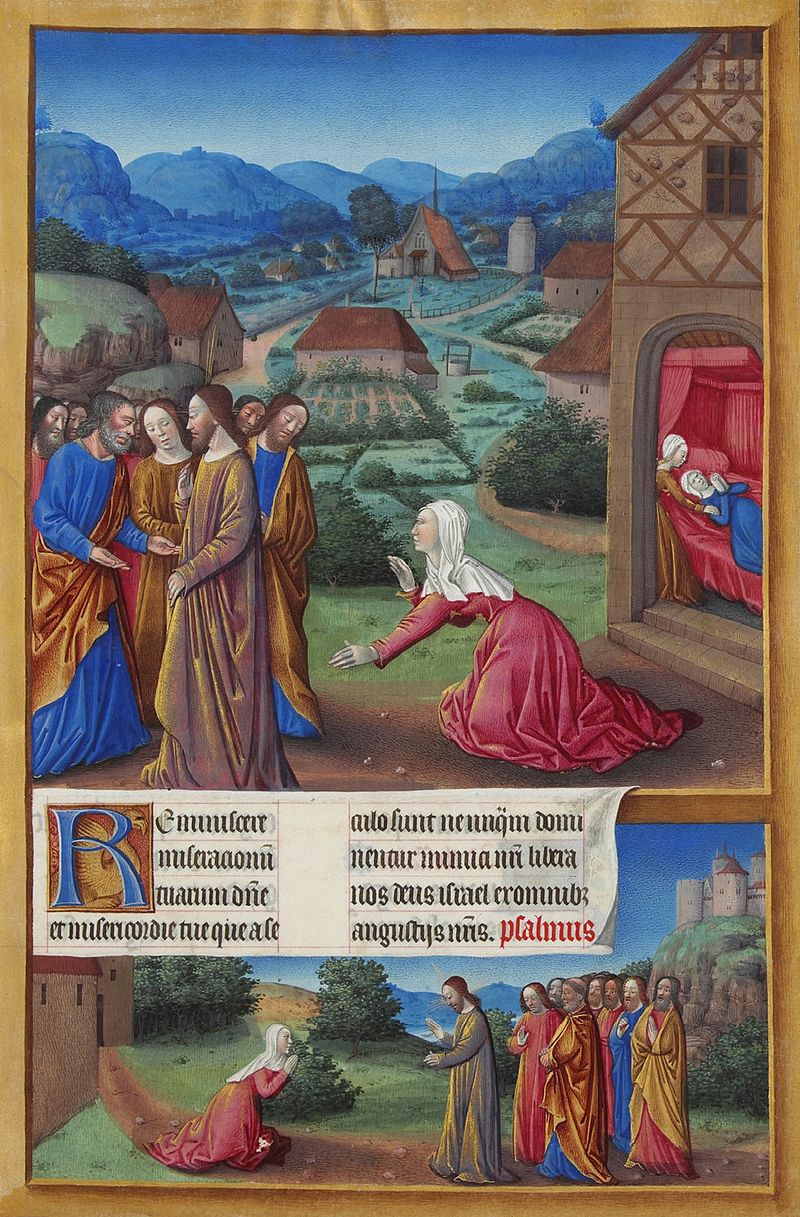
Have you ever prayed to God and felt He was not listening?  The evangelist tells us that “a Canaanite woman”—that is, an outsider—came to Jesus.  She “called out, ‘Have pity on me, Lord, Son of David!’”  This woman, despite not being a Jew, nonetheless knew who Jesus was, and cried out to Him for help.  But what happened next?

Jesus did not say a word in response.  Not a word!  Here is a woman whose daughter is being tormented, and Jesus did not say even a word in answer.  If you have ever prayed intensely about a serious problem, and felt that God did not answer, you can identify with this woman.

But can you identify with what the woman does next?  Her faith is not shaken.  She goes now to Jesus a second time, and simply says, “Lord, help me.”  But how does Jesus respond this time?

Jesus speaks in a way that can strike us—at first hearing—as an insult.  He says to this outsider, “‘It is not right to take the food of the children and throw it to the dogs.’”  The “children” Jesus is referring to are the children of Israel.  By contrast, this woman is an outsider, and in that sense is a “dog”.  However, the woman’s response shows that she understands what Jesus is up to.  But do you understand what He is up to when He challenges you in your spiritual life?

+     +     +

God knows you better than you know yourself.  God demands faith from us, even when we believe we have nothing left.  He is willing to draw our faith out of us.  We might even say that He is willing to test us, in order to purify and strengthen our faith.  Jesus knows what sort of faith the woman in the Gospel Reading has.  He is willing to draw it out, because without faith on this woman’s part, He will not choose to work a miracle for her.

Faith is always necessary for God’s plan for our lives to reach its goal.  Whenever you read in the Gospel about Jesus not working a miracle that seems needed, it’s not because He is unable.  The fact is that without faith on our part, God’s grace would be taken for granted.  Of course, that begs the question:  exactly what kind of faith does God want from us?

The faith that God wants from us is not passive; it’s active.  God does not want from us the sort of faith that just says, “God is going to take care of everything, so I can sit back and coast.”  That is not our Catholic understanding of faith.  Faith is something active on our part.  It demands constant prayer.  It demands the sort of dialogue, and even the sort of banter, that we hear between Jesus and the Gentile woman.  We might even say that God wants us to challenge Him in our prayer, as the woman in today’s Gospel passage does.

+     +     +

The bottom line is that above all else, God wants us to have an active faith.  He wants us to have a persevering faith.  This is the faith that turns to Jesus as the Lord of our lives, and trusts Him to give us not what we want, but what we truly need.
The Nineteenth Sunday in Ordinary Time [A]

The Nineteenth Sunday in Ordinary Time [A]
I Kings 19:9,11-13  +  Romans 9:1-5  +  Matthew 14:22-33
August 9, 2026

After the fire there was a tiny whispering sound.

references to the Catechism of the Catholic Church cited for this Sunday by the Vatican’s Homiletic Directory:

CCC 164: faith experiences testing
CCC 272-274: only faith can follow mysterious ways of providence
CCC 671-672: in difficult times, cultivate trust that all is subject to Christ
CCC 56-64121-122218-219: history of covenants; God’s love for Israel
CCC 839-840: the Church’s relationship to the Jewish people

Every one of you has been lonely at some point in your life.  Sometimes the feeling of loneliness is caused by distance.  Many recent high school graduates will leave soon for college.  They will look forward to new friends and experiences. But many of them will experience homesickness, which is one type of loneliness.

There are many types of loneliness, and they have many different causes. Once, a mother told me how lonely she felt on the morning she dropped off her youngest child on his first day of kindergarten.  She had taken her older children to their first days of kindergarten, as well.  But this was different.  On that August day, without knowing exactly why, she felt that her loneliness was from crossing a threshold in her life.  She felt that she’d never again be needed by others in the same way.

+     +     +

These different examples of loneliness raise a question.  What is the difference between loneliness and “aloneness”?  They’re definitely not the same.  It’s true that a person who is alone can also be lonely.  But on the other hand, a person can feel lonely in the midst of a room full of friends.

One difference between the two is that loneliness is inside us, while aloneness is outside us.  Aloneness is easy to spot:  if we notice someone who has no one else around him, it’s obvious that he’s alone.

But loneliness, on the other hand, is not as easy to spot.  Because loneliness is inside a person, you could only see loneliness in another if you could see into his or her soul.  It’s true that sometimes the state of a person’s soul becomes visible.  This might happen by an expression on a person’s face, or tears running down the person’s cheeks.  But often, we do not see those signs, sometimes because the loneliness is hidden, or maybe we’re not being attentive to others.

So how does all this about loneliness and aloneness relate to today’s Scriptures?  They’re shown by two persons in today’s Scriptures.  There is Elijah in the First Reading, and Our Lord Jesus at the start of today’s Gospel passage.

+     +     +

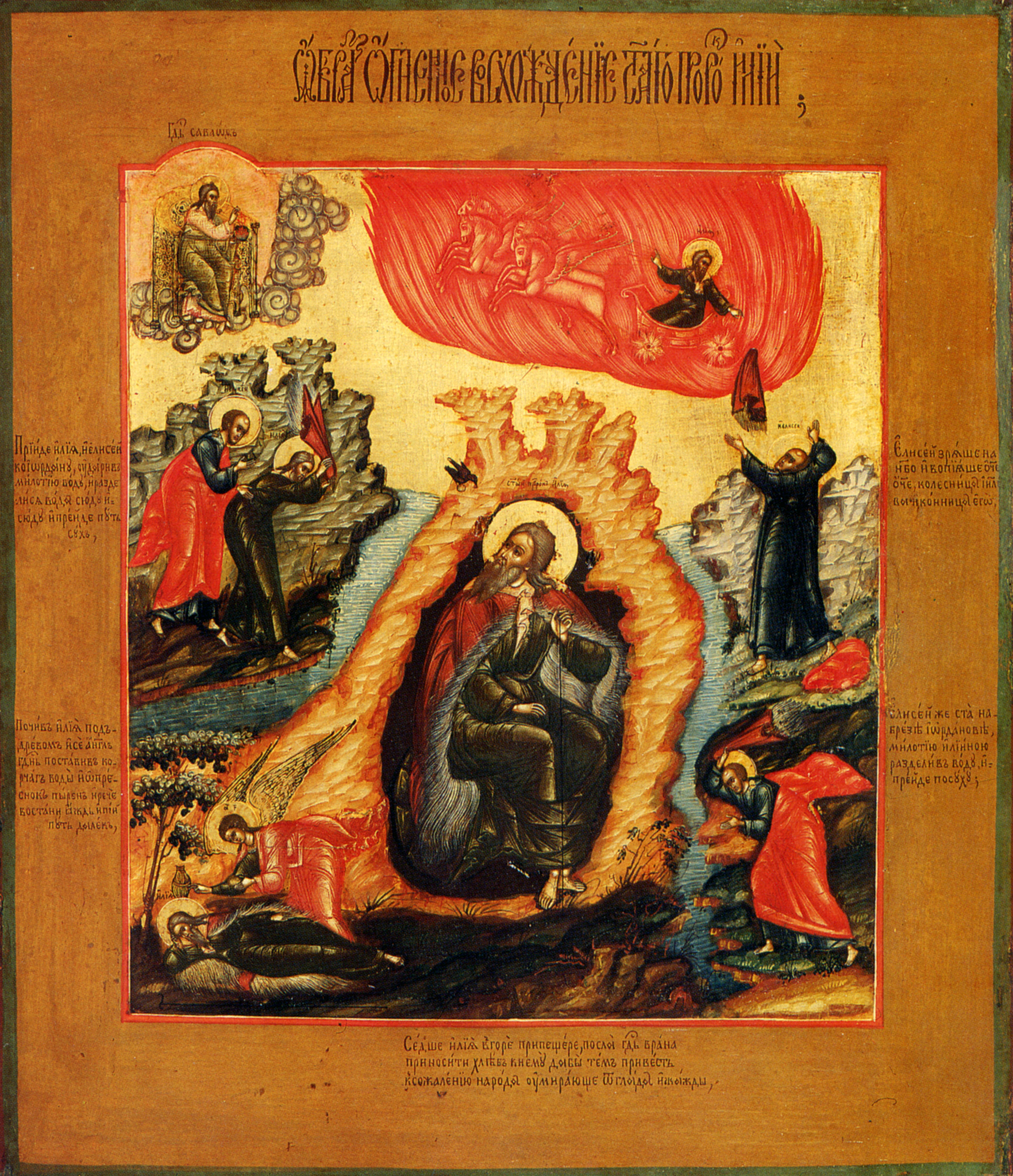
The First Reading’s portrait of Elijah is a detail of a much larger canvas.  Reflect on the context that surrounds Elijah today.  You would have to read the verses leading up to today’s First Reading to learn that Elijah is in flight, for fear of his life.  Elijah was the enemy of King Ahab, the wicked king of Israel.  Among his evil deeds, Ahab and his wife Jezebel had every prophet of Israel murdered by the sword, except Elijah.

At the start of the chapter from which today’s First Reading comes, Jezebel vows to end Elijah’s life within a day’s time.  Although Israel’s prophets often faced death threats, Elijah acts very humanly and flees.  He prays “that he might die, saying, ‘It is enough; now, O Lord, take away my life…’” [I Kings 19:4].  At the start of today’s First Reading, Elijah has fled for his life for forty days and forty nights.  Elijah has hidden himself in a cave inside the mountain of Horeb.

So with Elijah in mind, consider a time in your own life that resembles Elijah’s darkness.  Elijah is in a dark place, both in his physical surroundings, and within his soul.  But what happens next foreshadows what God offers you at times of darkness.  It’s within Elijah’s darkness that the Lord God chooses to speak to Elijah.  In your own life, the Lord promises you that when you are in darkness, He will speak to you. But will you be able to hear Him?

Sacred Scripture reveals to us the obvious fact that God can speak however He wishes.  He can speak through “a strong and heavy wind” [I Kings 19:11]:  remember the day of Pentecost [Acts 2:2].  He can speak through an “earthquake” [I Kings 19:11]:  remember the death of Jesus [Matthew 27:51].  He can speak through “fire” [I Kings 19:12]:  recall the descent of the Holy Spirit [Acts 2:3].  God can choose to speak through signs that are loud and eye-catching.  But He can also do the opposite, speaking through “a tiny, whispering sound.” This is how God the Father speaks to us in times of darkness.

+     +     +

At the beginning of today’s Gospel Reading, Jesus “went up on the mountain by Himself to pray.  When it was evening He was there alone.”  We have to be alone in order to hear the whispering of God the Father. The aloneness that God the Father demands also includes the silencing of electronic devices.  Jesus was willing to listen for, and listen to, the voice of His Father in Heaven.  He was not afraid of doing what the Lord asked of Him, even if this meant carrying and dying on the Cross.  He was not afraid because He knew that the love of His Father is stronger than death.

It’s easy to notice the fires, earthquakes, and driving winds that God the Father sends your way.  But what about the whispers?  What are you missing by not listening for—and not listening to—your Father whispering to you?

The Transfiguration of the Lord [A]

The Transfiguration of the Lord [A]
Daniel 7:9-10,13-14  +  2 Peter 1:16-19  +  Matthew 17:1-9
August 6, 2026

Today the Church celebrates the Feast of Jesus’ Transfiguration.  Within this scene that the Gospel Reading describes, there are three icons for us to attend to.  Each icon symbolizes a different experience of our spiritual life.  These three icons are:  the tent; the cross; and the glory.  What do these three symbolize?

+     +     +

The first icon is the tent of which Peter speaks.  He says to Jesus, “If you wish, I will make three tents here, one for you, one for Moses, and one for Elijah.”  Peter wants to make tents so they can stay there and prolong their experience on the mountaintop.

Peter is a beginner in the spiritual life.  He is a child in the spiritual life.  He’s like a child who wants to start supper with dessert.

God does not want His pastors to encourage Jesus’ disciples to be like Peter.  The tent symbolizes what is man-made.  It cannot fulfill man.  It can be used on the journey like a tool, but when substituted for what is God-made, it turns the Faith inside-out.

+     +     +

The second icon is the Cross of which Jesus speaks.  He charged the three apostles, “Do not tell the vision to anyone until the Son of Man has been raised from the dead.”  Today’s Gospel Reading comes from St. Matthew’s account of the Gospel.  In St. Luke’s account of the Transfiguration, we hear that Jesus, Moses, and Elijah “spoke of [Jesus’] exodus that he was going to accomplish in Jerusalem.”  This exodus is the Way of the Cross.

Jesus is the Master of the spiritual life.  He is God the Father’s “beloved Son, with whom [the Father is] well pleased”.  The Father bids us to listen to him because He is the Father’s own divine Word.

The world encourages us to build tents to rest in fleeting pleasures.  The Lord commands that we take up our own crosses and follow Him to Calvary.  The world spins in circles, leading nowhere.  The Cross leads to death, and through Christ, to eternal life.  This is why the motto of St. Bruno’s Carthusian order is “stat crux dum volvitur orbis”:  “the cross stands while the world turns”.

+     +     +

The third icon is the glory of the Father.  This is the glory of the Father’s only-begotten Son.  This glory is a gift to the apostles to fortify them against the roadblocks along the Way of the Cross.

This glory is not man-made.  It is divine, yet it is fleeting.  It is not something in which the apostles can rest, but a gift for which to give thanks as they continue to follow Jesus.  This glory shines forth twice in this scene.  The Father’s glory shines forth first in His Son.  Jesus “was transfigured before them; his face shone like the sun and his clothes became white as light.”  The Father’s glory also shines through the cloud as He speaks:  “behold, a bright cloud cast a shadow over them, then from the cloud came a voice that said, ‘This is my beloved Son, with whom I am well pleased; listen to him.’”

The Father wishes that we would gaze upon His beloved Son, and listen to Him as calls us to follow Him to Calvary.  This brief gift is a means to a much greater end.  Sharing in the gift of the Cross is the only means by which to experience the Father’s glory without end in Heaven.

The Eighteenth Sunday in Ordinary Time [A]

The Eighteenth Sunday in Ordinary Time [A]
Isaiah 55:1-3  +  Romans 8:35,37-39  +  Matthew 14:13-21

… he said the blessing, broke the loaves, and gave them to the disciples, who in turn gave them to the crowds.

references to the Catechism of the Catholic Church cited for this Sunday by the Vatican’s Homiletic Directory:

CCC 2828-2837: give us this day our daily bread
CCC 1335: miracle of loaves prefigures the Eucharist
CCC 1391-1401: the fruits of Holy Communion

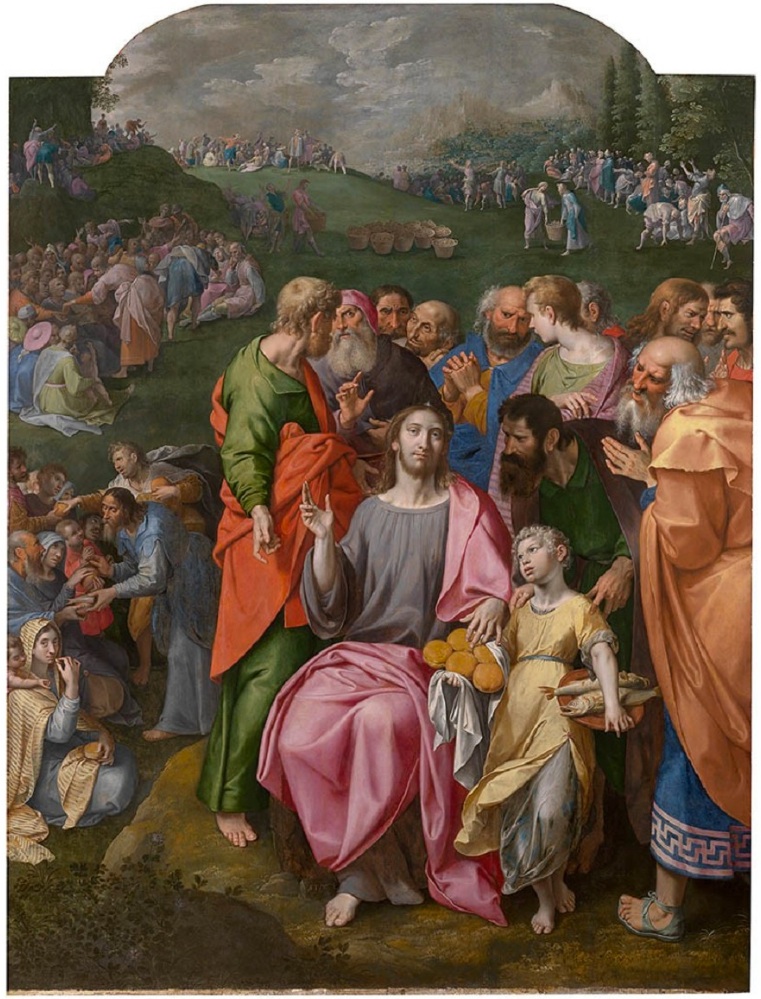
What do you think is the meaning of Jesus feeding a crowd of more than five thousand people with only a few loaves of bread and a couple of fish?  Was Jesus simply showing his power to work a miracle:  demonstrating his power over material things?  Of course, that was part of it.  But this miracle of feeding the five thousand has far more to tell us about Christ than just this.

Being compassionate, Jesus was certainly concerned with the physical well-being of the people who had come to hear Him preach.  Just how deep Christ’s compassion was is made obvious when we consider again something the first verse of this passage tells us.  Jesus is told about the hunger of the crowds right after hearing of John the Baptist’s death, and withdrawing by boat to a deserted place by Himself.  If we were to imagine this, we would see just how human Christ was, responding in grief and perhaps anger at the murder of His cousin.  He withdrew from others to be by Himself.  Yet even at this point in His life, the needs of others pressed upon Him.  His response was that of God Himself:  He turned to help those in need.

We could look at this compassion of Jesus and see in it an example for ourselves.  As Christians, we are called to walk in the footsteps of Christ and imitate Him.  We are especially to imitate the sort of self-sacrifice that He shows in this passage, the sort of self-sacrifice that came to full expression in His death on the Cross.

But this passage is not chiefly about our need to imitate Christ.  We all have our limits.  Very likely, if we learned of the murder of a close relative, we’d be of little help to others.  None of us can expect to match the depth of Christ’s self-sacrifice.

But again, that’s not the chief point of this passage.  Within this event, the example that ought to be our chief focus is not the response of Jesus, but the request of the crowds.  The crowds seek out Jesus because they know that they are in need.  But exactly what kind of need do they have?

Being compassionate, Jesus was certainly concerned with the physical well-being of the people who had come to hear Him preach.  But He knew the people in the crowds better than they knew themselves.  Christ had a much deeper concern for their spiritual well-being.  He had reminded them that their ancestors, whom God had fed in the desert by sending bread in the form of manna, had died.  His divine Father, Jesus told them, had sent Him to be their spiritual bread which would allow them to live forever.  If they would eat this bread by accepting Him and following His commandments, they could enter into God’s eternal kingdom of love.

In today’s First Reading, Isaiah says in the name of the Lord, “Come to me heedfully, listen, that you may have life.”  This is the same message which Jesus conveyed to those people gathered near the Sea of Galilee.  He brought His meaning home to them in a concrete way by giving them physical bread to satisfy their bodily hunger.  But at the same time, He revealed that He was the spiritual bread which God had sent to bring them eternal life.  His miracle used what was physical in order to point towards what is spiritual.

The crowds naturally had a spiritual hunger.  Perhaps some of them were not even aware of this hunger inside their souls.  Unfortunately, many of us today also are not aware of the hunger in our souls.  Instead, we are distracted by many things such as our work, our leisure, and our possessions.  We are worried about many things without giving heed to the one needful thing.  Jesus, then, calls us first to recognize the greatest hunger in our lives, and then to seek the One who alone can fill it.

OT 18-0AMultiplication of the Loaves and Fish by Ambrosius Francken I (1544–1618)