
The Third Sunday of Easter [A]

The Third Sunday of Easter [A]
Acts 2:14,22-33  +  1 Peter 1:17-21  +  Luke 24:13-35
St. Anthony’s Catholic Church, Garden Plain, KS
April 19, 2026

St. Luke the Evangelist explains at the start of today’s Gospel passage that it’s set on “[t]hat very day, the first day of the week”.  This is another way of saying that today’s Gospel passage is set on the day of Jesus’ Resurrection.

On that original Easter Sunday, “two of Jesus’ disciples were going to a village seven miles from Jerusalem called Emmaus”.  These two disciples symbolize you and me.  Like these two disciples, you and I at times wander away from God.  In the Gospel passage, the two disciples are walking away from Jerusalem.  They are walking away from the scene of Jesus’ Passion, Death, and Resurrection.  In other words, they’re moving on with their lives.  Though they’ve heard some rumor that Jesus was still alive, they have not put any faith in the story.  After all, they’re walking away from Jerusalem:  away from any chance of encountering this Jesus who supposedly had risen from the dead.

So we need to ask:  how often are we like these two disciples?  Rather than holding fast to our faith and making it the center of our lives, we walk away from opportunities to encounter Jesus.  In today’s Gospel passage, we hear that these two disciples were “conversing and debating… about all the things that had occurred” the past several days.  In other words, they’re talking about Jesus, but they’re also walking away from Jesus.

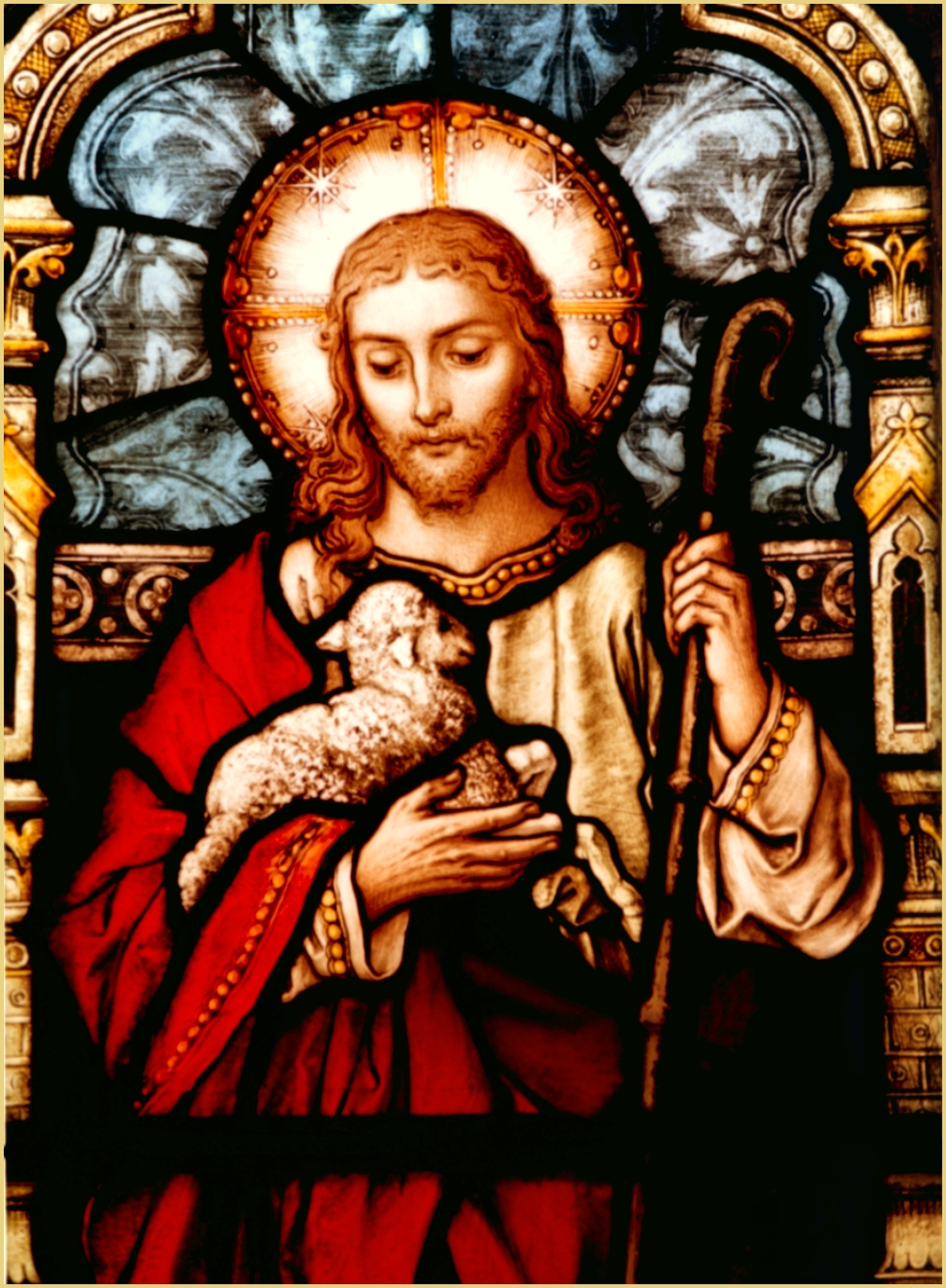
Yet while these two doubting disciples were walking away from Jerusalem, what happened?  “Jesus Himself drew near and walked with them”.  Here we see Jesus acting as the Good Shepherd.  Next Sunday we will hear Jesus describe Himself as the Good Shepherd who seeks out those who have wandered away from Him.  But today, we see Jesus living out this mission.  We see Jesus acting as the Good Shepherd.

Now, to put what Jesus is doing here into perspective, consider:  when the events of today’s Gospel Reading start, how many thousands of Jesus’ flock are dwelling within the gates of Jerusalem?  Yet here is Jesus, walking seven miles out of His way in order to bring these two wandering sheep back through the Sheepgate, and back into the fold.

Reflecting upon today’s Gospel passage, we ought to take comfort if we ourselves sometimes wander away from Him and His teachings.  We can take comfort in the fact that the patience, compassion, and love which Jesus shows to these two doubting disciples are the very same patience, compassion, and love that He has for each of us.  It does not matter where or how far we might wander away.  He seeks us out.

In today’s Gospel passage, the Good Shepherd asks these two straying sheep, “What are you discussing as you walk along?”  These disciples do not recognize their Good Shepherd, or know His voice.  So they recount to Him what their hope had been:  “that Jesus would be the one to redeem Israel.”  

Here’s a key point.  The doubting disciples believe that their hope has been shattered.  They believe this because Jesus had died.  The death of Jesus shattered their hope.  It seems obvious to these doubting disciples that someone who has died can do nothing for anyone. 

Against their false belief about their shattered hope, Jesus speaks harshly:  “Oh, how foolish you are!  How slow of heart to believe….  Was it not necessary that the Christ should suffer these things and enter into His glory?”  Jesus is directing His disciples’ attention to one of the most important truths of the Gospel.

The Cross—the death of Jesus—cannot destroy our hope.  Instead, the Cross of Jesus IS our hope.  That is why we put the crucifix on display in our homes, in our workplaces, and above the very center of our sanctuaries.  The crucifix is the visual expression of the truth that’s at the heart of our Catholic Faith:  that Christ’s death is our life.

So then Jesus goes through the entire body of Jewish Scripture with these doubting disciples.  He “interpreted to them what referred to Him” in the Old Testament.  He showed them that the Christ would have to suffer death in order to be “the one to redeem Israel”, and not only Israel, but—in time—the entire world.

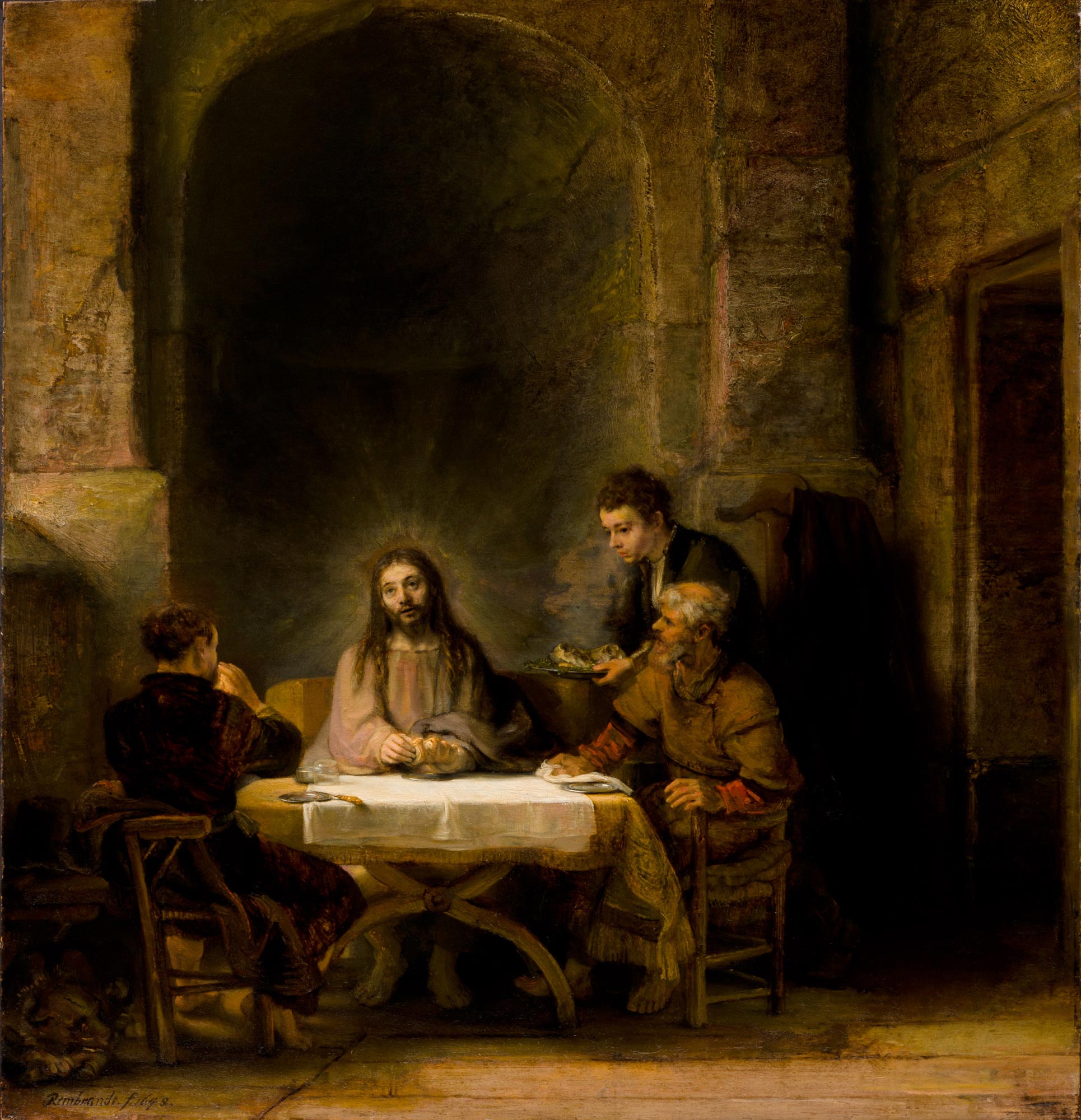
The doubting disciples, now starting to believe, invite this man—still unknown to them—to stay with them once they reach their goal.  But this man, the Risen Lord, has another goal in mind.  He stays with them, but “while He was with them at table, he took bread, said the blessing, broke it, and gave it to them.” 

These four actions of Jesus—taking bread, saying the blessing over it, breaking it, and giving it to the disciples—might sound like ordinary actions.  However, when we compare this verse from today’s Gospel passage to St. Luke’s account of the Last Supper, we see that the language is the same.  St. Luke, in describing Jesus’ actions at the Last Supper, uses these same four phrases.

This connection between the Eucharist that Jesus instituted at the Last Supper and His actions at Emmaus in today’s Gospel passage is made even more clear by the last sentence of today’s Gospel passage:  “the two recounted what had taken place on the way and how he was made known to them in the breaking of the bread.”  This same phrase—“the breaking of the bread”—also occurs in the fifth book of the New Testament, Acts of the Apostles.  In Acts of the Apostles, the phrase “the breaking of the bread” describes the early Church’s celebration of the Eucharist.  St. Luke the Evangelist, the author of today’s Gospel passage, was also the author of Acts of the Apostles.

So when Jesus towards the end of today’s Gospel passage takes bread, says the blessing, breaks it, and gives it to the disciples, we reach the goal of today’s Gospel passage.

“With that their eyes were opened and they recognized Him”.  They recognized Jesus in the Eucharist.  Here is the sacrament that is the center of our Catholic Faith.  In the Holy Eucharist, God is with us in the Flesh.  In the Holy Eucharist, the Sacrifice of Jesus on the Cross is made present in our midst.

However, if you recognize Christ in the Eucharist, who is it exactly that you consider Him to be?  Is Christ only a good shepherd, drawing you closer to His side for comfort and protection?  He wants to be even more for you.  Is Christ only a teacher, interpreting the Scriptures for you?  He wants to be even more for you.  The Messiah who suffered and died for you on the Cross is also your Lord and your God.  He is the One who created you, and the One who wants to lead you along His Way.

How often do we wonder during the week if God is with us?  How often during the week do we feel like God has abandoned us?  In fact, He is always there for us:  we simply do not recognize His Presence in our midst.  How often do we feel weak and unable to live up to the demands of our Christian Faith?  Here in the Eucharist is the greatest source of all our spiritual strength.  Jesus wants us to worthily receive His Body and Blood, in order to receive the graces that we need to be loving during the week both to God and neighbor, loving with the same depth of love with which God loves each of us.

The Second Sunday of Easter — Divine Mercy Sunday [A]

The Second Sunday of Easter — Divine Mercy Sunday [A]
Acts 2:42-47  +  1 Peter 1:3-9  +  John 20:19-31
St. Anthony’s Catholic Church, Garden Plain, KS
April 12, 2026

Why is the Second Sunday of Easter celebrated as Divine Mercy Sunday?  Why not celebrate Divine Mercy Sunday on the fifth Sunday of Easter?  Or, for that matter, the second Sunday of Lent?  Or the twenty-fourth Sunday in Ordinary Time?  This Sunday’s Scriptures answer the question.  Consider first today’s Responsorial Psalm, and then today’s Gospel passage.

“Give thanks to the Lord for He is good, His love is everlasting.”  This is the refrain for today’s Psalm:  it is Psalm 118, verse 1.  This is one of the verses of Scripture that you can end up scratching your head over, if you consult different Catholic translations of this verse into English.  If you look up this verse in one Catholic translation, the last phrase of this verse is:  “His steadfast love endures for ever.”  But if you turn then to another Catholic translation of Psalm 118:1, in the last phrase you hear this:  “His mercy endures forever.”

These different translations reflect an important truth of our Catholic Faith.  God’s mercy is His love.  We might even go so far to say that that’s the message of Divine Mercy Sunday:  God’s mercy is His love.

Of course, we need to make a distinction.  God’s love does sometimes take other forms.  Mercy is only one of the forms that God’s love takes.

After all, “in the beginning”, before Adam and Eve and their Original Sin, there never had been any mercy because there never had been sin.  Mercy exists only in the face of sin.  From all eternity, before God created anything, there was not mercy, because there was only God Himself, and God is love.  But when sin entered the world, God responded by bestowing His love in the form of mercy.

+     +     +

So with that in mind, consider today’s Gospel passage.  This beautiful passage from the 20th chapter of the Gospel according to St. John gives us the origin of the Sacrament of Confession.  One of the most important truths that this passage reveals is that it was on the very night following His Resurrection that Jesus gave the Sacrament of Confession to His Church.

This timing is definitely not a coincidence.  This is a providential part of God’s plan of salvation history.  The Sacrament of Confession is the Christian’s key to unlocking his or her potential for holiness, and so also his or her potential for sharing his faith in Jesus’ Divine Mercy.

To understand this better, keep in mind that Jesus gave His disciples a simple message about His Gospel.  He explained that what God wants from His followers can be summed up in two commands:  love God, and love your neighbor.

So, if God’s mercy is His love, what does that tell us about God’s two commands to us?  Today’s Scriptures reveal to us that to love God is to accept His divine mercy, and to love our neighbor is to bestow His divine mercy.  Think of an image from your student days in science class:  the simple electrical circuit.  No matter how much juice is in storage, ready and able to give power, if the circuit is open, you break the flow of electricity.  That open circuit reflects what happens when we’re willing to accept God’s divine mercy, but not to bestow it on others.

You can think of this in terms of the prayer that Jesus taught us:  the Our Father.  The Our Father ends with several petitions that we make to the Father.  Most of us don’t realize how dangerous one of these petitions is.  We beg God the Father in these words:  “forgive us our trespasses as we forgive those who trespass against us”.  That tiny word “as” is like the switch in the electrical circuit:  with it we either open or close the circuit of mercy.  If we do not forgive those who trespass against us—if we harbor grudges and are unwilling to reconcile with our sibling, spouse, parent, or any other neighbor—then every time we pray the Our Father, we are petitioning God not to forgive us.  Why would we ask God not to forgive us?  It does not make sense?  Neither does asking God to show mercy towards us, when we are unwilling to show mercy to others.

At the end of the Sacrament of Confession, in one of the optional conclusions the priest says, “Give thanks to the Lord, for He is good”:  those words are the start of today’s Psalm refrain.  It’s up to the person going to Confession to conclude that verse in both his words and actions:  “for His mercy endures forever.”

Easter Sunday of the Resurrection of the Lord

Easter Sunday of the Resurrection of the Lord
Acts 10:34,37-43  +  Colossians 3:1-4 [or 1 Corinthians 5:6-8]  +  John 20:1-9
St. Anthony’s Catholic Church, Garden Plain, KS
April 5, 2026

Tomorrow if you go to Walmart, you’re likely to see the store decorated for the Fourth of July.  In most of the secular world, there is an attention deficit.

But God wants us to enjoy this celebration of Our Lord’s Resurrection.  God wants us to celebrate this Easter joy the way that we enjoy the best meal we’ve ever eaten; the way that we enjoy the best evening of conversation we’ve ever had.  God wants us to enjoy Easter by luxuriating in it.  God wants us not to turn the page tomorrow and forget about the mystery of Jesus rising from the dead.

God wants us to celebrate the Resurrection of Jesus for fifty days:  seven weeks plus one more day.  The last day of this season of celebrating the Resurrection will fall on Sunday, May 24 (the day before Memorial Day).  Between today and May 24, God wants us to “rest” in the joy of Jesus’ Resurrection.

Consider this word “rest”.  This word “rest” means a lot of different things to a lot of different persons.  To a three-year-old, the last thing he wants to do is take a nap, and he’ll let you know that.  To someone older, whose hair is a different color than when in school (or who doesn’t have as much hair as when in school), rest is something prized, sought after, and even snuck in wherever and whenever possible.  Then again, there’s the “rest” that we wish upon our dearly departed:  we pray that they will “rest in peace”.

In contrast to all of those kinds of “rest”, there is the rest that God is calling us to during these fifty days of Easter.  What is this kind of rest?

To see what this “Easter rest” is, we have to go back to “the beginning”:  not to the day of Jesus’ Resurrection, but many thousands of years before, “in the beginning”, when God created the heavens and the earth.

In six days God created the heavens and the earth.  Then, on the seventh day, God rested.  We might be tempted to think that God on that seventh day acted like we would if we were in His divine shoes.  But God does not rest as we rest.  When God “rests”, He delights, He rejoices, He exults.  On the seventh day, God rested in His creation, He was like a grandparent spending a day surrounded by children and grandchildren, delighting in the goodness of those lives:  that creation.  On the seventh day God rested in His creation, because He found it good, and very good.

Another way to consider this sense of “rest” is connected to the word “arrested”: not in the sense that a policeman arrests a criminal, but in a more personal sense. Imagine that you go on pilgrimage to Rome, and in visiting the Sistine Chapel, your attention is “arrested” by the fresco of the Last Judgment. It’s almost as if you are within the scene portrayed. The artistry transports you, and you “rest” within that sacred work.

This helps us understand the rest into which God is calling us.  He wants us to rest with Him, in His Presence, and in fact, within Him.  He wants us to enter into His rest [cf. Ps 95:11 and Heb 4:11].  We enter into His rest by placing faith in Christ and His power over sin and death:  by letting Him live His life within us, instead of us making our lives about ourselves and our own works.

During these fifty days of the Easter Season, we do not just celebrate over and over for fifty times Jesus rising from the dead.  We celebrate what Jesus chose to do after rising from the dead.  For forty days He appeared to His disciples to prepare them for what was coming next.  After forty days, the Risen Jesus ascended to Heaven, to sit at the Father’s Right Hand.  After ten more days, God the Father and God the Son sent down from Heaven their Holy Spirit.

This Holy Spirit, who is the Love of the Father and the Son, is what makes us sinners like Christ.  This Holy Spirit is the Gift whose Life destroys the power of sin and death.  This Holy Spirit is what allows Christ to live within us, and to live through us.  So ask God during these fifty days to open your heart further to the grace of the Holy Spirit, to make your life more like the life of Jesus Christ, who has risen from the dead so that you can rest in the beauty of God’s merciful Love.

Palm Sunday of the Passion of the Lord [A]

Palm Sunday of the Passion of the Lord
Matthew 21:1-11  +  Isaiah 50:4-7  +  Philippians 2:6-11  +  Matthew 26:14—27:66
St. Anthony’s Catholic Church, Garden Plain, KS
March 29, 2026

Jesus became a slave to sin for the sake of mankind.  Jesus, like His Mother, never committed sin, or inherited Original Sin.  Yet Saint Paul in his Second Letter to the Corinthians states something even more profound about Jesus.  St. Paul writes that God the Father “made [Jesus] to be sin who did not know sin” [2 Corinthians 5:21].  We heard that in the Second Reading on Ash Wednesday.  It’s in the light of this truth that today, on Palm Sunday, we need to look on Jesus as a slave to sin.

Here’s the difference between Jesus and us:  Jesus freely accepted the yoke of the Cross.  On the other hand, sinful human beings—stretching from Adam and Eve to us—always accept slavery freely.  In other words, by sinning we lose our freedom.  The devil whispered to Eve, “You shall be like gods!”  Had he spoken the truth he would have told them “You shall be slaves!”

Jesus, however, “though he was in the form of God, / did not regard equality with God / something to be grasped. / Rather, he emptied himself, / taking the form of a slave….”  Consider those words—from today’s Second Reading—in the light of today’s Gospel passages.

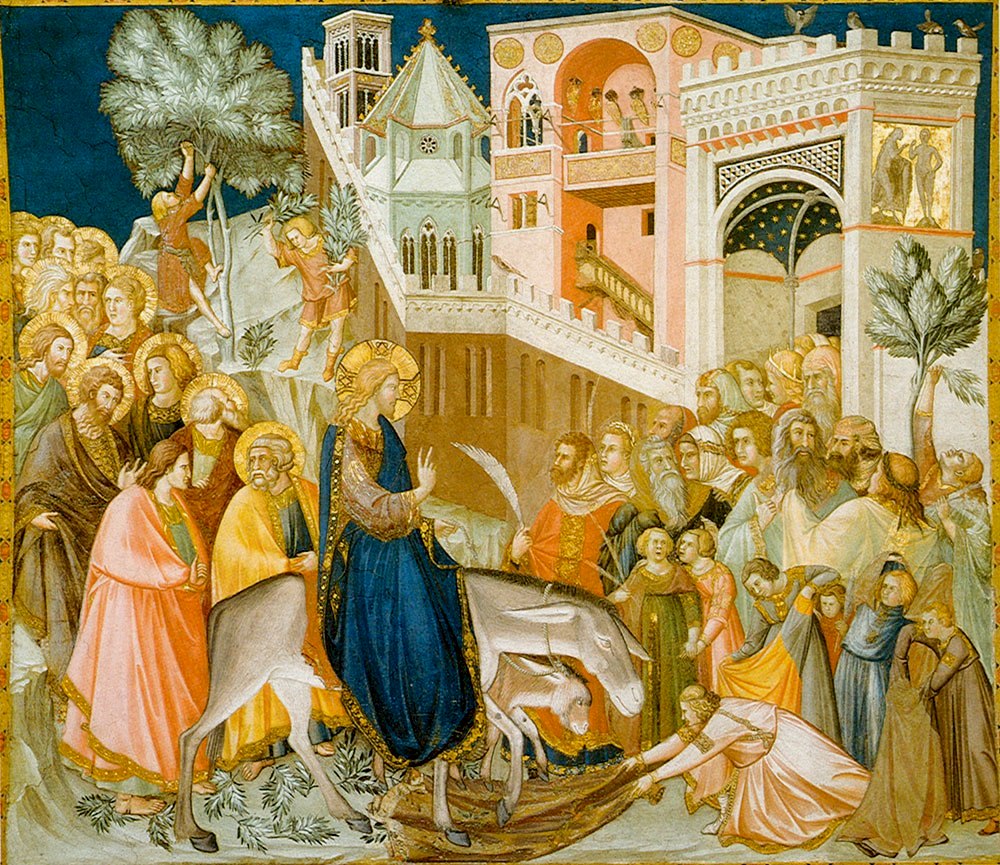
This is the only Sunday when there are two Gospel passages proclaimed at Sunday Mass.  The first we heard before the Entrance Procession.  It’s a very optimistic, hopeful passage, proclaiming the triumphal entrance of the Messiah into Jerusalem.  For century after century the Jews had longingly waited for the coming of the Messiah, and now Jesus seemed to make clear, by His entrance into the royal city, that He was the One.

But very soon after He arrived, things began to go downhill.  The second Gospel proclamation on Palm Sunday stands in contrast to the first:  not only in length, but also in tenor.  The optimistic triumph of Jesus’ procession into Jerusalem stands in contrast to the spite-filled mockery of Jesus’ recession out of Jerusalem to the top of Calvary.

Jesus’ descent into slavery is progressive.  We can hear this progress—or rather, regress—in our own words.  That is, when you see the Passion in the format shown in your hand missal or in the parish missalette—divided into spoken parts like the script of a play—the crowd’s words reveal Jesus’ descent.  These words reveal the fickleness of the heart held slave to sin.

Jesus, although He was and is God, did not save Himself from the Cross.  In this, He reveals to us what life is all about.  Life is about love.  Love is about an other, not about my self.