
The Fourth Sunday of Easter [A]
Acts 2:14,36-41 + 1 Peter 2:20-25 + John 10:1-10
April 26, 2026
Throughout this past year, many people have turned their attention to the man elected Pope last May 8th. What’s drawn the attention of many is the fact that he was born in the United States. Less attention has been paid to the fact that he belongs to the religious order named after St. Augustine. Saint Augustine was a bishop in northern Africa, then still part of the Roman Empire. The members of the Order of St. Augustine follow what is called “the Rule of St. Augustine”, which he composed in the year A.D. 400.
Saint Augustine is regarded as the greatest theologian of the Church’s first thousand years (excepting, maybe, some of the apostles). St. Augustine’s best-known work is called The Confessions. This work is sometimes called the world’s first spiritual autobiography.
However, to call The Confessions just an autobiography would sell it short. The Confessions does not focus only on Augustine. It does not focus chiefly on Augustine. The Confessions focuses chiefly upon the life of God. The course of Augustine’s autobiography winds from his focus upon his own self, to his focus upon God. That is to say, in the early part of his life, Augustine focused upon himself, his own interests, his own success, and his own satisfaction. At the age of thirty-three, after many years of intense spiritual struggle and many mortal sins, Augustine was baptized. He gave his life over to God, and he gave his life over to God’s interest in Augustine’s life. In doing this, Augustine experienced the success, satisfaction, and peace that the world cannot give.
+ + +
In the iconography of the Church, every saint is portrayed with certain symbols that define his or her life of holiness. Saint Peter, for example, is often portrayed in Christian art holding the Keys of the Kingdom. Saint Boniface, the patron saint of Germany, is often portrayed bearing the axe he used to convert the pagans of that land. Saint Augustine is often portrayed holding in his hand a burning heart: a heart burning with the love of God.
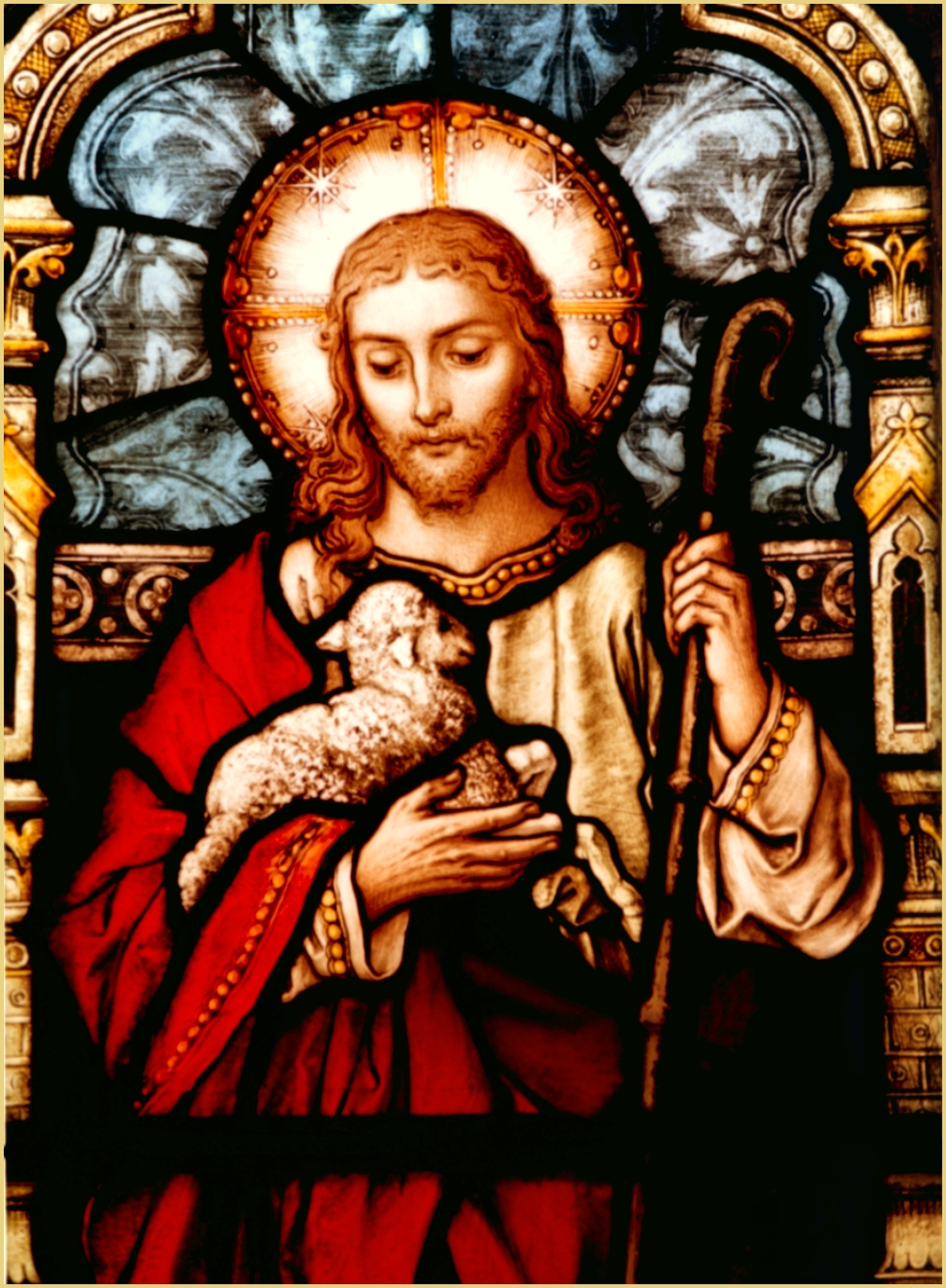
That image of St. Augustine can help us appreciate the Scriptures on this Good Shepherd Sunday. Every year on the Fourth Sunday of Easter, the Gospel Reading comes from John 10. In this chapter of John, Jesus speaks of Himself as the Good Shepherd, and also as “the gate for the sheep”. Because of his wayward youth, Augustine undoubtedly would have had a devotion to the image of Jesus as a Good Shepherd. Augustine would have appreciated the words of today’s Second Reading: “By his wounds you have been healed. For you had gone astray like sheep, but you have now returned to the shepherd and guardian of your souls.”
In order to understand this Good Shepherd, each of us has to recognize ourselves as a wandering sheep, and ask why we wander. Augustine spent many years of his life pondering this question, and his Confessions deal with this problem at length. Let me share with you two short passages from St. Augustine’s Confessions.
The first passage is the very first paragraph of The Confessions. In this passage, we hear the most famous sentence of the whole work (perhaps the most famous line written by St. Augustine):
“Great are You, O Lord, and greatly to be praised;
great is Your power, and of Your wisdom there is no end.
And man, being a part of Your creation, desires to praise You —
man, who bears about with him his mortality, the witness of his sin,
even the witness that You resist the proud,
— yet man, this part of Your creation, desires to praise You.
You move us to delight in praising You;
for You have made us for Yourself,
and our hearts are restless until they rest in You.”[1]
The second passage is from late in The Confessions, after the autobiographical section. After reviewing his life, with all its sins, and all the lost opportunities to accept God’s grace, Augustine writes this:
“Too late have I loved you, O Beauty so ancient, O Beauty so new.
Too late have I loved you!
You were within me but I was outside myself, and there I sought you!
In my weakness, I ran after the beauty of the things you have made.
You were with me, and I was not with you.”[2]
Those passages reveal St. Augustine’s insights into the fallen human nature of us wandering sheep. Our human hearts are restless because they’re torn between sin and grace. They’re torn between living for our self and living for God.
+ + +
With that in mind, reflect upon today’s Responsorial Psalm: the twenty-third Psalm. More specifically, reflect upon the refrain of today’s Responsorial Psalm: “The Lord is my shepherd; there is nothing I shall want.” Even more specifically, reflect upon the refrain’s very last word: “want”. What does the Psalmist mean when he prays: “The Lord is my shepherd; there is nothing I shall want”?
For a long time, I misunderstood the meaning of this word “want”, and therefore, the meaning of this line of the 23rd Psalm. For a long time, I thought that the word “want” meant “desire”. I thought that this line meant that when I follow the Lord as my shepherd, there is nothing I shall desire. But that’s not what the word means here. In the 23rd Psalm, the word “want” means “lack”. Now in modern English, we don’t use the word “want” to mean “lack” as often as we use the word “want” to mean “desire”. But to give an example, the word “want” in the sense of “lack” figures in the old adage that goes like this:
“For want of a nail the horseshoe was lost; / for want of a horseshoe the horse was lost; / for want of a horse the rider was lost; / for want of a rider the battle was lost; / and for want of the battle the kingdom was lost. / The kingdom was lost for want of a nail.”
So in the sense of “want” that means “lack”, we pray in the 23rd Psalm: “The Lord is my shepherd; there is nothing I shall lack.”
Why is this verse important for us wandering sheep to reflect upon? One reason is that many of Jesus’ sheep are wandering because they think that “want” means “desire”. That is to say, many of Jesus’ sheep think that the 23rd Psalm means that if the Lord is my shepherd, there is nothing I shall desire, because God will fulfill all of my desires. You might say that he’s sort of like Santa Claus. I tell God what I desire, and he fulfills my wish list. But that’s not who God is, and that’s not what the 23rd Psalm prays.
The 23rd Psalm prays that because the Lord is my Shepherd, there is nothing I shall lack. I shall not be lacking in life. So the key distinction is between our desires and our needs.
Augustine struggled for more than thirty years because he didn’t understand that distinction. Augustine’s heart was given over to his desires, instead of to his needs. When a person gives his life over to his desires, instead of to his needs, his life is buffeted by desires, because in this world, there is no end to desires.
What Augustine realized is that each of our desires need to be submitted to—subjected to—the Good Shepherd and His will. He, rather than yourself, is the Shepherd of your life, leading you from earth to Heaven. He, rather than yourself, is best able to distinguish your desires from your needs.
What’s more, the Good Shepherd, rather than yourself, is best able to order your needs, putting first what needs to go first. The Good Shepherd is the One who shepherds us by reminding us of the lesson He first taught in the home of Martha and Mary: that in the end, there is only one thing truly needed, and that only God can meet that need.
[1] St. Augustine of Hippo, The Confessions, I,1,1. < https://www.newadvent.org/fathers/1101.htm >
[2] The Confessions, X,27,38. < https://melbournecatholic.org/news/late-have-i-loved-you-st-augustine >