
The Fifth Sunday of Easter [A]
Acts 6:1-7 + 1 Peter 2:4-9 + John 14:1-12
May 3, 2026
“… like living stones, / let yourselves be built into a spiritual house / to be a holy priesthood to offer spiritual sacrifices / acceptable to God through Jesus Christ.”
On the Saturday of Memorial Day weekend, Deacon Peter Bergkamp will be ordained to the Priesthood of Jesus Christ. Each of us needs to keep Deacon Peter and his fellow deacons in our prayers between now and May 23rd. The blessing of having a fellow parishioner ordained to the priesthood reminds us to pray always for more vocations. Our Scriptures this Sunday help us see why the priesthood of Jesus Christ is so important.
However, sometimes it’s difficult to appreciate the depth of Jesus’ Priesthood. We might think of His Priesthood in just one way: that is, the ordained priesthood that we see at the altar at Sunday Mass. But actually, there are three distinct forms in which Jesus lives out His Priesthood within His Church.
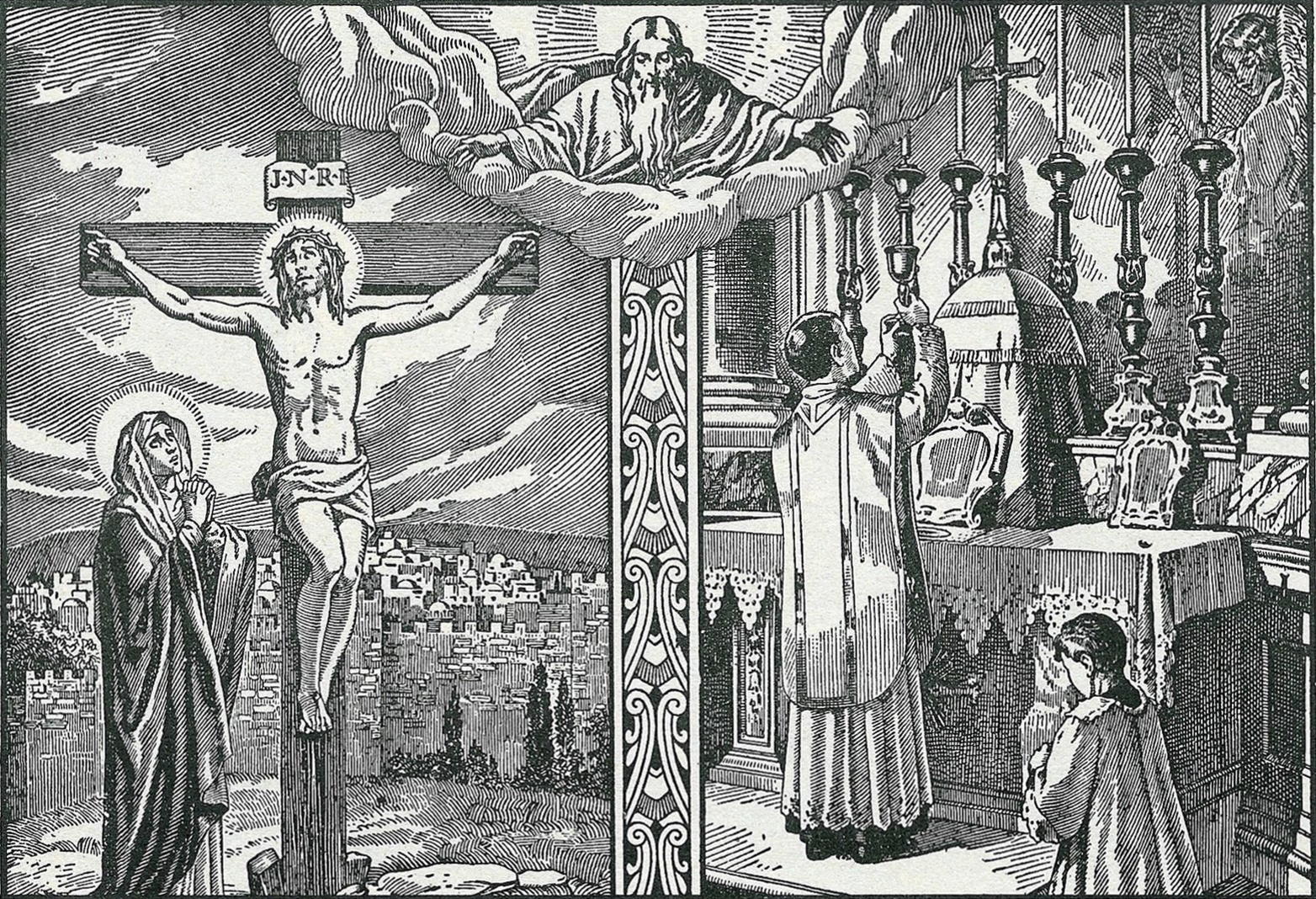
The first is in history: that is, what Jesus accomplished when He walked this earth some 2000 years ago. This is most especially true of what Jesus sacrificed for us sinners on Good Friday. Jesus acted as a priest in offering His Self for us sinners on the Cross out of love for us. Jesus acted as a priest in giving us the Eucharist the night before He died.
+ + +
So while the first form in which Jesus lives out His Priesthood is historical, the second and third are sacramental. In the second and third, Jesus lives out His Priesthood through the lives of Christians: through the members of His Mystical Body. The second is the ordained priesthood, which Deacon Peter is preparing to enter into. The third is called the baptismal priesthood, which every Christian enters into at the moment of baptism.
Today’s Second Reading points our attention towards the baptismal priesthood. During the ritual of Baptism, the celebrant anoints the newly baptized person with Sacred Chrism. At the same time, the celebrant says, “[Almighty God] now anoints you with the Chrism of salvation, so that you may remain as a member of Christ, priest, prophet and king, unto eternal life.”
It’s important to understand how much the baptismal priesthood and the ordained priesthood have in common. However, it’s also important to understand how they’re different.
+ + +
There are two things that the baptismal priesthood and the ordained priesthood have in common.
The more important of these is that both are only possible because Jesus makes them so. When an individual is baptized, Jesus by His grace makes it possible for that Christian to live her or his life through Jesus’ Priesthood. When a man is ordained a priest, Jesus conforms that man to the life of Jesus Christ. Once a man is ordained, when he carries out the sacraments, he acts in persona Christi: “in the person of Christ”.
However, in the case of Baptism and in the case of the ordained priesthood, what happens is not a one-time occurrence. It might be better to say that when these sacraments are received, Jesus establishes a link between Himself and the individual. To use a modern metaphor: you might say it’s like an internet connection between the Web and an individual computer. The computer is always dependent upon the Web for internet access. So when Jesus baptizes someone, or ordains a man, Jesus establishes a link, or a relationship, between Himself and the individual.
Through that on-going relationship, Jesus gives the power to make loving acts of sacrifice. This power to make acts of loving sacrifice is the heart of both the baptismal priesthood and the ordained priesthood. In fact, this is the second thing that the ordained priesthood and the baptismal priesthood have in common. Both exist for the sake of making loving sacrifices. Again: both the ordained priesthood and the baptismal priesthood exist for the sake of making loving sacrifices.
+ + +
So given those similarities, what distinguishes these two forms of priesthood? One important difference is the type of sacrifices that are made.
Those who are ordained priests offer their most important sacrifices within the walls of the church. The ordained priest’s chief sacrifices are liturgical. He offers sacrifice to God, and then he gives God’s grace—the fruit of the sacrifice—to God’s People. The ordained priest offers the sacraments: most importantly, the Holy Sacrifice of the Mass. The ordained priest makes Christ present truly and substantially at the altar.
By contrast, the baptized person makes most of her or his sacrifices out in the world. This begins in the home, and for those who live with family, these sacrifices are made for the sake of their families. Of course, this also extends outside the home: into the workplace, the marketplace, the community, and elsewhere.
+ + +
Consider all this from a practical perspective, with some statistics that are both sobering and hopeful. Last year, in the entire country of Germany, there were 25 men ordained to the priesthood.[1] Last year in the Diocese of Wichita, there were 51 seminarians, and six of them will be ordained to the priesthood this month.
Many people ask why the Diocese of Wichita has so many ordinations year after year after year. While there are many factors, the most often cited is the number of people in our diocese who pray in Eucharistic Adoration. Both laypersons and priests sacrifice their time to pray in Eucharistic Adoration, before the Lord Jesus. They pray to Him who, in the Eucharist, is our High Priest. They pray to Him who, in the Eucharist, strengthens us to live lives of loving sacrifice. They pray to Him for their families, and they pray for more vocations to the ordained priesthood.
In the Catechism, the Church teaches this:
“The Eucharist is ‘the source and summit of the Christian life’. ‘The other sacraments, and indeed all [church] ministries and works of the apostolate, are bound up with the Eucharist and are oriented toward it.’”[2]
The Eucharist is “the source and summit of the Christian life”. Therefore the Eucharist is the source and summit of Christ’s Priesthood within His Church. For both the baptized faithful, and ordained priests, the closer they draw to the Eucharist—the closer they draw to the Sacrifice of the Mass, and the more they spend time in Eucharistic Adoration—the more they become like Christ, and so are able to allow Christ to love through their lives of sacrifice.
Jesus gave the Eucharist to His disciples at His Last Supper, on the night before He sacrificed Himself for sinful man. Jesus gave the Eucharist to be an everlasting means of sharing in the power of His Self-Sacrifice on the Cross. The Eucharist makes us present at Calvary on Good Friday. Jesus through the Eucharist calls us to share in His sacrifice, so that we can share in His divine life.
[1] https://www.pillarcatholic.com/p/how-priestly-formation-is-changing
[2] Catechism of the Catholic Church 1324, quoting Lumen Gentium 11 and Presbyterorum Ordinis 5.