
Palm Sunday of the Passion of the Lord
Matthew 21:1-11 + Isaiah 50:4-7 + Philippians 2:6-11 + Matthew 26:14—27:66
March 29, 2026
Jesus became a slave to sin for the sake of mankind. Jesus, like His Mother, never committed sin, or inherited Original Sin. Yet Saint Paul in his Second Letter to the Corinthians states something even more profound about Jesus. St. Paul writes that God the Father “made [Jesus] to be sin who did not know sin” [2 Corinthians 5:21]. We heard that in the Second Reading on Ash Wednesday. It’s in the light of this truth that today, on Palm Sunday, we need to look on Jesus as a slave to sin.
Here’s the difference between Jesus and us: Jesus freely accepted the yoke of the Cross. On the other hand, sinful human beings—stretching from Adam and Eve to us—always accept slavery freely. In other words, by sinning we lose our freedom. The devil whispered to Eve, “You shall be like gods!” Had he spoken the truth he would have told them “You shall be slaves!”
Jesus, however, “though he was in the form of God, / did not regard equality with God / something to be grasped. / Rather, he emptied himself, / taking the form of a slave….” Consider those words—from today’s Second Reading—in the light of today’s Gospel passages.
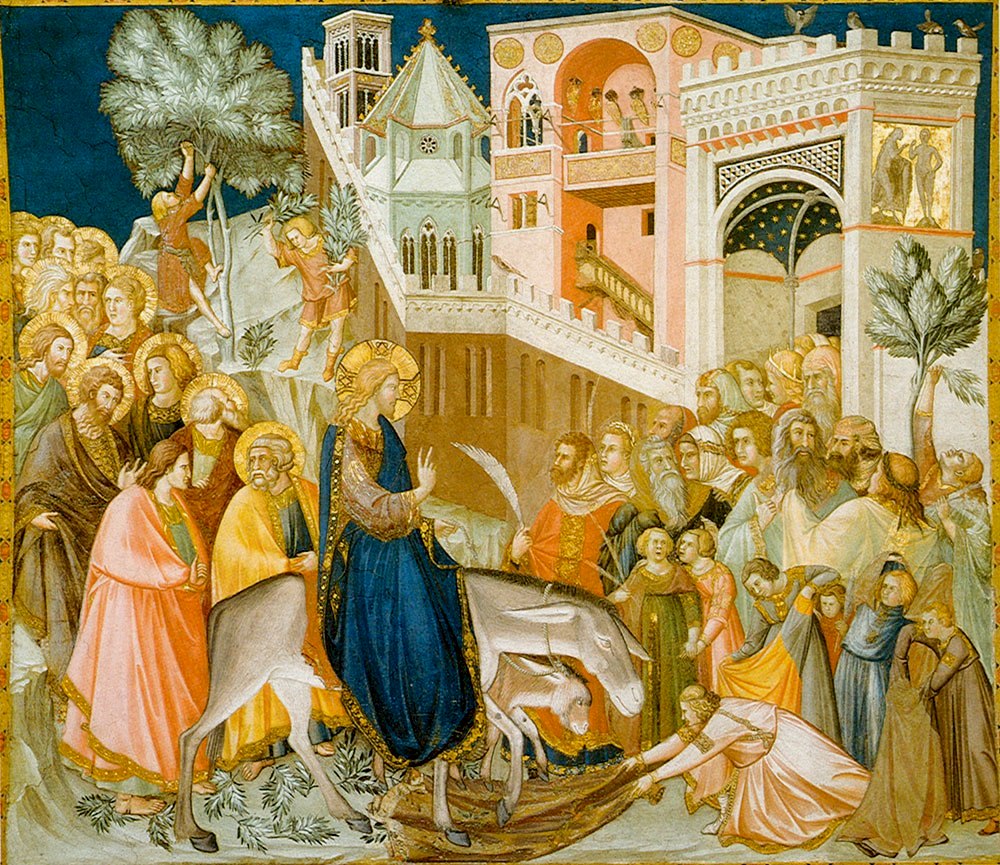
This is the only Sunday when there are two Gospel passages proclaimed at Sunday Mass. The first we heard before the Entrance Procession. It’s a very optimistic, hopeful passage, proclaiming the triumphal entrance of the Messiah into Jerusalem. For century after century the Jews had longingly waited for the coming of the Messiah, and now Jesus seemed to make clear, by His entrance into the royal city, that He was the One.
But very soon after He arrived, things began to go downhill. The second Gospel proclamation on Palm Sunday stands in contrast to the first: not only in length, but also in tenor. The optimistic triumph of Jesus’ procession into Jerusalem stands in contrast to the spite-filled mockery of Jesus’ recession out of Jerusalem to the top of Calvary.
Jesus’ descent into slavery is progressive. We can hear this progress—or rather, regress—in our own words. That is, when you see the Passion in the format shown in your hand missal or in the parish missalette—divided into spoken parts like the script of a play—the crowd’s words reveal Jesus’ descent. These words reveal the fickleness of the heart held slave to sin.
Jesus, although He was and is God, did not save Himself from the Cross. In this, He reveals to us what life is all about. Life is about love. Love is about an other, not about my self.