
The Twenty-fifth Sunday in Ordinary Time [A]

The Twenty-fifth Sunday in Ordinary Time [A]
Isaiah 55:6-9  +  Philippians 1:20-24,27  +  Matthew 20:1-16
September 20, 2026

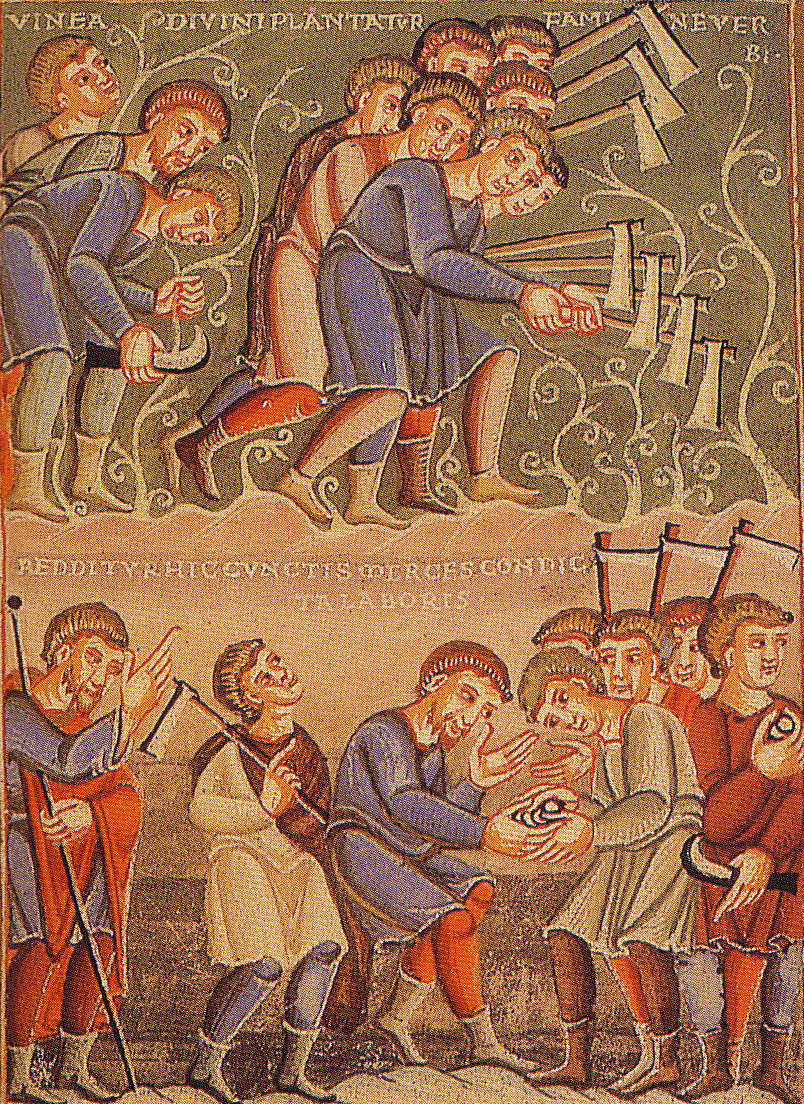
There are always many different ways to apply one of Jesus’ parables to our own lives.  The most obvious way to understand today’s parable is to see the vineyard as representing the Church on earth, in which each of us has work to do.  This work is chiefly done through our vocations, which for most Christians means to be husbands and wives, and then fathers and mothers.  The Christian’s work also includes stewardship in one’s parish and diocese, as well as making sacrifices for and in the wider world.

Most Catholics are cradle Catholics, and are represented in today’s parable by those who began working in the vineyard at the start of day.  Whenever thinking about the gift of being a cradle Catholic, I think of my older brother.  When our mother was pregnant with him, the doctors told our parents that he would not survive after birth.  So he was baptized moments after he was born.  He died the next day, ready for his eternal reward.

By contrast, some enter the Church after living a long life on their own terms.  Some persons are baptized not only in old age, but on their deathbeds.  In terms of today’s parable, those persons would be like workers who start in the vineyard at 5:59 pm, one minute before the end of the workday.  The person baptized on his deathbed receives the same reward as the cradle Catholic:  that reward being eternal life.

So given the generosity of the vineyard owner—which is to say, given the generosity of God the Father, whom the vineyard owner represents—we might be tempted to focus our attention on the fellow who started work at five in the afternoon.  Should we be envious of him?  Should we be envious of the person who is baptized at the end of a long life, after pursuing whatever his heart desired?  Intuitively we sense that the answer is “No”, although we might have trouble explaining why.  Here are a few reasons not to be envious of the worker who starts late in the day.

For one thing, the desires of the heart are often fleeting:  not always, but more often than we would like.  Trying to lead a fulfilling life by chasing after all of one’s desires ends up being like trying to chase one’s shadow.  Saint Augustine laid bare the vanity of this path in his Confessions, declaring:

“Late have I loved you, Beauty so ancient and so new, late have I loved you!  /  Lo, you were within,  /  but I outside, seeking there for you,  /  and upon the shapely things you have made  /  I rushed headlong—I, misshapen.  /  You were with me, but I was not with you.”

St. Augustine was not baptized until the age of 33.  He died at the age of 75, and in addition to serving as a bishop in Northern Africa when the Roman Empire was crumbling around him, only to give way to barbarian invaders at the end of his life, Augustine was also a great preacher and scholar, gifting to posterity writings of immense riches.  If anyone deserved at the moment of his death to hear the words “Well done, good and faithful servant … enter into the joy of your master”, it was Augustine.[1]  Nonetheless, in the waning years of his life, he looked back on his youth and regretted how much time he wasted:  time that could have been spent doing some further good for the Lord.

The sooner a person recognizes in her or his own life this insight of St. Augustine, the sooner that person can find lasting fulfillment.

For another thing, the sooner a person sets to work in the vineyard, the richer the Lord’s harvest.  The person who waited until his deathbed to be baptized—had he been baptized years earlier—could have invited others to join him in making a Holy Hour before the Blessed Sacrament, or to pray with him outside an abortion clinic, turning the hearts of persons about to enter the clinic gates.  Had he been baptized years earlier, he could have used his God-given talents as a lector, choir member, or PSR catechist.  Had he been baptized years earlier, he could have spent an hour each week praying for vocations, moving the heart of a young woman to enter the convent, and moving the heart of a young man to enter the seminary.

St. Paul, in today’s Second Reading, speaks to the same distinction that the parable brings to our attention.  The parable distinguishes between the labor done in the vineyard, and the reward given at close of day.  St. Paul is more straightforward.  He speaks about the same distinction, but in terms of life on earth, and life in Heaven.

As far as St. Paul’s own soul is concerned, he longs “to depart this life and be with Christ [in Heaven], for that is far better”:  far better for Paul, that is.  But Paul knows that Paul’s life is not only about Paul.  That’s why he continues by stating:  “that I remain in the flesh”—that is, in the Lord’s vineyard—“is more necessary for” the benefit of God’s people.

+     +     +

So what are we supposed to take away from today’s parable?  It’s hard to imagine that Jesus wants us to be like the last worker in the vineyard, working only one hour at the end of the day.  But it’s just as hard to imagine that Jesus would want us to imitate the envious person who had started early in the day.

Maybe Jesus wants us to be like neither:  not trying to avoid until the last hour what God asks, and also not worrying about others in the vineyard, or their pay.  Instead, the Lord wants us to grow morally and spiritually by focusing upon the master of the vineyard.  What we do, we do for him.  Our vocations, our stewardship, and our sacrifices for our community:  it’s all for Him.


[1] Matthew 25:21.
Friday of the Twenty-fourth Week in Ordinary Time [II]

While Father Weldon was away, I had the chance to offer Mass at St. Joseph’s in Andale.  This is the sermon preached today to the football team and the other parishioners present.

Friday of the Twenty-fourth Week in Ordinary Time [II]
St. Joseph Catholic Church, Andale, KS
September 18, 2026

You sometimes hear it said that competing in sports is good training for life.  If that’s true—and in fact, it is—then you have to ask:  in life, who is your opponent?  This evening your opponent will be Wellington’s football team.  But who will be your opponent in ten years; in twenty years; in fifty years?

Fortunately, we’re blessed to belong to a Church that’s nearly 2000 years old.  During those twenty centuries, many saints have written about those questions.  The saints teach us that in our lives on this earth, we have three opponents.

The first is the Devil.  That’s pretty obvious, but the second is not as obvious.  Our second opponent is the world.  God created the world to be good, but because of sin, there’s much in the world around us that we have to oppose strongly.

Our third opponent in our Christian lives on earth is the least obvious.  It is our own selves.  Saint Paul speaks about this opponent in one of his letters in the New Testament.  He makes a confession about his own weakness:  “I do not understand my own actions.  For I do not do what I want, but I do the very thing I hate” [Romans 7:15].

Because of Original Sin, each of us finds ourselves divided.  In addition to doing the hard work of cultivating the virtues, you also need God’s grace.  Without God’s grace, you can do nothing.  With His grace, you will find self-mastery, so that you can accomplish all things in Christ.

The Twenty-fourth Sunday in Ordinary Time [A]


The Twenty-fourth Sunday in Ordinary Time [A]
Sirach 27:30—28:7  +  Romans 14:7-9  +  Matthew 18:21-35
September 13, 2026

Pride and anger have something in common.  Both can be either good or evil.

Take pride, for example.  A student ought to take pride in a report card with very good grades.  A sports team ought to take pride in winning a championship.  A farmer ought to take pride in completing the season’s harvest.  All of these forms of pride are morally good, and deserved, even though each demands qualification.  Each requires the exercise of the virtue of prudence.

After all, while the student can rightly take pride in his hard work and his intelligence, where did the capacity for hard work and intelligence come from?  He was given those gifts—not to mention the gift of life itself—from his parents in cooperation with God’s providence.  Furthermore, the student likely has other people as well, such as teachers, whom he needs to recognize as helping him if he’s going to take pride in his academic accomplishments.  That’s why every morally upright act of pride demands that it not be completely self-centered, but instead that it gives credit to others where credit is due.  Likewise for the athlete, the farmer, the businessman, the politician, the parent, the spouse, and so on.

Pride can be exercised in a morally upright way, but pride can also be a terrible sin and even a horrible vice when the human person is lacking in prudence and humility.  Something very similar is true of anger.  Anger can be exercised in a morally upright way.  But anger can also be a terrible sin, and even a horrible vice.  Today’s Scripture passages show us the dark underside of the sin and vice of anger.

However, before reflecting on today’s Scripture passages, we ought to consider a passage that shows us anger in a good light:  in the light of Jesus Christ.  All four of the Gospel accounts record Jesus’ cleansing of the Temple in Jerusalem.  He overturns the money changers’ tables.  He makes a whip of cords, and drives out both those selling animals, and the money changers.  And He declares:  “It is written, ‘My house shall be a house of prayer, but you have made it a den of thieves.’”

The fact that all four evangelists recorded this event in their Gospel accounts drives home an important truth:  that anger can be both morally good, and even holy.  However, like with pride, the virtue of prudence has to guide a person’s anger.  If prudence and humility do not guide a person’s anger, the anger becomes first sinful, and then a vice:  the type of anger we hear about in today’s Scripture passages.

“Wrath and anger are hateful things, yet the sinner hugs them tight.”  That opening sentence of today’s First Reading points to one of the paradoxes of the sin and vice of anger.  Wrath and sinful anger are so harmful to the person who holds them inside, and yet there can be a harmful compulsion to hold on to them:  or in the words of Sirach, to hug them tight.  But why would anyone hug tight, next to oneself, things that are hateful?  It makes no sense.

You might as well drive to the nearest pet store and purchase two porcupines.  Take them home.  Name one of the porcupines “Wrath”, and the other porcupine “Anger”.  Then every night before you go to sleep, take your porcupines in your arms and hug them tight.  Give them a great big hug.  That would make more sense than hugging tight the sin of anger and the vice of wrath.  It would make more sense because the porcupines would only harm your body, while the sin of anger and the vice of wrath harm your soul, and place your soul in jeopardy of eternal punishment.

So, if anger can be either righteous or sinful—virtuous or vicious—the question is:  what makes the difference?

The key difference is the object.  What is the object of one’s anger?  What are you angry at?  What are you angry about?

There are many people running around in the world who don’t know what they’re angry about, which results in them being angry at everything, and venting their anger at whatever or whoever happens to be in front of them.  But for anger ever to be righteous—for anger ever to be morally good—there has to be a clear object of one’s anger, and there has to be a just reason for focusing one’s anger at that object.  In the case of the Cleansing of the Temple, the object of Jesus’ anger was the money changers and those selling animals in the Temple.  He had a just reason for being angry at them because they were profaning God’s Temple, and He took action against those who were doing wrong.

Of course, there are times in this world here below when it’s impossible to direct one’s anger at the true and just object of one’s anger.  Imagine, for example, parents whose high school daughter is killed in a car accident by a drunk driver.  The tragic situation is made even more difficult because the drunk driver was also killed in the accident, meaning that the parents have no way of seeking justice in a courtroom against the man who killed their daughter.  The parents do not have their daughter.  They do not have the means to seek justice on this earth.  What can they do in the face of their anger?

Remember that when Jesus was asked by a Pharisee which commandment is the greatest, Jesus named two commandments, which sum up His entire Gospel:  love God with your whole heart, soul, and mind, and love your neighbor as yourself.  Whenever you’re at a moral or spiritual impasse, that reminds you how to proceed.

For example, in the case of the parents whose daughter was killed, although they are unable to seek justice in the courtroom, they can love their neighbor by becoming advocates for those suffering as they have, or for those at risk by advocating in a preventive manner.  In these sorts of ways, their anger can become productive and life-giving.

Yet in addition to loving their neighbors, the grieving parents need even more to love God, asking for a share in His strength and wisdom.  When someone with a just reason for being angry has no way of seeking justice, it’s important for that person to ask God in prayer for guidance about the best way to direct one’s anger.

Of course, even when someone with just anger does have the means to address directly the object of his anger, it’s important to take one’s anger to God in prayer.  Through prayer and the grace of the sacraments, God can increase within the justly angry person the virtues of prudence and humility, so that he can address the object of his anger in the most holy way possible.

However, today’s Gospel passage suggests that God might direct the angry person in a different direction:  namely, to the exercise of mercy.  The king in today’s parable clearly symbolizes God the Father, who mercifully forgives sins.  It’s because the king had forgiven the servant who owed him a huge amount that the king expects that servant to “pay it forward”, to use a modern expression.  When the servant does the opposite, the king justly grows angry, and “in anger… handed him over to the torturers until he should pay back the whole debt.”  Then, Jesus, to drive home the symbolism of the parable, explains:  “So will my heavenly Father do to you, unless each of you forgives your brother from your heart.”

So at the beginning of the parable, the king shows mercy, but at the end, he acts out of a just anger towards the servant who refused to show mercy to a fellow servant.  Jesus does not explain the punishment of the servant who refused to imitate his king:  does this punishment symbolize the eternal pains of Hell, or the temporal punishment of Purgatory, or maybe simply earthly punishment that has to be suffered in order to come to one’s senses?  Jesus does not tell us.

But the point of the parable is clear.  The point of the parable mirrors one of the lines of the only spoken prayer that Jesus taught.  Often we pray the Our Father too rapidly, and don’t think about the meaning of each phrase.  Each time we pray the Our Father, we need to be conscious of what we’re saying when we speak these words:  “Forgive us our trespasses, as we forgive those who trespass against us”.  That tiny word “as” in the middle of the sentence is incredibly important, because we’re asking God the Father to forgive us “as” we forgive those who sin against us.  In other words, if we do not forgive our neighbor, then we’re telling God the Father not to forgive us, and if God the Father does not forgive us, then our punishment will certainly be without end.

In this world here below, there are times when we’re justifiably angry, and justified in seeking justice.  If we never sought justice in this world, this world would be filled with chaos.  But if we never extended mercy, this world would be filled with persons who never become like God the Father.  Justice can bring us a measure of peace on earth.  But only Divine Mercy can bring us to eternal peace in Heaven.  If you’ve never prayed the Chaplet of Divine Mercy, take the time to learn about it, and to begin praying it.  While sinful anger and wrath are hateful things, Divine Mercy is a godly thing.  The sinner hugs anger and wrath tight to himself.  Through Divine Mercy, God hugs the sinner tight to Himself.

1   Luke 19:46; cf. Isaiah 56:7 and Jeremiah 7:11.
2 Matthew 22:35-40.