
The Twenty-fifth Sunday in Ordinary Time [A]
Isaiah 55:6-9 + Philippians 1:20-24,27 + Matthew 20:1-16
September 20, 2026
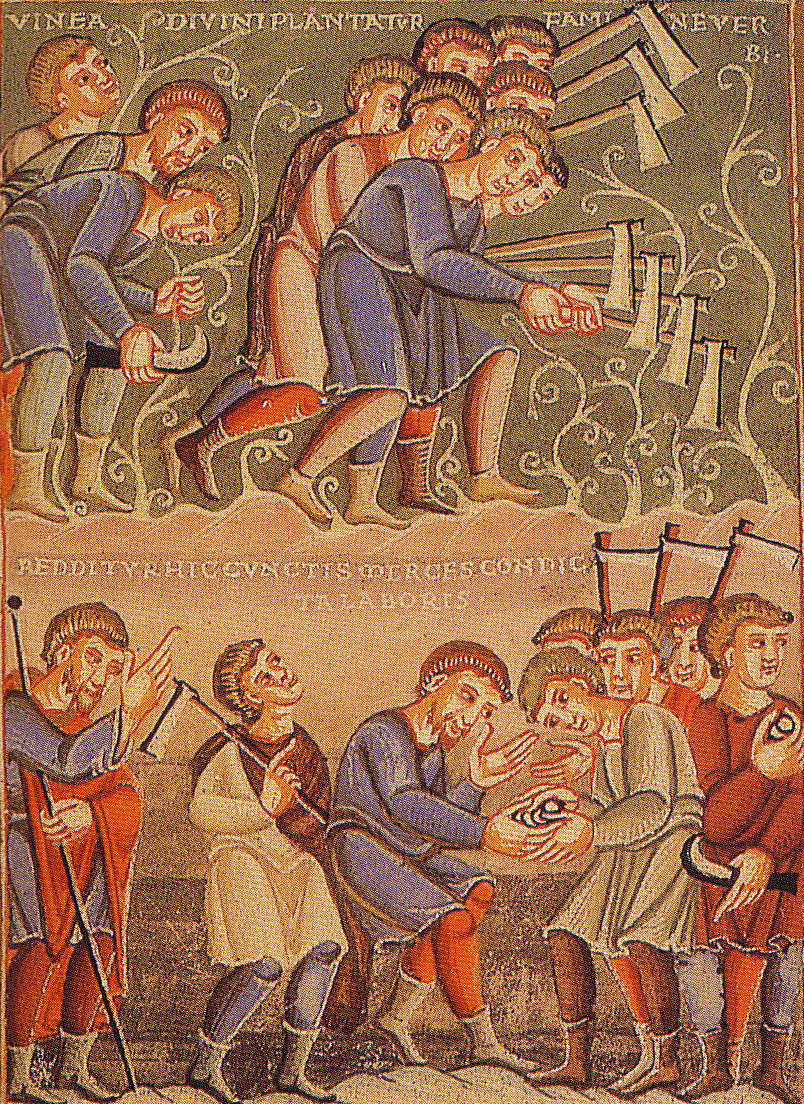
There are always many different ways to apply one of Jesus’ parables to our own lives. The most obvious way to understand today’s parable is to see the vineyard as representing the Church on earth, in which each of us has work to do. This work is chiefly done through our vocations, which for most Christians means to be husbands and wives, and then fathers and mothers. The Christian’s work also includes stewardship in one’s parish and diocese, as well as making sacrifices for and in the wider world.
Most Catholics are cradle Catholics, and are represented in today’s parable by those who began working in the vineyard at the start of day. Whenever thinking about the gift of being a cradle Catholic, I think of my older brother. When our mother was pregnant with him, the doctors told our parents that he would not survive after birth. So he was baptized moments after he was born. He died the next day, ready for his eternal reward.
By contrast, some enter the Church after living a long life on their own terms. Some persons are baptized not only in old age, but on their deathbeds. In terms of today’s parable, those persons would be like workers who start in the vineyard at 5:59 pm, one minute before the end of the workday. The person baptized on his deathbed receives the same reward as the cradle Catholic: that reward being eternal life.
So given the generosity of the vineyard owner—which is to say, given the generosity of God the Father, whom the vineyard owner represents—we might be tempted to focus our attention on the fellow who started work at five in the afternoon. Should we be envious of him? Should we be envious of the person who is baptized at the end of a long life, after pursuing whatever his heart desired? Intuitively we sense that the answer is “No”, although we might have trouble explaining why. Here are a few reasons not to be envious of the worker who starts late in the day.
For one thing, the desires of the heart are often fleeting: not always, but more often than we would like. Trying to lead a fulfilling life by chasing after all of one’s desires ends up being like trying to chase one’s shadow. Saint Augustine laid bare the vanity of this path in his Confessions, declaring:
“Late have I loved you, Beauty so ancient and so new, late have I loved you! / Lo, you were within, / but I outside, seeking there for you, / and upon the shapely things you have made / I rushed headlong—I, misshapen. / You were with me, but I was not with you.”
St. Augustine was not baptized until the age of 33. He died at the age of 75, and in addition to serving as a bishop in Northern Africa when the Roman Empire was crumbling around him, only to give way to barbarian invaders at the end of his life, Augustine was also a great preacher and scholar, gifting to posterity writings of immense riches. If anyone deserved at the moment of his death to hear the words “Well done, good and faithful servant … enter into the joy of your master”, it was Augustine.[1] Nonetheless, in the waning years of his life, he looked back on his youth and regretted how much time he wasted: time that could have been spent doing some further good for the Lord.
The sooner a person recognizes in her or his own life this insight of St. Augustine, the sooner that person can find lasting fulfillment.
For another thing, the sooner a person sets to work in the vineyard, the richer the Lord’s harvest. The person who waited until his deathbed to be baptized—had he been baptized years earlier—could have invited others to join him in making a Holy Hour before the Blessed Sacrament, or to pray with him outside an abortion clinic, turning the hearts of persons about to enter the clinic gates. Had he been baptized years earlier, he could have used his God-given talents as a lector, choir member, or PSR catechist. Had he been baptized years earlier, he could have spent an hour each week praying for vocations, moving the heart of a young woman to enter the convent, and moving the heart of a young man to enter the seminary.
St. Paul, in today’s Second Reading, speaks to the same distinction that the parable brings to our attention. The parable distinguishes between the labor done in the vineyard, and the reward given at close of day. St. Paul is more straightforward. He speaks about the same distinction, but in terms of life on earth, and life in Heaven.
As far as St. Paul’s own soul is concerned, he longs “to depart this life and be with Christ [in Heaven], for that is far better”: far better for Paul, that is. But Paul knows that Paul’s life is not only about Paul. That’s why he continues by stating: “that I remain in the flesh”—that is, in the Lord’s vineyard—“is more necessary for” the benefit of God’s people.
+ + +
So what are we supposed to take away from today’s parable? It’s hard to imagine that Jesus wants us to be like the last worker in the vineyard, working only one hour at the end of the day. But it’s just as hard to imagine that Jesus would want us to imitate the envious person who had started early in the day.
Maybe Jesus wants us to be like neither: not trying to avoid until the last hour what God asks, and also not worrying about others in the vineyard, or their pay. Instead, the Lord wants us to grow morally and spiritually by focusing upon the master of the vineyard. What we do, we do for him. Our vocations, our stewardship, and our sacrifices for our community: it’s all for Him.
[1] Matthew 25:21.