The Twelfth Sunday in Ordinary Time [A]

The Twelfth Sunday in Ordinary Time [A]
Jeremiah 20:10-13  +  Romans 5:12-15  +  Matthew 10:26-33
June 21, 2026

The Bible can be overwhelming.  But there’s an old saying by Pope St. Gregory the Great that offers hope.

The Bible “is… a kind of river… both shallow and deep, wherein both the lamb may find a footing, and the elephant float at large.”[1]  God’s Word makes His Love clear both to the simple and to the profound.

However, sometimes we expect more of ourselves than God does when it comes to His holy Word.  Jesus does not ask you, as His disciple, to memorize entire passages of the Bible.  He does not ask you to learn the names of all the books of the Bible.  He asks you instead to listen to Him when He speaks to you through His written Word.

But what is the chief setting where God speaks His Word to you?  It’s commendable if you read the Bible privately each day.  But that’s not the chief setting in which God means for His written Word to enter your life.  It’s commendable if you participate in a Scripture study group, like the one held here this past Lent.  But that’s not the chief setting in which God means for His written Word to enter your life.

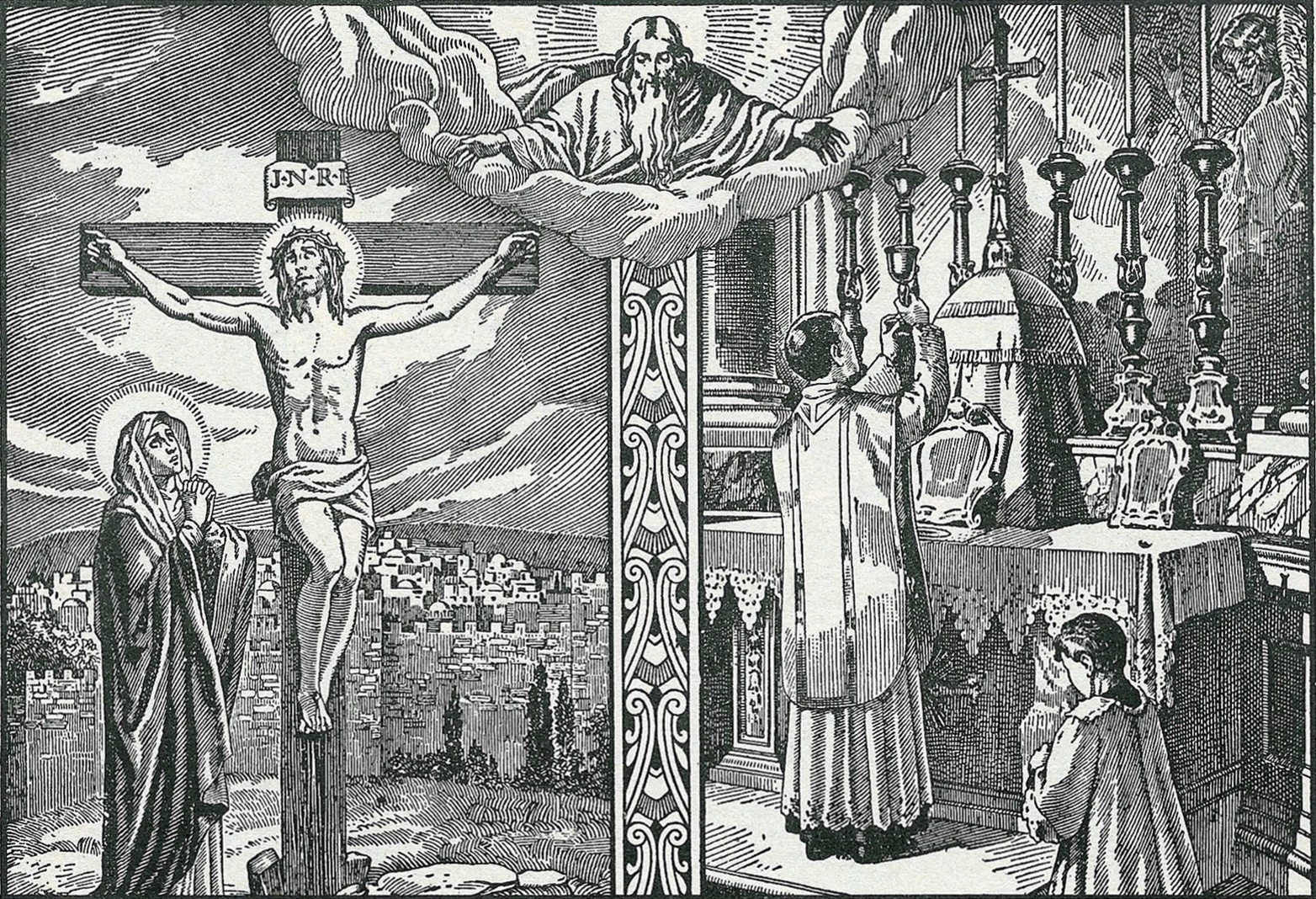
The chief setting in which God means for you to hear His written Word is the Holy Sacrifice of the Mass.  Passages, verses, and phrases from the Bible are proclaimed all throughout the Mass.  For example, shortly before receiving Holy Communion, the priest holds up the Sacred Host.  Then he says, “Behold the Lamb of God, behold him who takes away the sins of the world.  Blessed are those called to the supper of the Lamb.” 

The first part of that acclamation is from the first chapter of St. John the Evangelist’s Gospel account.  St. John the Baptist proclaims those words as he points out Jesus.[2]  The latter part is from the nineteenth chapter of the Book of Revelation, also written by St. John the Evangelist.  St. John in this verse records an angel describing Heaven as “the supper of the Lamb.”[3]

What about the next words at Mass, which the entire congregation speaks?  Those words echo the cry of the centurion to Jesus in the eighth chapter of St. Matthew’s Gospel.  The centurion speaks about Jesus healing his servant, but you and I speak about Jesus healing our soul by receiving Holy Communion:  “Lord, I am not worthy that you should enter under my roof, but only say the word and my soul shall be healed.”[4]

The celebration of Holy Mass is filled with example after example of verses and phrases taken from the Bible.  They’re woven into the fabric of the Mass so seamlessly that it’s easy to forget that they come from the Bible.

More directly taken from the Bible are the antiphons and readings of the Mass.  Some missalettes and hymnals do not include the antiphons in their pages.  This is in spite of the fact that the antiphons, unlike hymns, are specifically assigned by the Church to each Sunday.  The antiphons are very helpful to helping us appreciate God’s Word, for a reason I’ll circle back to in a few moments.

All of the Scripture readings at Mass follow a progression, building up to the Gospel Reading.  We stand for the Gospel because Jesus Himself speaks and acts directly, for us to learn from and to be inspired by.

In this Sunday’s Gospel Reading, we hear from the tenth chapter of St. Matthew’s Gospel account.  The whole passage is Jesus speaking to His Twelve Apostles, and consists of ten sentences.  The challenge in hearing and pondering this passage is that there’s so much to take in.  This is the biggest challenge for most Christians:  not to be overwhelmed by the Bible.  This is one reason that the Church, as a good mother, portions the Scriptures for Sunday Mass over three years.

When we’re considering a given Sunday’s Scripture readings, there’s a simple practice that can help keep us from being overwhelmed.  When you are listening to or reading God’s written word in Sacred Scripture, pray to the Holy Spirit.  Ask the Holy Spirit to draw your attention to, and to focus your attention upon, one particular part of God’s written Word.  It may be a single verse, or it may be a phrase, or it may even be a single word within a verse.

This is why the antiphons of the Mass—the Entrance Antiphon, Offertory Antiphon, and Communion Antiphon—are helpful.  They’re very brief, and because of their brevity, they’re easy to focus on.  But with the Holy Spirit’s help, you can focus on a single verse, or phrase, or even a single word within any Reading at Mass.

This past week as I read and re-read this Sunday’s Scripture readings, one verse stood out.  It’s from Jesus’ words to the Apostles in the Gospel Reading:  “Everyone who acknowledges me before others I will acknowledge before my heavenly Father.”  How does Jesus speak to you and me through these words?

One point that stands out is the humility that Jesus’ words evoke.  He explains that if someone acknowledges Him before others, He will acknowledge that person before before God the Father.  Conversely, if someone does not acknowledge Jesus before others, He will not acknowledge that person before before God the Father.

One way to reflect upon any given verse, phrase, or word of Scripture is to hold it up in the light of other similar scripture passages.  In the case of Jesus’ words about acknowledging Him, a passage from the Sermon on the Mount sheds some light.  This passage is actually going to be proclaimed at weekday Mass this coming Thursday.

During the Sermon on the Mount, Jesus declares:

“‘Not everyone who says to me, “Lord, Lord,” will enter the kingdom of heaven, but only the one who does the will of my Father in heaven.  Many will say to me on that day, “Lord, Lord, did we not prophesy in your name?  Did we not drive out demons in your name?  Did we not do mighty deeds in your name?”  Then I will declare to them solemnly, “I never knew you.  Depart from me, you evildoers.”’”[5]

Jesus is very specific here about His reason for saying about someone, “I never knew you.”  The reason is that someone not carrying out the will of God the Father.  This drives home the hard truth that you cannot coast through life thinking that being baptized will guarantee your salvation.  Doing the will of Jesus’ Father is key.

That relates directly to Jesus’ words in today’s Gospel Reading:  “Everyone who acknowledges me before others I will acknowledge before my heavenly Father.”  God the Father wills that you acknowledge Jesus before others.

Each of you must pray and discern for yourself how this ought to be taking place in your lives.  What are the places, and the circumstances, and the ways in which God is calling you to acknowledge Jesus before others?  Faith in Christ is not authentic if it’s only private, hidden from others.  Each of you must pray and discern for yourself about the places, the circumstances, and the ways in which God is calling you to acknowledge Jesus before others.


[1] Saint Gregory The Great, Moralia in Job, Prefatory Letter to Leander of Seville, IV [https://www.ecatholic2000.com/job/untitled-05.shtml].

[2] John 1:29.

[3] Revelation 19:9.

[4] Cf. Matthew 8:8.

[5] Matthew 7:21-23.
The Eleventh Sunday in Ordinary Time [A]

The Eleventh Sunday in Ordinary Time [A]
Exodus 19:2-6a  +  Romans 5:6-11 +  Matthew 9:36—10:8
St. Anthony’s Catholic Church, Garden Plain, KS
June 14, 2026

In the First Reading, God makes a promise to the Israelites.  If they listen to His word and keep their covenant with Him, He would hold them as a special possession. 

But then God’s promise went further.  He promised that they would be dearer to Him than all other people, though all the earth is His. 

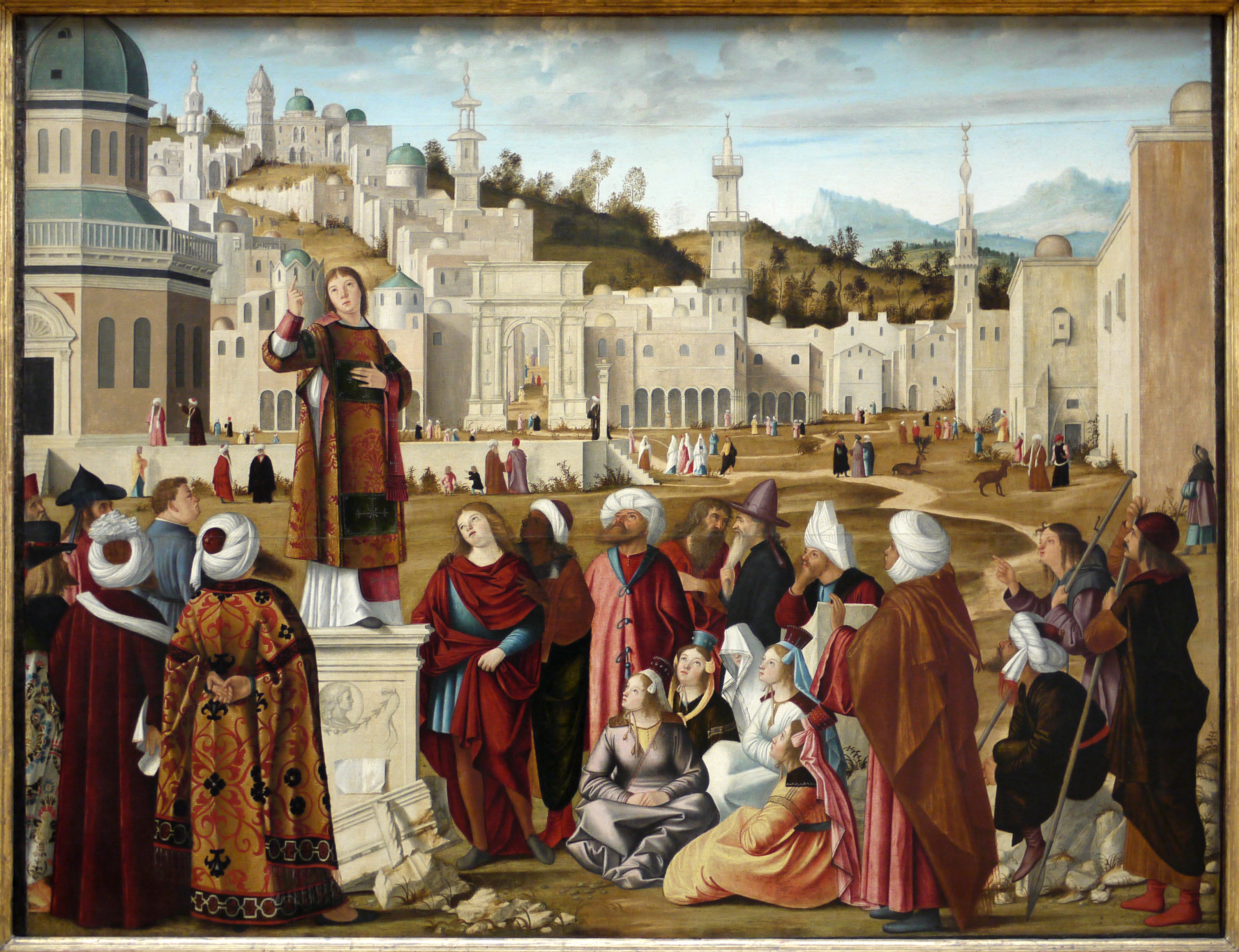
Finally, He concludes His promise with a surprising statement.  He declares “You shall be to me a kingdom of priests, a holy nation.”  This statement is as true of the Church today as it was of the Israelites in their day.  The Church to which you belong is “a kingdom of priests”

We owe it to ourselves to unpack this phrase:  “a kingdom of priests”.  In the Church, Jesus is our High Priest on the Cross.  From the power of the Cross flow two forms of priesthood:  the ordained priesthood and the baptismal priesthood.

+     +     +

It’s true that ordained priests play an important—and, in fact, essential—role in the life of the Church.  However, it’s also true that every Christian, by virtue of her or his baptism, is a priest.  This baptismal priesthood is central to living in the world as a disciple of Jesus Christ.

St. Paul in the Second Reading reminds us that Christ Jesus made the ultimate sacrifice for us on the Cross.  While we were still sinners, Christ died for us.  Christ is our High Priest.  He is not like the priests of the Old Testament who offered goats and bulls as sacrifices.  Christ offered Himself as a sacrifice.  This is a key difference between the Old Testament priesthood and the priesthood of Jesus.

Jesus offered Himself on the Cross as the Lamb of God, who takes away the sins of the world.  So in imitation of Jesus, every baptized Christian offers herself or himself in sacrifice out of love of God and neighbor.  As the members of Christ’s Mystical Body—the Church—we are all together a kingdom of priests.

We learn how to sacrifice through the example of those who guide us in our lives.  Chief among these examples is Christ, of course.  The Church looks to the example that Jesus Christ gave us on the Cross.  However, the Cross is not the only example which Jesus gives us.  In fact, the entire life of our Lord shows us the love He has for us. 

In today’s Gospel Reading, we see that Jesus was not willing to let any need go untended.  Jesus couldn’t stand to see the suffering experienced by those with unclean spirits and diseases.  So he gave His twelve apostles a share in His own authority, so could share in His work of healing.

In giving His healing power to the apostles, Jesus showed the same concern that He shows today in the Sacrament of the Anointing of the Sick.  Only ordained priests may confer the Sacrament of the Anointing of the Sick.  However, every baptized Christian is called to carry out the corporal works of mercy. 

God calls the baptized to feed the hungry and give drink to the thirsty, to visit the sick and imprisoned, and to clothe those who are without.  He calls us to shelter the homeless, and to bury the dead.  By means of these sacrifices, we imitate our Lord Jesus.  The corporal and the spiritual works of mercy are key ways in which we live out our baptismal priesthood.  We make a sacrifice from the heart in order to care for the needs of others.

But consider another reason why we need to take the baptismal priesthood so seriously.  Our lives—for good or ill—set examples for others, most especially for our youth.  Christ did  not only give His followers a mandate to care for others.  He also commanded them to pray that others down the road would join the work of God’s harvest. 

That latter command is addressed to us in our day and age, as well.  Jesus declares:  “The harvest is abundant but the laborers are few; so ask the master of the harvest to send out laborers for his harvest.”  Clearly the “vocations crisis” is not something unique in Church history.  It was even present in Jesus’ own day.

Of course, the most important source of strength for living out the baptismal priesthood is Jesus’ Body and Blood in the Eucharist.  We cannot fully carry out God’s will for our lives without the strength that comes from the Eucharist.  That leads us to the importance of the ordained priesthood.

We are blessed in our diocese when it comes to vocations to the ordained priesthood.  Many bishops from other dioceses have asked why our diocese is so blessed.  You might say that—in a good sense—it’s a matter of the chicken and the egg.  Which blessing comes first?  Is the stewardship of rank and file baptized Christians so strong in our diocese because we have such an abundance of ordinations?  Or do we have such an abundance of vocations because of the examples of sacrificial stewardship that young people see growing up?  The answer is “Yes”, and “Yes”.

It’s also important to note the sacrifice of time that so many members of our diocese make in prayer before the Blessed Sacrament.  The prayers offered in Eucharistic Adoration throughout our diocese are an essential reason for the blessings in our diocese.  This is especially true of the vocations to the ordained priesthood that God is perpetually calling forth from our parishes.

When we care for others, and when we pray to God, we recognize that we are small.  We exist and we live in this world in order to serve others.  That service prepares others and ourselves to see more clearly that this world here below is not all there is.  In this world, we prepare others and ourselves for the life to come, which God wills to be our eternal inheritance.  Every gift that we have received, we are to give as a gift.

Corpus Christi

The Most Holy Body and Blood of Christ [A]
Deuteronomy 8:2-3,14-16  +  1 Corinthians 10:16-17  +  John 6:51-58
St. Anthony’s Catholic Church, Garden Plain, KS
June 7, 2026

“In the beginning”, God created man in an earthly paradise.  God meant this earthly paradise to serve mankind throughout history.  You might call this God’s “Plan A”.

However, man freely chose to bring sin into this world.  Through human free will, fallen man transformed the world into a place filled with death and sin.  Fallen man stopped God’s “Plan A” in its tracks.

So at that point, God had a choice to make.  What would He do about fallen man and this world of sin and death?  God had several options.

In all justice and fairness, God could have abandoned man.  In that case, man would surely have fallen even further into chaos.  Thanks be to God, God did not choose to abandon us.

As an alternative, God had the choice of coming down to earth to deal with the mess man made.  However, even in that case, God had many different options.

For example:  God could have descended to earth and dealt with fallen man as a strict disciplinarian.  He could have used the proverbial rod to reform mankind.  Or He could have come to earth as a harsh judge who was only interested in punishing, rather than reforming, man.

Thanks be to God, neither of those is the “Plan B” that God chose.  Today’s feast helps us reflect upon God’s actual choice, which as Christians we call “salvation history”.  The heart of salvation history is God the Father sending His divine Son into our world of sin as a merciful Redeemer.  The love which this Redeemer bestows on fallen man is so abundant that it’s difficult to appreciate it fully.  One of the abundant blessings that the Redeemer gives God’s adopted children is the gift of the Eucharist.

+     +     +

To appreciate what the Son of God accomplished, there are two names He has that we ought to reflect on.

The first of these names has a connection to one of our former bishops.  Bishop Eugene Gerber, when he was made a bishop, chose an episcopal motto consisting of a single word.  This is the Hebrew word “Emmanuel”.  In the first chapter of his Gospel account, St. Matthew the Evangelist quotes from the Old Testament prophet Isaiah.  The prophet Isaiah foretold that a virgin would bear a child, and the child’s name would be “Emmanuel”.  This name means “God with us”.

Another name for the Son of God also comes from the first chapter of Matthew.  St. Matthew narrates how “the angel of the Lord” announced the Incarnation to St. Joseph, and says about Mary:  “She will bear a son and you are to name him Jesus, because he will save his people from their sins.”

The Holy Name of Jesus literally means “God saves”.  But we should never take that truth for granted.  God never had to save fallen man.  He certainly could, in justice and fairness, have condemned fallen man instead of saving him. 

Think about this.  God could have chosen to enter our world in order to condemn us.  In that case, God still would have been “God with us”, but He would have been “with us” in order to condemn us.  In and of itself, God being “with us” is not the Good News.  The Good News is that God is with us in order to save us.

+     +     +

But today’s feast of Corpus Christi also rejoices in the truth of how God chooses to save fallen man.  God—being divine and therefore all-powerful—could have chosen to save us in many different ways.  God could have chosen merely to snap His fingers and forgive fallen man.  God could have chosen to redeem fallen man by destroying all other creatures on the planet as a scapegoat sacrifice.  God could have employed an infinite number of ways to save fallen man.  But what means did He choose?

God sent His own divine Son down from Heaven to become human.  God the Son became human so that He could offer up His Flesh and Blood, soul and divinity on the Cross.  That’s the Good News.  That’s the way in which—and the key reason why—God chose to be “God with us”.  He is with us so that by Jesus dying, you might have life, and have it more abundantly.  That is the heart of God’s “Plan B”.  But God’s love does not stop there.

+ + +

The mystery of today’s feast of Corpus Christi celebrates God’s abundant goodness.  God manifests His goodness not only in redeeming fallen man instead of rejecting him.  God manifests His goodness not only in choosing to redeem him by means of His Son’s death on the Cross.  God also manifests His goodness in gifting to His Church the Most Blessed Sacrament of the Holy Eucharist.  This gift makes Christ’s sacrifice on the Cross present to us.

Some Christians do not believe that the Eucharist is a gift from God.  Some even claim that it’s idolatry to believe that Jesus is truly and substantially present in the Most Blessed Sacrament.  How would you respond if someone stated that the Mass is an insult to what Jesus accomplished on Calvary?

Each of us needs to be able to respond to those claims.  We need to be able to respond not only to help others draw closer to the fullness of the Christian Faith.  We also need to be able to respond for our own sake.  Each of us needs to understand the mystery of the Eucharist better, so that we can love the Eucharist better.

The Blessed Sacrament of the Eucharist does not, in truth, add anything to Jesus’ victory on Calvary.  The Sacrament of the Eucharist makes Jesus’ victory present:  here and now.  As God the Father chose to send His Son down from Heaven into this fallen world, so the Son of God chooses to make His self-sacrifice present to us in our own fallen age.  The Eucharist is God with us.

Every Mass brings Jesus’ death to the altar on which the Sacrifice of the Mass is celebrated.  Within this sacred celebration, Jesus invites you to accept Him as “Emmanuel”.  Jesus invites you to receive Him as “Emmanuel”, so that His life might be your life.  He wants you to be strengthened by the Eucharist so that you can serve as a member of His Mystical Body, the Church.  The Eucharist is “God with us” in order to strengthen us for our days in this world.