The Most Holy Body and Blood of Christ [A]
Deuteronomy 8:2-3,14-16 + 1 Corinthians 10:16-17 + John 6:51-58
June 7, 2026
“In the beginning”, God created man in an earthly paradise. God meant this earthly paradise to serve mankind throughout history. You might call this God’s “Plan A”.
However, man freely chose to bring sin into this world. Through human free will, fallen man transformed the world into a place filled with death and sin. Fallen man stopped God’s “Plan A” in its tracks.
So at that point, God had a choice to make. What would He do about fallen man and this world of sin and death? God had several options.
In all justice and fairness, God could have abandoned man. In that case, man would surely have fallen even further into chaos. Thanks be to God, God did not choose to abandon us.
As an alternative, God had the choice of coming down to earth to deal with the mess man made. However, even in that case, God had many different options.
For example: God could have descended to earth and dealt with fallen man as a strict disciplinarian. He could have used the proverbial rod to reform mankind. Or He could have come to earth as a harsh judge who was only interested in punishing, rather than reforming, man.
Thanks be to God, neither of those is the “Plan B” that God chose. Today’s feast helps us reflect upon God’s actual choice, which as Christians we call “salvation history”. The heart of salvation history is God the Father sending His divine Son into our world of sin as a merciful Redeemer. The love which this Redeemer bestows on fallen man is so abundant that it’s difficult to appreciate it fully. One of the abundant blessings that the Redeemer gives God’s adopted children is the gift of the Eucharist.
+ + +
To appreciate what the Son of God accomplished, there are two names He has that we ought to reflect on.
The first of these names has a connection to one of our former bishops. Bishop Eugene Gerber, when he was made a bishop, chose an episcopal motto consisting of a single word. This is the Hebrew word “Emmanuel”. In the first chapter of his Gospel account, St. Matthew the Evangelist quotes from the Old Testament prophet Isaiah. The prophet Isaiah foretold that a virgin would bear a child, and the child’s name would be “Emmanuel”. This name means “God with us”.
Another name for the Son of God also comes from the first chapter of Matthew. St. Matthew narrates how “the angel of the Lord” announced the Incarnation to St. Joseph, and says about Mary: “She will bear a son and you are to name him Jesus, because he will save his people from their sins.”
The Holy Name of Jesus literally means “God saves”. But we should never take that truth for granted. God never had to save fallen man. He certainly could, in justice and fairness, have condemned fallen man instead of saving him.
Think about this. God could have chosen to enter our world in order to condemn us. In that case, God still would have been “God with us”, but He would have been “with us” in order to condemn us. In and of itself, God being “with us” is not the Good News. The Good News is that God is with us in order to save us.
+ + +
But today’s feast of Corpus Christi also rejoices in the truth of how God chooses to save fallen man. God—being divine and therefore all-powerful—could have chosen to save us in many different ways. God could have chosen merely to snap His fingers and forgive fallen man. God could have chosen to redeem fallen man by destroying all other creatures on the planet as a scapegoat sacrifice. God could have employed an infinite number of ways to save fallen man. But what means did He choose?
God sent His own divine Son down from Heaven to become human. God the Son became human so that He could offer up His Flesh and Blood, soul and divinity on the Cross. That’s the Good News. That’s the way in which—and the key reason why—God chose to be “God with us”. He is with us so that by Jesus dying, you might have life, and have it more abundantly. That is the heart of God’s “Plan B”. But God’s love does not stop there.
+ + +
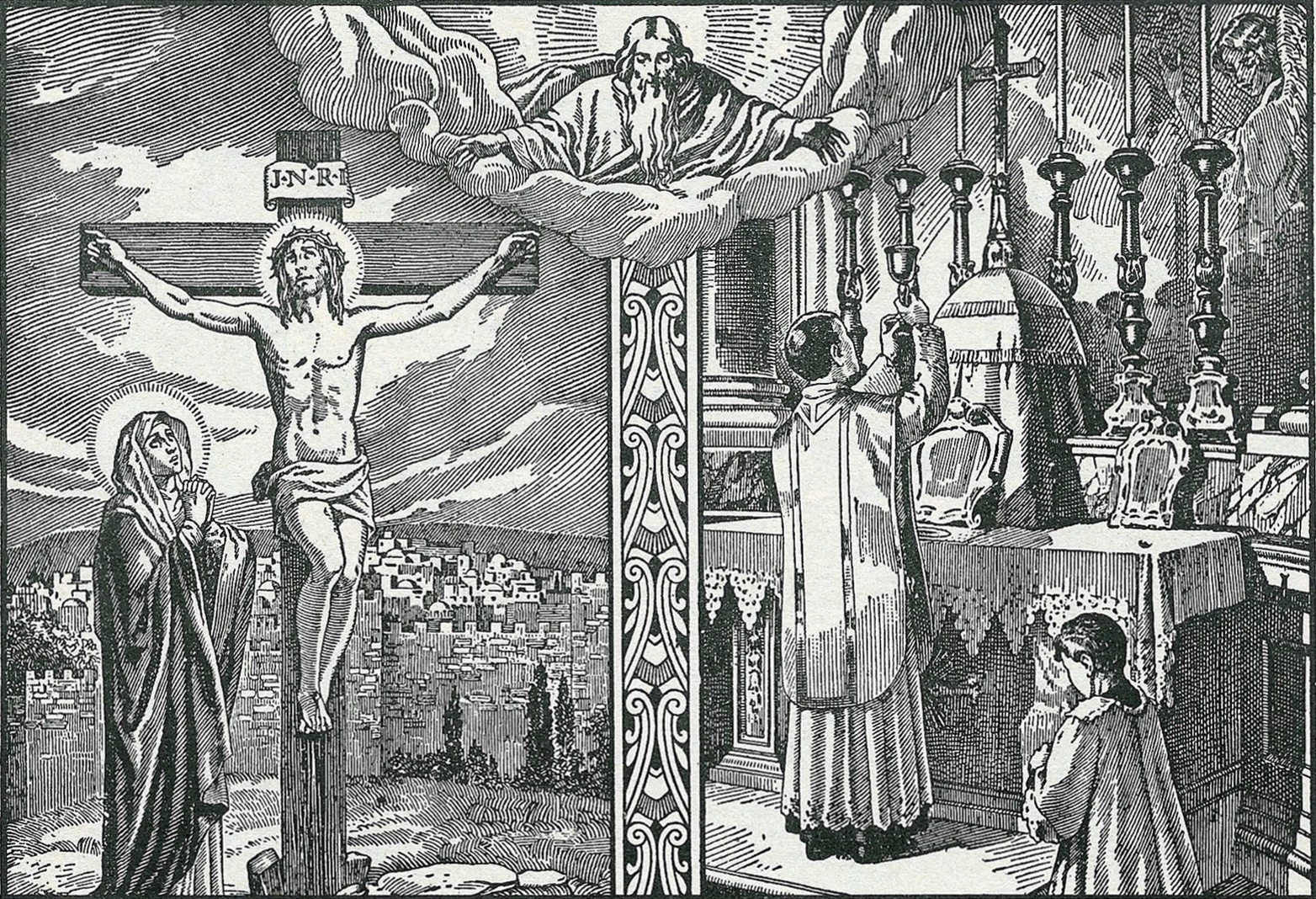
The mystery of today’s feast of Corpus Christi celebrates God’s abundant goodness. God manifests His goodness not only in redeeming fallen man instead of rejecting him. God manifests His goodness not only in choosing to redeem him by means of His Son’s death on the Cross. God also manifests His goodness in gifting to His Church the Most Blessed Sacrament of the Holy Eucharist. This gift makes Christ’s sacrifice on the Cross present to us.
Some Christians do not believe that the Eucharist is a gift from God. Some even claim that it’s idolatry to believe that Jesus is truly and substantially present in the Most Blessed Sacrament. How would you respond if someone stated that the Mass is an insult to what Jesus accomplished on Calvary?
Each of us needs to be able to respond to those claims. We need to be able to respond not only to help others draw closer to the fullness of the Christian Faith. We also need to be able to respond for our own sake. Each of us needs to understand the mystery of the Eucharist better, so that we can love the Eucharist better.
The Blessed Sacrament of the Eucharist does not, in truth, add anything to Jesus’ victory on Calvary. The Sacrament of the Eucharist makes Jesus’ victory present: here and now. As God the Father chose to send His Son down from Heaven into this fallen world, so the Son of God chooses to make His self-sacrifice present to us in our own fallen age. The Eucharist is God with us.
Every Mass brings Jesus’ death to the altar on which the Sacrifice of the Mass is celebrated. Within this sacred celebration, Jesus invites you to accept Him as “Emmanuel”. Jesus invites you to receive Him as “Emmanuel”, so that His life might be your life. He wants you to be strengthened by the Eucharist so that you can serve as a member of His Mystical Body, the Church. The Eucharist is “God with us” in order to strengthen us for our days in this world.