Sts. Simon and Jude, Apostles

Sts. Simon and Jude, Apostles
Ephesians 2:19-22  +  Luke 6:12-16
October 28, 2021

… with Christ Jesus Himself as the capstone.

St. Paul, at the beginning of today’s First Reading, declares to the Ephesians:  “You are no longer strangers and sojourners”.  But St. Peter, in his first epistle, admonishes his disciples:  “conduct yourselves with reverence during the time of your sojourning” [1 Peter 1:17-21].  How should we understand this discrepancy?  Were St. Paul and St. Peter speaking to different groups of disciples?  Were their words about sojourning in reference to differing circumstances?

Another name for the Church Militant—which is to say, the Church on earth—is the Pilgrim Church.  It’s important that we teach every disciple on earth to have this focus:  namely, that we do not live for this world, even as we take our faith into the world.  So on this feast of two holy apostles, what are we to make of St. Paul declaring, “You are no longer strangers and sojourners”?

In the second phrase of the first sentence, St. Paul makes his intent more clear.  The first half of today’s First Reading is a single sentence:  “You are no longer strangers and sojourners, but you are fellow citizens with the holy ones and members of the household of God, built upon the foundation of the Apostles and prophets, with Christ Jesus Himself as the capstone.”

St. Paul is setting down before the Ephesians his vision of the Church’s nature:  what we would call his “ecclesiology”.  He’s preaching about the Church’s essence.  Although we, like the Ephesians, are sojourning in faith each day, we also share now—by grace—in the eternal life that the Church Triumphant enjoys fully in Heaven.  The role of the apostles—and in turn their successors, including the bishop of one’s own diocese—is to foster our faith, to fix our hearts and minds, and all our apostolates and ministries here on earth, upon the eternal life of Heaven.

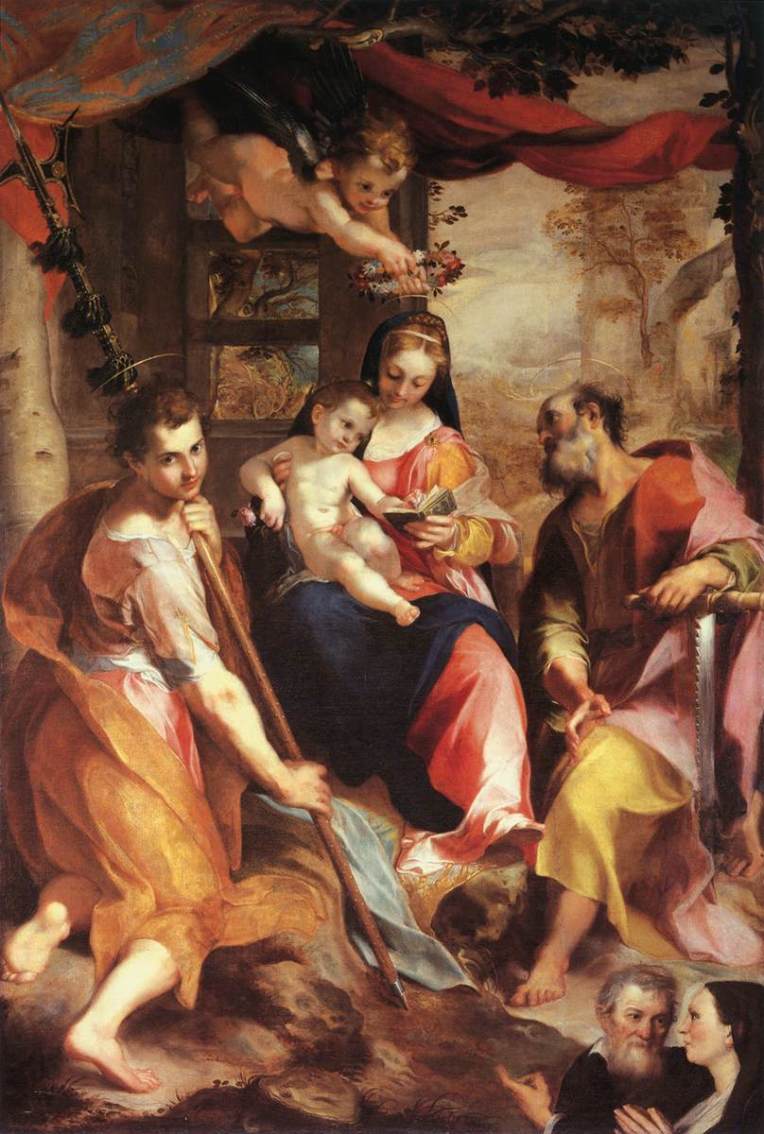
Sts. Simon and Jude with Virgin and Child

Virgin and Child with Sts. Simon and Jude by Federico Barocci [1535-1612]

Wednesday of the Thirtieth Week in Ordinary Time [I]

Wednesday of the Thirtieth Week in Ordinary Time [I]
Romans 8:26-30  +  Luke 13:22-30
October 27, 2021

“‘Depart from me, all you evildoers!’”

Christ in today’s Gospel touches upon one of the great temptations faced by those who serve Him.  Repeatedly He tells us that our motivations are as important as our words and actions.  Indeed, bad motives can cancel the “good” we think do and say.

There should be only one motive for serving God in Christ, and that is the sincere desire to return the love He pours out on us and to do His will out of that love, not just for our good but also for the good of others.  God is interested in the condition of our hearts, not just an impressive list of our deeds.

Sin enters into the serving of Christ when it is used as a means of self-aggrandizement or to line pockets with “green.”  While such people may perform well their hearts remain focused on themselves.  They dazzle audiences with their cleverness and charisma and say only what pleases the listeners—denying or downplaying sin, rationalizing wrongdoings, emphasizing God’s love while failing to mention God’s irrevocable truths and the justice by which we must live.  Theirs is the “wide door” against which Christ speaks.

Tuesday of the Thirtieth Week in Ordinary Time [I]

Tuesday of the Thirtieth Week in Ordinary Time [I]
Romans 8:18-25  +  Luke 13:18-21
October 26, 2021

“To what shall I compare the Kingdom of God?”

Today’s Gospel passage presents two brief parables in which Jesus specifically focuses our attention on “the Kingdom of God”.  It might seem a simple question, but what exactly is this Kingdom?  Is this Kingdom meant to be the Church’s life on earth?  Is this Kingdom in fact Heaven, which is to say, being in the presence of God?  In the latter case, the Church on earth only foreshadows the full glory of the Kingdom of God.

The Second Vatican Council spoke directly about the connection between the Church and the Kingdom of God.  The Council explained that this connection is a relationship of service, stating:  “While helping the world and receiving many benefits from it, the Church has a single intention:  That God’s Kingdom may come, and that salvation of the whole human race may come to pass.”  What this quote does not explain is whether one ought to hope for the coming of this Kingdom on earth, or whether it’s only possible for this Kingdom to be realized on the other side of death’s door.

In any case, the sacrifice that Christ makes of His Body for the sake of the Church is a paradigm.  It is a paradigm for understanding the sacrifice that the Church makes for the sake of the Kingdom.  This mission of the Church is inherently future-oriented, calling forth from Christians the virtue of hope, as they look forward to the Church’s final fulfillment at the Lord’s Second Coming.

OT 30-2

Monday of the Thirtieth Week in Ordinary Time

Monday of the Thirtieth Week in Ordinary Time
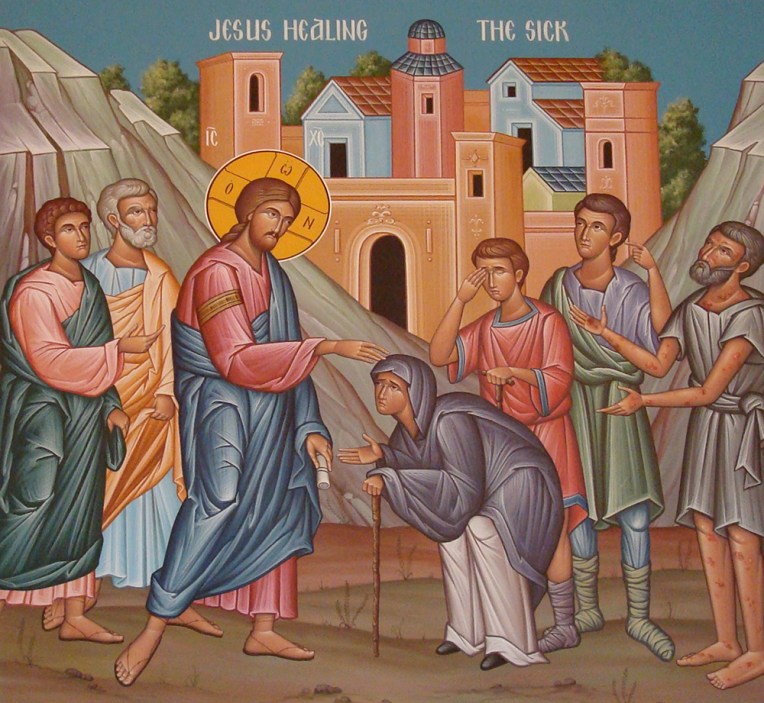
Luke 13:10-17

As He said this, all His adversaries were put to shame ….

Why is Jesus so insensitive?  Being a divine person, Jesus knew that His words against the ruler of the synagogue would cause His adversaries shame.  But still He spoke as He did.

Is it a sin to make another person ashamed?  The ruler of a politically correct culture would respond, “Always and everywhere.”  Jesus must believe differently.

It’s interesting that this Gospel narrative has no parallel in any of the other three Gospel accounts.  Only St. Luke presents this narrative.  Yet St. Luke’s Gospel account is known especially for highlighting the theme of mercy in the Good News of Jesus Christ.  That might, were we to think like the politically correct, for whom praise and popularity are life’s chief virtues, seem an odd contradiction.  But perhaps instead this narrative reveals to us a certain integrity.

It is precisely for the sake of mercy that Jesus speaks here as He does.  Shame has a place, Jesus reveals here, in lowering the one who has falsely raised himself or herself.  But this very act of shaming enables mercy to be shown:  here, to the woman who had had a spirit of infirmity for eighteen years.  May Jesus help us in our modern culture to rid ourselves of two-dimensional views of mercy and shame, and accept with gratitude all that comes forth from God’s Word.

Saturday of the Twenty-ninth Week in Ordinary Time [I]

Saturday of the Twenty-ninth Week in Ordinary Time [I]
Ephesians 4:7-16  +  Luke 13:1-9
October 23, 2021

“Sir, leave it for this year also ….”

Both in the Old Testament and the New Testament, gardens, plants and trees of all sorts are used as symbols of growth—and decay—within the spiritual life.  The very first story of the Bible takes place in a garden called Eden.  And today in the Gospel Reading, Jesus tells us a parable along the same lines.

Your spiritual life is the fig tree, and you are the gardener.  Your spiritual life is planted in the Lord’s orchard.  What we have to come to grips with is the fact that we are accountable to the Lord, just as in today’s parable the gardener is accountable to the owner of the orchard.  We are accountable for bearing spiritual fruit in our lives on this earth.

That’s why we’re here on this earth.  If we believed, as some of our fellow Christians do, that the entire point of our relationship with Christ is to be “saved”, then we would be better off dying as soon as we’re baptized.  But the whole truth is that salvation comes to us only at the end of our life on this earth, if we have been faithful to tending our spiritual life, and bearing fruit through the many ways that our spiritual life nourishes our daily life.

OT 29-6

Friday of the Twenty-ninth Week in Ordinary Time [I]

Friday of the Twenty-ninth Week in Ordinary Time [I]
Romans 7:18-25  +  Luke 12:54-59
October 22, 2021

The willing is ready at hand, but doing the good is not.

Saint Paul’s epistle to the Romans is not only the longest but also the most profound of all his epistles.  The breadth of themes and the depth to which he explores them is profound.  Today’s First Reading from the seventh chapter of Romans explores how the human person experiences division within himself.  St. Paul describes this as “the principle that when I want to do right, evil is at hand.”

Perhaps the most intriguing phrase in today’s First Reading is St. Paul’s admission that “I do not do the good I want, but I do the evil I do not want.”  His words call out the division in fallen man between what the “I” wants, and what it wills.  This is not a mere putting of one’s wants and desires to the side, and acting in spite of them.  St. Paul speaks of what modern thought might term a “compulsion” that drives the ego.  However, he ascribes this acting out of evil to the work of “sin that dwells in me.”

St. Paul is not seeking to cast blame away from himself.  He’s not trying to say, “The devil made me do it.”  He does indeed admit that this struggle is within his very self:  “I see in my members another principle at war with the law of my mind, taking me captive to the law of sin”.  Regardless of how fierce this struggle is, or how deep the division it causes, the remedy is clear and at hand.  St. Paul’s entire epistle to the Romans is full of thanksgiving to God for the grace of Christ our Savior.

OT 29-5

The Thirtieth Sunday in Ordinary Time [B]

The Thirtieth Sunday in Ordinary Time [B]
Jeremiah 31:7-9  +  Hebrews 5:1-6  +  Mark 10:46-52

Jesus stopped and said, “Call him.”

Catholics believe in the inalienable dignity of every human life, from the moment of conception until natural death.  In the face of a culture opposed to such belief, we need to desire that those who disagree would see that life is a gift:  that they would join us in seeing life as a blessing to be promoted, fostered, and chosen.

But how do you bring about such a complete change of view?  It would almost be like a blind man regaining his sight.

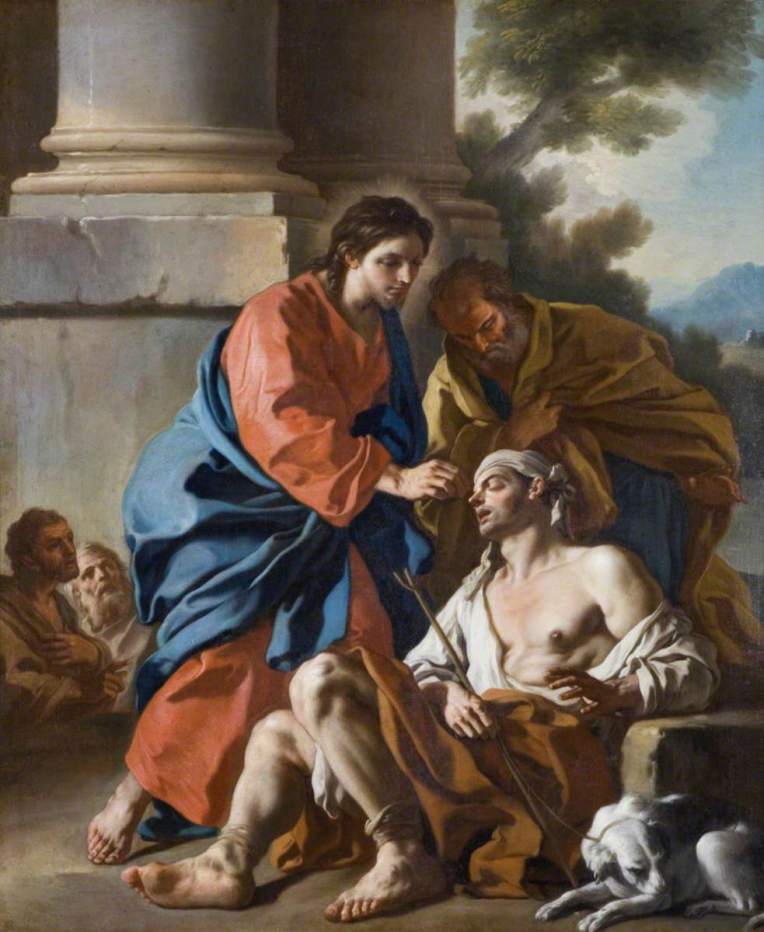
In Sunday’s Gospel Reading, Jesus gives Bartimaeus his sight when He says:  “Go your way.  Your faith has saved you.”  But notice what the next two phrases of the Gospel reveal.  These next two phrases are linked.  They are really two sides of the same coin.  The evangelist tells us first that “immediately, [Bartimaeus] received his sight”; and second, that Bartimaeus “followed [Jesus] on the way.”

Reflect on how the greatest gift—the strongest virtue—that Jesus offers us is the divine virtue of caritas (sometimes called “divine charity” or simply “love”).  This greatest virtue is the glory of being human.  God’s divine life is the end—the goal—of man.  We pray this truth in the Rosary:  the Joyful, Luminous, and Sorrowful Mysteries all lead to the Glorious Mysteries as the chapters of a novel lead to its climax.  Likewise, all the virtues of the Christian life lead to its goal:  the divine virtue of caritas; divine charity; divine love:  the life of the Trinity who is Father, Son and Holy Spirit.

We can only see how and why this is true if we see human life itself as gift.  We only see this truth if we understand the reason for the blind man receiving his sight in today’s Gospel Reading.  Jesus did not restore Bartimaeus’ sight just to ease his earthly life.  Jesus worked this miracle also to help Bartimaeus along the path to Heaven.

Jesus tells us that the blind man regains his sight because of his faith.  But the blind man shows us his faith by what he does.  When Jesus releases Bartimaeus by saying, “Go / your / way,” the man with vision follows Jesus on Jesus’ way.  In other words, the person with vision makes the Way of Jesus his own way.  There is no other way for us to walk if we want to be truly happy.  Every other path results in a dead-end, or an endless circle going nowhere.

So how do we travel this Way of Jesus?  By a wheel.  Picture a wheel and use this image to sum up how the Christian virtues work in concert within the healthy Christian soul.

The first virtue is humility, which is like the center of the wheel.  Humility is the mother of the other virtues, which radiate out from humility.

Then the virtue of prudence is like the wheel’s axle.  In other words, prudence is the “inner ear” of the soul, helping us to keep our balance and to steer our actions.

Most of the other virtues are like the wheel’s spokes.  Consider courage.  Courage flows from humility.  By contrast, false courage seeks to dominate and make my ego ever larger.  But in Christian humility, I do not worry about my ego.  However, this courage still has to be steered and given balance by prudence.  After all, even the martyr has to choose the best time to be courageous:  he doesn’t want to be foolhardy or give up his life for a cause that could be defended more simply.

But what is the goal of this courage?  If the spokes radiate out from humility and are steered by prudence, where do they radiate out towards?  The goal of every virtue is the divine virtue of caritas.  This divine virtue is the wheel’s tire.  It’s where—so to speak—the rubber hits the road, and God’s grace animates daily life.

So in humility, we give up our own self, so that we can be transformed into the likeness of Jesus.  Jesus is the divine caritas who became flesh and dwelt among us, for us and our salvation.  This is what Bartimaeus learns in Sunday’s Gospel.

This is what happens in the life of every blind person, as he gives up his own way through the world, and instead follows Jesus on the Way:  the Way that leads to Calvary, and through Calvary into the eternal life of God.
Thursday of the Twenty-ninth Week in Ordinary Time [I]

Thursday of the Twenty-ninth Week in Ordinary Time [I]
Romans 6:19-23  +  Luke 12:49-53
October 21, 2021

“No, I tell you, but rather division.”

Both the rhetoric and substance of Jesus’ proclamation in today’s Gospel passage are challenging.  It’s challenging to know how rightly to interpret His words.  The fire of His baptism is the source of the division that He has come to establish.  How can we understand these words and images in our own daily lives as disciples?

The most obvious interpretation of the fire that Jesus mentions is in light of God the Holy Spirit.  Through the graces that first were given at Pentecost in the Upper Room, the Holy Spirit inflames the hearts and minds of those called to be members of Jesus’ Mystical Body on earth.  Formed by the Holy Spirit into one Body, these members live out the baptism of Jesus.  Jesus’ baptism in the Jordan was a foreshadowing of His baptism on Calvary.  This latter baptism is the one which the Body of Christ today lives out.  As His members, you and I have to bear our share in this baptism if the Holy Spirit might use us as the Father’s instruments.

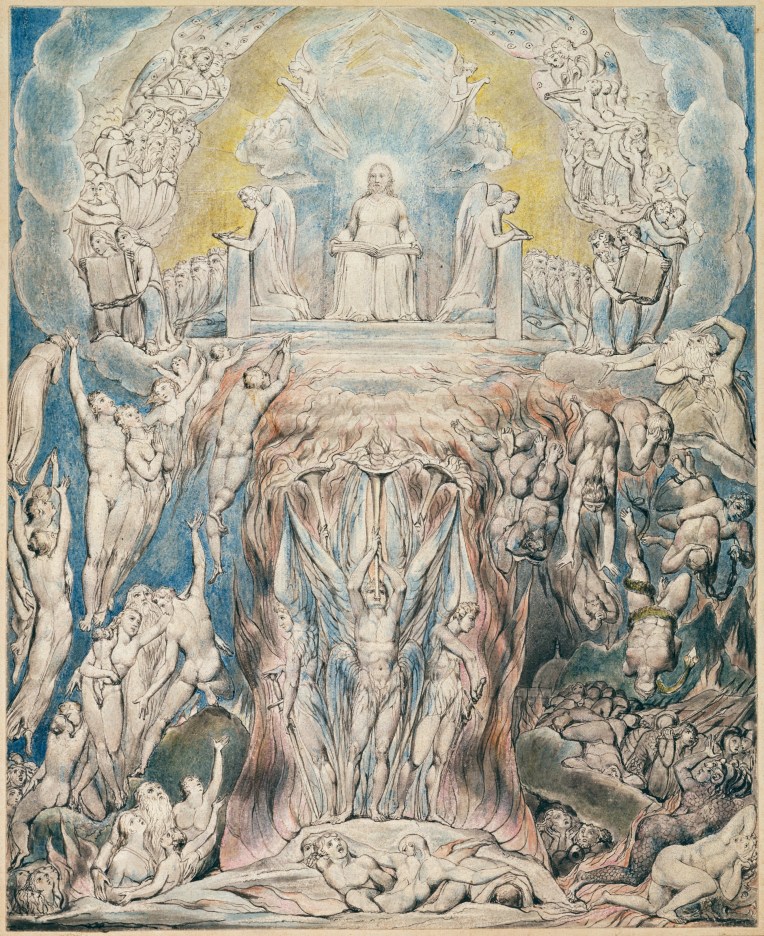
If we are faithful to the Father—allowing the baptism of Jesus’ suffering to be the vessel for the outpouring of the Holy Spirit through us—division will result, as Jesus describes in today’s Gospel passage.  This is not division for the sake of division, but for the sake of unity.  We pray in the midst of all division, that every person may recognize and accept his share in the life of the Trinity.

Wednesday of the Twenty-ninth Week in Ordinary Time [I]

Wednesday of the Twenty-ninth Week in Ordinary Time [I]
Romans 6:12-18  +  Luke 12:39-48
October 20, 2021

“Much will be required of the person entrusted with much, and still more will be demanded of the person entrusted with more.”

St. Luke the Evangelist presents many “stewardship parables”.  Today’s Gospel passage offers two, one much longer than the other.  The upshot of both is an explicit moral that lets no Christian off easily:  “Much will be required of the person entrusted with much, and still more will be demanded of the person entrusted with more.”  How do these words apply to an ordinary Christian?

No Christian is ordinary.  At the moment of a person’s baptism, God infuses grace into that adopted child’s soul.  The graces given include the divine virtues of faith, hope and charity.  God entrusts this grace to His adopted child.  Consider this fact in light of Jesus’ words at the end of today’s Gospel passage.  God entrusts His own divine life to His adopted children.  And of course, the graces received at Baptism are but the “first installment” of our inheritance.  As we continue to grow as His children, God continues to bestow grace upon us through the sacraments and prayer.

“Much will be required of the person entrusted with much”.  What will be required of us, then, as sharers in the divine life?  Are you a “faithful and prudent steward”?  Both of these virtues—fidelity and prudence—are required to be stewards of the graces that God gives us.  Both help keep our attention on our Master:  the beginning and end of all the graces of our lives.

OT 29-3