Thursday of the Twenty-ninth Week in Ordinary Time [I]

Thursday of the Twenty-ninth Week in Ordinary Time [I]
Romans 6:19-23  +  Luke 12:49-53
October 21, 2021

“No, I tell you, but rather division.”

Both the rhetoric and substance of Jesus’ proclamation in today’s Gospel passage are challenging.  It’s challenging to know how rightly to interpret His words.  The fire of His baptism is the source of the division that He has come to establish.  How can we understand these words and images in our own daily lives as disciples?

The most obvious interpretation of the fire that Jesus mentions is in light of God the Holy Spirit.  Through the graces that first were given at Pentecost in the Upper Room, the Holy Spirit inflames the hearts and minds of those called to be members of Jesus’ Mystical Body on earth.  Formed by the Holy Spirit into one Body, these members live out the baptism of Jesus.  Jesus’ baptism in the Jordan was a foreshadowing of His baptism on Calvary.  This latter baptism is the one which the Body of Christ today lives out.  As His members, you and I have to bear our share in this baptism if the Holy Spirit might use us as the Father’s instruments.

If we are faithful to the Father—allowing the baptism of Jesus’ suffering to be the vessel for the outpouring of the Holy Spirit through us—division will result, as Jesus describes in today’s Gospel passage.  This is not division for the sake of division, but for the sake of unity.  We pray in the midst of all division, that every person may recognize and accept his share in the life of the Trinity.

Wednesday of the Twenty-ninth Week in Ordinary Time [I]

Wednesday of the Twenty-ninth Week in Ordinary Time [I]
Romans 6:12-18  +  Luke 12:39-48
October 20, 2021

Much will be required of the person entrusted with much, and still more will be demanded of the person entrusted with more.”

St. Luke the Evangelist presents many “stewardship parables”.  Today’s Gospel passage offers two, one much longer than the other.  The upshot of both is an explicit moral that lets no Christian off easily:  “Much will be required of the person entrusted with much, and still more will be demanded of the person entrusted with more.”  How do these words apply to an ordinary Christian?

No Christian is ordinary.  At the moment of a person’s baptism, God infuses grace into that adopted child’s soul.  The graces given include the divine virtues of faith, hope and charity.  God entrusts this grace to His adopted child.  Consider this fact in light of Jesus’ words at the end of today’s Gospel passage.  God entrusts His own divine life to His adopted children.  And of course, the graces received at Baptism are but the “first installment” of our inheritance.  As we continue to grow as His children, God continues to bestow grace upon us through the sacraments and prayer.

“Much will be required of the person entrusted with much”.  What will be required of us, then, as sharers in the divine life?  Are you a “faithful and prudent steward”?  Both of these virtues—fidelity and prudence—are required to be stewards of the graces that God gives us.  Both help keep our attention on our Master:  the beginning and end of all the graces of our lives.

OT 29-3

Tuesday of the Twenty-ninth Week in Ordinary Time

Tuesday of the Twenty-ninth Week in Ordinary Time
Luke 12:35-38

“Blessed are those servants whom the master finds vigilant on his arrival.”

 In the Lord’s parable today He proclaims that “blessed are those servants”.  He’s wanting us to identify ourselves with them, and imitate them so that we might share in their blessedness.  How can we connect our lives to the lives of those servants?

Perhaps you’ve heard the old adage, “Always begin with your end in mind.”  “End” in this case refers to one’s goal.  Many people, of course, wander through life aimlessly, but Christians are meant to have Heaven as their goal, or end.  In this case, repeating that adage to ourselves each day helps us to live each day for God, by recalling that we can only get to Heaven by living out our faith in God.  This way of thinking approximates what Jesus is getting at in His parable.

However, there’s an immediacy to Jesus’ parable that’s missing in that adage.  His parable reminds us of a sobering fact:  that we know not the day nor the hour when our lives will end.  The Master may come at an unexpected time.  Therefore, we need not only always to be focused, but also to be vigilant, since the end we have in mind may confront us today.

St. Luke the Evangelist

St. Luke the Evangelist
2 Timothy 4:10-17  +  Luke 10:1-9
October 18, 2021

“Go on your way; behold, I am sending you like lambs among wolves.”

While the word “apostle” literally means “one who is sent”, today’s Gospel passage is not about Jesus sending the Twelve.  It is about Jesus sending the 72 ahead of Him as what we might call “advance men”.  The 72 are to prepare people to receive Jesus.  Through this mission, we can relate this Gospel passage to our own lives as disciples, and to the lives of those whom we’re called to serve.

Very few members of the Church serve as successors of the apostles in the role of bishop, but by contrast, every Christian is sent by Jesus to prepare others to receive Him.  This fact is often overlooked today.  There is a confusion still, so many years after the Second Vatican Council, between the roles of the clergy and laity.

The role of the laity in the Church is largely “outside” the Church, rather than in the sanctuary.  The laity are meant by God—designed by God in His design for the Mystical Body of Christ—to carry the fruits of the Church into the wider, secular world.  The word “apostolate” is all but obsolete today in referring to the work of the laity, but it needs to be reclaimed, in order to describe the right and responsibility of the laity to engage the “world” with the Good News of Christ.

GG_.tif

St. Luke the Evangelist paints the Virgin & Child

Saturday of the Twenty-eighth Week in Ordinary Time [I]

Saturday of the Twenty-eighth Week in Ordinary Time [I]
Romans 4:13,16-18  +  Luke 12:8-12
October 16, 2021

“For the Holy Spirit will teach you at that moment what you should say.”

Twice in today’s Gospel passage, God the Holy Spirit is referred to.  The first mention is somewhat ambiguous in meaning:  in its plainest sense, “blaspheming against the Holy Spirit” would refer to denying that the Holy Spirit is truly and fully God.  The Church has had to combat such denial throughout her history.

The second mention of the Holy Spirit refers to a situation that many Christians face at some point in their lives.  Whether at the point of death or with the fear of mere embarrassment, Christians at a loss as to how to defend the Faith must rely on the Holy Spirit.  Even the most brilliant Christian orator or preacher (St. Augustine of Hippo being a prime example) knows that human brilliance in any measure is dwarfed by, and indeed comes from, the Wisdom of the Holy Spirit.

However, the Holy Spirit teaching the Christian what to say does not mean that the Christian becomes a puppet or megaphone of the Holy Spirit.  It is the Holy Spirit who teaches at that moment, but it’s still the Christian who must speak in his own name about the Holy Name of Jesus, making the Good News his own.

St. Teresa of Jesus, Virgin & Doctor of the Church

St. Teresa of Jesus, Virgin & Doctor of the Church
Romans 4:1-8  +  Luke 12:1-7
October 15, 2021

“Be afraid of the one who after killing has the power to cast into Gehenna ….”

In the secular culture that surrounds modern Western man, the only image of Jesus that is acceptable is that of a spiritual teddy bear.  The idea that Jesus makes demands or sets boundaries is incompatible with modern secularism.

What can make of today’s Gospel passage, then?  Jesus declares:  “I shall show you whom to fear.  Be afraid of the one who after killing has the power to cast into Gehenna; yes, I tell you, be afraid of that one.”

Still, just three sentences later Jesus demands:  “Do not be afraid.”  There seems to be a contradiction.  Jesus tells us to be afraid, and then not to be afraid.

Jesus insists that we have a fully-rounded, rather than two-dimensional, view of God.  We may consider Jesus to be speaking of God the Father, or of Himself, when He describes the one whom we should fear.  As God, the Father, Son and Holy Spirit condemn the one who is a spiritual hypocrite.  Fear of God, the Just Judge, however, is a fear that helps us shape our lives.  This is a “holy fear”, or rather, “fear of the Lord”.  This fear gives direction to our days on this earth and to each day’s choices.  But guided by this holy fear, we can trust God who guides us to Himself.

St. Teresa of Avila by Peter Paul Rubens (1577-1640)

The Twenty-ninth Sunday in Ordinary Time [B]

The Twenty-ninth Sunday in Ordinary Time [B]
Isaiah 53:10-11  +  Hebrews 4:14-16  +  Mark 10:35-45

So let us confidently approach the throne of grace to receive mercy and to find grace for timely help.

The New Testament Letter to the Hebrews, from which Sunday’s Second Reading is taken, reflects upon the meaning that suffering gains through Jesus’ Cross.  Here one of the best-known definitions of “courage” is illustrated:  “not the absence of fear, but fear that has been prayed over.”

In other words, courage means being willing to bring God into a decision about whether to fight or flee from conflict.  Once God shows you whether a conflict demands your involvement, the stakes are raised.  Because to abandon a conflict in which God has staked a claim is to abandon God Himself.

But does God really care about taking sides?  Isn’t it better just to leave people alone?  Maybe all of us, instead of holding fast to what the Church teaches, should just let everyone do what they want.  Are we wrong to insist that non-Catholics, just as much as Catholics, are held by God to certain teachings or beliefs?  Or should we accept the majority opinion of the United States Supreme Court in a 1992 ruling defending abortion?  In that case of Planned Parenthood vs. the pro-life governor of Pennsylvania, the majority opinion of the United States Supreme Court made the following declaration:  “At the heart of liberty is the right to define one’s own concept of existence, of meaning, of the universe, and of the mystery of human life.”

In the face of this sort of claim, you—as a Catholic—have four paths to consider taking.  Two of these are against conflict, while the other two accept conflict.

The first path that leads away from conflict is the path of resignation.  This is the path of least resistance; the path of joining in with the culture that surrounds us.  Countless Catholics walk this path today:  many are politicians; many are members of the media; some are ordinary, middle-class citizens; some are even clergy.  They walk this liberal path away from conflict saying, “Let’s have everyone create his own morality.  It’s not our place to impose our morality on others.”  But this is not our Catholic Faith.

However, there’s another path that also leads away from conflict.  This is the path that leads into a bunker.  This conservative path away from conflict says, “Modern culture today is going to ‘you know where’ in a hand basket.”  So these people, of whom many are Catholic, decide to close in on themselves, and close above them the door to their bunker.  Inside, they carry on, living the Faith as they’ve been given it, but not passing it on to anyone except their own children, ignoring the mandate of Holy Mother Church to be a missionary people.  The path into a bunker is not our Catholic Faith.

Those are the two paths that lead away from conflict.  But in the opposite direction, there are two paths that accept conflict.  Each demands its own type of courage.

The first path that accepts conflict is the path of aggression.  This is the path of greatest resistance.  Only those who enjoy conflict follow this path.  The goal of this path is dominance.  Its operating theory is that life is a “zero-sum game”:  it says, “I can’t win, unless you lose.”  It’s like the card game “War”, and is just as interesting.  The type of courage needed to walk this path is the courage of the child’s game “King of the Hill.”  But this is not our Catholic Faith.

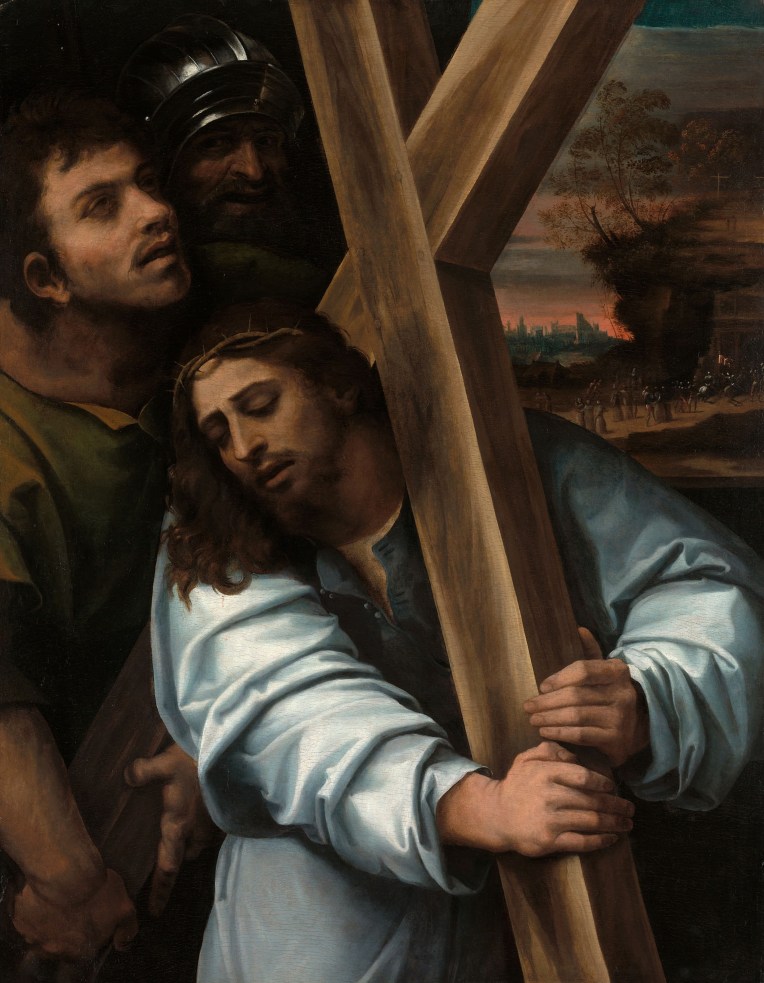
The second path that accepts conflict is the path that demands the Christian virtue of courage.  This form of courage is the courage of Christ the King, who did not dominate as the king of the hill of Calvary, but sacrificed his life there so that others could join Him:  not just us, but all mankind, gathered there with Mary and the Beloved Disciple in worship of the King who died for us.  This is our Catholic Faith.

We fight—by defending the Truth about the dignity of human life—not in order to defeat others, but in order to bring them to see and live the Truth.  We do this because seeing and living the Truth sets people free, enriching the life of every person and our entire culture:  transforming it as a leaven from within, and leading those who love this Truth into the life of God.

Thursday of the Twenty-eighth Week in Ordinary Time [I]

Thursday of the Twenty-eighth Week in Ordinary Time [I]
Romans 3:21-30  +  Luke 11:47-54
October 14, 2021

“Yes, I tell you, this generation will be charged with their blood!”

On the occasions when Jesus refers to persons from the Old Testament, it’s usually Moses or Abraham of whom He speaks.  Today’s Gospel passage, though, is the only time that Jesus refers to Abel (along with the parallel passage in Matthew 23:34).

What’s intriguing about Jesus’ reference to Abel is that He speaks about him in relation to the Old Testament prophets.  Jesus speaks about “the blood of all the prophets shed since the foundation of the world”.  Clearly Jesus doesn’t agree with those modern scholars who consider the first generations of mankind in Genesis to be literary creations.  After all, why would Jesus’ own generation, as He declares, be charged with the blood of a fictional character?

Regardless, we need to reflect on why Jesus included Abel among the prophets.  Certainly, like the prophets, Abel was murdered for professing his belief in God.  But his profession was not made verbally, as prophets usually proclaim their prophecies.  In the fourth chapter of Genesis, we hear that Abel “brought to the Lord an offering… of the firstlings of his flock and of their fat portions.  And the Lord had regard for Abel and his offering, but for Cain and his offering He had no regard” [Gn 4:3,4-5].

It might seem cavalier to say that Cain and Abel were engaged in the first of mankind’s “liturgy wars”.  Nonetheless, Jesus pointing our attention to the prophetic nature of right worship reminds us of the need for “orthodoxy” within the Mystical Body of Christ.

Wednesday of the Twenty-eighth Week in Ordinary Time [I]

Wednesday of the Twenty-eighth Week in Ordinary Time [I]
Romans 2:1-11  +  Luke 11:42-46
October 13, 2021

“You pay tithes … but you pay no attention to judgment and to love for God.”

If the scholar of the Law who interrupted Jesus’ lambasting of the Pharisees thought he would earn an apology from Jesus, he quickly realized otherwise.  Contrary to modern notions of Jesus as a sort of “spiritual teddy bear”, today’s Gospel passage splashes cold water on our souls, forcing us to ask whether Jesus might speak of us in a similar manner.

However, in addition to the sober fact of Jesus’ forthright willingness to condemn those deserving condemnation, we could consider in turn each of the “woes” that Jesus articulates today.  Here consider just the first.

“You pay tithes… but you pay no attention to judgment and to love for God.”  All three of these objects of religion—tithes, judgment, and love—are due to God from human persons.  They “belong” to God, we might say, each in its own manner.  Why might it be that the Pharisees are willing to give the first, but not the latter two?

There certainly is a hierarchy among the three.  “Love for God” is due God because “God is love”.  Judgment is due God in that only He—all-loving and all-knowing—can judge truly.  Tithing of materials goods such as “of mint and of rue and of every garden herb” is due God because He is the Lord of creation.  Nonetheless, the ascent to God in the practice of religion involves the ascent of a staircase with many steps.  The tithing of material goods is one of the lower steps, and the Pharisees are content to rest there.  This step is meant to lead us further upwards: closer to God, towards a higher share in God’s divine nature of eternal love.

OT 28-3