Monday of the 21st Week in Ordinary Time [I]

Monday of the 21st Week in Ordinary Time [I]
1 Thessalonians 1:1-5,8-10  +  Matthew 23:13-22
August 26, 2019

“You do not enter yourselves, nor do you allow entrance to those trying to enter.”

Christians often confess the sin of anger, perhaps without considering that anger cannot only be justified at times, but indeed can at times even be righteous.  Perhaps the most famous example from the earthly life of our Savior is His overturning the tables of the money-changers in the Temple.  However, the words of Jesus also at times demonstrate anger on His part.  His words in today’s Gospel passage could hardly have been spoken without anger.  But when justified, anger must be directed to an object deserving anger.  What is the object of Jesus’ condemnation today?

We might at first consider the object of Jesus’ anger to be the scribes and Pharisees, and in one sense that’s true.  But we ought to remember that on Calvary, Jesus died for them as for us, with deep love in His Sacred Heart for them.  Jesus never at any moment did not want these “blind fools” to “exult in glory” in Heaven.

Today’s redaction of the Gospel says that Jesus’ words were said “to the crowds and to His disciples”.  Indirectly, He may have said these words for their sake, but clearly they were directed to the scribes and Pharisees.  More importantly, His words were spoken not only for the crowds and His disciples, but also for the scribes and Pharisees:  for their conversion, that they might “rejoice in [Jesus as] their king”.

OT 21-1

The 21st Sunday in Ordinary Time [C]

The 21st Sunday in Ordinary Time [C]
Isaiah 66:18-21  +  Hebrews 12:5-7,11-13  +  Luke 13:22-30
August 25, 2019

   … He scourges every son He acknowledges.   

In today’s Second Reading, Saint Paul speaks about the “trials” involved in spiritual discipline.  He also refers to discipline as training.  Writing to the Hebrew Christians, he explains:  “At the time, all discipline seems a cause not for joy but for pain, yet later it brings the peaceful fruit of righteousness to those who are trained by it.”

The verb “train”, like the verb “try”, is simple and not very exciting.  To train for a new job at work, or for a new position on the team, or for the role of altar server at Holy Mass, is very simple.  In fact, it’s pretty routine.  But routine is at the heart of success.  Football players get tired and maybe even bored with running the same plays over and over and over again.  Why do the same plays have to be run so many times?  Most adults know the answer to that question from the experiences of life.  The problem is that many people don’t think that the principle of discipline—that the connection between trial, training, and success—has any connection to the life of Christian prayer.

What role does discipline have in the life of Christian prayer?  I’m not referring to the prayers that are spoken, like the Rosary or the Liturgy of the Hours.  I’m referring to the type of prayer which leads to communion with God Himself in contemplation.  Above and beyond spoken prayers, and above and beyond meditation where one reflects on some mystery of the Faith or some truth about God, the prayer which leads to communion with God is as simple as it is difficult.  In this prayer, where the Christian disposes himself or herself to receive the gift of contemplation, discipline definitely is needed.

It’s true that some people believe that there is no such connection.  They think of contemplation being as simple as going outside on a sunny day and soaking in the rays of the sun.  Prayer for them is simply basking in the warmth of God’s love.  The obvious problem with this analogy is that there are these things called clouds in the sky.  So also are there clouds in the life of prayer.  In fact, there are not just clouds in the life of prayer, but at times there are also thunderclouds, lightning and hail.  This is true even in the prayer lives of the saints.  The best guides in this regard are St. Teresa of Jesus (also known as St. Teresa of Avila) and St. John of the Cross.

But apart from the inclement weather of prayer, even more difficult to accept for those who want their prayer life to be sunny and 72° seven days a week is the fact of God’s silence.  Why does God sometimes respond to our efforts at prayer with silence:  that is, by offering us no response whatsoever?

In her book titled The Interior Castle, St. Teresa of Avila speaks about the “interior and exterior trials” that God sets between Himself and the faithful Christian, and which call for disciplined commitment to prayer.  She describes the exterior trials of gossip, persecution, and “the severest illnesses”.  At greater length she describes interior trials.  Within one of these interior trials, she explains:  “The Lord, it seems, gives the devil [freedom] so that the soul might be tried and even be made to think it is rejected by God.”  Regarding such trials, St. Teresa admits that “there is no remedy in this tempest but to wait for the mercy of God.”

As she describes this discipline of waiting for the mercy of God, St. Teresa notes that “at an unexpected time, with one word alone or a chance happening, [God] so quickly calms the storm that it seems there had not been even as much as a cloud in that soul….  And like one who has escaped from a dangerous battle and been victorious, it comes out praising our Lord; for it was He who fought for the victory. … Thus, it knows clearly its wretchedness and the very little we of ourselves can do if the Lord abandons us.”

It’s here that God gives us the chance to learn one of the chief lessons about discipline.  Whereas in human endeavors—whether reciting multiplication tables, or running passing plays, or hitting a high note on the trumpet—discipline leads us to become smarter, stronger, and more skilled, in the life of Christian prayer discipline teaches us how to rely not on ourselves and our talents, but on God and His mercy.

+     +     +

click HERE to watch Jeff Cavins’ reflection for this liturgical Sunday (6:28)

click HERE to read the homily of Monsignor Charles Pope for this Sunday

click HERE to read the homily for this Sunday from Pluscarden Abbey in Scotland

+     +     +

click HERE to read Pope Francis’ 2016 Angelus address for this Sunday

click HERE to read Pope Emeritus Benedict’s 2007 Angelus address for this Sunday

click HERE to read the reflection of St. John Paul II upon this Sunday’s Responsorial Psalm.

OT 21-0C

The Trinity with Christ Crucified [Austrian, about 1410]
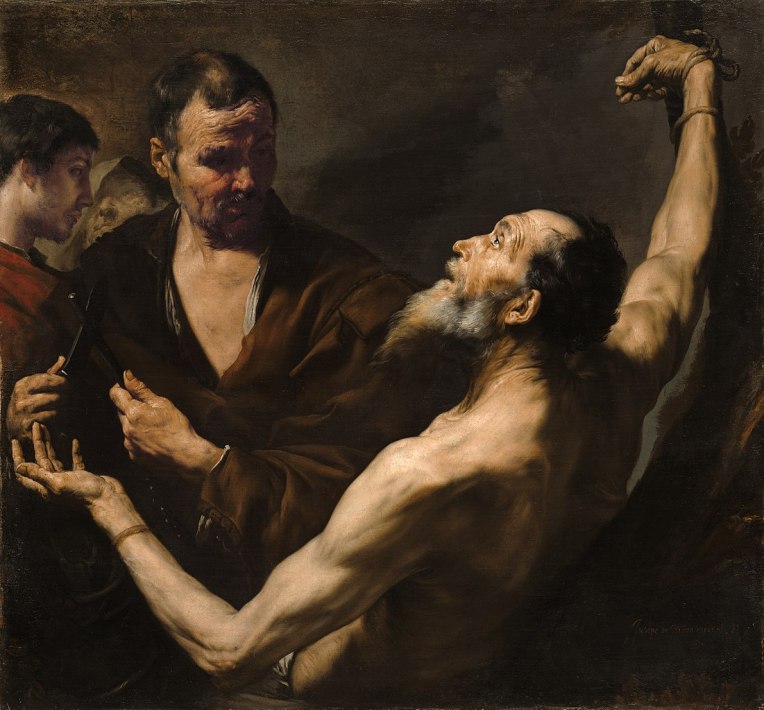
St. Bartholomew the Apostle

St. Bartholomew the Apostle
Revelation 21:9-14  +  John 1:45-51
August 24, 2019

   “Come and see.”   

When Philip points out Jesus as the promised Messiah, what does Nathaniel—also known as Bartholomew—say?  We can almost see Nathaniel shrugging his shoulders as he says, “Can anything good come from Nazareth?”  In this one sentence, he insults both Jesus and Jesus’ hometown.  Clearly, he does not have faith at this point.

But we see that Nathaniel is like Peter:  a slow learner, but someone who, once he realizes what’s going on, is completely “in”.  When Nathaniel hears Jesus call him, he realizes who Jesus is, and confesses this truth, declaring:  “Teacher, you are the Son of God; you are the king of Israel.”  So if any of us are slow to learn, we should remember that Jesus does not give up on us.  Jesus will still call each of us to live out his vocation each day, and give him whatever is needed to carry it out.

Yet we should also note something else in this “vocation story”:  that is, the role of Philip.  When God calls a young man to be a priest, or a young woman to the consecrated life, He usually calls him or her through other people.  We need not only to encourage vocations:  we need also to encourage those “other people” like Philip to encourage vocations.

After all, Philip said just three words:  “Come and see.”  But if Philip had not said these three simple words, Nathaniel might never have met Jesus, and the Church would not have been built up by this holy apostle Bartholomew.  Little words can do a lot for God’s great glory.

St. Bartholomew LORES

The Martyrdom of St. Bartholomew by Jusepe de Ribera [1591-1652]

Friday of the 20th Week in Ordinary Time [I]

Friday of the 20th Week in Ordinary Time [I]
Ruth 1:1,3-6,14-16,22  +  Matthew 22:34-40
August 23, 2019

   “The whole law and the prophets depends on these two commandments.”   

When we were little we were expected to memorize the basic truths of our Faith.  At the top of the list were the Ten Commandments, which are difficult for a child to memorize.  Today’s Gospel passage offers a clue to help us to remember—or to teach—the Ten Commandments more easily.

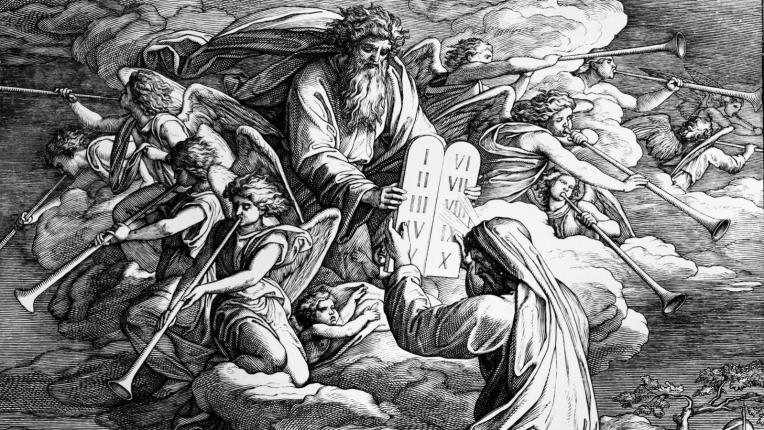
If not pointed out, we may never have noticed that in many pictures of Moses bringing down the two tablets from Mt. Sinai, the Ten Commandments are not divided five and five.  Rather, the first tablet has the first three commandments, and the other tablet the remaining seven.  This illustrates Jesus’ teaching today:  that there are, in fact, simply “two commandments”.

On the Cross most especially, in His very Person, Jesus embodies the unity of these “two commandments”.  True God and true man, Jesus’ teaching today merely foreshadows what He teaches us on Calvary.  Some people teach a piety that promotes complete devotion to God, but ignores or even disdains the corrupted human race.  Others teach an ethic that promotes an apotheosis of human nature, but disdains or even altogether denies God.  But neither of God’s “two commandments” can stand or be understood thoroughly without the other.  Jesus reveals the meaning of each of these commandments in His divine Person, and in His Self-sacrifice on Calvary.

The Ten Commandments

The Queenship of the Blessed Virgin Mary

The Queenship of the Blessed Virgin Mary
Judges 11:29-39  +  Matthew 22:1-14
August 22, 2019

   “Many are invited, but few are chosen.”   

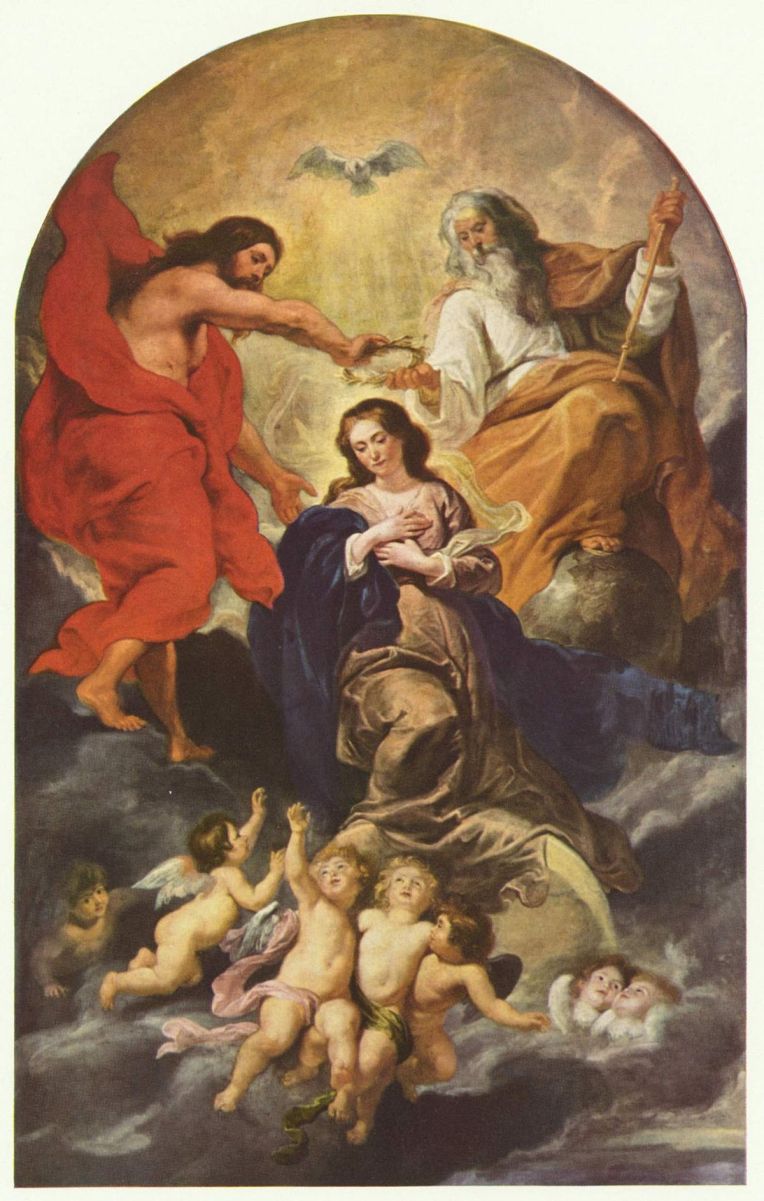
Today’s feast of Mary’s Queenship falls one week after the feast of her Assumption.  Seven days ago, we celebrated the Fourth Glorious Mystery of the Rosary, and today we celebrate the Fifth (Mary being crowned as the Queen of Heaven and earth).  These two feasts of Mary are connected, and teach us about who Mary our Mother is.  The Assumption and the Queenship of Mary also teach us what being a Christian is about.

When we think back on salvation history, there are many “marvelous deeds” to reflect upon.  We might consider the marvel of God parting the Red Sea, or the marvel of the walls of Jericho falling, or indeed the marvelous deeds of Creation that God wrought “in the beginning”.

However, our Christian faith declares that even more marvelous than any of the deeds that God worked in the Old Testament are the marvelous “deeds” who are saints.  We might think it a bit odd to consider any human persons as “deeds” of God, but that is what they are:  not only because they were created by God, but also because of the redemption and sanctification wrought by God through the Paschal Mystery, and offered through the Church to “all the nations”.

Among all of “God’s marvelous deeds” in all of creation, then, the most marvelous is the Blessed Virgin Mary.  We can say of Our Lady what the Church prays in the first Preface of Saints:  “Lord, holy Father, almighty and eternal God… you are praised in the company of your Saints / and, in crowning their merits, you crown your own gifts.”

When we teach little ones about the twenty mysteries of the Rosary, do we teach them that these twenty mysteries are chapters in a single story, and that the Crowning of Our Blessed Mother is the final chapter of this marvelous story?  Certainly, all of the “marvelous deeds” of salvation history are ultimately for the Glory of God.  At the same time, these marvelous deeds were done for us poor sinners, and this includes the deed of creating, redeeming, and sanctifying so glorious a mother.

Coronation of Mary - Rubens

The Coronation of the Virgin by Peter Paul Rubens [1577-1640]

for the optional Scripture readings for the Queenship of Mary click HERE

Pope St. Pius X

Pope St. Pius X
Judges 9:6-15  +  Matthew 20:1-16
August 21, 2019

   “…the last will be first, and the first will be last.”   

Clarity emerges from Jesus’ parable in today’s Gospel.  He teaches us who we are to live our lives for, and how we may serve them.

Jesus’ parable, of course, is not about economics, but about merciful love.  At the end of the parable, when the landowner rhetorically asks, “am I not free to do as I wish with my own money?”, we understand that Jesus is, so to speak, putting words in the mouth of God the Father.  When faced with us human sinners, God the Father asks, “am I not free to do as I wish with my own merciful love?”

You and I gripe and complain as we walk through life.  We’re just like the laborers in this parable.  We cannot understand why others should receive blessings in their lives when they don’t deserve them.  We notice, in fact, not only that “the rain falls on the just and the unjust”, and that “the Lord makes His sun to shine on the evil and the good.”   God actually shows mercy to those who do not deserve it.  In our pride, this gets to us, because it seems unjust.

When we find ourselves torn between what seems just, and what God chooses to offer, we need to reflect again on the answer that the Father gave us when He sent His eternal Son to become flesh and blood, in order to offer that flesh and blood on Calvary, and in the Holy Sacrifice of the Mass.  You might spend some time in prayer during this next week simply gazing at a crucifix, reflecting on this mystery of how Jesus on the Cross bound together the love of God and the love of neighbor.  God asks us to prefer His form of mercy to our own sense of justice.

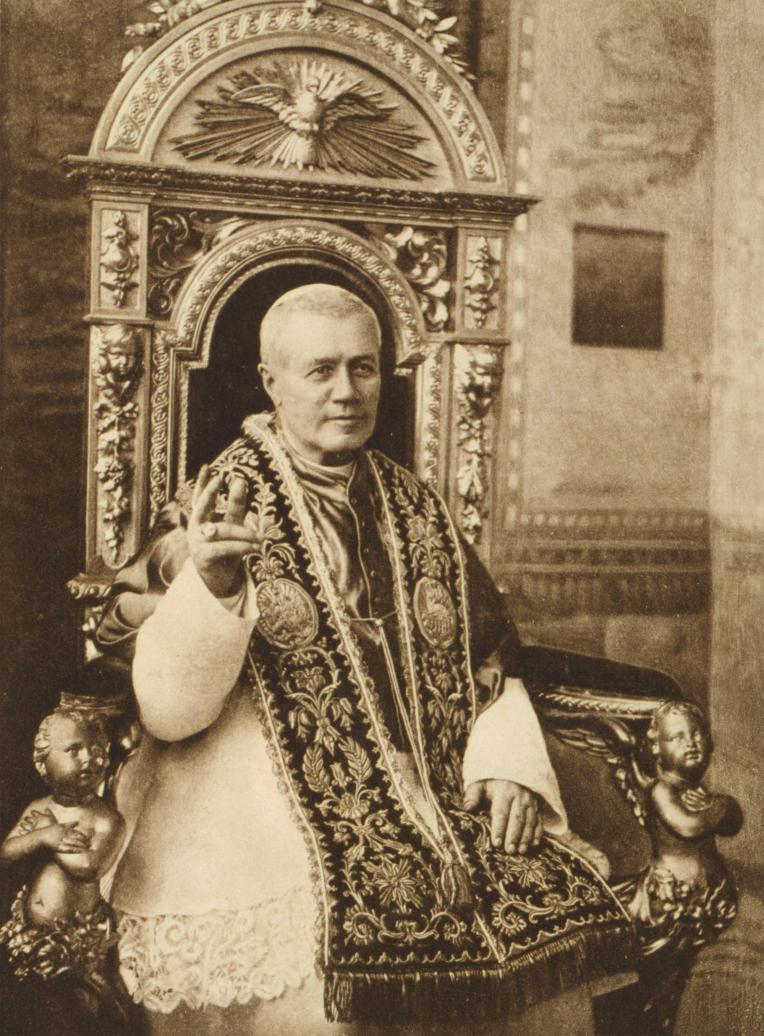
St. Pius X

Pope St. Pius X
click HERE to learn more about his papacy

St. Bernard, Abbot & Doctor of the Church

St. Bernard, Abbot & Doctor of the Church
Judges 6:11-24  +  Matthew 19:23-30
August 20, 2019

   “What will there be for us?”   

Peter often comes across as a less than stellar candidate for the college of apostles, much less the leader of the apostles.  Consider that after Jesus has declared that salvation is impossible for man to accomplish, but that “for God all things are possible”, what does Peter reply?  He replies, “We have given up everything and followed you.  What will there be for us?”  Obviously Peter is not embarrassed by his self-interest.  We might admire his honesty in expressing himself, even if he himself isn’t so admirable on this occasion.  Can you imagine a brand new postulant arriving at the convent and asking where she can find the hot tub and the coffee bar?

But Jesus answers Peter’s question with a forbearance that might leave us scratching our heads.  Perhaps we need to reflect on whether, and how, Jesus is acting pedagogically here.  Jesus offers Peter an impressive response, assuring us that great gifts are in store in Heaven for those who are saved by God.

But this begs the question:  how does God save us?  For man it is impossible to save himself, but for God it is possible to save man.  But how does God save man?  This question seems to pass over Peter’s head, and perhaps at times over ours as well.  The answer, simply, is the Way of the Cross.  Peter in time will walk there.  God invites you to do so today.

St. Bernard 2

St. Bernard of Clairvaux, Abbot & Doctor of the Church

Monday of the 20th Week in Ordinary Time [I]

Monday of the 20th Week in Ordinary Time [I]
Judges 2:11-19  +  Matthew 19:16-22
August 19, 2019

   “Teacher, what good must I do to gain eternal life?”   

The young man in today’s Gospel Reading knows that something more is needed.  He’s very confident that he has observed the commandments, but knows that he still lacks something for the gaining of eternal life.  Jesus’ response aims for Heaven:  “to be perfect”, the young man must sell what he has in order to give to the poor, and then he must follow Jesus.

It would not be accurate to take today’s passage as a proof that every Christian must abandon all his or her possessions.  Jesus was speaking on this occasion to an individual.  Individual members of the Body of Christ have different vocations, and are called in different ways.

What every Christian vocation does have in common with every other is to seek “to be perfect”.  In fact, Jesus commands us elsewhere to be perfect as our heavenly Father is perfect.  That might seem an impossibly lofty goal, were we not to understand the meaning of the word “perfect”.  From the Latin, it could be loosely translated as “to become what one is”, or in other words, “to become what one is meant to be”.  God “designed” each human person, and calls each human person, to spend himself in love for others, and above all, for God Himself as the ineffable Other.  However God may ask you to accomplish this, give thanks for His call.

OT 20-1

The 20th Sunday in Ordinary Time [C]

The 20th Sunday in Ordinary Time [C]
Jer 38:4-6,8-10  +  Heb 12:1-4  +  Lk 12:49-53
August 18, 2019

   “No, I tell you, but rather division.”   

The family is the chief earthly example of the “cloud of witnesses” described in today’s Second Reading.  Another term for this “cloud of witnesses” is the “communion of saints”.  One of the great truths about human families is that we tend over time to resemble those we are close to, for good or ill.  It’s in the domestic church—the family—that we witness the Faith, and learn to practice the Faith.

Each person has her own portrait of God in her mind:  one’s own personal idea of what God “looks like”.  Each Christian paints such a “portrait of God” from one’s spiritual experiences growing up, from personal devotions, and from one’s relationships in the Communion of Saints.

Parents, in the eyes of a child, are the first images of God.  Often, it’s from a mother that a child has his first glimpse of God’s tenderness and gentleness.  Likewise, it’s often from a father that a child has his first glimpse of God’s steadfastness through adversity.

For example, there are those who have a great personal devotion to the Stations of the Cross.  Some Catholics pray the Stations not just on Fridays of Lent, but 52 Fridays a year.  They do this to express their thanks to God the Father for giving up His Son, and to Christ for handing over His life for us poor sinners.  For the Christian with a deep devotion like this, her portrait of God the Father is one where she can see how much mercy the Father has for her:  that the Father sacrificed His Son as if for her alone.

But Jesus talks in the Gospel passage today about what happens when a family is divided.  For example, when parents divorce, and a child sees his father running away from adversity instead of standing steadfast, or when a child sees his mother acting viciously towards his father, it’s not surprising that a child’s belief in God is shattered.  The percentage of children from broken homes who grow up and choose not to practice any sort of faith shows how important the roles of mother and father are, and how big an influence parents have on their children’s practice of the Faith.

Today’s Second Reading and Gospel passage can seem to be talking about two opposite things.  The Letter to the Hebrews encourages us that, “since we are surrounded by so great a cloud of witnesses, [we should] rid ourselves of every burden and sin that clings to us, and persevere in running the race that lies before us….”  This “great cloud of witnesses” doesn’t just mean the saints who are already in heaven.  It includes also those who share our Faith here on earth.  After our participation in the Mass, and devotions of our Faith, and after the example of our parents, it is through other fellow Christians within this “great cloud of witnesses” that we are either strengthened in our Faith, or grow weaker.

This is part of the responsibility that each one of us has as a baptized Christian; that is, as a member of the communion of saints.  Each of us has a responsibility to be there for others, and to be an example for others.  This is where our Gospel passage comes in.  Although our Second Reading talks about the importance of the communion of saints, Jesus in our Gospel passage says that He came into this world to bring division.  He did not come to establish peace on this earth.

Now maybe this isn’t a picture of God that we like.  Maybe we want to think about God as a teddy bear.  But either Jesus is lying in today’s Gospel passage, or we have to accept the fact that following Jesus sometimes means causing division.  If we are not willing to stand for our Catholic Faith, and recognize it as a treasure from God to be shared with others because it has the power to give eternal life, then there’s not much reason to be Catholic.

What is our Faith worth?  Jesus answered this question in a very clear way.  To see His answer, all we have to do is look at the Crucifix.  But consider that which we see as an example for us on the crucifix:  this mere example is, in the Eucharist, the true presence of Jesus’ Body and Blood, soul and divinity.  Jesus offers us His sacrificial Self, so that we might have the strength to live for others within and for the sake of that “great cloud of witnesses” that is His Church.

+     +     +

click HERE to watch Jeff Cavins’ reflection for this liturgical Sunday (7:02)

click HERE to read the homily for this Sunday from Pluscarden Abbey in Scotland

click HERE to read the homily of Msgr. Charles Pope for this Sunday

+     +     +

click HERE to read Pope Francis’ 2016 Angelus address for this Sunday

click HERE to read Pope Emeritus Benedict’s 2007 Angelus address for this Sunday

click HERE to read from a General Audience of St. John Paul II on God the Holy Spirit

OT 20-0C

Coronation of the Virgin by Fra Angelico [ca. 1395-1455]