Friday of the 21st Week in Ordinary Time [I]

Friday of the 21st Week in Ordinary Time [I]
1 Thessalonians 4:1-8  +  Matthew 25:1-13
August 30, 2019

   “Therefore, stay awake, for you know neither the day nor the hour.”   

The parable that Jesus teaches in today’s Gospel passage presents at the outset a question which can prevent us from reaching down into Jesus’ point.  We might well ask, “Why are there ten virgins but only one bridegroom?”  What is the setting or background to this story that Jesus is telling?  Scholars may debate such points, but for ordinary Christians like ourselves, it would be more fruitful to set aside such speculation, and dwell instead on applying the parable to our own spiritual lives today.

Christ is the divine Bridegroom, and each Christian is—in our fallen humanity—called to wed one’s self to Christ.  Our sacramental, spiritual life consists of our espousal to Christ, and in this each of us is one member of the Mystical Body of Christ.  Throughout her history the Church has (so far) had well over a billion members, each a spiritual bride to Christ.  Men may have difficulty applying this imagery to themselves, and of course this imagery has to be considered carefully.  Nonetheless, the writings (not to say the very lives) of both male and female saints show us how to grow authentically within these truths.

If we were to apply Jesus’ parable in a succinct way, we might consider the final sentence, where the divine Bridegroom exhorts us to “stay awake”.  We ought not rest comfortably in God’s grace, but rather realize our need each day to be alert to His coming more deeply into our lives.

OT 21-5

The Passion of St. John the Baptist

The Passion of St. John the Baptist
1 Thessalonians 3:7-13  +  Mark 6:17-29
August 29, 2019

   When his disciples heard about it, they came and took his body and laid it in a tomb.   

How did Saint John the Baptist get to be strong enough to speak the truth, even when he knew that it could mean the end of his life?

John constantly preached and practiced penance.  Before Jesus’ Baptism of the Holy Spirit, Saint John preached a different baptism.  Saint John preached a baptism of penance.  Like the Old Testament prophets, Saint John fasted in the desert so that he would be strong enough to speak the truth.  Keep in mind that in the Jordan River, the baptism that Jesus received was John’s baptism, not the Sacrament of Baptism.  Jesus’ received John’s baptism as a sign that His own earthly vocation would be one of penance:  the Way of the Cross.

If we practice penance in our lives—having been baptized first into Christ’s life—we will be strong enough spiritually to stand up for the Truth, who is Jesus.  With this in mind, listen very closely today to the Preface to the Eucharistic Prayer.

There are five saints—the Blessed Virgin Mary, Saint John the Baptist, Saint Joseph, and Saints Peter and Paul—who have their own prefaces.  In the preface that is prayed today, listen especially to its account of John’s last and greatest act of witness to Jesus.  With this is mind, receive Holy Communion today while asking Jesus to allow the Eucharist to help you be a more authentic witness to Jesus.

St. John the Baptist Beheading

St. Augustine, Bishop & Doctor of the Church

St. Augustine, Bishop & Doctor of the Church
1 Thessalonians 2:9-13  +  Matthew 23:27-32
August 28, 2019

   “Woe to you, scribes and Pharisees, you hypocrites.”   

The next time sometime suggests to you that Jesus was nothing more than a teddy bear, point out today’s Gospel passage.  One of several things will happen.  That someone may recognize that he’s mistaken.  Or that someone may suggest—as some scholars actually do—that this passage was made up, and that Jesus never said what this passage records Him as saying.  Or that person might suggest that it’s only against people like the scribes and Pharisees that Jesus ever spoke in such a way.

The third of these possibilities is most likely to be the response of those challenged to explain this passage.  But this is where the sharp point of the Gospel needs to be recognized.

Today’s passage was not included in Matthew’s Gospel account so that we could wag our fingers at those in our own lives who resemble the scribes and Pharisees.  Rather, we need to hold their lives up to ours, and see to what extent we mirror them.  We might like Jesus always to be a teddy bear, but more often than not we need Him not to be.

St. Augustine - Philippe de Champaigne

St. Augustine of Hippo, Bishop & Doctor of the Church

learn about St. Augustine of Hippo’s collected works HERE

St. Monica

St. Monica
1 Thessalonians 2:1-8  +  Matthew 23:23-26
August 27, 2019

   “Blind Pharisee, cleanse first the inside of the cup….”   

In today’s Gospel passage, we hear Jesus rather harshly commanding that exterior and interior religious practices be integrated.  The right way in which to integrate them is to put first things first:  that is, to tend first to the inner dispositions of the soul, and then from the soul’s strength to practice virtuous acts.

Jesus condemns the “blind Pharisee” who appears clean on the outside, but inside is full of plunder and self-indulgence.  His actions may appear virtuous, but they are not.  They are deeds that may have good effects.  But these actions worsen a division in the soul of the one who carries them out.

Similarly, Jesus’ first condemnation here—of the scribes and Pharisees—concerns a different form of “dis-integration”.  These “hypocrites” are doing certain good works, but not the works that are far better and more central to a life given to God.  This dis-integration suggests that even the good works are being done for bad reasons.

Jesus doesn’t condemn the scribes and Pharisees for tithing:  indeed, He says they should have tithed.  But He uses a purposefully ridiculous metaphor to describe what they’re doing:  they are straining out the gnat, but swallowing the camel!  The latter part of the metaphor ought to remind us of another quote from Jesus:  “it is easier for a camel to pass through the eye of a needle then for a rich man to enter the Kingdom of Heaven.”

St. Monica & St. Augustine

St. Monica and her son St. Augustine of Hippo

Monday of the 21st Week in Ordinary Time [I]

Monday of the 21st Week in Ordinary Time [I]
1 Thessalonians 1:1-5,8-10  +  Matthew 23:13-22
August 26, 2019

“You do not enter yourselves, nor do you allow entrance to those trying to enter.”

Christians often confess the sin of anger, perhaps without considering that anger cannot only be justified at times, but indeed can at times even be righteous.  Perhaps the most famous example from the earthly life of our Savior is His overturning the tables of the money-changers in the Temple.  However, the words of Jesus also at times demonstrate anger on His part.  His words in today’s Gospel passage could hardly have been spoken without anger.  But when justified, anger must be directed to an object deserving anger.  What is the object of Jesus’ condemnation today?

We might at first consider the object of Jesus’ anger to be the scribes and Pharisees, and in one sense that’s true.  But we ought to remember that on Calvary, Jesus died for them as for us, with deep love in His Sacred Heart for them.  Jesus never at any moment did not want these “blind fools” to “exult in glory” in Heaven.

Today’s redaction of the Gospel says that Jesus’ words were said “to the crowds and to His disciples”.  Indirectly, He may have said these words for their sake, but clearly they were directed to the scribes and Pharisees.  More importantly, His words were spoken not only for the crowds and His disciples, but also for the scribes and Pharisees:  for their conversion, that they might “rejoice in [Jesus as] their king”.

OT 21-1

The 21st Sunday in Ordinary Time [C]

The 21st Sunday in Ordinary Time [C]
Isaiah 66:18-21  +  Hebrews 12:5-7,11-13  +  Luke 13:22-30
August 25, 2019

   … He scourges every son He acknowledges.   

In today’s Second Reading, Saint Paul speaks about the “trials” involved in spiritual discipline.  He also refers to discipline as training.  Writing to the Hebrew Christians, he explains:  “At the time, all discipline seems a cause not for joy but for pain, yet later it brings the peaceful fruit of righteousness to those who are trained by it.”

The verb “train”, like the verb “try”, is simple and not very exciting.  To train for a new job at work, or for a new position on the team, or for the role of altar server at Holy Mass, is very simple.  In fact, it’s pretty routine.  But routine is at the heart of success.  Football players get tired and maybe even bored with running the same plays over and over and over again.  Why do the same plays have to be run so many times?  Most adults know the answer to that question from the experiences of life.  The problem is that many people don’t think that the principle of discipline—that the connection between trial, training, and success—has any connection to the life of Christian prayer.

What role does discipline have in the life of Christian prayer?  I’m not referring to the prayers that are spoken, like the Rosary or the Liturgy of the Hours.  I’m referring to the type of prayer which leads to communion with God Himself in contemplation.  Above and beyond spoken prayers, and above and beyond meditation where one reflects on some mystery of the Faith or some truth about God, the prayer which leads to communion with God is as simple as it is difficult.  In this prayer, where the Christian disposes himself or herself to receive the gift of contemplation, discipline definitely is needed.

It’s true that some people believe that there is no such connection.  They think of contemplation being as simple as going outside on a sunny day and soaking in the rays of the sun.  Prayer for them is simply basking in the warmth of God’s love.  The obvious problem with this analogy is that there are these things called clouds in the sky.  So also are there clouds in the life of prayer.  In fact, there are not just clouds in the life of prayer, but at times there are also thunderclouds, lightning and hail.  This is true even in the prayer lives of the saints.  The best guides in this regard are St. Teresa of Jesus (also known as St. Teresa of Avila) and St. John of the Cross.

But apart from the inclement weather of prayer, even more difficult to accept for those who want their prayer life to be sunny and 72° seven days a week is the fact of God’s silence.  Why does God sometimes respond to our efforts at prayer with silence:  that is, by offering us no response whatsoever?

In her book titled The Interior Castle, St. Teresa of Avila speaks about the “interior and exterior trials” that God sets between Himself and the faithful Christian, and which call for disciplined commitment to prayer.  She describes the exterior trials of gossip, persecution, and “the severest illnesses”.  At greater length she describes interior trials.  Within one of these interior trials, she explains:  “The Lord, it seems, gives the devil [freedom] so that the soul might be tried and even be made to think it is rejected by God.”  Regarding such trials, St. Teresa admits that “there is no remedy in this tempest but to wait for the mercy of God.”

As she describes this discipline of waiting for the mercy of God, St. Teresa notes that “at an unexpected time, with one word alone or a chance happening, [God] so quickly calms the storm that it seems there had not been even as much as a cloud in that soul….  And like one who has escaped from a dangerous battle and been victorious, it comes out praising our Lord; for it was He who fought for the victory. … Thus, it knows clearly its wretchedness and the very little we of ourselves can do if the Lord abandons us.”

It’s here that God gives us the chance to learn one of the chief lessons about discipline.  Whereas in human endeavors—whether reciting multiplication tables, or running passing plays, or hitting a high note on the trumpet—discipline leads us to become smarter, stronger, and more skilled, in the life of Christian prayer discipline teaches us how to rely not on ourselves and our talents, but on God and His mercy.

+     +     +

click HERE to watch Jeff Cavins’ reflection for this liturgical Sunday (6:28)

click HERE to read the homily of Monsignor Charles Pope for this Sunday

click HERE to read the homily for this Sunday from Pluscarden Abbey in Scotland

+     +     +

click HERE to read Pope Francis’ 2016 Angelus address for this Sunday

click HERE to read Pope Emeritus Benedict’s 2007 Angelus address for this Sunday

click HERE to read the reflection of St. John Paul II upon this Sunday’s Responsorial Psalm.

OT 21-0C

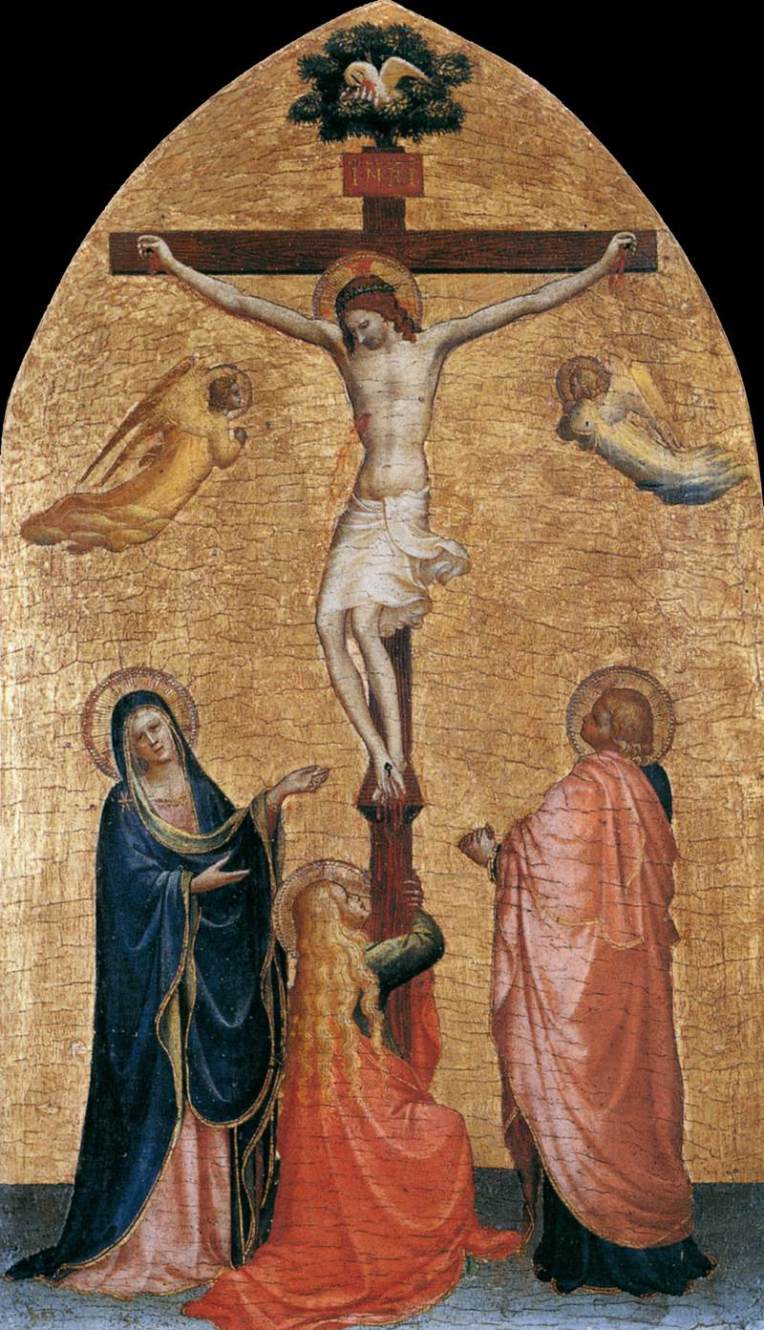
The Trinity with Christ Crucified [Austrian, about 1410]

St. Bartholomew the Apostle

St. Bartholomew the Apostle
Revelation 21:9-14  +  John 1:45-51
August 24, 2019

   “Come and see.”   

When Philip points out Jesus as the promised Messiah, what does Nathaniel—also known as Bartholomew—say?  We can almost see Nathaniel shrugging his shoulders as he says, “Can anything good come from Nazareth?”  In this one sentence, he insults both Jesus and Jesus’ hometown.  Clearly, he does not have faith at this point.

But we see that Nathaniel is like Peter:  a slow learner, but someone who, once he realizes what’s going on, is completely “in”.  When Nathaniel hears Jesus call him, he realizes who Jesus is, and confesses this truth, declaring:  “Teacher, you are the Son of God; you are the king of Israel.”  So if any of us are slow to learn, we should remember that Jesus does not give up on us.  Jesus will still call each of us to live out his vocation each day, and give him whatever is needed to carry it out.

Yet we should also note something else in this “vocation story”:  that is, the role of Philip.  When God calls a young man to be a priest, or a young woman to the consecrated life, He usually calls him or her through other people.  We need not only to encourage vocations:  we need also to encourage those “other people” like Philip to encourage vocations.

After all, Philip said just three words:  “Come and see.”  But if Philip had not said these three simple words, Nathaniel might never have met Jesus, and the Church would not have been built up by this holy apostle Bartholomew.  Little words can do a lot for God’s great glory.

St. Bartholomew LORES

The Martyrdom of St. Bartholomew by Jusepe de Ribera [1591-1652]

Friday of the 20th Week in Ordinary Time [I]

Friday of the 20th Week in Ordinary Time [I]
Ruth 1:1,3-6,14-16,22  +  Matthew 22:34-40
August 23, 2019

   “The whole law and the prophets depends on these two commandments.”   

When we were little we were expected to memorize the basic truths of our Faith.  At the top of the list were the Ten Commandments, which are difficult for a child to memorize.  Today’s Gospel passage offers a clue to help us to remember—or to teach—the Ten Commandments more easily.

If not pointed out, we may never have noticed that in many pictures of Moses bringing down the two tablets from Mt. Sinai, the Ten Commandments are not divided five and five.  Rather, the first tablet has the first three commandments, and the other tablet the remaining seven.  This illustrates Jesus’ teaching today:  that there are, in fact, simply “two commandments”.

On the Cross most especially, in His very Person, Jesus embodies the unity of these “two commandments”.  True God and true man, Jesus’ teaching today merely foreshadows what He teaches us on Calvary.  Some people teach a piety that promotes complete devotion to God, but ignores or even disdains the corrupted human race.  Others teach an ethic that promotes an apotheosis of human nature, but disdains or even altogether denies God.  But neither of God’s “two commandments” can stand or be understood thoroughly without the other.  Jesus reveals the meaning of each of these commandments in His divine Person, and in His Self-sacrifice on Calvary.

The Ten Commandments

The Queenship of the Blessed Virgin Mary

The Queenship of the Blessed Virgin Mary
Judges 11:29-39  +  Matthew 22:1-14
August 22, 2019

   “Many are invited, but few are chosen.”   

Today’s feast of Mary’s Queenship falls one week after the feast of her Assumption.  Seven days ago, we celebrated the Fourth Glorious Mystery of the Rosary, and today we celebrate the Fifth (Mary being crowned as the Queen of Heaven and earth).  These two feasts of Mary are connected, and teach us about who Mary our Mother is.  The Assumption and the Queenship of Mary also teach us what being a Christian is about.

When we think back on salvation history, there are many “marvelous deeds” to reflect upon.  We might consider the marvel of God parting the Red Sea, or the marvel of the walls of Jericho falling, or indeed the marvelous deeds of Creation that God wrought “in the beginning”.

However, our Christian faith declares that even more marvelous than any of the deeds that God worked in the Old Testament are the marvelous “deeds” who are saints.  We might think it a bit odd to consider any human persons as “deeds” of God, but that is what they are:  not only because they were created by God, but also because of the redemption and sanctification wrought by God through the Paschal Mystery, and offered through the Church to “all the nations”.

Among all of “God’s marvelous deeds” in all of creation, then, the most marvelous is the Blessed Virgin Mary.  We can say of Our Lady what the Church prays in the first Preface of Saints:  “Lord, holy Father, almighty and eternal God… you are praised in the company of your Saints / and, in crowning their merits, you crown your own gifts.”

When we teach little ones about the twenty mysteries of the Rosary, do we teach them that these twenty mysteries are chapters in a single story, and that the Crowning of Our Blessed Mother is the final chapter of this marvelous story?  Certainly, all of the “marvelous deeds” of salvation history are ultimately for the Glory of God.  At the same time, these marvelous deeds were done for us poor sinners, and this includes the deed of creating, redeeming, and sanctifying so glorious a mother.

Coronation of Mary - Rubens

The Coronation of the Virgin by Peter Paul Rubens [1577-1640]

for the optional Scripture readings for the Queenship of Mary click HERE