The 23rd Sunday in Ordinary Time [C]

The 23rd Sunday in Ordinary Time [C]
Wis 9:13-18  +  Philm 9-10,12-17  +  Lk 14:25-33
September 8, 2019

   And thus were the paths of those on earth made straight.   

Asking God for things is a tricky business.  We might even say that of all the types of Christian prayer, the prayer of petition demands the most deliberation.  Today’s First Reading addresses this challenge indirectly, asking rhetorically:  “Who can know God’s counsel, or who can conceive what the Lord intends?  For the deliberation of mortals are timid, and unsure are our plans.”  We might paraphrase these verses by asking, “When I pray, how can I get my human free will to align with God’s divine and providential will?”

So to “fine tune” our prayers in order to make them more effective, here’s a question for you.  But be careful, because it’s a trick question:  “When we petition God in prayer, should we pray for a good thing?”  The answer is “Yes… and No.”  Today’s Scripture passages explain why by giving us examples of, and by describing, the virtue of prudence.

If someone were to ask you, “Should you pray for a good thing?”, then you should answer “No!”  The definition of prudence shows us why we should not pray just for a good thing.  Notice in this definition the two tasks that prudence enables us to carry out.

The Catechism of the Catholic Church defines prudence as “the virtue that disposes practical reason to discern our true good in every circumstance, and to choose the right means of achieving it” [CCC 1806].  Prudence empowers us to do two things:  first, to see our “true good” in a given circumstance; and second, to choose the means to reach this “true good”.  So prudence guides both our intellect (in seeing the “true good”), and our will (in choosing the “true good”).  Prudence is really the most practical of all the virtues, because it guides the marriage of our intellect and will in daily life.

Nonetheless, as insightful as this definition is, it begs an important question.  What is this “true good”?

Our Scripture passages today show us how this “true good” is not just the good as opposed to the bad.  The true good is the best good, out of many good choices.

When we were little, our parents taught us to make moral choices by recognizing right from wrong; good from bad; what is holy from what is evil.  This is the first stage of moral wisdom.  This is the foundation of making moral choices.  It’s essential that we understand that difference.  In fact, to put it bluntly, this difference is the difference between Heaven and hell.  But as a Christian, you have to build upon that foundation.

The foundation of Christian morality is about good versus bad.  We build on that by hearing God call us beyond only choosing what is good.  God wants us to do far more:  He wants us to choose what is best over and above what is merely good.  It’s in this sense that God does not want you to choose a good thing:  God wants you to choose the best thing.  “Good” is not good enough.  Only “the best” is good enough for God, and for you and your vocation.

To illustrate all this, consider a particular setting in which many Christians must make tough moral choices:  parenting.  Of all the struggles that parents face—and they face many, given that their children are surrounded today by a corrupt culture—one of the harder struggles is to instill the virtue of prudence into the lives of their children.

Humility, by contrast, is far easier for children to acquire, because life itself has a way of teaching everyone humility.  All of us who are adults have learned many lessons about humility over the years:  some people call it the “school of hard knocks”.  However, the virtue of prudence doesn’t force its way into your life as humility does.

Here’s another difference between humility and prudence for parents to keep in mind.  After humility, prudence is the second-most foundational virtue.  Where humility is the mother of all the other virtues, the Catechism uses a striking image to describe prudence:  the Catechism calls prudence the “charioteer” of all the other virtues.

In other words, you can think of prudence as being the “inner ear” of the Body of Christ.  As your inner ear controls your body’s sense of balance, so prudence controls the balance of your soul, including the balance of your moral choices.  You could be the strongest football player, the most poised ballerina, or the most agile sprinter in the world.  But if that one little part of your inner ear didn’t work, then you and your strength, poise and agility would fall flat on your face.

Everyone needs a sense of balance:  not only physical balance, but even more so moral balance.  Other virtues may be more powerful and even more important, but without prudence, they won’t allow you to reach for the greatest good in life.

+     +     +

click HERE to watch Jeff Cavins’ reflection for this liturgical Sunday (5:15)

click HERE to read the homily of Monsignor Charles Pope for this Sunday

click HERE to read the homily for this Sunday from Pluscarden Abbey in Scotland

+     +     +

click HERE to read Pope Francis’ 2013 Angelus address for this Sunday

click HERE to read Pope Emeritus Benedict’s 2007 homily for this Sunday

click HERE to read St. John Paul II’s 2004 homily for this Sunday
OT 23-0C

Saturday of the 22nd Week in Ordinary Time [I]

Saturday of the 22nd Week in Ordinary Time [I]
Colossians 1:21-23  +  Luke 6:1-5
September 7, 2019

   …persevere in the faith, firmly grounded, stable, and not shifting from the hope of the Gospel….   

Following yesterday’s majestic hymn about the transcendent Christ, Saint Paul in today’s First Reading from Colossians speaks plainly to sinners.  Just as Paul addressed the Colossians as those who had been redeemed in Christ but who were—at the time of his writing—struggling to remain faithful, so we also are addressed today:  we who know very well the experience of sin, and its consequent forms of alienation.

Paul’s address to the Colossians here has two parts, focusing first on Christ and then on them.  Paul reminds the Colossians that their reconciliation was won “in the fleshly Body of Christ through His death”.

But the Colossians, for their part, must imitate Christ.  Here we ought to put ourselves in the shoes of the Colossians.  We are “holy, without blemish” if we “persevere in the faith, firmly grounded, stable, and not shifting from the hope of the Gospel”.  The key to persevering in faith, and standing fast in hope, is to live in love.  This love is ours in the person of Jesus.

OT 22-6

Friday of the 22nd Week in Ordinary Time [I]

Friday of the 22nd Week in Ordinary Time [I]
Colossians 1:15-20  +  Luke 5:33-39
September 6, 2019

   “Rather, new wine must be poured into fresh wineskins.”   

Depending on circumstances, two given cousins may resemble each other very closely, or not at all.  Today’s Gospel passage presents a contrast between Jesus and His cousin, John the Baptist.  Jesus confirms the differences between Him and John, although these differences lead in the same direction.

The context of this contrast is a complaint lodged against Jesus by the scribes and Pharisees.  They uphold the practice of fasting and prayer, but at the same time note that Jesus’ disciples don’t seem to engage in either.

Jesus responds with a metaphor and a parable.  Consider the former.  Jesus describes Himself as a bridegroom.  We as modern Christians understand that by this metaphor Jesus is referring to Himself as the bridegroom of the Church, though that part of the metaphor would have been lost on His original hearers.  But He continues by noting that when the bridegroom is taken away, then the wedding guests will fast.

The latter part of the metaphor can be applied in two ways.  The first we can reflect on in terms of Jesus’ earthly life, and the time of His Passion and death during Holy Week.  The second we can reflect on in terms of our own earthly lives as pilgrims on our way to Heaven:  that is to say, as members of the Church Militant.  We may only share fully in the wedding feast of the Lamb in Heaven, and so while still here below we fast and pray, hoping for complete union in Heaven with the Lord.

OT 22-5

Thursday of the 22nd Week in Ordinary Time [I]

Thursday of the 22nd Week in Ordinary Time [I]
Colossians 1:9-14  +  Luke 5:1-11
September 5, 2019

   “But if you say so, I will….”   

In spite of Peter’s knowledge and experience in fishing, and in spite of his having been up all night long, Peter and his fishing partners had caught absolutely nothing.  Sometimes in what we do, also, we try our best, even at things we’ve done before and know a lot about, but things don’t work out for us.  That’s a natural part of life in this fallen world.

But in today’s Gospel passage, we hear about Jesus coming along.  Jesus was a carpenter, not a fisherman.  Jesus tells Peter to put out the fishing boat into deep water (not the best place to catch fish), and after the sun had risen (not the best time).  Peter starts out with a protest against Jesus’ idea, but then has second thoughts, and replies to Jesus, “But if you say so, I will….  I will lower the nets.”

Remember that God’s ways are not our ways.  Sometimes, when we pray, we end up telling God what He should be doing.  And when we hear God talking to us, we think His ideas are bad ideas.  When Jesus asks us to do something for Him, we should listen.  And through the grace that we receive in Holy Communion, we should speak as Peter speaks, and say to Jesus, “But if you say so, I will….”

OT 22-4

Wednesday of the 22nd Week in Ordinary Time [I]

Wednesday of the 22nd Week in Ordinary Time [I]
Colossians 1:1-8  +  Luke 4:38-44
September 4, 2019

   …we have heard of your faith in Christ Jesus….   

Today the Church at weekday Mass begins to proclaim Saint Paul’s Letter to the Colossians.  We will hear from this letter over the next eight days, and will hear from the first three of its four chapters.

Most of St. Paul’s letters have introductions similar to one another, following a format that was common in Paul’s day for letter-writing.  But with greater scrutiny we notice unique touches with which Paul foreshadows the kernel of each letter.  One of these touches that he paints in today’s reading evokes the three divine virtues.

Paul says to the Colossians:  “we have heard of your faith in Christ Jesus and the love that you have for all the holy ones because of the hope reserved for you in Heaven.”  Paul is writing in this letter to commend the Colossians, yet also to caution them in light of temptations to not focus their lives on Christ.  Here at the beginning of the letter Paul is praising the Colossians at the same time he illustrates the reason that they might be commended.

For each of us, also, there is a need to grow closer to Christ, and to leave aside false hopes, empty loves, and blinding faith.  Christ is the means by which to grow in authentic faith, hope and love.  Christ is the fulfillment of all three:  the love of the Father, into the depths of which the Father wants us to enter.

©Photo. R.M.N. / R.-G. OjŽda

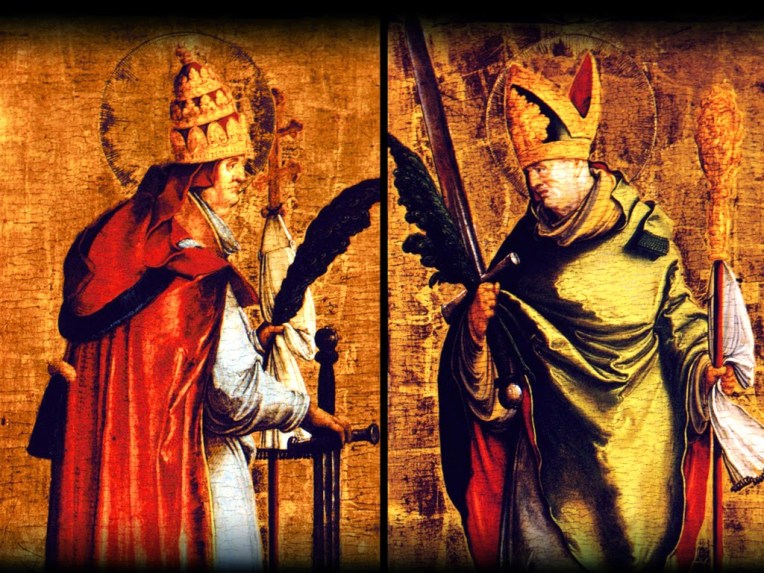
Pope St. Gregory the Great, Doctor of the Church

Pope St. Gregory the Great, Doctor of the Church
1 Thessalonians 5:1-6,9-11  +  Luke 4:31-37
September 3, 2019

   …they were astonished at His teaching because He spoke with authority.   

Astonishment is evoked by the fact that Jesus teaches with authority.  Why is there this astonishment, and what does it mean for Jesus to teach with authority?

In the culture that surrounds us, every person believes himself to be his own authority.  In effect, this wide-spread belief means that no real authority exists.  In our society there is a great need for clarity about the meaning and purpose of authority.

At its most literal level, the word “authority” is related to the word “author”.  The author of a novel can create worlds of his own design from his imagination.  Laws of physics need not apply.  Strange creatures can exist, and fantastic events are commonplace.  Tolkien, Baum and Rodenberry are all authors in this sense.  They have the authority to create worlds and races of creatures, and to confer life upon and take life from individuals.  However, this is merely a fictional form of authority.  In reality, there is only one Author of creation.

Jesus, as God from God and Light from Light, is this divine Author.  Through His divinity He has authority.  He exercises this authority throughout the three years of His public ministry for various persons, and for all mankind on Calvary.  However, in the face of His exercise of divine authority, astonishment arises for varied reasons.

Most cannot believe that a mere man could exercise divine authority.  Jesus, of course, was not merely a man, even though He was fully so.  In our own lives, we should not be astonished by the authority or power of Jesus.  We should root our daily lives in His desire to grant us His divine life.

St. Gregory the Great

Pope St. Gregory the Great, Doctor of the Church

Monday of the 22nd Week in Ordinary Time [I]

Monday of the 22nd Week in Ordinary Time [I]
1 Thessalonians 4:13-18  +  Luke 4:16-30
September 2, 2019

   …the dead in Christ will rise first.   

Today’s First Reading is often proclaimed at funerals.  It’s full of teaching from St. Paul about death and the afterlife, fitting for meditation as fall draws closer and our minds turn to the Last Things.  Unfortunately, some of the Church’s teachings about the Last Things have been distorted.  We can find clarity through the wisdom of holy doctors of the Faith, and the Tradition and Magisterium of the Church.

Consider one of the phrases that St. Paul uses in this passage.  He refers to the dead when he writes of “those who have fallen asleep”.  Are we to understand this phrase literalistically?  That interpretation has been adopted by some Christians to the exclusion of the Catholic belief in the saints being alive and active in Heaven.  The Catholic belief in the afterlife would interpret this phrase of St. Paul as referring to the physical appearance of the dead:  that is, once the soul has left the human body, it seems to our physical senses that the person has fallen asleep.

The various human authors of Sacred Scripture often use such metaphors, which appeal only to what seems to be the case to the outer senses.  This appeal has a pedagogic purpose in teaching those who have yet come to understand the Faith fully.  The context, of course, in which to understand this phrase is Christ.  All depend on Christ for their life.  Those who sleep in death await Christ’s Second Coming for the raising of their bodies.  We who work in life rejoice in Christ coming among us in the Eucharist, to strengthen us in the face of the death that we embrace through our sins.

OT 22-1 YrI

The 22nd Sunday in Ordinary Time [C]

The 22nd Sunday in Ordinary Time [C]
Sir 3:17-18,20,28-29   +   Heb 12:18-19,22-24   +   Lk 14:1,7-14
September 1, 2019

Humble yourself the more, the greater you are, and you will find favor with God.

In the Catechism’s discussion of the Tenth Commandment—forbidding the coveting of thy neighbor’s goods—humility is mentioned.  You might wonder what humility has to do with not coveting thy neighbor’s goods.  To illustrate the connection, the Catechism quotes the fourth-century saint Gregory of Nyssa.

In St. Gregory’s writing titled “On Blessedness”, he points out how Jesus “speaks of voluntary humility as ‘poverty in spirit’; the Apostle [Paul] gives an example of God’s poverty when he says:  ‘For your sakes He became poor’” [CCC 2546].

The key point that St. Gregory makes is that humility is a kind of poverty.  This key can help us reflect upon today’s Scriptures.

As you know, Jesus speaks about this “poverty in spirit” in the very first sentence of His Sermon on the Mount.  The Sermon on the Mount takes up 3 out of the 28 chapters of St. Matthew’s account of the Gospel.  In the sermon’s very first verse Jesus declares:  “Blessed are the poor in spirit, for the Kingdom of Heaven is theirs” [Mt 5:3].  That first verse of Jesus’ greatest sermon sheds more light on those words of St. Gregory of Nyssa.

The first point to focus on is the importance of the word “voluntary”.  Jesus speaks of “voluntary humility” as being poverty of spirit.  In this light, we can contrast two kinds of humility:  voluntary and involuntary.  On the one hand, there’s the kind of humility that we freely choose, and on the other hand there’s the kind of humility that’s forced upon us.

Poverty in spirit is not the kind of humility that’s forced upon us.  Poverty in spirit can only be the kind of humility that we freely choose.  In fact, this is the goal that Jesus is driving us toward in today’s parable:  poverty in spirit, which is voluntary humility.

In today’s Gospel Reading, “Jesus went to dine at the home of one of the leading Pharisees”.  Note how at this home, everyone is observing everyone else.  The evangelist tells us that, on the one hand, “the people there were observing [Jesus] carefully”.  But on the other hand, Jesus addresses His parable “to those who had been invited” because Jesus had noticed “how they were choosing the places of honor at the table”.  They were choosing, not humility, but self-promotion.

Jesus illustrates the two kinds of humility through His parable.  Jesus first describes someone seating himself “in the place of honor”, and then being forced by the host to embarrass himself by moving down to “the lowest place”.  This is what’s called “humble pie”:  involuntary humility.  This is not the humility that Jesus wants us to cultivate.  This is not the humility that can be called “poverty of spirit.”  This kind of humility originates in pride, and results in a fall.

But then, Jesus describes the kind of humility that originates in God.  What does Jesus tell us to do?  “[T]ake the lowest place[,] so that when the host comes to you[,] he may say, ‘My friend, move up to a higher position.’”  In other words, practice the virtue of voluntary humility.  Don’t get frustrated with how often life serves you “humble pie”.  Take the initiative:  practice the virtue of voluntary humility, and you’ll find yourself eating much less, and more spiritually healthy in the bargain.

Yet if we understand the need to practice humility voluntarily, we still have a problem:  humility is difficult to practice.  As in Jesus’ parable, there’s often embarrassment connected to acting humbly.  How can we overcome the difficulties connected with acting humbly?

The answer, of course, is Jesus.  But not just following His example.  Certainly, Jesus gave us three great examples of humility:  being conceived at the Annunciation, dying on Calvary, and handing Himself to His disciples in the Eucharist.  He becomes human, He offers His humanity on the Cross, and He offers His Body, Blood, Soul and Divinity through the Holy Sacrifice of the Mass.  These examples are important for our meditation:  for us to imagine these mysteries and ponder their meaning.  Yet how could you or I possibly be strong enough to imitate such examples?

The answer is to enter into Jesus’ life through the Self-Gift of His Body and Blood, soul and divinity.  Only through the grace of Jesus’ sacramental life can you share in Jesus’ own humility, and make His humility your own.

In today’s First Reading, Sirach counsels you to “[h]umble yourself the more, the greater you are”.  Through Baptism, you are a child of God.  So indeed you are.  That is a profoundly great vocation, yet also a demanding one.  To be faithful to that vocation, your humility must be the humility of God’s only-begotten Son.  Thanks be to God, He has called His children to the head of the Banquet Table, to be strengthened by Jesus’ own life.  Blessed are those called to the Supper of the Lamb.

+     +     +

click HERE to watch Jeff Cavins’ reflection for this liturgical Sunday (6:25)

click HERE to read the homily of Monsignor Charles Pope for this Sunday

click HERE to hear the homily of Fr. Mike Schmitz for this Sunday (21:36)

+     +     +

click HERE to read Pope Francis’ 2016 Angelus address for this Sunday

click HERE to read Pope Emeritus Benedict’s 2010 Angelus address for this Sunday

click HERE to read a reflection of St. John Paul II upon the Church’s mission to invite and serve the poor

Adoration of the Lamb 02

Adoration of the Lamb from the Ghent Altarpiece [ca. 1425-1432]
by Hubert and Jan van Eyck

Saturday of the 21st Week in Ordinary Time [I]

Saturday of the 21st Week in Ordinary Time [I]
1 Thessalonians 4:9-11  +  Matthew 25:14-30
August 31, 2019

   “A man going on a journey called in his servants and entrusted his possessions to them.”   

It’s helpful to remember that the parables proclaimed at Holy Mass yesterday and today come from Chapter 25 of Matthew.  This is the final chapter before Matthew’s account of the Last Supper and the events that follow.  The section from which these parables come is sometimes called “the Olivet discourse”, in which Jesus’ attention is fixed on the judgment of Jerusalem.

We should not be aloof, though, in listening to Jesus’ words of judgment against Jerusalem.  The city of Jerusalem in the Old Testament is roughly analogous to the Body of Christ in the New Testament.  Jerusalem was meant to be the dwelling place of God on earth, where His holy people would dwell in unity.  In this light we ought to listen to this parable and consider how God will judge us.

The multiplicity of servants in today’s parable offers us hope, as well as room for cautious consideration.  We might ask, “Which of these servants do I most resemble?”  Perhaps, for example, we need to be jarred from self-complacency, and look hard at the last servant.

To avoid hearing the ultimate sentence of today’s parable, we ought to reflect on the penultimate sentence:  “For to everyone who has, more will be given… but from the one who has not, even what he has will be taken away.”  These words give focus to this parable, and can help us use it as an examination of conscience.

OT 21-6