Tuesday of the Tenth Week in Ordinary Time [II]

Tuesday of the Tenth Week in Ordinary Time [II]
I Kings 17:7-16  +  Matthew 5:13-16
June 9, 2020

“But if salt loses its taste, with what can it be seasoned?”

Yesterday at weekday Mass we began hearing from the Sermon on the Mount, which is found in the fifth through seventh chapters of the Gospel account of Saint Matthew (5:3—7:27).  In today’s passage from the Sermon on the Mount, Jesus calls His disciples “the salt of the earth” and “the light of the world”.  Either of these could serve you as the basis for a long period of meditation.  But consider just one aspect of what Jesus sets before you today.

Salt has long been used as a preservative of food.  So one might be tempted to consider Jesus’ image of “the salt of the earth” as meaning that Christians are called to preserve life.  In other words, Christians are called to preserve what we already have.  But the following words of Jesus suggest something further.

Jesus speaks of salt in terms of its taste, as a seasoning.  As most of us know, salt isn’t meant to be tasted by itself.  Most of us would be repulsed by even the idea of putting a spoonful of salt in our mouths.  But it’s common to sprinkle salt liberally on one’s food in order to bring out the taste within the food.

Here we can reflect on Jesus’ image in terms of our own discipleship.  If Jesus’ disciples are “the salt of the earth”, Jesus is paying a compliment to “the earth”.  There is value—taste—in the world because it was created by God.  Even though the world that we live in is full of sin, our role as disciples involves bringing out what is good in God’s creation—cultivating that good—so that it might be elevated by God’s supernatural grace.

OT 10-2

Monday of the Tenth Week in Ordinary Time [II]

Monday of the Tenth Week in Ordinary Time [II]
I Kings 17:1-6  +  Matthew 5:1-12
June 8, 2020

“Blessed are the poor in spirit, for theirs is the Kingdom of Heaven.”

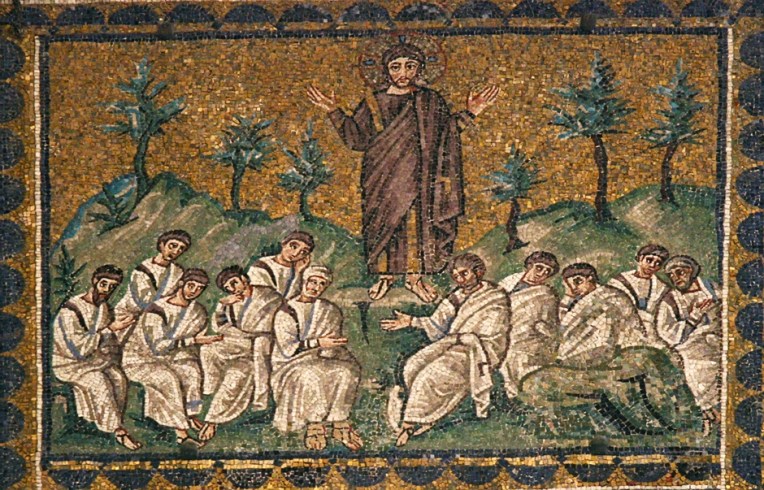
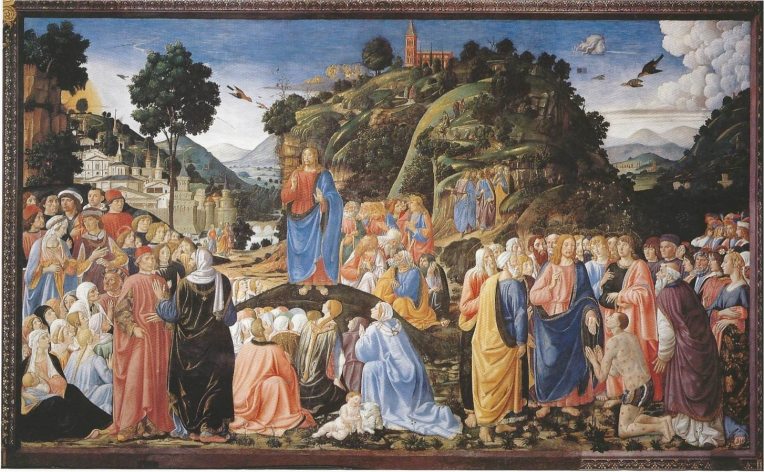
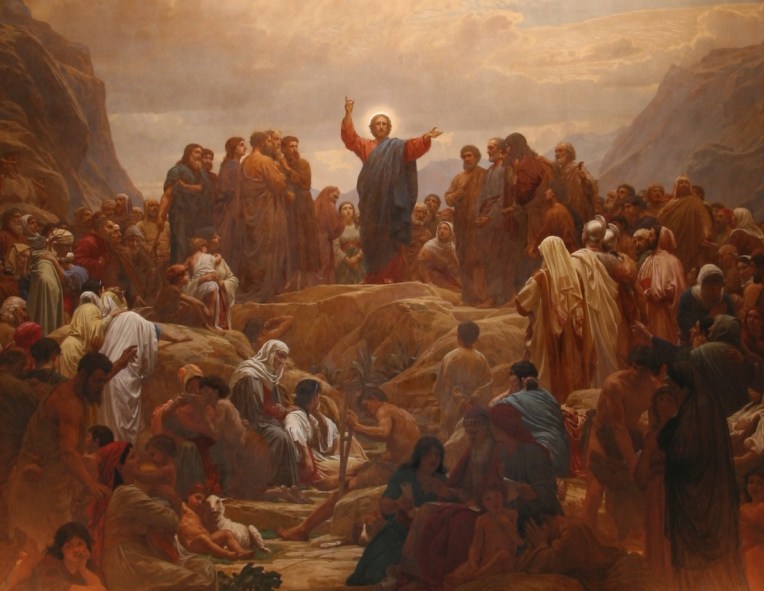
Beginning today and for many days to come, we hear at weekday Mass from the Sermon on the Mount.  This sermon is one of the chief features of St. Matthew the Evangelist’s Gospel account.  As such, the sermon illustrates Matthew’s portrait of Jesus:  Jesus as the living fulfillment of Moses.

Moses was the prophet who led God’s People to an earthly salvation in the Old Testament:  from physical slavery in Egypt to freedom in the Promised Land.  But Jesus effects salvation in an infinitely more profound way.  So while many features of Jesus’ life and ministry echo the role of Moses, at the same time there are discrepancies between the two of them which point out how Jesus fulfills what Moses could only foreshadow.

Note in today’s Gospel passage two points of the evangelist’s “setting the stage” for the Sermon on the Mount.  First, Jesus “went up the mountain”.  This act is reminiscent of Moses ascending Mount Sinai to receive the Law from God.  However, where Moses must receive the Word of God before teaching it to the people, Jesus is the Word of God!  Jesus teaches “from the heart” of His divinity.

Second, note that “after He had sat down, His disciples came to Him.”  The fact that Jesus sits down points out that Jesus is a teacher.  In ancient cultures—contrary to our American experience—a teacher would sit while the students would stand.

More significant, though, is that “His disciples came to Him.”  Moses had to descend the mountain in order to share with the people the Word he had received from God.  Later, God declared that if anyone should even touch the mountain that he must die.  Then when Moses descended to teach the people, he found that they were worshiping an idol!

But Jesus invites His disciples to join Him up on the mountain.  This contrast to Moses suggests that Jesus will teach in His great sermon something profoundly interior.  He wants His disciples to join Him on the mountain, symbolizing that He is inviting them to climb:  that is, to transcend everything that is of the earth.  So Jesus invites us today to ascend to the Word of God, and through His words, closer to the heart of the Father’s divine life.

OT 10-1

Saturday of the Ninth Week in Ordinary Time [II]

Saturday of the Ninth Week in Ordinary Time [II]
2 Timothy 4:1-8  +  Mark 12:38-44
June 6, 2020

“… but she, from her poverty, has contributed all she had, her whole livelihood.”

We live in a society where values contrary to the Gospel are canonized.  A person’s value is measured in economic terms.  The poor are shunned as worthless.

God has a different set of values from those of our society.  When Jesus saw the wealthy putting large amounts of money into the collection box of the Temple, He was not impressed.  It was not as if the wealthy should not have given large sums, but Jesus was looking for something else.  He saw that something else in the poor widow who donated only two small copper coins.  He explains to us what He saw:  “[The wealthy] have all contributed from their surplus wealth, but she, from her poverty, has contributed all she had, her whole livelihood.”

It was the generosity of the widow that mattered, not the amount that she gave.  We are called to be generous people, unselfish in all our relationships with others.  God does not value us for giving our money; or, for that matter, for giving our time and talent.  God values us for the generosity from which our giving flows.  Generosity flows from the love that we receive in the celebration of the Holy Eucharist.

OT 09-6

St. Boniface, Bishop and Martyr

St. Boniface, Bishop and Martyr
2 Timothy 3:10-17  +  Mark 12:35-37
June 5, 2020

The great crowd heard this with delight.

Today’s Gospel Reading is as unusual as it is brief.  The unusual nature of this passage of only three verses (or four sentences) is highlighted by the evangelist’s concluding observation that the “great crowd heard this with delight”.  What is it about Jesus’ words that delights them?

We have a clue to Jesus’ aim in His initial question:  “How do the scribes claim that the Christ is the son of David?”  Jesus’ subsequent words, then, seem a rebuke of the scribes.  Likely, the members of the crowd were not fans of the scribes, so that Jesus’ rebuke allows the crowd to delight in what they wished they themselves could do.

But Jesus never rebukes without wanting those rebuked to turn instead to the Truth.  Consider the content of Jesus’ rebuke.  Jesus is rebuking what the scribes claim about the Christ.  We know from the entire context of the Gospel that this claim is one basis by which Jewish leaders would put Jesus to death.  Jesus indeed is the Christ.  Jesus is the only begotten Son of God.

The delight of the crowd, then, is like the cheers of “Hosanna!” on Palm Sunday.  The crowd’s delight will be short-lived if this Christ who delights them today is tried tomorrow as a criminal.  Perhaps, however, the rebuke that Jesus issues today would ultimately bear fruit in the conversion of a scribe towards faith in the Word made flesh.

St. Boniface 2

The Most Holy Trinity [A]

The Most Holy Trinity [A]
Exodus 34:4-6,8-9  +  2 Corinthians 13:11-13  +  John 3:16-18

“The Lord, the Lord, a merciful and gracious God, slow to anger and rich in kindness and fidelity.”

+     +     +

references to the Catechism of the Catholic Church cited for this Solemnity by the Vatican’s Homiletic Directory:

CCC 202, 232-260, 684, 732: the mystery of the Trinity
CCC 249, 813, 950, 1077-1109, 2845: the Trinity in the Church and her liturgy
CCC 2655, 2664-2672: the Trinity and prayer
CCC 2205: the family as an image of the Trinity

+     +     +

A well-written biography fascinates.  The narrative of a subject’s life—the events surrounding the person, as well as the choices which the person makes amidst those events—captures the imagination.  The individual person’s choices are windows into the person’s inner life:  the person’s mind, heart and soul.

Something similar is true regarding the Most Blessed Trinity.  Theologians describe the Trinity by means of two different terms.  One is called the “economic Trinity”.  The word “economic” refers in this case not to money, but to works performed, as in the phrase “home economics”.  So the “economic Trinity” is the Blessed Trinity described in terms of works performed “outside” the Trinity.

In other words, the “economy” of the Trinity is those works that the Trinity never had to carry out, but nevertheless freely chose to carry out.  The Trinity did so simply out of love.  These works chiefly fall into two groups:  creation and salvation.  The work of creation concerns every created thing in the universe, visible and invisible.  The work of salvation solely concerns mankind.

The Trinity’s works of creation and salvation both serve as windows into the inner life of the Trinity.  This inner life is called the “immanent Trinity”.  This inner life of God is the very essence of the Trinity.  While the works of the “economic Trinity” are “exterior” to God, and therefore never had to be carried out, the “immanent Trinity” is God’s essential Being in eternity:  as He was in the beginning, is now, and ever shall be.

On this Sunday’s Solemnity of the Most Holy Trinity, we can reflect on God’s works of creation and salvation as a way to peer into His inner life as the Trinity.  It’s fitting that the Church celebrates the Solemnity of the Most Holy Trinity on the Sunday after Pentecost.  The two solemnities stand in a certain contrast to each other.  Pentecost celebrates the culmination of the Trinity’s “economy of salvation”, while the Solemnity of the Most Holy Trinity peers into the inner life of the “immanent Trinity”.  Consider further the connection between the “economic Trinity” and the “immanent Trinity”, and how the former illuminates the latter.

The beauty of creation inspires poets and mountain climbers, biologists and physicists to see the works of creation in a transcendent way.  In other words, the beauty of the works of creation point our attention to “where” they came from.  For believers, this reflective act of transcendence leads beyond those particular works, and also beyond the “how” of creation, all the way back to God.

Chief among the visible works of God’s creation is the human being.  It’s little wonder that first-time parents draw closer to God as they stand in awe at the innocence, beauty and dignity of a single, tiny human life.  Throughout the Church’s history, the greatest teachers of the Catholic Faith have reflected on how man—male and female—is created in the image of God.  This image is seen especially in how man’s intellect and will operate.  Although every animal has an intellect and a will, allowing it to reason and make choices, the human intellect and will are different because they are capable of self-transcendence.  The human intellect can map the cosmos and the human will can construct an edifice to last a millennium.

Yet while the works of creation reveal God’s inner life in a myriad of ways, the Trinity’s work of salvation does so even more powerfully.  In the order of salvation history, this work includes both redemption and sanctification.

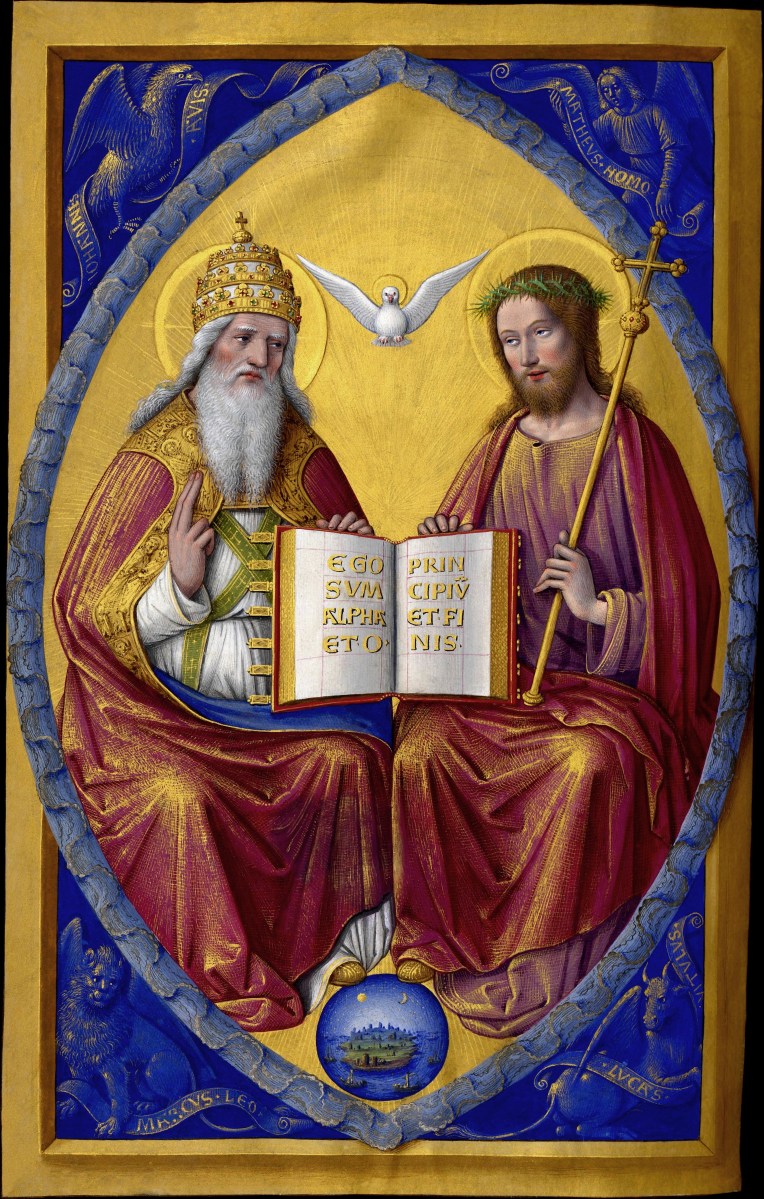
In the fullness of time God revealed Himself as a Trinity of Persons when He established His new and everlasting Covenant through the Sacrifice of Jesus on the Cross.  In this singular act of self-sacrifice—which Jesus offered fully through His human intellect and will, which is to say, knowingly and freely—Jesus gave up His divine and human life for the sake of His Bride, the Church.  Nonetheless, the Sacrifice of the Cross is not only the work of God the Son.  It is a Trinitarian sacrifice, made at the initiative of God the Father and through the Power of God the Holy Spirit, who is the love of the Father and the Son for each other.

Trinity - Grandes Heures Anne de Bretagne HIRES cropped

Thursday of the Ninth Week in Ordinary Time [II]

Thursday of the Ninth Week in Ordinary Time [II]
2 Timothy 2:8-15  +  Mark 12:28-34
June 4, 2020

“There is no other commandment greater than these.”

In in the Mystery of the Word made Flesh, God makes clear to us—in the flesh—not only His divine nature.  In His human life, God the Son makes clear to us the meaning of the Law of ancient Israel.  In the person of Christ Jesus, we learn how to fulfill the great teaching given our fathers in faith.

In particular, if we listen carefully to Our Lord’s summary of the Torah in today’s Gospel passage, we notice that as there are two natures—divine and human—in the one person of Jesus Christ, so these two commands form one single commandment.

Love, quite obviously, is the common denominator between these two commands:  “Love the Lord completely,” and “Love your neighbor as yourself.”  Understanding these two as one means having Christ at the center of our entire spiritual focus:  seeing in Christ our neighbor, and seeing in Christ our Lord and God.  So we are to love others as Christ loved us from the Cross.

However, we must even go one step further.  We are to love others so that others will love as Christ has loved us.  Not merely are we to give our lives for others.  We are so to have an effect on others that they in turn will do the same.  But how is this possible?  We cannot control the decisions of others.  Even if we love them they may hate us in turn.  Yet God’s grace makes all things possible.

OT 09-4

St. Charles Lwanga & Comp., Martyrs

St. Charles Lwanga & Comp., Martyrs
2 Timothy 1:1-3,6-12  +  Mark 12:18-27
June 3, 2020

“He is not God of the dead but of the living.”

In today’s Gospel passage, Our Lord tries to make clear to the Sadducees the meaning of the Resurrection.  We too, however, even if we understand and believe in both the Resurrection of Our Lord and the promise of resurrection that God offers to all who die, perhaps need to realize what type of claim the Resurrection places upon us.

To believe in the Resurrection is to believe in the future fulfillment of God’s grace.  In turn, this is to understand that the suffering of the present is as nothing compared to the future glory to be revealed in Christ Jesus.  Furthermore, this is to guard in God’s name what has been entrusted to each of us until that final Day, which for each of us is the day of one’s death.

We never find Our Lord going into great detail about the nature of the afterlife.  There are two practical reasons for this.  First, the glory which will be the reward of God’s elect is too far beyond our comprehension.  Second, our only hope for sharing in that glory is to persevere in running the race which God has set before us in the here and now.  The virtue of perseverance stirs into flame the gift of God, which each of us first received at baptism.  In this flame, each of us is purified like gold in the furnace.

OT 09-3

Tuesday of the Ninth Week in Ordinary Time [II]

Tuesday of the Ninth Week in Ordinary Time [II]
2 Peter 3:12-15,17-18  +  Mark 12:13-17
June 2, 2020

“Repay to Caesar what belongs to Caesar and to God what belongs to God.”

Jesus trips up the Pharisees and Herodians in today’s Gospel passage because of a dichotomy in their thinking.  They easily recognize the image of Caesar, but fail to see two even more clear images.  Focus on the first.

They fail to see Jesus as the divine Image of God the Father:  in other words, they don’t recognize Jesus’ divinity.  In addressing Jesus they say, “Teacher, we know that you are a truthful man”.  Then they assert of him, “You do not regard a person’s status but teach the way of God in accordance with the truth.”  In both statements they speak of Jesus in regard to truth (he is a truthful man and he teaches the way of God in accord with the truth) without recognizing that Jesus, as the divine Image of the Father, is the Truth made flesh.

We might be willing to pardon this, as most in the Gospel fail to see Jesus’ divinity, either (at least before His Resurrection).  This failure is at the heart of the drama in the Gospel, and reaches a climax on Calvary with Jesus’ cry:  “Father, forgive them, for they know not what they do”  [Luke 23:34].

OT 09-2

The Blessed Virgin Mary, Mother of the Church

The Blessed Virgin Mary, Mother of the Church
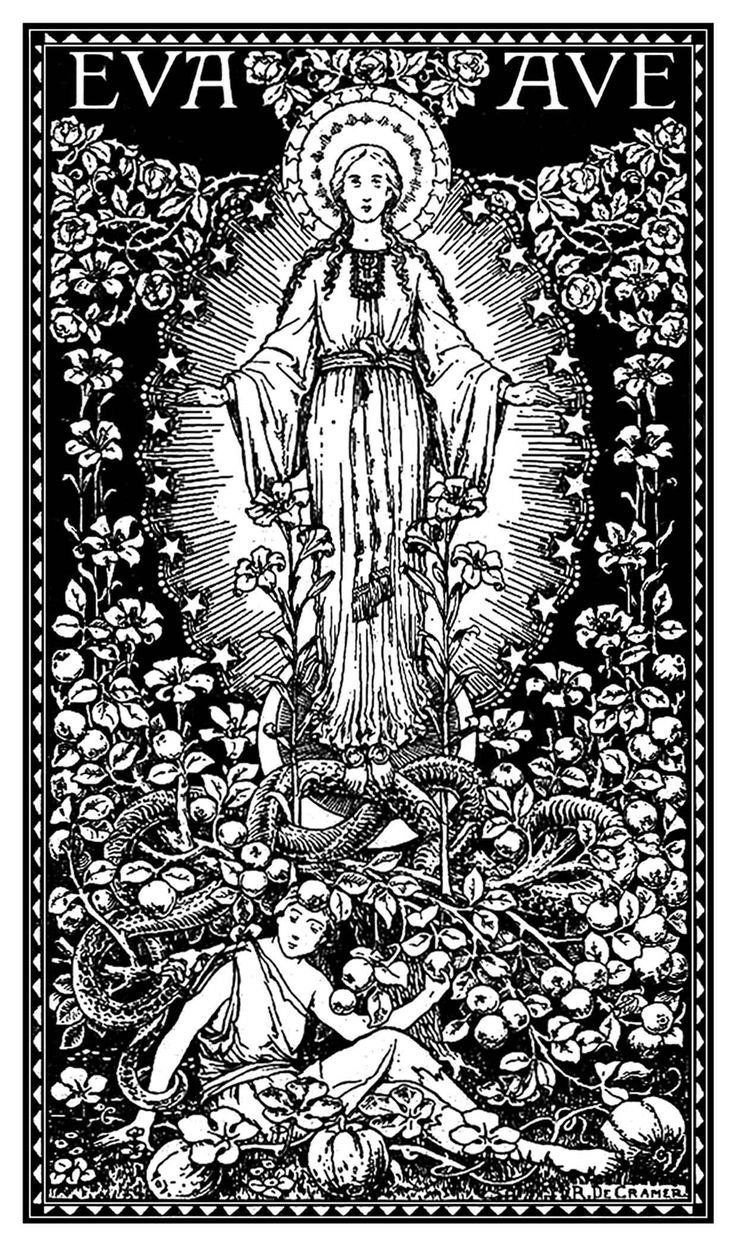
Genesis 3:9-15,20 [or Acts 1:12-14]  +  John 19:25-34
June 1, 2020

And from that hour the disciple took her into his home.

On the feast of Our Lady of Lourdes in 2018, Robert Cardinal Sarah—the prefect of the Congregation for Divine Worship and the Discipline of the Sacraments—announced the institution of a new obligatory memorial for the Ordinary Form of the Roman Rite of the Catholic Church.  This memorial is to be celebrated every year on Pentecost Monday, which is to say, the day following Pentecost Sunday.  In the Extraordinary Form of Holy Mass, this is the second day of the Octave of Pentecost.

In his decree inscribing this new memorial into the General Roman Calendar, Cardinal Sarah noted the following:

“The joyous veneration given to the Mother of God by the contemporary Church, in light of reflection on the mystery of Christ and on His nature, cannot ignore the figure of a woman (cf. Gal 4:4), the Virgin Mary, who is both the Mother of Christ and Mother of the Church.”

“Indeed, the Mother standing beneath the cross (cf. Jn 19:25), accepted her Son’s testament of love and welcomed all people in the person of the beloved disciple as sons and daughters to be reborn unto life eternal. She thus became the tender Mother of the Church which Christ begot on the cross handing on the Spirit. Christ, in turn, in the beloved disciple, chose all disciples as ministers of his love towards his Mother, entrusting her to them so that they might welcome her with filial affection.”

“This celebration will help us to remember that growth in the Christian life must be anchored to the Mystery of the Cross, to the oblation of Christ in the Eucharistic Banquet and to the Mother of the Redeemer and Mother of the Redeemed, the Virgin who makes her offering to God.”

Mary the Mother of the Church