“‘…whoever receives me receives the one who sent me.’”
Why, throughout the Season of Easter, does the Gospel passage at Holy Mass narrate the events leading up to the Passion and Death of Jesus? One reason is practical. When from the four Gospel accounts the narratives taking place following the Resurrection are put together, there are still relatively few passages for proclamation: certainly not enough for the entire Easter Season. Continue reading →
When we recite the Creed on Sundays and solemnities, in its second part (the part in which we profess our faith in the Second Person of the Blessed Trinity) we profess that God the Son is “eternally begotten of the Father.” This statement is a profession of the divinity of Jesus Christ, a statement made against the heresy of the Egyptian priest Arius, who taught that “there was a time when the Son was not.” Continue reading →
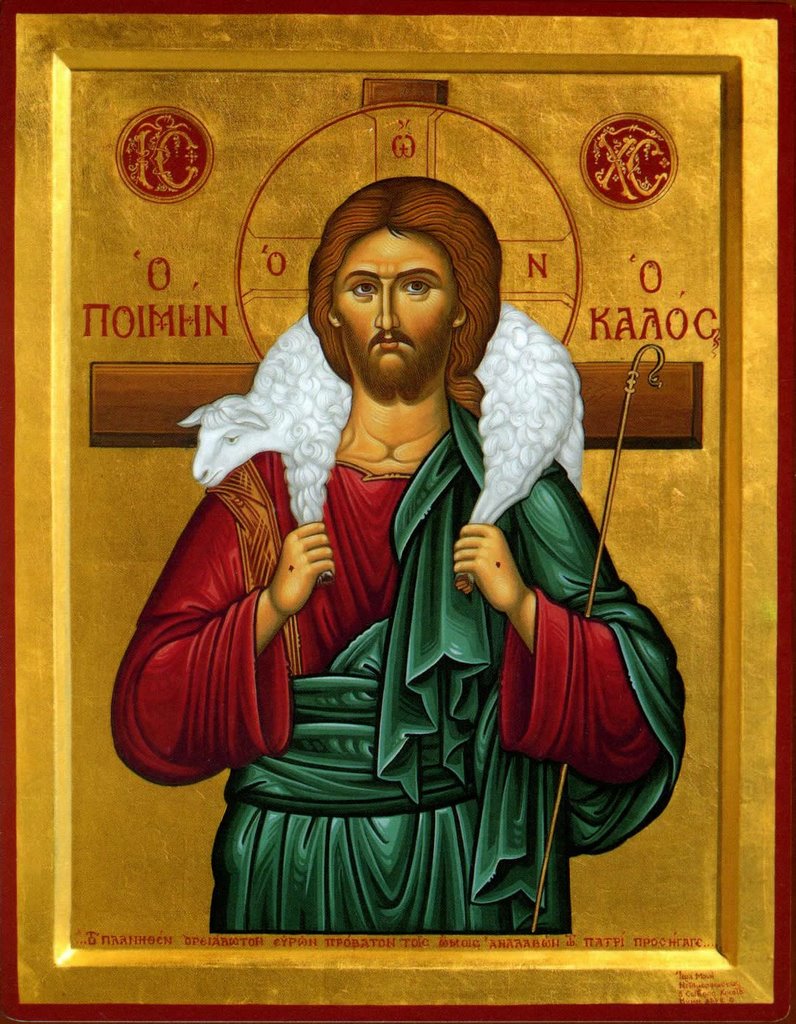
Today’s Gospel passage ends in an intriguing manner, taking an odd turn “off course”. As a whole, the passage seems to be about Jesus dispelling the Jews’ “suspense” by identifying Himself as the Good Shepherd. He then describes His relationship with His sheep, and the fact that by following His voice, His sheep have eternal life. So far, so good. The metaphors that Jesus uses echo imagery from the Old Testament. We seem to be on familiar, comfortable ground. But then an important shift occurs. Continue reading →
Monday of the Fourth Week of Easter [Year A] Acts 11:1-18 + John 10:11-1
“‘A good shepherd lays down his life for the sheep.”
Having grown up in the middle of Kansas, in a town with a population of less than 1000, I’ve known many people who raise sheep. I don’t think any of them were “shepherds” in the sense that caring for sheep was their whole livelihood. Still, they cared for and tended to these animals from before the sheep were born until they met their natural end. All of these persons who raised sheep were good, decent, hard-working, salt-of-the-earth people. But I honestly don’t think anyone among them would have laid down his life for his sheep.
When Jesus states, then, that a “good shepherd lays down his life for the sheep”, we have to assume that Jesus is using understatement. That is to say, any shepherd who lays down his life for his sheep is not just a “good” shepherd. He’s something much more.
In fact, it’s the mismatch between the human life of a shepherd and the sheepish life of a dumb animal that gives Jesus’ statement its force. Of course, while the difference between a human shepherd and a dumb sheep is a mismatch, it’s a finite mismatch. On the other hand, there is an infinite distance between the divine nature of Jesus and the fallen human nature of us who are Jesus’ sheep. We are as nothing compared to the divine shepherd. All the more, then, ought we work at appreciating more deeply the mystery of why this infinite God would choose to enter among our sinful human family and lay down His life for us.
“‘I came so that they might have life and have it more abundantly.’”
Every year, the Gospel passage on this Fourth Sunday of Easter comes from the tenth chapter of St. John’s Gospel account. This entire chapter focuses upon the imagery of sheep and their shepherd. That’s why the Fourth Sunday of Easter is called “Good Shepherd Sunday”. But in today’s Gospel passage, while Jesus does mention “the shepherd of the sheep”, His chief focus lies elsewhere.
Jesus focuses in today’s Gospel passage upon “the gate for the sheep”. This focus is emphasized by Jesus in the way he introduces his teaching about the gate. “Amen, amen, I say to you….” Here we need to stop and consider this important phrase.
In the Gospel account of St. John, Jesus speaks this phrase—“Amen, amen, I say to you…”—fifty times. Fifty times Jesus begins an important teaching with this phrase which signals to us just how important the subsequent teaching is. Jesus means these words to be a red flag. Jesus doesn’t want us to miss His point. He’s emphatic in getting His point across. Continue reading →
“‘To whom shall we go? You have the words of eternal life.’”
In these words, Saint Peter, the first sinner entrusted with leading the Church on earth, speaks for all of us who are followers of Christ. During the past week, Saint John in the sixth chapter of his Gospel account has been relating how Jesus shocked and scandalized many faithful Jews. Jesus has presented them with His teaching about the Eucharist, the central belief and practice of our Catholic faith. And what has been the response of the crowds around Jesus? They say, “This sort of talk is hard to endure! How can anyone take it seriously?”Continue reading →
“‘For my Flesh is true food, and my Blood is true drink.’”
Jesus, like any good teacher, responds to the ignorance of those to whom he’s speaking. The Jews quarreled among themselves, saying, “How can he give us his flesh to eat?” And Jesus replies not by saying that “eating his flesh” is just a figure of speech.
Instead, Jesus replies by saying, “if you do not eat the Flesh of the Son of Man and drink His Blood, you have no life in you. …For my Flesh is true food and my Blood is true drink.”Continue reading →
The “marks of the Church” are four adjectives that describe the Church’s nature and mission: one, holy, catholic and apostolic. One of these is highlighted in today’s First Reading from Acts of the Apostles: the Church is “apostolic”.
The whole New Testament is apostolic: its books were written either by the apostles, or by their disciples from the apostles’ testimonies. The book of the New Testament that immediately follows the four accounts of the Gospel clearly highlights this mark of the Church since it is called Acts of the Apostles. From the Ascension of Jesus in Chapter 1, to the Descent of the Holy Spirit in Chapter 2, and throughout the book to its final chapter, the apostles—the Twelve—are highlighted. Continue reading →
Today is the feast of two apostles, Philip and James. The Scriptures for this feast highlight that the Church’s foundation is apostolic. However, the role of the apostles is not limited to the Church’s beginning.
Those ordained to the office of bishop continue to carry out the work first entrusted to the apostles. It’s true that each and every member of the Church has a vocation that is missionary in nature. The word “apostle” literally means “one who is sent”. Every Christian is called to “go outside himself” and share with others the natural and supernatural gifts he has received. Most Christians do this chiefly through family life, and in the secular workplace. Continue reading →