St. Boniface, Bishop & Martyr

St. Boniface, Bishop & Martyr
2 Peter 3:12-15,17-18  +  Mark 12:13-17
June 5, 2018

“Repay to Caesar what belongs to Caesar and to God what belongs to God.”

Jesus trips up the Pharisees and Herodians in today’s Gospel passage because of a dichotomy in their thinking.  They easily recognize the image of Caesar, but fail to see two even more clear images.  Focus on the first.

They fail to see Jesus as the divine Image of God the Father:  in other words, they don’t recognize Jesus’ divinity.  In addressing Jesus they say, “Teacher, we know that you are a truthful man”.  Then they assert of him, “You do not regard a person’s status but teach the way of God in accordance with the truth.”  In both statements they speak of Jesus in regard to truth (he is a truthful man and he teaches the way of God in accord with the truth) without recognizing that Jesus, as the divine Image of the Father, is the Truth made flesh.

We might be willing to pardon this, as most in the Gospel fail to see Jesus’ divinity, either (at least before His Resurrection).  This failure is at the heart of the drama in the Gospel, and reaches a climax on Calvary with Jesus’ cry:  “Father, forgive them, for they know not what they do”  [Luke 23:34].

Monday of the Ninth Week in Ordinary Time

Monday of the Ninth Week in Ordinary Time
Mark 12:1-12

“They will respect my son.”

The chief priests and elders had forgotten the place of the Lord in their lives.  They thought that they were the masters of Israel, rather than its shepherds.  They thought that they were the landowners, rather than the tenants.  They thought that they were the lords of the manor, rather than the stewards.

The action of today’s parable demonstrates just how topsy-turvy these stewards are.  Believing that they’re the masters of the situation justifies, in their minds, their beating and stoning of the landowner’s messengers, and finally, their murder of his son.

Of course, you and I know how this parable turns out in real life:  that is, during Holy Week.  The chief priests, elders, and other leaders of Israel are not willing to give up the claim to be masters.  So when they come face-to-face with Jesus, who is the rightful heir to the throne of Israel, there’s bound to be conflict.  Like the son in the parable, Jesus is seized and put to death.  Jesus is the “stone that the builders rejected” which “has become the cornerstone”.

Corpus Christi [B]

The Most Holy Body and Blood of Christ [B]
Ex 24:3-8  +  Heb 9:11-15  +  Mk 14:12-16,22-26
June 3, 2018

“This is my blood of the covenant, which will be shed for many.”

Some fifty years after the close of the Second Vatican Council, disagreements still simmer over the best way to interpret its teachings.  Disagreement is found is different areas of the Church’s life, such as marital morality and ecumenism.  Yet nothing engenders more disagreement than the celebration of the Eucharist.  Today’s feast of Corpus Christi can help us reflect upon the Church’s teachings about this most blessed of the seven sacraments.

One of the more confused ideas used to interpret the Council is that Holy Mass ought to be entertaining (for example, through its music or preaching).  During summer vacation, if you travel far enough outside our diocese, you might stumble upon Masses animated by the principle of giving the faithful what they want.

By contrast, the Church’s history shows a different approach:  give the faithful what they need, and do so by giving them what God has handed down.  There are two questions that have to be answered, then.  First, what do the Christian faithful most need?  Second, what has God handed down?

We’re not talking here about the sacraments’ inner essence, which is grace, but about their outer form, which the Church has the power to change to some extent.  Concerning the form of Holy Mass, what principle should shape it?  What would be wrong with elements drawn from popular entertainment, which clearly draw crowds marked by outer enthusiasm?

Some seem eager for great crowds and great outer enthusiasm in churches.  Yet the history of the Church, both ancient and modern, shows that when the Church sets the course of her mission according to numbers and outer enthusiasm, the Church bears little lasting fruit for lack of roots.  Consider that during the hours that Jesus was nailed to the Cross, the number of His followers was few, and they had little enthusiasm for the way He had trod.  Nonetheless, the Church knows that she is called to preach nothing but Jesus Christ crucified [see 1 Cor 2:2].

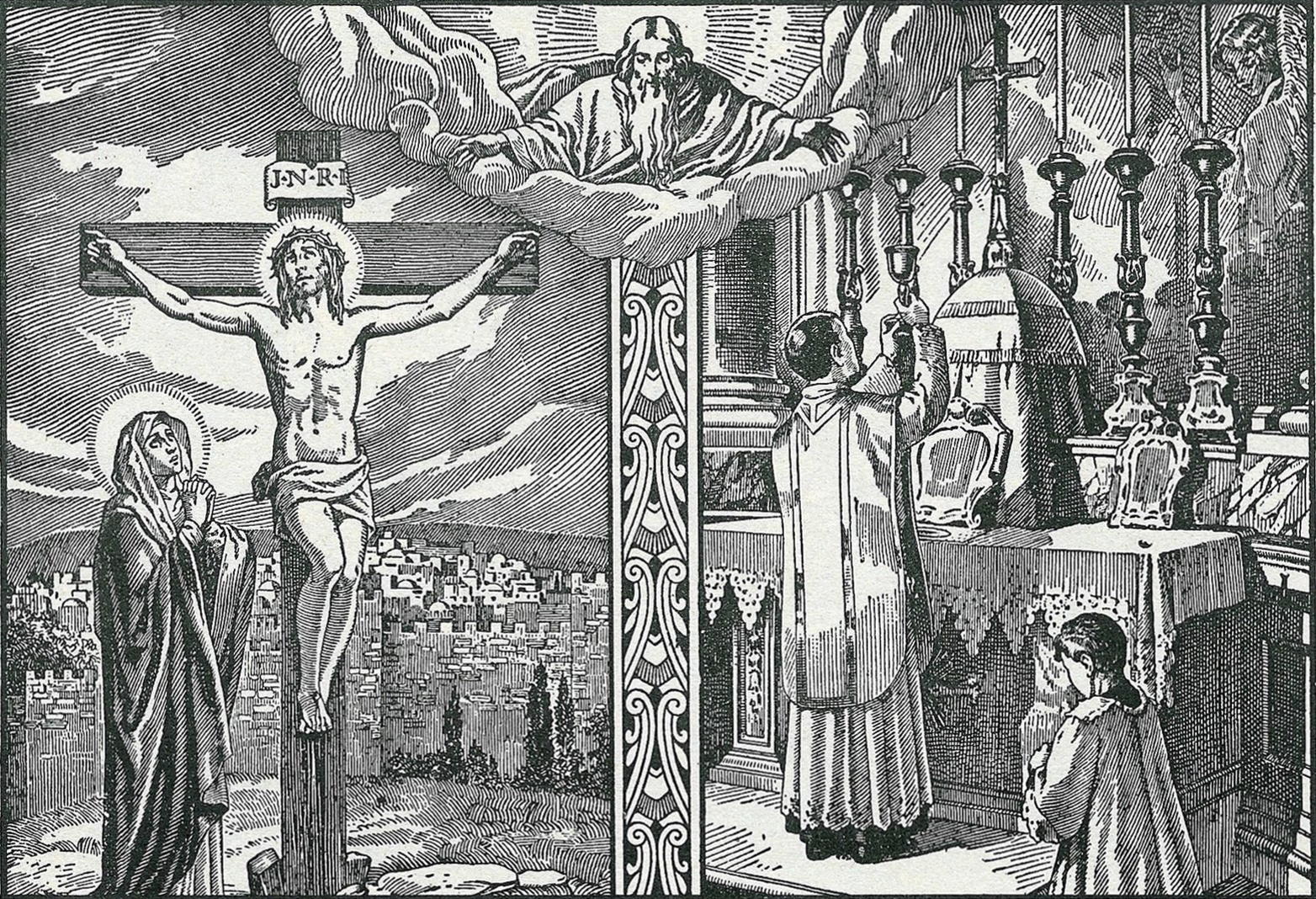
At the heart of this preaching is self-sacrifice.  If we want to know what the Christian faithful most need, then, we need to know self-sacrifice.  Jesus’ words at the Last Supper, when He instituted the Eucharist, reflect this central principle.  “This is my body, which will be given for you; do this in memory of me.”  “This is my blood of the covenant, which will be shed for many.”  These words of Jesus don’t reflect a spirit of entertainment, which indulges whatever the crowd currently cries for.

But how can a principle like self-sacrifice take form within Holy Mass?  Consider the example of hymn lyrics.  Tally the proper nouns and pronouns in any given hymn.  Are most of them first-person (I, me, mine, we, us, ours), or do most of them refer to God?  Who is the focus of the hymn:  man or God?  A hymn that illustrates the principle of self-sacrifice sings more about God than man, and sings about man as fallen and redeemed by Jesus’ self-sacrifice on Calvary.

So if the faithful need chiefly from the form of Holy Mass a spirit of self-sacrifice, what, secondly, has God handed down to the Church to foster this goal?  The simplest answer is that He has given Himself, in Word and Sacrament.  God’s Word and the Sacrament of Corpus Christi shape the form of Holy Mass.  The content of the Mass shapes the form of the Mass.  Form follows function, and one of the functions of Mass is to form us into the likeness of Jesus Christ, and Him crucified.

If that seems a bit abstract, consider practical examples regarding the role of Scripture within Holy Mass.  With a few exceptions, most consider the fact that more of the Bible is read at Mass during the year to be a positive change made after the Second Vatican Council.  Yet two other modern changes distort—towards one extreme or the other—the place of Scripture within Holy Mass.

In some churches built or renovated after the Second Vatican Council, the altar and pulpit are positioned at equal distances from the sanctuary’s midpoint.  This arrangement suggests that the two chief parts of Holy Mass—the Liturgy of the Word and the Liturgy of the Eucharist—are of equal importance.  Yet the Church throughout her history has taught that the structure of Mass—like salvation history itself—contains a dynamism.  The first half of Mass prepares the faithful for the second half, as the Old Testament prepares God’s People for the New, where the Word becomes Flesh and dwells among us.

On the other hand, the modern change that gives prominence to hymns at Mass has come at the cost of the proclamation of Scripture.  In the form of Mass used before the Second Vatican Council, hymns didn’t supplant the singing of the scriptural antiphons (during the Entrance procession, the Offertory, and the Communion procession).  Each of them—antiphons and hymns—had its own place.  But the modern form of Mass allows these scriptural antiphons—which may be sung either in a brief form or in an extended form like the Responsorial Psalm—to be omitted altogether, impoverishing the faithful by substituting the human words of hymns for the divine Word of Scripture.

What the Christian faithful most need is what they most deeply want.  God has handed down to man through the Church what mankind most deeply wants:  self-transcendence through self-sacrifice.  The Church’s Sacred Liturgy inspires us, nourishes us, and fits us for self-sacrifice, and so for fitting praise to God for His own self-sacrificial love.
Sacrifice of the Mass 2

Saturday of the 8th Week in Ordinary Time [II]

Saturday of the Eighth Week in Ordinary Time [II]
Jude 17,20-25  +  Mark 11:27-33
June 2, 2018

Beloved, remember the words spoken beforehand by the Apostles of our Lord Jesus Christ.

Our First Reading at weekday Mass this week has come from the First Letter of St. Peter, at least until this morning’s Mass.  Next Monday our First Reading will begin to come from the Second Letter of St. Peter.  This morning’s First Reading is from the Letter of St. Jude, which is only one chapter long, and which within the New Testament is the next to the last book.

Who is the Jude who authored this letter?  At the beginning of the letter he identifies himself as “a slave of Jesus Christ and brother of James”.  Yet within the letter, the author’s words seem to exclude him from being one of the apostles, for he exhorts his listeners to “remember the words spoken beforehand by the apostles of our Lord Jesus Christ, for they told you….”  Surely Jude wouldn’t have spoken about the apostles in the third person if he were one of them.

Nonetheless, Jude’s letter testifies—as do all the New Testament letters—to the centrality of apostolic teaching within the Church.  “Beloved, remember the words spoken beforehand by the Apostles of our Lord Jesus Christ.”  Jude doesn’t simply say, “Remember the words spoken by our Lord Jesus Christ.”  The teaching of the apostles is vital to the proclamation of the Gospel.  In turn, the teachings of the successors of the apostles in our own day must be given due respect.

St. Justin, Martyr

St. Justin, Martyr
1 Peter 4:7-13  +  Mark 11:11-26
June 1, 2018

“…forgive anyone against whom you have a grievance….”

Saint Mark, in composing the Gospel passage that we hear today, uses a literary technique to show the meaning of faith.  He takes what would seem like two different scenes—Jesus cursing the fig tree, and Jesus confronting those who profane the Temple—and combines them in order to form a single passage, in which one illuminates the other.

The purpose of the Gospel as a whole is to proclaim the Good News of Jesus Christ.  In this particular passage, the good news is that placing faith in Christ produces miraculous fruit in our lives.

The Good News of Jesus stands in sharp contrast to the messages of self-fulfillment that the world tries to preach in so many forms.  Therefore, the four evangelists use images of contrast in order to convey the Gospel.  The withered fig tree is an image of those who have no faith, such as those who profane the Temple.  Such are those who live by the standards of the world.

We are called, however, to make an act of faith in Christ Jesus.  Today we recognize especially the first step involved in such an act, declared by Our Lord in the last sentence of today’s Gospel passage:  “When you stand to pray, forgive anyone against whom you have a grievance so that your heavenly Father may in turn forgive you your faults.”

The Visitation of the Blessed Virgin Mary

The Visitation of the Blessed Virgin Mary
Zephaniah 3:14-18  +  Luke 1:39-56
May 31, 2018

…Elizabeth, filled with the Holy Spirit, cried out in a loud voice….

Catholic art is beautiful because it focuses on persons:  the three Divine Persons, and human persons as well.  In Catholic art that portrays today’s feast—the Visitation of Our Blessed Mother—there are four persons shown to the eye of the viewer.  Of course, two of them have to be shown indirectly because they are unborn children:  St. John the Baptist in the womb of Elizabeth, and Our Lord in the womb of the Blessed Virgin.  Sometimes these two unborn children are portrayed by something akin to halos shining, indicating the grace that dwells within these women through their openness to human and divine life.

If we were to order these four persons in order of holiness, we would first place the Lord Jesus, who is not merely a holy human being, but the source of all holiness:  the eternal Son of God.  We would certainly place second the Blessed Virgin Mary, the Mother of God:  she who merited to bear our Redeemer.  We would likely place third St. John the Baptist, whom some theologians have taught was without Original Sin.

But reflect today on Saint Elizabeth:  fourth in this line, yet like you and me.  She is a human creature, not a divine Person.  She receives assistance from the Blessed Virgin, as you and I do each day.  She was chosen not for drama, as was her son, but for simplicity of life.  In light of St. Elizabeth’s vocation, what do you and I take today from her example?  “…Elizabeth, filled with the Holy Spirit, cried out in a loud voice….”  Ask Jesus in your prayers to open your heart to the Holy Spirit, that you might each day speak of His power, His glory, and His love for all people.

Wednesday of the 8th Week in Ordinary Time [II]

Wednesday of the Eighth Week in Ordinary Time [II]
1 Peter 1:18-25  +  Mark 10:32-45
May 30, 2018

“You do not know what you are asking.”

Throughout the course of the four accounts of the Gospel, most of the apostles take turns appearing quite clueless.  Today the cluelessness of James and John (the Beloved Disciple!) is on display.

Today’s Gospel passage begins with Jesus foretelling His passion, death, and resurrection.  This momentous proclamation is met with complete self-interest on the part of the sons of Zebedee.  When they express to Jesus their request, He replies with words that you and I need to commit to memory because of how often, likely, each of us deserves to hear them:  “You do not know what you are asking.”

Although there are commonly four types of prayer through which a Christian speaks to God—petition, adoration, contrition, and thanksgiving—the early stages of our spiritual life tend to be dominated by our speaking to God, rather than listening to God.  In our speaking to Him, we tend to focus more on petition than the other three types of spoken prayer.  To too many of our petitions, the words of Jesus to James and John are the only fitting reply:  “‘You do not know what you are asking.’”

Here’s a very good petition to offer to God in your prayers today:  “Help me, Lord, to focus on Your providential Will rather than my own self-focused will, and help me to listen for your Word rather than to voice my own.”

Tuesday of the 8th Week in Ordinary Time [II]

Tuesday of the Eighth Week in Ordinary Time [II]
1 Peter 1:10-16  +  Mark 10:28-31
May 29, 2018

“Many that are first will be last, and the last will be first.”

St. Mark the Evangelist doesn’t offer details about Peter stating that Jesus’ disciples have given up everything to follow Him.  But Jesus surely reads Peter’s heart before replying.  Jesus is speaking to us disciples in the 21st century, as well.  He offers a direct explanation of the logic of discipleship, and then sums up His teaching with a brief saying that we can meditate upon at length.

Is there some regret in Peter’s heart as he lays bare the sacrifice he’s made to follow Jesus?  Jesus explains that both in this world and the next, a disciple’s sacrifice bears fruit.  In “this present age”, material sacrifices are compensated by the superabundance shared in by the church.  All the more, “in the age to come”, eternal life with Jesus is the consequence of following Him.  Jesus’ logic lays bare what St. Francis of Assisi expressed in his canticle:  “It is in giving that we receive, and in dying that we are born to eternal life.”

Jesus gives us a brief saying to sum up the logic of discipleship.  “Many that are first will be last, and the last will be first.”  This seems to respond to Peter by saying:  love your God and neighbor first, and your neighbors will care for your earthly needs, and God will care for you eternally in His love in Heaven.

Monday of the 8th Week in Ordinary Time [II]

Monday of the Eighth Week in Ordinary Time [II]
1 Peter 1:3-9  +  Mark 10:17-27
May 28, 2018

“How hard it is for those who have wealth to enter the Kingdom of God!”

Why is it hard “for those who have wealth to enter the Kingdom of God”?  The Church does not teach that human wealth is evil in and of itself.  While some mistakenly think that Scripture says that money is the root of all evil, the correct quote from Saint Paul is that “the love of money is the root of all evils” [1 Timothy 6:10].  Nonetheless, that begs the question:  what is it about the love of money that turns the wealthy away from the Kingdom of God?

The Church teaches that pride is chief among the seven “capital sins”.  The “love of money” must directly relate to pride.  Human wealth tempts the wealthy person to sin against both God and neighbor:  against the former because the wealthy person is tempted to feel no need for God; against the latter because the wealthy person is tempted to feel superior to the neighbor with less human wealth.  Money is enticing because so many different things can be possessed and accomplished by it.  But as with every material thing, money is meant to offer the Christian opportunities to serve both God and man.