The Passion of St. John the Baptist

The Passion of St. John the Baptist
2 Thessalonians 3:6-10,16-18  +  Mark 6:17-29
August 29, 2018

When his disciples heard about it, they came and took his body and laid it in a tomb.

How did Saint John the Baptist get to be strong enough to speak the truth, even when he knew that it could mean the end of his life?

John constantly preached and practiced penance.  Before Jesus’ Baptism of the Holy Spirit, Saint John preached a different baptism.  Saint John preached a baptism of penance.  Like the Old Testament prophets, Saint John fasted in the desert so that he would be strong enough to speak the truth.  Keep in mind that in the Jordan River, the baptism that Jesus received was John’s baptism, not the Sacrament of Baptism.  Jesus’ received John’s baptism as a sign that His own earthly vocation would be one of penance:  the Way of the Cross.

If we practice penance in our lives—having been baptized first into Christ’s life—we will be strong enough spiritually to stand up for the Truth, who is Jesus.  With this in mind, listen very closely today to the Preface to the Eucharistic Prayer.

There are five saints—the Blessed Virgin Mary, Saint John the Baptist, Saint Joseph, and Saints Peter and Paul—who have their own prefaces.  In the preface that is prayed today, listen especially to its account of John’s last and greatest act of witness to Jesus.  With this is mind, receive Holy Communion today while asking Jesus to allow the Eucharist to help you be a more authentic witness to Jesus.

St. Augustine, Bishop & Doctor of the Church

St. Augustine, Bishop & Doctor of the Church
2 Thessalonians 2:1-3,14-17  +  Matthew 23:23-26
August 28, 2018

“Blind Pharisee, cleanse first the inside of the cup….”

In today’s Gospel passage, we hear Jesus rather harshly commanding that exterior and interior religious practices be integrated.  The right way in which to integrate them is to put first things first:  that is, to tend first to the inner dispositions of the soul, and then from the soul’s strength to practice virtuous acts.

Jesus condemns the “blind Pharisee” who appears clean on the outside, but inside is full of plunder and self-indulgence.  His actions may appear virtuous, but they are not.  They are deeds that may have good effects.  But these actions worsen a division in the soul of the one who carries them out.

Similarly, Jesus’ first condemnation here—of the scribes and Pharisees—concerns a different form of “dis-integration”.  These “hypocrites” are doing certain good works, but not the works that are far better and more central to a life given to God.  This dis-integration suggests that even the good works are being done for bad reasons.

Jesus doesn’t condemn the scribes and Pharisees for tithing:  indeed, He says they should have tithed.  But He uses a purposefully ridiculous metaphor to describe what they’re doing:  they are straining out the gnat, but swallowing the camel!  The latter part of the metaphor ought to remind us of another quote from Jesus:  “it is easier for a camel to pass through the eye of a needle then for a rich man to enter the Kingdom of Heaven.”

Homily for the 21st Sunday in Ordinary Time [B]

The Twenty-first Sunday in Ordinary Time [B]
Jos 24:1-2,15-17,18  +  Eph 5:21-32  +  Jn 6:60-69
August 26, 2018

In your home, you might have a plaque or a sign with one of the sentences from today’s First Reading.  “As for me and my household, we will serve the Lord.”  That sentence is found in the last chapter of the Book of Joshua.  But we need to relate that single sentence to the entire Book of Joshua, and we also need to relate that sentence to today’s Gospel passage.  In both, there are challenges made to the People of God.  The People of God have to decide what their response will be.  You need to reflect on the responses we witness in today’s Scripture passages, so that you yourself—as a member of the People of God—can respond to the spiritual challenges facing you today.

First, what do we know about the Old Testament Book of Joshua?  It’s the sixth book of the Bible, and continues the trajectory of the first five books.  The first five books focus upon the Law of Moses.  God gave the Law to Moses in the midst of Israel’s Exodus from slavery in Egypt to freedom in the Promised Land.  That Promised Land is very important, because it’s the goal line of the Bible’s first five books.

Remember that God had promised the land of Canaan to Abram way back in Chapter 12 of the Book of Genesis.  The fifth book of the Bible ends with Israel on the verge of completing its exodus.  But Moses dies in the last chapter before Israel can enter the Promised Land.  The Lord permits Moses to see the Promised Land from a nearby mountain, but not to enter.  This is the Lord’s punishment of Moses for his failures as a leader during the Exodus.

The next book of the Bible—the Book of Joshua—picks up immediately where the fifth book left off.  In fact, listen to the first two verses of the Book of Joshua:  “After the death of Moses the servant of the Lord, the Lord said to Joshua the son of Nun, Moses’ minister, ‘Moses my servant is dead; now therefore arise, go over this Jordan [River], you and all this people, into the land which I am giving to them, to the people of Israel.’”[1]  The entire Book of Joshua, then, shows how these words came true through Joshua’s leadership.

Today’s First Reading is taken from the last chapter of the Book of Joshua.  Having accomplished his God-given mission, Joshua is near death.  His last act is to gather “together all the tribes of Israel… summoning their elders, their leaders, their judges, and their officers.  When they stood in ranks before God, Joshua addressed all the people”.

There, Joshua issues an ultimatum to the People of God.  Joshua had witnessed their many infidelities during the course of the Exodus.  Chief among their infidelities were their violations of the First Commandment:  in a word, idolatry.  Starkly, Joshua forces them to make a choice:  “If it does not please you to serve the Lord, decide today whom you will serve….  As for me and my household, we will serve the Lord.”  This is the challenge that Joshua makes to the People of God.

Israel’s reaction was to declare, “we also will serve the Lord, for He is our God.”  Their words say that Joshua, the Israelites, and the Lord God are all on the same page.  That’s what their words say.  Whether Israel’s actions will match their words is heard throughout the rest of the Old Testament.
Yet while the Israelites profess to stand with Joshua, Jesus’ disciples are much more divided in today’s Gospel passage about whether to stand with Jesus.  This division has been simmering throughout the course of the Bread of Life sermon, which we’ve heard for five Sundays now.

The evangelist told us that the “Jews murmured about Jesus because He said, ‘I am the bread that came down from Heaven’”.  Then in last Sunday’s passage, the crowds went from bad to worse:  from murmuring to quarreling.  The “Jews quarreled among themselves, saying, ‘How can this man give us his flesh to eat?’”  Jesus responded to their quarreling not by apologizing for causing a misunderstanding.  Jesus didn’t tell the crowd that He was only speaking symbolically in talking about eating His flesh.  Instead, Jesus decided to up the ante.

To explain how Jesus ups the ante, we have to consider a sad truth about the current translation of the Gospel that the Church uses for Holy Mass.  When the “Jews quarreled among themselves, saying, ‘How can this man give us his flesh to eat?’”, the last word in this English translation is “eat”.  Jesus then replies by saying, “he who eats My Flesh and drinks My Blood has eternal life”.  According to the English translation, Jesus uses the word “eats”, which is just a different form of the same word that the Jews had spoken.  In English, there’s just one letter difference between the two words:  “eat” and “eats”.  But in the original Greek that St. John the Evangelist wrote, these two are different verbs altogether.

When the Jews quarrel, asking, “‘How can this man give us his flesh to eat?’”, the Greek verb is the infinitive “phagein”.  But when Jesus responds that one has eternal life if he “eats” Jesus’ flesh, the Greek verb is from the infinitive “trogein”, a different verb altogether.  Jesus is using a different verb than the verb the crowd used, in order to focus their attention.

So what’s the difference between these two verbs:  “phagein” and “trogein”?  Given our English translation, both verbs must be related to the action of eating.  But what’s the difference between the two verbs?  A sophomore from Kansas State can show us the difference.

Joe is from Abilene, Kansas, and is in his second year of college at Kansas State.  During the fall semester he meets a lovely young lady from Garden Plain by the name of Mary, and Joe falls head over heels for Mary.  They study together, they go to football games together, and they even go to Sunday Mass together at St. Isidore’s.

Well, when November rolls around, Mary asks what Joe’s family will do for Thanksgiving.  Joe explains that his whole family is going on a road trip during the entire week of Thanksgiving to visit his brother in North Carolina.  Because of his work-study job on campus, Joe is only going to have two days off that week, and can’t go with his family.  Mary invites Joe to have Thanksgiving dinner with her family in Garden Plain.  During the entire Thanksgiving meal, Joe is trying to remember everything his mother and sisters have ever taught him about dining etiquette, so much does he want to make a good impression.  Joe is eating in a specific way at Mary’s family’s Thanksgiving dinner.

Now, by way of contrast, consider what happens when Kansas State’s football team not only wins their conference, but has such a good record that they’re invited to the nation’s top bowl game at the start of January.  Joe and Mary have attended all the home games, and even a few of the away games, and they manage to get tickets to the championship game.  In the parking lot before the championship game, Joe and Mary attend a tailgate party hosted by a campus group with a reputation for out-of-this-world BBQ.  Now, as Joe is chowing down on an entire side of BBQ ribs, do you think that he’s going to “eat” those ribs the same way that he “ate” Thanksgiving dinner at Mary’s family’s home?  Not likely.

The way in which Joe eats those ribs is akin to the meaning of that word which Jesus uses to describe eating the flesh of the Eucharist.  This is how Jesus ups the ante during His Bread of Life sermon.  Jesus not only does not apologize for saying that His disciples must eat the Flesh of the Son of Man.  He not only does not say that His language is just metaphorical, symbolic, and spiritual.

Instead, Jesus ups the ante by using a word for eating that reinforces His point about the physicality of what’s He’s speaking about.  Jesus wants there to be no mistake about the reality of His Real Presence in this sacrament that He will give His followers at the Last Supper.  Note that during His sermon on the Bread of Life, Jesus does not say, “the Bread that I am giving you here and now”, but “the Bread that I will give is my flesh for the life of the world.”  He will offer the Bread of Life at the Last Supper when He institutes the Holy Sacrifice of the Mass.  He will offer the Bread of Life here and now in this sanctuary minutes from now.

We’ve heard the responses of two different groups of persons.  In the Old Testament, we heard Israel’s response to Joshua, accepting his call to serve the Lord alone.  In the Gospel passage, we heard the response of the many disciples to Jesus’ Bread of Life sermon, rejecting Jesus and His teaching, and no longer following Him.  But there are three others whose responses we need to consider briefly.

First, consider Peter’s response to Jesus.  Jesus asks the Twelve if they, like so many of the crowd, also want to leave Him.  As the leader of the Twelve, Peter speaks for them:  “Master, to whom shall we go? … We have come to believe and are convinced that you are the Holy One of God.”  Strong words on Peter’s part.  He’s made a strong affirmation, similar to the words of Israel in response to Joshua.  But there’s another similarity between Israel in the Old Testament and Peter in the Gospel.

Both make a profession a faith, only to show themselves later unwilling or unable to keep their faith.  Much of the rest of the Old Testament after the Book of Joshua is a sad commentary on the infidelity of Israel to the solemn covenant that had made with the Lord.  For his part, Peter throughout the course of the four Gospel accounts, and also at times within the Acts of the Apostles, shows himself a weak, sinful man whom Jesus at one point addresses as “Satan”.  Both Israel and Peter are like the son in the parable who insists that he’ll do his father’s will, but then fails to do so.[2]

Second, consider the response of someone who is mentioned by name in the last two verses of John 6.  For whatever reasons, those who selected the passages to be heard at Sunday Mass chose to conclude today’s Gospel passage two verses shy of the end of John 6.  You might consider reading these two verses in your bible:  John 6:70-71.

Recall that at the end of today’s Gospel passage, Jesus asks not only Peter, but “the Twelve”, “‘Do you also want to leave?’”  Today’s passage ends on the positive note of Peter’s profession, but the chapter itself ends on a less positive note.  In reply to Peter’s profession of faith, Jesus insists:  “‘Did I not choose you twelve?  Yet is not one of you a devil?’”  St. John the Evangelist comments upon these words of the Lord in the chapter’s final verse:  “He was referring to Judas, son of Simon the Iscariot; it was he who would betray Him, one of the Twelve.”

The evangelist’s words at the end of this important chapter of the Gospel reveal an important truth about the Church.  While the chief apostle was like the unfaithful son in the parable, Judas Iscariot was far worse.  Remember that in addition to being an evangelist, St. John was also one of “the Twelve”.  St. John the Evangelist concludes this highly important chapter of his Gospel account with these words about his fellow Apostle:  “it was he who would betray Him, one of the Twelve.”  Judas made His own response to Jesus:  he remained lurking in the background, staying close to Jesus for the sake of the day that he would betray the Son of God.

Thirdly, each of us in our own day has to make a response to the Lord Jesus.  Will we accept His words?  Will we not only profess our faith in Him, but live that faith, also?  Will we do that by means of accompanying the One who lives among us as a Mystical Body:  a Body with many members who are corrupted and yet are nonetheless loved by the Lord and for whom the Lord gave His life on Calvary and gives His life in the Holy Sacrifice of the Mass?


[1] Joshua 1:1-2.
[2] Matthew 21:28-32.
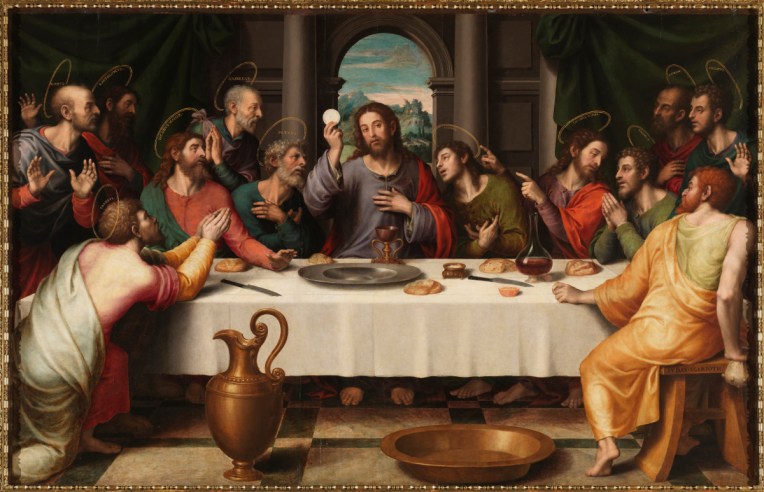
Last Supper - Juan de Juanes

St. Monica

St. Monica
2 Thessalonians 1:1-5,11-12  +  Matthew 23:13-22
August 27, 2018

Proclaim God’s marvelous deeds to all the nations.

When we think back over the course of salvation history, there are many “marvelous deeds” to reflect upon.  We might consider the marvel of God parting the Red Sea, or the marvel of the walls of Jericho falling, or indeed the marvelous deeds of Creation that God wrought “in the beginning”.

However, our Christian faith declares that even more marvelous than any of the deeds that God worked in the Old Testament are the marvelous “deeds” who are saints.  We might think it a bit odd to consider any human persons as “deeds” of God, but that is what they are:  not only because they were created by God, but also because of the redemption and sanctification wrought by God through the Paschal Mystery, and offered through the Church to “all the nations”.

Among all of “God’s marvelous deeds”, then, the most marvelous is the Blessed Virgin Mary.  We can say of Our Lady what the Church prays in the first Preface of Saints:  “Lord, holy Father, almighty and eternal God… you are praised in the company of your Saints / and, in crowning their merits, you crown your own gifts.”

When we teach little ones about the twenty mysteries of the Rosary, do we teach them that these twenty are chapters in a single story, and that the Crowning of Our Blessed Mother is the final chapter of this marvelous story?  Certainly, all of the “marvelous deeds” of salvation history are ultimately for the Glory of God.  At the same time, these “marvelous deeds” were done for us poor sinners, and this includes the deed of creating, redeeming, and sanctifying so glorious a mother.

The 21st Sunday in Ordinary Time [B]

The Twenty-first Sunday in Ordinary Time [B]
Jos 24:1-2,15-17,18  +  Eph 5:21-32  +  Jn 6:60-69
August 26, 2018

“This saying is hard; who can accept it?”

Today’s Second Reading is hard.  Many Christians do not accept it.  It can seem that the Church herself is not completely convinced that today’s Second Reading is worth hearing, because there’s an option for a shorter version that omits the less provocative parts.

“Wives should be subordinate to their husbands as to the Lord.”  Many Christians in the 21st century would say about this sentence what “[m]any of Jesus’ disciples” said about His teaching in John 6:  “‘This saying is hard; who can accept it?’”

Now, you may think that it’s comparing apples and oranges to hold up today’s Second Reading to the light of today’s Gospel passage.  One is preaching about Holy Matrimony, and the other about the Holy Eucharist.  But what if these two Scripture passages have more in common than it seems at first hearing?

The Second Reading’s context is summarized by the first sentence of the longer version:  a sentence which very strangely is not included in the shorter version.  “Be subordinate to one another out of reverence for Christ.”  This sentence makes clear that in Holy Matrimony, the husband submits himself to his wife in addition to the wife submitting herself to her husband.

The context is illuminated even more profoundly by the reading’s final sentence.  Fortunately, this sentence is included in both the longer and shorter forms:  “This is a great mystery, but I speak in reference to Christ and the Church.”  The subordination of husband and wife to each other is a mystery that receives its inspiration and its strength from the mystery of Christ and His Church being subordinate to each other.  This truth connects today’s Second Reading to the Gospel passage, and indeed, to all the Gospel passages of the five Sundays that conclude today.

          “‘This saying is hard; who can accept it?’”  What exactly is so hard about Jesus’ teaching in John 6?  When Jesus says that His Flesh is true food, and when He says that if you do not eat the Flesh of the Son of Man you will not have life in you, are there some who took His words so literally that they thought that Jesus was commanding cannibalism?

Understanding the literal meaning of the Word of God has always challenged Christians.  Even today, some Christians insist that every single word of the Bible must be taken in the most literal way possible (or some call it, literalistically).  But they do make exceptions:  for example, John 6 and Isaiah 26:4.  As you recall, Isaiah 26:4 declares that “The Lord is an eternal rock.”  Now, what do you imagine that Heaven is like, if the angels, archangels and saints are all joined in praise around a rock that sits there forever?  Clearly, as Catholic Christians we do not agree with those among our separated brethren who say that every word of the Bible must be interpreted literalistically.

Jesus knows that the disciples who leave Him after hearing about the Bread of Life—and the evangelist says that they were “many of His disciples”—do in fact understand what He’s saying.  The problem isn’t in their heads, but in their hearts.  They are not willing to subordinate their minds and hearts to Jesus Christ.  They are not willing to allow Jesus to serve them as their Lord in the sacrifice of His Flesh and Blood for His Bride, the Church.

For cradle Catholics, it’s really not very hard to accept the Church’s beliefs about the Real Presence of Jesus in the Eucharist.  But to integrate that belief into our daily life is profoundly hard, no matter how long you’ve been a Catholic.  To receive the Eucharist in Holy Communion on Sunday is a very simple action.  But to allow the grace of His Body and Blood to transform you from within, so that Jesus lives in you, and He leads your life 24/7:  that’s the life of a saint.

Too often in our modern day, we approach God from the perspective of a consumer culture, where God offers us deals, and His grace is like a cash-back program for participating in the sacraments.  Instead, God in truth calls each Christian to a divine marriage.  There are many New Testament writings on Holy Matrimony.  These include today’s Second Reading, but also include all of John 6, which is about Jesus subordinating His whole Self—Flesh, Blood, soul and divinity—for His Spouse, the Church, including you who are a member of His Church.

Saturday of the 20th Week in Ordinary Time [II]

Saturday of the Twentieth Week in Ordinary Time [II]
Ezekiel 43:1-7  +  Matthew 23:1-12
August 25, 2018

“… you have but one Father in Heaven.”

Today’s Gospel passage contains a verse that some Christians quote to “prove” that one of Catholics’ most common practices is “unbiblical”.  Jesus declares, “Call no one on earth your father; you have but one Father in heaven.”  These words of Jesus would seem to disqualify the Catholic practice of addressing a priest as “Father”, as well as referring to the Pope as the “Holy Father”.

Those who make this argument might be taken aback, then, if it were pointed out to them how many passages from Saint Paul’s letters show the Apostle referring to himself as a spiritual father.  For example, Paul explains how the Corinthians have one father.  He squarely preaches to them, “You might have thousands of guardians in Christ, but not more than one father […] it was I who begot you in Christ Jesus…” [1 Cor 4:15].  It’s hard to imagine—if you were to interpret Holy Scripture in a literalistic sense—any words that more directly contradict Jesus’ command to “call no man on earth your father” than what St. Paul says of himself:  “You might have thousands of guardians in Christ, but not more than one father […] it was I who begot you in Christ Jesus….”

What are we to make of this seeming contradiction?  St. Paul’s following words only seem to heighten the contradiction against Jesus’ command.  St. Paul commands those listening to him:  “Be imitators of me, as I am of Christ” [1 Cor 4:16].  Why doesn’t St. Paul just say instead, “Be imitators of Christ”?  Some Christians will argue over and over again that the Catholic priesthood is a corruption of the Word of God because it puts a middle-man—a mediator—between Christ and the individual believer.  They will say instead that the individual Christian can go straight to Christ, without needing men in between.  (Of course they’ll turn a blind eye to the plain fact that the act of preaching—which is so prominent in Protestant denominations—is an act of a man mediating the Word of God to his listeners.)

It’s here that the teachings of Saint Paul—found, of course, in the Holy Bible—lead us deeper into the mystery of the Christian Faith.  St. Paul’s words don’t contradict Jesus’ command to call no man on earth your father:  St. Paul’s words deepen the revelation of Jesus.  Christian fathers, whether in the home or in the sanctuary, whether through the Sacrament of Marriage or through the Sacrament of Holy Orders, are called to say—by their example if not by their words—what St. Paul proclaims here:  “Be imitators of me, as I am of Christ.”  Christian fathers are called to lead their children each day and each week deeper into the life of Christ.

St. Bartholomew, Apostle

St. Bartholomew, Apostle
Revelation 21:9-14  +  John 1:45-51
August 24, 2018

“Come and see.”

When Philip points out Jesus as the promised Messiah, what does Nathaniel—also known as Bartholomew—say?  We can almost see Nathaniel shrugging his shoulders as he says, “Can anything good come from Nazareth?”  In this one sentence, he insults both Jesus and Jesus’ hometown.  Clearly, he does not have faith at this point.

But we see that Nathaniel is like Peter:  a slow learner, but someone who, once he realizes what’s going on, is completely “in”.  When Nathaniel hears Jesus call him, he realizes who Jesus is, and confesses this truth, declaring:  “Teacher, you are the Son of God; you are the king of Israel.”  So if any of us are slow to learn, we should remember that Jesus does not give up on us.  Jesus will still call each of us to live out his vocation each day, and give him whatever is needed to carry it out.

Yet we should also note something else in this “vocation story”:  that is, the role of Philip.  When God calls a young man to be a priest, or a young woman to the consecrated life, He usually calls him or her through other people.  We need not only to encourage vocations:  we need also to encourage those “other people” like Philip to encourage vocations.

After all, Philip said just three words:  “Come and see.”  But if Philip had not said these three simple words, Nathaniel might never have met Jesus, and the Church would not have been built up by this holy apostle Bartholomew.  Little words can do a lot for God’s great glory.

Thursday of the 20th Week in Ordinary Time [II]

Thursday of the Twentieth Week in Ordinary Time [II]
Ezekiel 36:23-28  +  Matthew 22:1-14
August 23, 2018

“Many are invited, but few are chosen.”

What are we to make of the violence in this parable?  The violence flies in two directions.  The second is on the part of the king, who acts in retribution.  Jesus issues a warning to us here that His Father is not just some sort of teddy bear, but rather a Just Judge.  On a practical level, though, the first form of violence is more important for us to reflect on, for it challenges our own way of acting.

First, some who are invited to the feast carry out violence.  Some invited guests simply refuse to come:  “Some ignored the invitation and went away, one to his farm, another to his business.”  But the rest of those invited killed the messengers!  Who are these invited guests, and who are the messengers?

In terms of the first century, when Jesus walked the earth, these invited guests symbolize those to whom Jesus was originally speaking.  The evangelist tells us that these are “the chief priests and elders of the people”.  But the evangelist recorded this parable in his Gospel account because it has perennial meaning.  This parable has been proclaimed in churches in every century since Jesus walked the earth.  The parable’s invited guests symbolize all of mankind who have heard God’s desire that “all peoples” and “all nations” enter into the wedding feast of Heaven.  We need, for our own sake, to understand the parable’s invited guests as ourselves:  you and I!

If we remember not only that God is inviting us into Heaven, but that confessing our sins to the Lamb who was slain is the ticket into the banquet, then we can more easily identify with the ungrateful invited guests.  “Some ignored the invitation and went away, one to his farm, another to his business.”  These persons have no need for either the ticket or the feast.  They have their own lives, and they are their own masters.

But then there are the others who had been invited.  They “laid hold of [the king’s] servants, mistreated them, and killed them.”  This violence forces the question:  who are these servants, and how can we understand the violence done to them?  Those who bring the Lord’s invitation to conversion may be other persons:  for example, a spouse, a parent, a priest, an employer, a neighbor, a grandparent, or a friend.  Unfortunately, we want spouses who compliment us, priests who tickle our ears from the pulpit, and friends who will tell us about the faults of others, rather than about our own.

The Queenship of the Blessed Virgin Mary

The Queenship of the Blessed Virgin Mary
Ezekiel 34:1-11  +  Matthew 20:1-16
August 22, 2018

“…the last will be first, and the first will be last.”

Jesus’ parable teaches us who we are to live for, and how we may serve them.

This parable, of course, is not about economics, but about merciful love.  When the landowner rhetorically asks, “am I not free to do as I wish with my own money?”, we understand that Jesus is, so to speak, putting words in the mouth of God the Father.  When faced with us human sinners, God the Father asks, “am I not free to do as I wish with my own merciful love?”

You and I gripe and complain like the laborers in this parable.  We cannot understand why others should receive blessings when they don’t deserve them.  We notice, in fact, not only that “the Lord makes His sun to shine on the evil and the good.”   God actually shows mercy to those who do not deserve it.  This gets to us because it seems unjust.

When we find ourselves torn between what seems just and what God chooses to offer to sinners, we need to reflect again on the answer that the Father gave us when He sent His eternal Son to become flesh and blood, so as to offer that flesh and blood on Calvary and through the Holy Sacrifice of the Mass.  Praying while gazing at a crucifix can help us reflect on the Cross as binding together the love of God and the love of neighbor.  In the light of this Cross, God asks us to prefer His form of mercy to our own sense of justice.

Coronation of Mary - Rubens