The Most Holy Body and Blood of Christ
Genesis 14:18-20 + 1 Corinthians 11:23-26 + Sequence + Luke 9:11-17
When the sacrament is broken, / Doubt not, but believe ’tis spoken, / That each sever’d outward token / doth the very whole contain.
If you were to survey a hundred Catholics and ask them why the Church says they have to go to Mass on Sundays, the most common answer might be either, “Because I’ll go to hell if I miss Mass” or “Because going to Mass is how we get to Heaven”. While there’s truth in both of those statements, they need to be placed in a broader context. Saint Paul puts us on the right track at the end of today’s Second Reading. He explains to the Corinthians what it is that they’re doing when the Eucharist is celebrated: “you proclaim the death of the Lord until He comes.”
St. Paul doesn’t say that celebrating the Eucharist is a proclamation of the power that Jesus showed in the miracle of the loaves and fishes. He doesn’t say that the Eucharist is a proclamation of visible power at all. The Eucharist is a proclamation of death: of the death of God in the Flesh. This is true for us today, also. When you participate in the Holy Sacrifice of the Mass, “you proclaim the death of the Lord until He comes.” At Holy Mass, when the Eucharistic Prayer is offered, you are transported mystically and sacramentally to the spot of Calvary, on the day of Good Friday some 2000 years ago.
Why this focus? Why is the Eucharist a proclamation of Jesus’ death? For one thing, it’s because the death of Jesus is the price of our salvation. Proclaiming the death of Jesus can help us to grow morally: in our gratitude to God, and so also in our expressions of charity. These pale in comparison to the sacramental grace that we’re able to receive through a devout and worthy reception of Holy Communion. Nonetheless, we might ask, why did God choose the death of Jesus as the means of our salvation and the vessel of His grace?
After all, God is All-Powerful. God can accomplish whatever He wills in whatever manner He wills. After all, God created with nothing more than His own Word when He said, to give just one example, “‘Let there be light’, and there was light” [Genesis 1:3]. So He could re-create mankind in the same way. God could simply have said, “Let there be forgiveness for mankind,” and mankind would have been forgiven.
On the other hand, there is a certain fittingness or aptness to God redeeming mankind through the death of God the Son. St. Thomas Aquinas writes about this at length in his Summary of Theology. St. Paul points out to the Romans that “just as through the disobedience of one man the many were made sinners, so through the obedience of one man the many will be made righteous” [Romans 5:19]. God is, if you will, into fittingness, aptness, and order, so it’s no surprise that God would choose to redeem mankind by the death of God made Flesh, rather than by a spoken “Fiat”. Nonetheless, God wasn’t limited to the choice that He did in fact make. He could have used any means He wished to redeem mankind.
But the Most Holy Sacrament of the Eucharist reveals yet another reason why God chose the death of Jesus as the means of man’s redemption. This reason is the most loving reason possible, though at first glance it might not appear so.
By way of contrast, imagine that God set the price of man’s salvation at ten billion galaxies. Imagine that God chose to redeem mankind from sin and death by destroying ten billion galaxies elsewhere in the universe. Where would that leave you? It would leave you free. It would leave you redeemed. But it would not leave you with the ability to imitate our merciful God. Can you offer ten billion galaxies to God? You cannot, because such an action is beyond the capacity of a human being.
But every human being can die, in many ways, and through many forms.
Death is our means of entrance into the saving mysteries of Christ. What could be simpler? This is why, when the Eucharist is celebrated, “you proclaim the death of the Lord until He comes.” This is why Jesus, at His Last Supper, willed to institute the Holy Sacrifice of the Mass as the way to Calvary. He did this so that in accepting worthily the Body and Blood of the Lord we might die to our selves: our fallen selves, so as to discover our true selves.
This is not easy to do. It may be simple, but it’s not easy. Those who work in health care or in hospice care have perhaps seen a person on his death bed who dies not from his disease, but from exhaustion: who expends all his energy not in continuing his life, but in avoiding his death. Sin, in our moral and spiritual life, can occupy much the same struggle. We don’t want to die, even though death is the only door by which we can enter eternal life.
This is why the Church compels each of her members to participate in the Holy Sacrifice of the Mass every Sunday and Holy Day of Obligation. By faithfully receiving the Body and Blood of Our Lord Jesus Christ, we receive Jesus’ life, which gives us the strength to die: to accept death as the means of life in Christ.
click HERE to watch Jeff Cavins’ reflection for Corpus Christi (4:55)
click HERE to watch the Corpus Christi homily of Cardinal Raymond Burke (14:22)
click HERE to watch the Corpus Christi homily of Fr. Ben Cameron, CPM (20:18)
+ + +
click HERE to read Pope Francis’ 2016 homily for Corpus Christi
click HERE to read Pope Emeritus Benedict’s 2010 homily for Corpus Christi
click HERE to read St. John Paul II’s 2004 homily for Corpus Christi
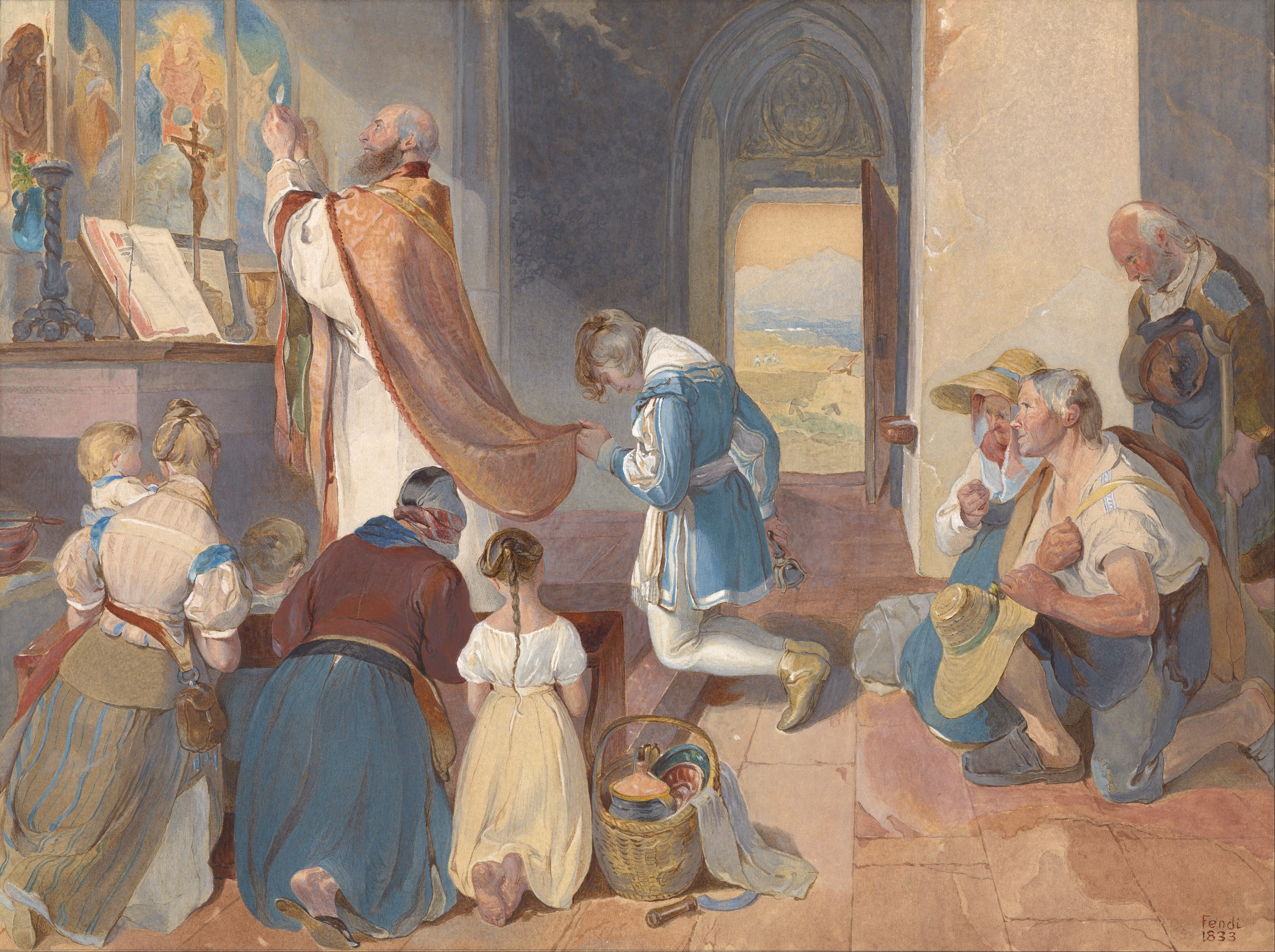
Fridolin Assists with the Holy Mass by Peter Fendi [1796-1842]