Our Lord Jesus Christ, King of the Universe [C]

Our Lord Jesus Christ, King of the Universe [C]
II Samuel 5:1-3  +  Colossians 1:12-20  +  Luke 23:35-43
November 24, 2019

   “Amen, I say to you, today you will be with me in Paradise.”   

+     +     +

click HERE to hear Scott Hahn’s reflection for this liturgical Sunday (2:59)

click HERE to watch Jeff Cavins’ reflection for this Sunday (4:58)

click HERE to read the homily of Monsignor Charles Pope for this Sunday

click HERE to watch the homily of Bishop Thomas Olmsted for this Sunday (17:59)

+     +     +

click HERE to read Pope Francis’ 2016 homily for this Sunday

click HERE to read Pope Emeritus Benedict’s 2010 Angelus address on this Sunday

click HERE to read St. John Paul II’s 1998 homily for this Sunday

+     +     +

This Sunday’s feast is the Solemnity of Our Lord Jesus Christ the King.  “King” is the key word.  The word “king” distinguishes this Sunday from the other Sundays of the year.  Every Sunday focuses upon Our Lord Jesus Christ.  But this Sunday we focus upon His kingship, and upon the battle that this King engages in.  Today’s Gospel Reading describes this battle in progress.

“The rulers sneered at Jesus and said, ‘He saved others, let him save himself if he is the chosen one, the Christ of God.’  … they called out, ‘If you are King of the Jews, save yourself.’”

These earthly rulers are extremely logical.  If Jesus could save others, why would he not save himself?  Of course, their sneer shows that they’re not serious in what they say.  They don’t believe that Jesus could save himself.  They probably don’t believe that Jesus saved others, either.  They likely claimed that those people whom Jesus reportedly saved were never really sick or dead in the first place.  The claims of Jesus working miracles were mere tricks.  So of course, given that Jesus couldn’t really save others, he would not—because he could not—save himself.

What’s clear in their way of thinking—a way of thinking that’s just as prevalent in the twenty-first century as in the first—is that the golden rule of life is “Me first”.  No one with power gives up power willingly.  No one with power does not use power for the greater glory of the most unholy trinity of “Me, Myself, and I”.

What the logic of this egoism overlooks is what Saint Francis of Assisi sang so ardently about:  that “it is in giving that we receive; … in pardoning that we are pardoned; and … in dying that we are born to eternal life.”  This is the logic of God.  This is the logic that leads to Calvary, from which Divine Mercy flows.

It is for mercy that Christ reigns as King upon the Cross.  Why, after all, would the Church proclaim on the feast of Christ the King the Gospel passage describing Jesus in His last moments before death?  It’s because the Cross is the earthly throne of Christ the King.  Thorns make up His crown.  Christ the King shows us His power not in living for Himself, but in dying for us poor sinners.  In this regard, we need to paraphrase the Prayer of St. Francis, because it’s in Christ the King dying that we are born to eternal life.  The King has laid down His life for us peasants.

Given all that, why do we Catholics gather each Sunday before an altar on which Christ the King sacrifices His life for us?  We do not only assemble there to give thanks for Christ the King’s sacrifice.

We also gather there to share in the sacrifice of Christ the King.  At the Last Supper, Jesus instituted the Holy Sacrifice of the Mass so that you and I would have a means of being transported mystically to the foot of Jesus’ Cross.  During Holy Mass we are present on that afternoon of Good Friday in order to enter into His sacrifice:  that is, to make His sacrifice our sacrifice.

Christ the King strengthens us not only so that each of us can get to Heaven.  He strengthens us through His Body and Blood, soul and divinity so that we might lead our daily lives in Him.  We accept the love of God at Holy Mass so that we’ll be strong enough to love everyone in this fallen world with the very love of God.

Of course, love is a notoriously slippery term.  Some people just think of love as an emotion or feeling.  But Christ the King shows us on the Cross that divine love actually is self-sacrifice.  If, when we leave Holy Mass, we wonder about how we can love others better, then we need to remember the ready answer that the Church offers us.  The Church points our attention towards the Corporal and Spiritual Works of Mercy.  Christ calls us to leave His Church, filled with the strength of His Body and Blood, soul and divinity, in order to share that love concretely with those in the world.

Christ the King C

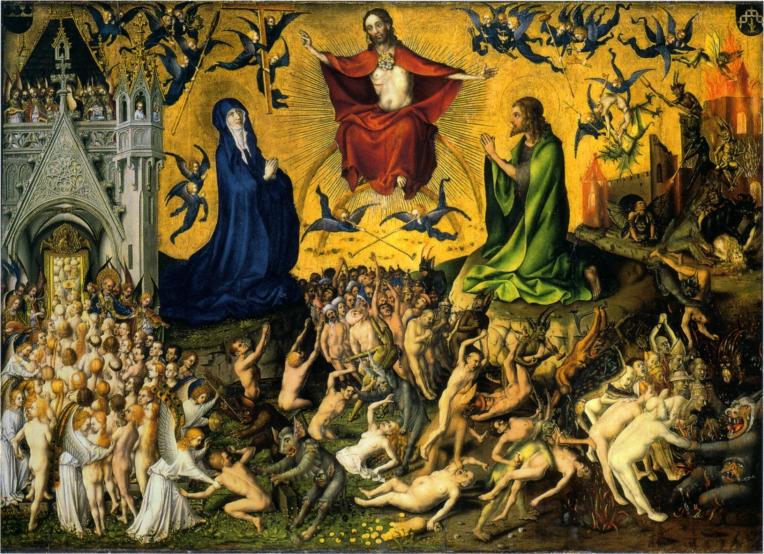
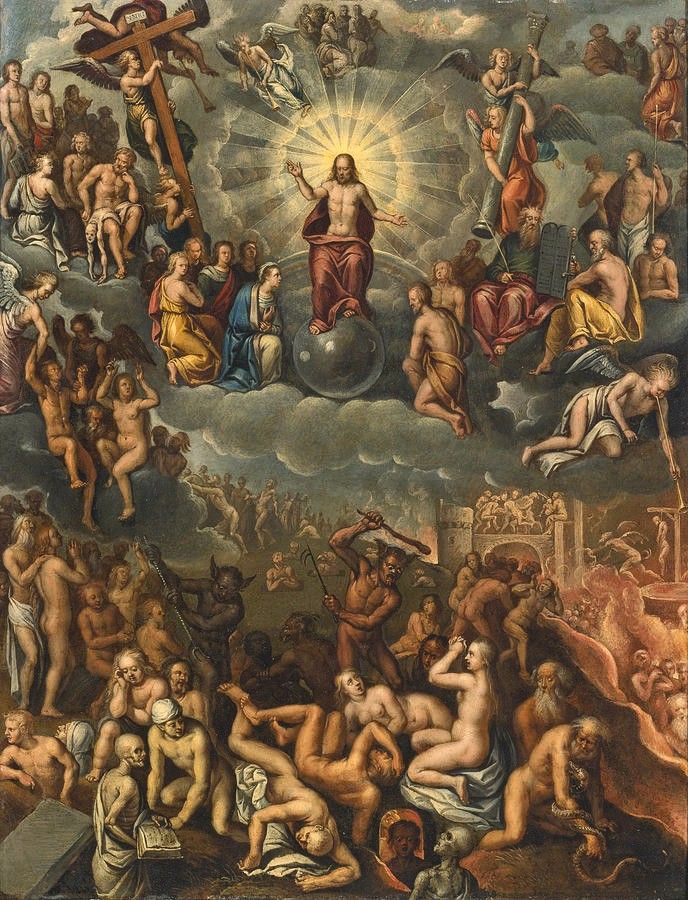
The Last Judgment by Jan Provoost [1465-1529]
Saturday of the 33rd Week in Ordinary Time [I]

Saturday of the 33rd Week in Ordinary Time [I]
I Maccabees 6:1-13  +  Luke 20:27-40
November 23, 2019

   And they no longer dared to ask Him anything.   

In today’s Gospel passage, Our Lord tries to make clear to the Sadducees the meaning of the Resurrection.  We too, however, even if we understand and believe in both the Resurrection of Our Lord and the promise of resurrection that God offers to all who die, perhaps may need to realize what type of claim the Resurrection places upon our Christian faith.

To believe in the Resurrection is to believe in the future fulfillment of God’s grace.  It is to understand that the suffering of the present is as nothing compared to the future glory to be revealed in Christ Jesus.  It is to guard in God’s name what has been entrusted to us until that final Day, which for each of us is the day of one’s death.

We never find Our Lord going into great detail about the nature of the afterlife.  There are two practical reasons for this.  First, the glory which will be the reward of God’s elect is too far beyond our comprehension.  Second, our only hope for sharing in that glory is to persevere in running the race which God has set before us, to stir into flame the gift of God each of us first received at our baptism, a flame in which we are purified like gold in the furnace.

OT 33-6

St. Cecilia, Virgin Martyr

St. Cecilia, Virgin Martyr
I Maccabees 4:36-37,52-59  +  Luke 19:45-48
November 22, 2019

And every day He was teaching in the temple area.

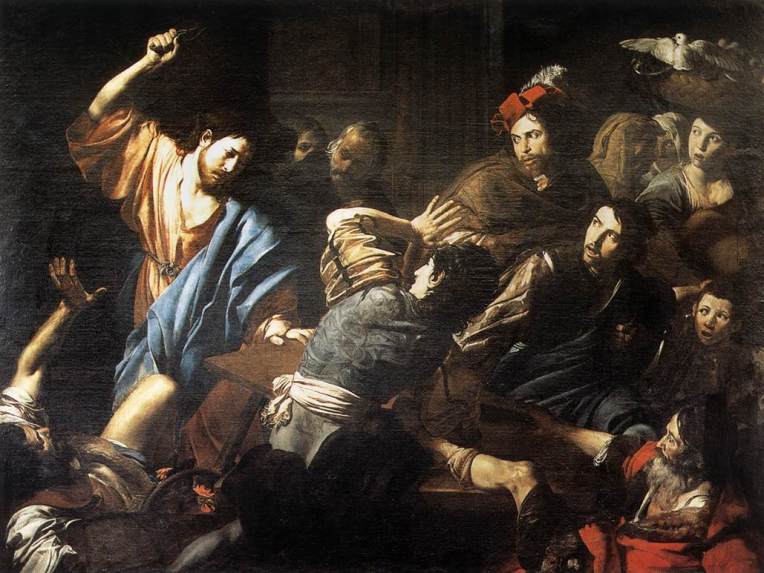
Lots of people in Jesus’ day were fed up with the materialism and commercialism that had crept into the practices of the Temple in Jerusalem.  This place, the Temple, was the holiest place in the entire world for Jews.  One of the obligations of a good Jew in the time of Jesus was to go to Jerusalem at the time of Passover, and offer a sacrifice in the Temple:  those who were wealthy offered an entire ox or sheep; those with less means offered turtledoves.  And so there grew up a very large market during the time around Passover, a system within which many abuses developed.  Jesus undoubtedly had many people cheering for Him as He told off the Jewish officials and the money-makers in the Temple.

But how many people cheered for Him on that occasion when the Jews asked for a sign from Jesus, and He replied, “Destroy this temple, and in three days I will raise it up”?  Probably some were baffled.  Likely, some became angry at Jesus:  here He had purified the Temple, and now He wanted to destroy it?  The Scriptures go on to tell us that Jesus’ own disciples only came to understand His words after His Resurrection, so we only imagine what those who did not know Jesus well thought of these words.  For ourselves, Christ is the Temple, of which we are parts through the Church.  We need to purify ourselves as Jesus cleansed the Temple, so that we might offer right sacrifice there.

OT 33-5

The Presentation of the Blessed Virgin Mary

The Presentation of the Blessed Virgin Mary
I Maccabees 2:15-29  +  Luke 19:41-44
November 21, 2019

“If this day you only knew what makes for peace….”

As the Church year draws to an end, Jesus in the weekday Gospel passages is drawing near to His own end in Jerusalem.  There is something a little anachronistic about this.  After all, it’s during Lent that we Christians liturgically observe Jesus drawing closer to His end, an end which culminates in the liturgies of the Sacred Triduum.

However, the end of the Church year—as it focuses on the end of human history itself—helps us realize that Jesus’ end is meant to be our end.  Further, the Risen and Ascended Lord Jesus will judge each of us at the end of time.  So today’s Gospel passage helps us orient our lives to our own end.

This passage is quite melancholy, not only because of Jesus’ tears, but also because of His words.  “If this day you only knew what makes for peace—but now it is hidden from your eyes.”  This sentence alone would offer many hours of meditation to one willing to ponder it.  But as Jesus continues to speak, He directs our attention more specifically towards Himself.  That this peace He speaks of is Jesus Himself becomes clear when He notes that the immanent destruction of Jerusalem is due to it not recognizing “the time of [its] visitation.”  Jesus visited God’s People that they might have eternal life, and they put the author of life to death outside Jerusalem.  Each of us shares in this rejection of Jesus by his own sins.

Presentation of the BVM 01

Wednesday of the 33rd Week in Ordinary Time [I]

Wednesday of the 33rd Week in Ordinary Time [I]
II Maccabees 7:1,20-31  +  Luke 19:11-28
November 20, 2019

“…from the one who has not, even what he has will be taken away.”

Those who think of Jesus as a “teddy bear” are challenged by the last sentence of Jesus in today’s Gospel passage.  These words conclude a lengthy parable, which St. Luke the Evangelist prefaces with a clear explanation of the motive for the parable:  Jesus “proceeded to tell a parable because He was near Jerusalem and they thought that the Kingdom of God would appear there immediately.”

The “king” speaks and acts harshly.  He refers to himself as “a demanding man”, but his greatest demand comes at the end of the parable.  Of his enemies he declares, “bring them here and slay them before me.”  The question is to whom this character in the parable refers in real life?  Can he possibly symbolize Jesus or God the Father?  The king’s demand is reminiscent of practices found in the Old Testament.  God Himself seems in the Old Testament to demand the murder of innocents.  Surely such ideas have no place in the teaching of Jesus?

However, the parable’s own inner logic suggests that the servants did have a choice.  This points to the choice that each servant of God has to follow Him or not.  At the end of each person’s life is a fork.  One branch leads to eternal life and the other to eternal death.  This is where the Kingdom of God comes to its fulfillment.

OT 33-3

Tuesday of the 33rd Week in Ordinary Time [I]

Tuesday of the 33rd Week in Ordinary Time [I]
II Maccabees 6:18-31  +  Luke 19:1-10
November 19, 2019

   “…today I must stay at your house.”   

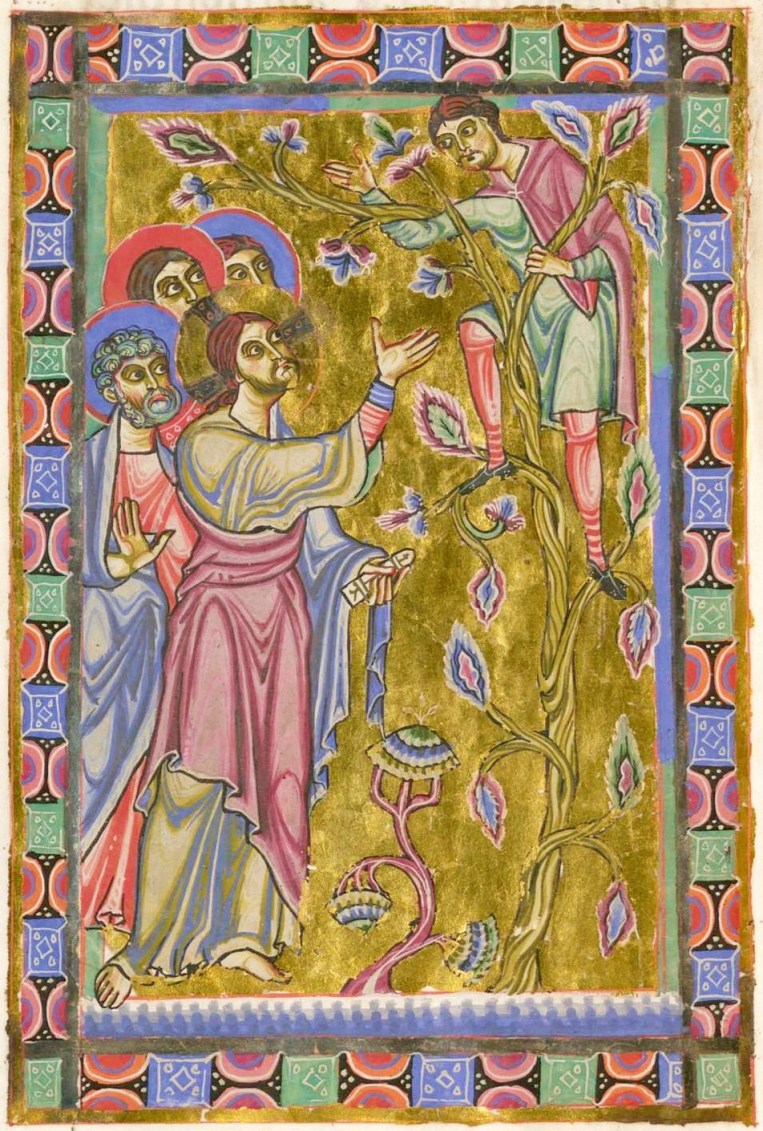
Zacchaeus is a rich collector of taxes.  Each of us, like him, is attached to worldly things, no matter how simple.  St. John of the Cross says that just as it does not matter if a bird is tied down by a thick rope or a thin string, so it does not matter if a Christian is tied down by wealthy goods or simple desires.  An attachment is an attachment, and any attachment—no matter how slight—keeps us from union with God.

On the other hand, Zacchaeus, like you, wants to see who Jesus is.  But Zacchaeus has two strikes against him.

The first strike against Zacchaeus is the crowd, because everyone wants to see Jesus.  It’s easy to get lost and not to be loved in a crowd.  One might ask himself, “How can Jesus love everyone?”

The second strike against Zacchaeus is his small size, which may represent the size of one’s own soul.  One might feel unworthy of God’s love, and ask himself, “How could Jesus love little old me?”

So Zacchaeus climbs up into a sycamore tree to see Jesus.  This is all Zacchaeus wants:  to see Jesus.  But that’s not enough for Jesus, so large is Jesus’ Sacred Heart.

Here’s the turning point in this Gospel passage.  When Jesus reached the tree that Zacchaeus had climbed, Jesus looked up and said, “Zacchaeus, come down quickly; for today I must stay at your house.”  Jesus takes the initiative to reach out to the individual sinner.  Just as He reached out to this little sinner, so He asks entry into the fullness of your heart, mind and soul.

OT 33-2

Monday of the 33rd Week in Ordinary Time [I]

Monday of the 33rd Week in Ordinary Time [I]
I Maccabees 1:10-15,41-43,54-57,62-63  +  Luke 18:35-43
November 18, 2019

Then the king wrote to his whole kingdom that all should be one people, each abandoning his particular customs.

At most of this week’s Masses, the First Reading is taken from the Old Testament books of Maccabees.  These books describe the persecution and perseverance of the Jewish people.  While the particular persecution that they faced may not seem easy to relate to, we need today to relate to the perseverance that they demonstrated.

In today’s First Reading, the king of Greece “wrote to his whole kingdom that all should be one people, each abandoning his particular customs.  All the Gentiles conformed to the command of the king, and many children of Israel were in favor of his religion”.  The parallel of this situation to the plight of Christians in the United States today is clear.

Today’s passage ends focusing on those Jews “who preferred to die rather than to be defiled… and they did die.  Terrible affliction was upon Israel.”  But we ought to be clear on what leads to this affliction:  the demand for a people to be falsely united.

To what extent may a government demand that a religious body of persons conform their teachings, practices and rituals to a norm established by and in support of that government?  The conflicts in this week’s readings from the Books of Maccabees will help us reflect on this important question.

Maccabeean brothers 01

The Thirty-Third Sunday in Ordinary Time [C]

The Thirty-Third Sunday in Ordinary Time [C]
Malachi 3:19-20  +  2 Thessalonians 3:7-12  +  Luke 21:5-19

References to the Catechism of the Catholic Church cited for today by the Vatican’s Homiletic Directory:
CCC 162-165: perseverance in faith; faith as the beginning of eternal life
CCC 675-677: the final trial of the Church
CCC 307, 531, 2427-2429: human labor as redemptive
CCC 673, 1001, 2730: the last day

   “By your perseverance you will secure your lives.”   

We can define the word “perseverance” as hanging on “through” what is “severe”.  Not many of us have ever literally faced something as severe as a cliff-hanger in the jungles of the Amazon.  Yet more than a few of us have faced death.

Maybe you were involved in a serious vehicle accident where you came within an inch of losing your life.  You might have faced a serious illness that could have been terminal, but for some mysterious reason took a turn for the better.  Regardless, every experience of suffering is an occasion for a moral choice between two opposing perspectives.  You must choose between looking at suffering as an end, or looking at it as a means.

The venerable Monsignor Ivan Eck has a saying that he’s well known for.  “In the face of suffering and in the face of loss, you can choose to be bitter or you can choose to be better.”  You get to choose.  The difference between the two choices is that, on the one hand, you can choose to be bitter through your own power alone.  On the other hand, you can only be better through God’s strength.

In this Sunday’s Gospel Reading, Jesus describes many types of suffering that His disciples might experience.  However, He’s not outlining these types of suffering to frighten us, but to alert us both to our need for perseverance and to what perseverance demands from us.

There’s a distinction that we need to understand in order to appreciate Christian perseverance.  God’s strength not only makes it possible for us to hang on in spite of what life throws at us.  In fact, we hang on to God Himself.

This Sunday’s First Reading can help us put into a broader perspective what it means to hang on to God.  The First Reading is taken from the Book of Malachi, which is the last book of the Old Testament.

Throughout the book named after him, Malachi prophesies—in the Name of the Lord—about what he calls “the day” or sometimes “that day”.  Without knowing Jesus, it’s easy to feel fear when Malachi prophesies:  “Lo, the day is coming, blazing like an oven, when all the proud and all evildoers will be stubble, and the day that is coming will set them on fire… says the Lord of hosts.”

However, in the last verse of today’s First Reading, we hear a message of hope.  Malachi prophesies in the Name of the Lord:  “But for you who fear my name, there will arise the sun of justice with its healing rays.”  These are words that can inspire perseverance.  Although these words speak of fear, this is a particular type of fear.  This is not servile fear, as you would naturally fear a wolf that’s bearing down upon you.  Malachi prophesies about the type of fear that brings healing and strength.

Fear of the Lord’s Name is another way of speaking about religious awe of God.  A more pedestrian way at getting at this same truth is the modern quip:  “There are only two things I know for sure:  #1, there is a God; and #2, I’m not Him.”  Of course, it’s easy to say such a thing, but harder to live from such a conviction.

Nonetheless, what the Jews knew only dimly, as in a mirror, Jesus revealed plainly in His very Person when He walked this earth.  The Most Holy Name of Jesus literally means “God saves.”

So consider this question:  how often do you call on the Name of Jesus as you work to persevere through difficulties?  You might be tempted often to use the Holy Name of Jesus in vain.  But Jesus instead wants us when we’re suffering to use His Name not to express frustration, but to call for the strength that only He can give.

Calling on the Name of Jesus when striving to persevere in faith may seem quaint to some.  To others, it may even seem superstitious.  Regardless, make a resolution that three times during the coming week you’ll call on the Name of Jesus out loud when you’re struggling with some situation, striving to persevere in the life of faith.

OT 33-0C

Saturday of the 32nd Week in Ordinary Time [I]

Saturday of the 32nd Week in Ordinary Time [I]
Wisdom 18:14-16;19:6-9  +  Luke 18:1-8
November 16, 2019

   Jesus told His disciples a parable about the necessity for them to pray always without becoming weary.   

In the first verse of today’s Gospel passage, St. Luke the Evangelist is unusually direct in explaining the exact meaning of Jesus’ parable.  “Jesus told His disciples a parable about the necessity for them to pray always without becoming weary.”  It is important to note that this parable is about one specific type of prayer to God:  prayer of petition.

Sometimes prayer is defined as “a conversation with God”.  That’s unfair to God for two reasons.  First, conversations normally take place between two persons of more or less equal standing.  While it’s true that prayer involves a dialogue with God, we have to keep in mind that what He has to say to each of us is far more important than what any of us might wish to say to Him.  In prayer, it’s far more important to listen to God than to speak to Him.

Second, prayer at its summit transcends what could be termed a conversation.  The form of prayer in which the believer and God dialogue is meant to be surpassed.  Dialogue is meant to lead to a loving silence, a form of prayer in which God and the believer rest in the goodness of His presence.  Dialogue or conversation is a means to getting there.

Nonetheless, in today’s Gospel passage Jesus teaches us about prayers of petition.  Petition is one specific form that prayer takes during the “conversational” stages of prayer.  In this stage, however, we pray not only with God’s almighty Power in mind (because He can get us what we want), but also with His providential Love in mind.  That is to say, God answers our prayers of petition not only for our own good, but for His goodness as well, so as to lead us into that goodness.

OT 32-6