Thursday of the 34th Week in Ordinary Time [I]

For the Scriptures and reflection for Thanksgiving Day, click HERE.

Thursday of the 34th Week in Ordinary Time [I]
Daniel 6:12-28  +  Luke 21:20-28
November 28, 2019

Some men rushed into the upper chamber of Daniel’s home and found him praying ….

Jesus issues a sharp challenge to you today.  His words might even be described as frightening.  Yet Jesus is not preaching fire and brimstone.  He’s not preaching, at least directly, about sin and damnation.  He is preaching, though, about the worldly desolation of Jerusalem, and signs above and upon earth that will cause people to “die in fright in anticipation of what is coming upon the world”.

Today’s First Reading from this last week of the Church year comes from the Book of the Prophet Daniel.  It is the famous story of “Daniel and the lions’ den”.  While the miracle of Daniel’s survival stands out as the dramatic hinge of the passage, less noticeable details deserve our attention, also.  For example, what was it that provoked the king’s anger at Daniel?  It was Daniel’s prayers of petition.  Daniel violated the decree that all were to petition no one—neither god nor man—except the king.  Daniel’s wisdom lay in trusting the Lord alone, or rather, knowing that petitions to anyone but the Lord would be of little meaning.

Many people find the idea of the end of the world very frightening, especially when it’s dramatized in literature or film.  The drama is enhanced by the physical destruction of worldly monuments and temples.  But physical destruction, no matter how vast the scale, pales in comparison to the destruction of a single human soul.

That phrase is not quite accurate, of course, because a soul can never be destroyed.  It would be more accurate to speak of “the destruction of a single human soul’s opportunity for eternal bliss”, or more simply, “the eternal damnation of a single human soul”.  Thanks be to God for His sending the Son of Man to redeem man from his sins.  This final truth is the reason for Jesus to speak hopefully at the end of today’s Gospel passage.  In effect, Jesus preaches that we need not fear the end of the world, or the end of earthly life, because when we place our faith in the Son of Man, we can have full assurance that our redemption is at hand.

OT 34-4

Wednesday of the 34th Week in Ordinary Time [I]

Wednesday of the 34th Week in Ordinary Time [I]
Daniel 5:1-6,13-14,16-17,23-28  +  Luke 21:12-19
November 27, 2019

“By your perseverance you will secure your lives.”

So many people grow fearful thinking about a cataclysmic end of the planet, even though the vast majority of mankind will never face it.  Perhaps you’ve seen one of those movies where there’s a dramatic end to life on the planet Earth as we know it.  Movies like that can draw a great deal of attention, and sell a lot of tickets and popcorn.  Nonetheless, it doesn’t matter if you die from an ice age covering the whole continent, or from old age in your own home:  death is death.

We reflect on this sobering truth at the end of each Church year:  in November, we pray to the saints in heaven, and for the faithful in Purgatory, and the Church reminds us of the “last things”:  heaven, hell, death, and judgment.  All this give us perspective.

In today’s Gospel passage, Jesus declares to His disciples, “By perseverance you will secure your lives.”  What does this mean?  Every day, God calls us to offer Him our lives in faith, and to live for others.  That’s how we can reach the hour of our deaths in God’s sight.  When all is said and done, there are two types of persons.  There are those who say in the end, “Heavenly Father, thy will be done.”  Then there are those to whom the Father says in the end, “My child, thy will be done.”

OT 34-3

Tuesday of the 34th Week in Ordinary Time [I]

Tuesday of the 34th Week in Ordinary Time [I]
Daniel 2:31-45  +  Luke 21:5-11
November 26, 2019

“… there will not be left a stone upon another stone ….”

Everything that’s built by human beings can be destroyed.  That’s why something like the Great Pyramids of Egypt are so awesome:  not simply because they are colossal, but because they have—to an amazing extent—survived the ravages of time.  You can think of one of the large cities on the West Coast of our own country:  from the air, as you fly into the area, you can be filled with awe.  Yet an earthquake could destroy everything in the area in a matter of minutes.

Through the prophet Daniel, God wanted King Nebuchadnezzar to know that his kingdom, so dear to him, could and would undergo destruction.  Other kingdoms would take its place, but they, too, would last only a time.  This prophecy of Daniel foreshadowed the words of Jesus, when he spoke of the Temple of Jerusalem:  it, like everything built by human beings, would be destroyed.  These are not the sorts of things to place our hope in.

But Daniel also prophesied that God would set up a kingdom that would not be destroyed.  There was no way that Daniel could understand this prophecy, but through Daniel, God was speaking about the Church:  not church buildings (even Saint Peter’s Basilica in Rome will some day fall), but the Church herself, made up of “living stones”.  Those who place their faith in Christ the King, and live in Him as members of His Mystical Body, will have eternal life.

OT 34-2

Monday of the 34th Week in Ordinary Time [I]

Monday of the 34th Week in Ordinary Time [I]
Daniel 1:1-6,8-20  +  Luke 21:1-4
November 25, 2019

“… she, from her poverty, has offered her whole livelihood.”

We live in a society in which values contrary to the Gospel are canonized.  A person’s value is measured in economic terms.  The poor are shunned as worthless.

God has a different set of values from those of our society.  When Jesus saw the wealthy putting large amounts of money into the collection box of the Temple, He was not impressed.  It was not as if the wealthy should not have given large sums, but Jesus was looking for something else.  He saw that something else in the poor widow who donated only two small coins.  He explains to us what He saw:  “[The wealthy] have all made offerings from their surplus wealth, but she, from her poverty, has offered her whole livelihood.”

It was the generosity of the widow that mattered, not the money she gave.  We are called to be generous people, unselfish in all our relationships with others.  God does not value us for giving our money; or, for that matter, for giving our time and talent.  God values us for the generosity from which our giving flows.  Generosity flows from the love that we receive in the celebration of the Holy Eucharist.

OT 34-1

Our Lord Jesus Christ, King of the Universe [C]

Our Lord Jesus Christ, King of the Universe [C]
II Samuel 5:1-3  +  Colossians 1:12-20  +  Luke 23:35-43
November 24, 2019

   “Amen, I say to you, today you will be with me in Paradise.”   

+     +     +

click HERE to hear Scott Hahn’s reflection for this liturgical Sunday (2:59)

click HERE to watch Jeff Cavins’ reflection for this Sunday (4:58)

click HERE to read the homily of Monsignor Charles Pope for this Sunday

click HERE to watch the homily of Bishop Thomas Olmsted for this Sunday (17:59)

+     +     +

click HERE to read Pope Francis’ 2016 homily for this Sunday

click HERE to read Pope Emeritus Benedict’s 2010 Angelus address on this Sunday

click HERE to read St. John Paul II’s 1998 homily for this Sunday

+     +     +

This Sunday’s feast is the Solemnity of Our Lord Jesus Christ the King.  “King” is the key word.  The word “king” distinguishes this Sunday from the other Sundays of the year.  Every Sunday focuses upon Our Lord Jesus Christ.  But this Sunday we focus upon His kingship, and upon the battle that this King engages in.  Today’s Gospel Reading describes this battle in progress.

“The rulers sneered at Jesus and said, ‘He saved others, let him save himself if he is the chosen one, the Christ of God.’  … they called out, ‘If you are King of the Jews, save yourself.’”

These earthly rulers are extremely logical.  If Jesus could save others, why would he not save himself?  Of course, their sneer shows that they’re not serious in what they say.  They don’t believe that Jesus could save himself.  They probably don’t believe that Jesus saved others, either.  They likely claimed that those people whom Jesus reportedly saved were never really sick or dead in the first place.  The claims of Jesus working miracles were mere tricks.  So of course, given that Jesus couldn’t really save others, he would not—because he could not—save himself.

What’s clear in their way of thinking—a way of thinking that’s just as prevalent in the twenty-first century as in the first—is that the golden rule of life is “Me first”.  No one with power gives up power willingly.  No one with power does not use power for the greater glory of the most unholy trinity of “Me, Myself, and I”.

What the logic of this egoism overlooks is what Saint Francis of Assisi sang so ardently about:  that “it is in giving that we receive; … in pardoning that we are pardoned; and … in dying that we are born to eternal life.”  This is the logic of God.  This is the logic that leads to Calvary, from which Divine Mercy flows.

It is for mercy that Christ reigns as King upon the Cross.  Why, after all, would the Church proclaim on the feast of Christ the King the Gospel passage describing Jesus in His last moments before death?  It’s because the Cross is the earthly throne of Christ the King.  Thorns make up His crown.  Christ the King shows us His power not in living for Himself, but in dying for us poor sinners.  In this regard, we need to paraphrase the Prayer of St. Francis, because it’s in Christ the King dying that we are born to eternal life.  The King has laid down His life for us peasants.

Given all that, why do we Catholics gather each Sunday before an altar on which Christ the King sacrifices His life for us?  We do not only assemble there to give thanks for Christ the King’s sacrifice.

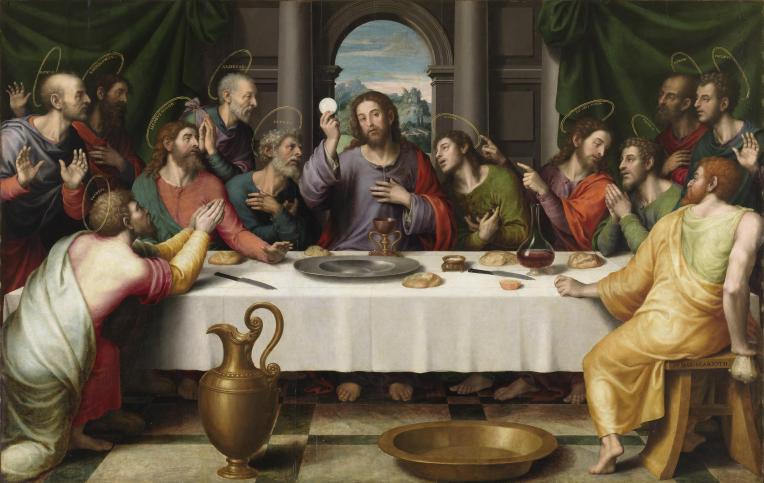
We also gather there to share in the sacrifice of Christ the King.  At the Last Supper, Jesus instituted the Holy Sacrifice of the Mass so that you and I would have a means of being transported mystically to the foot of Jesus’ Cross.  During Holy Mass we are present on that afternoon of Good Friday in order to enter into His sacrifice:  that is, to make His sacrifice our sacrifice.

Christ the King strengthens us not only so that each of us can get to Heaven.  He strengthens us through His Body and Blood, soul and divinity so that we might lead our daily lives in Him.  We accept the love of God at Holy Mass so that we’ll be strong enough to love everyone in this fallen world with the very love of God.

Of course, love is a notoriously slippery term.  Some people just think of love as an emotion or feeling.  But Christ the King shows us on the Cross that divine love actually is self-sacrifice.  If, when we leave Holy Mass, we wonder about how we can love others better, then we need to remember the ready answer that the Church offers us.  The Church points our attention towards the Corporal and Spiritual Works of Mercy.  Christ calls us to leave His Church, filled with the strength of His Body and Blood, soul and divinity, in order to share that love concretely with those in the world.

Christ the King C

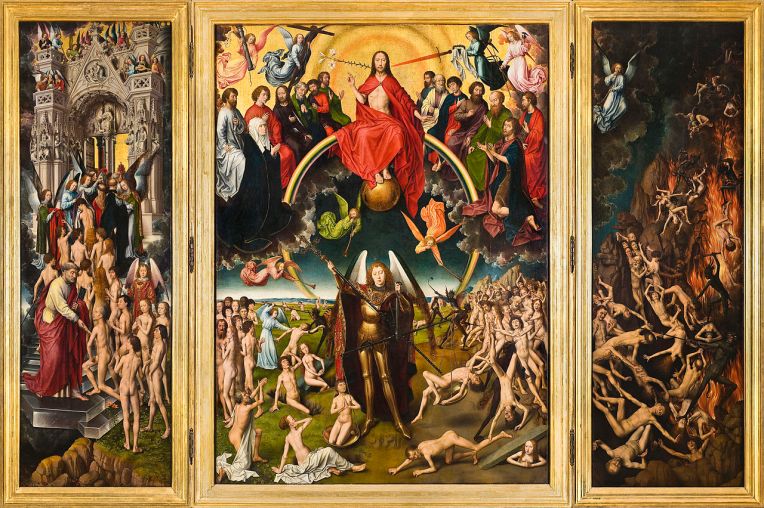
The Last Judgment by Jan Provoost [1465-1529]

Saturday of the 33rd Week in Ordinary Time [I]

Saturday of the 33rd Week in Ordinary Time [I]
I Maccabees 6:1-13  +  Luke 20:27-40
November 23, 2019

   And they no longer dared to ask Him anything.   

In today’s Gospel passage, Our Lord tries to make clear to the Sadducees the meaning of the Resurrection.  We too, however, even if we understand and believe in both the Resurrection of Our Lord and the promise of resurrection that God offers to all who die, perhaps may need to realize what type of claim the Resurrection places upon our Christian faith.

To believe in the Resurrection is to believe in the future fulfillment of God’s grace.  It is to understand that the suffering of the present is as nothing compared to the future glory to be revealed in Christ Jesus.  It is to guard in God’s name what has been entrusted to us until that final Day, which for each of us is the day of one’s death.

We never find Our Lord going into great detail about the nature of the afterlife.  There are two practical reasons for this.  First, the glory which will be the reward of God’s elect is too far beyond our comprehension.  Second, our only hope for sharing in that glory is to persevere in running the race which God has set before us, to stir into flame the gift of God each of us first received at our baptism, a flame in which we are purified like gold in the furnace.

OT 33-6

St. Cecilia, Virgin Martyr

St. Cecilia, Virgin Martyr
I Maccabees 4:36-37,52-59  +  Luke 19:45-48
November 22, 2019

And every day He was teaching in the temple area.

Lots of people in Jesus’ day were fed up with the materialism and commercialism that had crept into the practices of the Temple in Jerusalem.  This place, the Temple, was the holiest place in the entire world for Jews.  One of the obligations of a good Jew in the time of Jesus was to go to Jerusalem at the time of Passover, and offer a sacrifice in the Temple:  those who were wealthy offered an entire ox or sheep; those with less means offered turtledoves.  And so there grew up a very large market during the time around Passover, a system within which many abuses developed.  Jesus undoubtedly had many people cheering for Him as He told off the Jewish officials and the money-makers in the Temple.

But how many people cheered for Him on that occasion when the Jews asked for a sign from Jesus, and He replied, “Destroy this temple, and in three days I will raise it up”?  Probably some were baffled.  Likely, some became angry at Jesus:  here He had purified the Temple, and now He wanted to destroy it?  The Scriptures go on to tell us that Jesus’ own disciples only came to understand His words after His Resurrection, so we only imagine what those who did not know Jesus well thought of these words.  For ourselves, Christ is the Temple, of which we are parts through the Church.  We need to purify ourselves as Jesus cleansed the Temple, so that we might offer right sacrifice there.

OT 33-5

The Presentation of the Blessed Virgin Mary

The Presentation of the Blessed Virgin Mary
I Maccabees 2:15-29  +  Luke 19:41-44
November 21, 2019

“If this day you only knew what makes for peace….”

As the Church year draws to an end, Jesus in the weekday Gospel passages is drawing near to His own end in Jerusalem.  There is something a little anachronistic about this.  After all, it’s during Lent that we Christians liturgically observe Jesus drawing closer to His end, an end which culminates in the liturgies of the Sacred Triduum.

However, the end of the Church year—as it focuses on the end of human history itself—helps us realize that Jesus’ end is meant to be our end.  Further, the Risen and Ascended Lord Jesus will judge each of us at the end of time.  So today’s Gospel passage helps us orient our lives to our own end.

This passage is quite melancholy, not only because of Jesus’ tears, but also because of His words.  “If this day you only knew what makes for peace—but now it is hidden from your eyes.”  This sentence alone would offer many hours of meditation to one willing to ponder it.  But as Jesus continues to speak, He directs our attention more specifically towards Himself.  That this peace He speaks of is Jesus Himself becomes clear when He notes that the immanent destruction of Jerusalem is due to it not recognizing “the time of [its] visitation.”  Jesus visited God’s People that they might have eternal life, and they put the author of life to death outside Jerusalem.  Each of us shares in this rejection of Jesus by his own sins.

Presentation of the BVM 01

Wednesday of the 33rd Week in Ordinary Time [I]

Wednesday of the 33rd Week in Ordinary Time [I]
II Maccabees 7:1,20-31  +  Luke 19:11-28
November 20, 2019

“…from the one who has not, even what he has will be taken away.”

Those who think of Jesus as a “teddy bear” are challenged by the last sentence of Jesus in today’s Gospel passage.  These words conclude a lengthy parable, which St. Luke the Evangelist prefaces with a clear explanation of the motive for the parable:  Jesus “proceeded to tell a parable because He was near Jerusalem and they thought that the Kingdom of God would appear there immediately.”

The “king” speaks and acts harshly.  He refers to himself as “a demanding man”, but his greatest demand comes at the end of the parable.  Of his enemies he declares, “bring them here and slay them before me.”  The question is to whom this character in the parable refers in real life?  Can he possibly symbolize Jesus or God the Father?  The king’s demand is reminiscent of practices found in the Old Testament.  God Himself seems in the Old Testament to demand the murder of innocents.  Surely such ideas have no place in the teaching of Jesus?

However, the parable’s own inner logic suggests that the servants did have a choice.  This points to the choice that each servant of God has to follow Him or not.  At the end of each person’s life is a fork.  One branch leads to eternal life and the other to eternal death.  This is where the Kingdom of God comes to its fulfillment.

OT 33-3