Tuesday of the 4th Week in Ordinary Time [II]

Tuesday of the 4th Week in Ordinary Time [II]
II Samuel 18:9-10,14,24-25,30—19:3  +  Mark 5:21-43
February 4, 2020

“Do not be afraid; just have faith.”

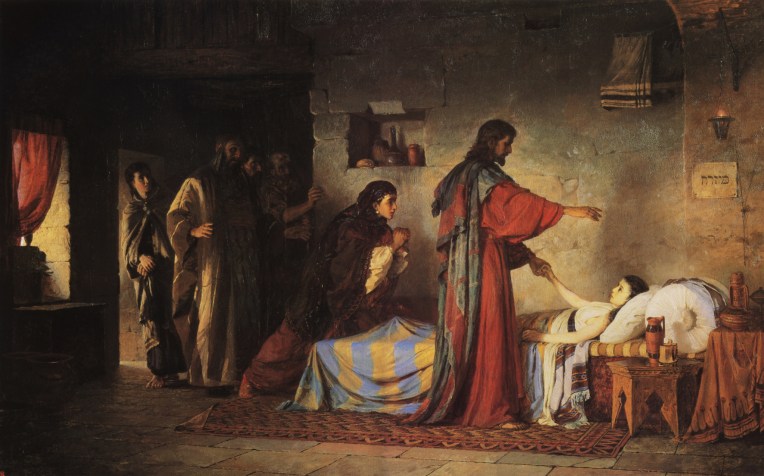
In today’s Gospel passage are two people who see how God wants to be in their lives in time of need.  Each of you, no doubt, fields petition from those whom you serve.  So many people turn to Christ in need.  If it weren’t for petitionary prayer, the prayer lives of many Christians would never get off the ground!  But it’s a start.  God is content to listen to all the prayers of petition that His children wish to make.

Consider the woman in the Gospel, who had suffered for so many years.  She interrupts Christ in the midst of His trying to help someone else.  We should make that woman’s faith our own:  not simply her faith in Christ’s power, but also her faith in His patience and compassion.  There is no true need in our lives that we should not offer to God.

Is every petition answered as we wish, as are the petitions of this woman and the official?  Some Christians stop offering their petitions to God—or even stop believing in God—when He doesn’t provide the response they want.  Growth in prayer includes the experience of accepting God each time He says “No” to us, and learning through those experiences of “No” to trust His providential Will more deeply.

OT 04-2

Monday of the 4th Week in Ordinary Time [II]

Monday of the 4th Week in Ordinary Time [II]
II Samuel 15:13-14,30;16:5-13  +  Mark 5:1-20
February 3, 2020

…they began to beg [Jesus] to leave their district.

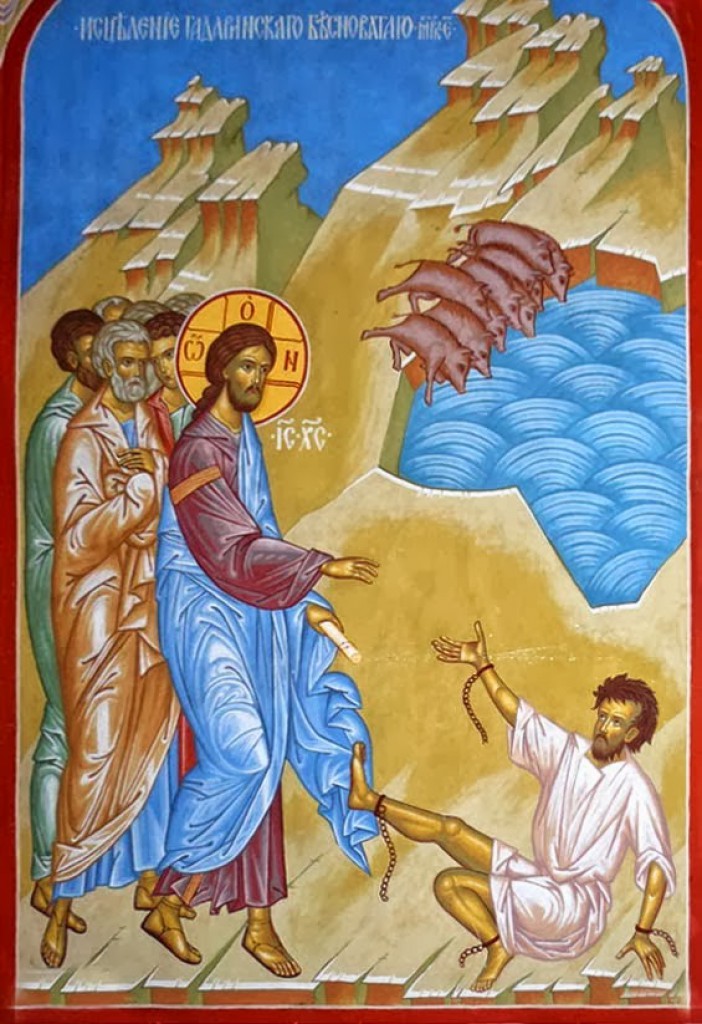
Demonic possession is an extremely serious matter.  While some today dismiss it, suggesting that all reported cases of possession are in fact psychological disorders, the Church takes today’s Gospel passage at its word.

One striking point in this narrative is the reaction of people to the swineherds’ report:  “they began to beg [Jesus] to leave their district.”  Why do the people react this way?  One might expect the people to express gratitude to Jesus, and invite Him to stay as their protector.

Perhaps the people were in shock, never before imagining that demons might dwell among them.  However, demonic possession in the Holy Land was not uncommon in Jesus’ day.  Perhaps the reaction of the people reflects what we see in modern Western culture.  We know that evil exists, but we tend to think of it existing only “out there”.

When evil shows itself plainly in our own towns, our own homes, and our own lives, we express disbelief at how such violence could possibly happen “here”.  The sad truth is that sin, violence and death is everywhere, and in every human life.  After all, if it could exist in the earthly lives of Our Lord and Our Blessed Mother, why should we think of ourselves—who are sinners—as exempt from its power?  While each of us needs to practice prudence to deter suffering, we should have no illusions of escaping it.  In the midst of such illusions, Christ has no place.

OT 04-1

The Presentation of the Lord

The Presentation of the Lord
Malachi 3:1-4  +  Hebrews 2:14-18  +  Luke 2:22-40 [or Lk 2:22-32]
February 2, 2020

“…for my eyes have seen your salvation, which you prepared in the sight of all the peoples….”

+     +     +

click HERE for Scott Hahn’s reflection for this feast (2:59)

click HERE to read the homily of Msgr. Charles Pope for this feast

click HERE to watch the homily for this feast from the cathedral in Phoenix

click HERE to watch the homily of Bishop Hugh Gilbert OSB, of Aberdeen, Scotland for this feast

+     +     +

click HERE to read the 2014 homily of Pope Francis for this feast

click HERE to read the 2013 homily of Pope Benedict for this feast

click HERE to read the 2003 homily of St. John Paul II for this feast

+     +     +

reference to the Catechism of the Catholic Church related to this Sunday:

CCC 529:   the Presentation of the Lord Jesus in the Temple

+     +     +

February 2nd is the fortieth day after December 25th.  That’s why the Church celebrates the Presentation of the Lord every year on February 2nd.  This year February 2nd happens to fall on a Sunday.  Because the feast of the Presentation is such an important mystery of Jesus’ life, when this date falls on a Sunday, the readings and prayers for the corresponding Sunday in Ordinary Time are set aside.

The Jewish meaning of presenting one’s first-born son in the Temple is hinted at in today’s Gospel Reading.  Listen to St. Luke the Evangelist’s explanation in today’s Gospel:  “When the days were completed for their purification according to the law of Moses, Mary and Joseph took Jesus up to Jerusalem to present Him to the Lord, just as it is written in the law of the Lord… and to offer the sacrifice… in accordance with the dictate in the law of the Lord.” 

Three times in this single sentence, St. Luke refers to “the law” of the Jewish people.  There are three actions taking place:  first, the purification of mother and child before the Lord; second, the presentation of the first-born son to the Lord; and third, the sacrifice of animals to the Lord.

What are Joseph and Mary about as they take place in these Jewish rituals?  They know that this child is not the fruit of their marriage.  They know that this child was conceived through the Power of the Holy Spirit.  This child—they know—has not entered this world in order to overthrow legions of men, armed with sword and spear.  Joseph and Mary know that this child was sent by God the Father to overthrow the legions of the devil, armed with pride, envy, lies and malice.

The Law is fulfilled through Jesus Christ.  The Law that brought some measure of earthly peace to Jews who followed its prescriptions is fulfilled in Jesus Christ for you and all mankind.  Jesus Christ was conceived by the Virgin Mary through the Power of the Holy Spirit, was presented by Joseph and Mary in the Temple, was crucified under Pontius Pilate, suffered, died and was buried, and on the third day rose again from the dead:  not to offer you earthly peace, but to offer you life for eternity with the Father in Heaven.

+     +     +

Joseph and Mary presenting Jesus in the Temple seems like a simple act of worship, but it foreshadows the end of Jesus’ earthly life.  Joseph and Mary are handing over the child in their care to God the Father.  Their presentation is an act of honesty and humility:  they’re admitting that this child is God the Father’s from the beginning, and they’re admitting that for them to be entrusted with this child is an honor they don’t deserve.

That’s where we can see a link between what Joseph and Mary were doing on the day they presented Jesus, and what human parents do on the day they bring their child to the baptismal font.  Each and every child is not only a gift from God, but also belongs to God, from the day of his or her conception, all the way to the day of his or her death, unto the eternal life that God wills for each of His children.

So it was with Jesus.  Jesus did not belong to Joseph and Mary.  Jesus was not entrusted to Joseph and Mary in order for Joseph and Mary to be fulfilled.  Jesus was entrusted to Joseph and Mary that they might prepare Him to fulfill the Law some thirty-three years later on Good Friday.  Joseph’s and Mary’s vocations were to prepare Jesus’ earthly path to Calvary.  We can think here of the Old Testament story of Abraham presenting Isaac, his first-born, for sacrifice on Mount Moriah.

St. Luke the Evangelist in today’s Gospel passage foreshadows for us the share that Mary will have in the Passion of the Christ.  Once Mary and Joseph have presented Jesus in the Temple, Simeon explains to Mary that “this child is destined… to be a sign of contradiction—and you yourself a sword will pierce—so that the thoughts of many hearts may be revealed.”

+     +     +

If you truly believe in the consolation that Jesus offers you, it’s not morbid to imagine yourself at the end of your life, lying on your deathbed.  You know, there’s an old saying that counsels:  “Always begin with your end in mind.”  For us as Christians, our ultimate end is life with the Father in Heaven.  But how we prepare for our earthly end—or as we say in the “Hail Mary”, “the hour of our death”—directs each of our earthly days, either towards or away from our ultimate end.  So we benefit greatly if we always begin each morning with our end in mind.

During this coming week, consider all the opportunities you have to let go of pre-conceived ideas about what earthly life is meant to be about.  Jesus is not the completion of our lives on earth:  He completes our life only in Heaven.  Jesus is not the answer to all our questions.  It’s not our questions that Jesus came into this world to answer.  Jesus came into this world to answer for our sins.  Jesus didn’t come into this world to fulfill our dreams.  He came into this world to teach us how to dream about something worthy of dreams.  Jesus teaches you what life is meant for in helping you prepare to say in your old age, and on the day of your death:  “Now, Master, you may let your servant go in peace, according to your Word”.
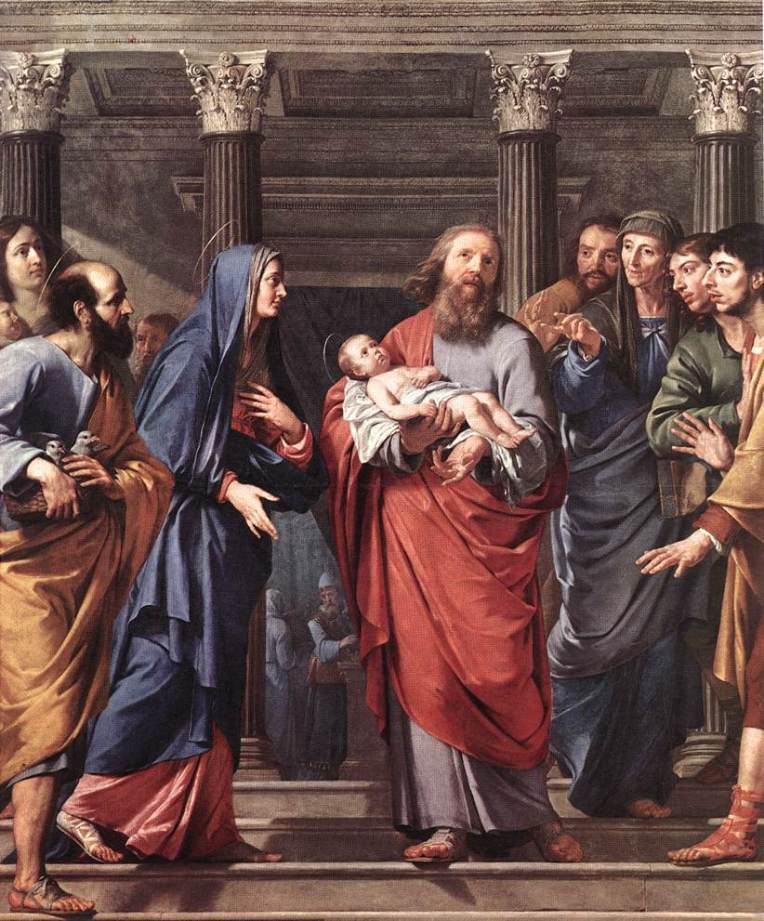
Presentation - Philippe de Champaigne

Saturday of the 3rd Week in Ordinary Time [II]

Saturday of the 3rd Week in Ordinary Time [II]
II Samuel 12:1-7,10-17  +  Mark 4:35-41
February 1, 2020

“Who then is this whom even wind and sea obey?”

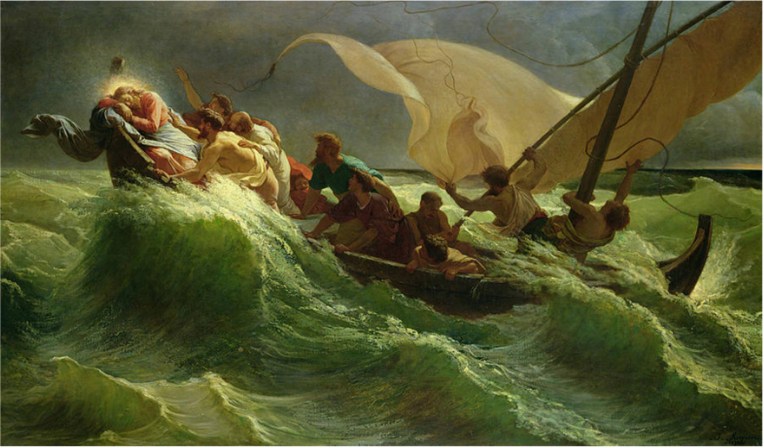
Is today’s lesson not to wake Jesus?  The miracle in today’s Gospel passage seems to be Jesus rebuking the wind and sea, resulting in “great calm”.  However, it’s not only the wind and sea that Jesus rebukes.  Perhaps more important is Jesus’ rebuke of His disciples.

Jesus chooses not to calm the disturbance in His disciples’ souls in the same manner that He calms the sea and wind.  But He does challenge them:  “Do you not yet have faith?”  His rebuke of the elements and of His disciples seems to have a meritorious effect on them.  “They were filled with awe” at His power over the elements.  But is this the faith He demanded of them?

It’s only natural to be impressed at the power of nature, and of God’s power over nature.  It’s something supernatural, however, to allow God to have power over oneself.  This is the sort of faith Jesus is asking for from His disciples.  Faith is a gift freely given, but it’s also a gift that must be freely accepted.  Jesus will not calm our souls without our consent, or rather, our faith in His power to do so.  The disciples marvel at Jesus as one “whom even wind and sea obey”.  Even more marvelous, however, is a disciple who obeys Jesus as His Lord.

OT 03-6

Friday of the 3rd Week of Ordinary Time [II]

Friday of the 3rd Week of Ordinary Time [II]
II Samuel 11:1-4,5-10,13-17  +  Mark 4:26-34
January 31, 2020

“This is how it is with the Kingdom of God ….”

Jesus today proclaims two parables about the Kingdom of God.  In wanting to understand these parables, we might wonder what exactly the Kingdom of God is.  Is the Kingdom of God the realm of Heaven, or is it the Church, some measure of both, or something else entirely, such as the individual Christian’s soul?

Jesus never directly addresses this question.  But even without defining “the Kingdom of God”, we can say that the kernel of each “Kingdom parable” describes in some way the reality of Heaven, and/or the Church, and/or the Christian’s soul.

Take Jesus’ second parable in today’s Gospel passage.  The change from the “smallest of all the seeds” to “the largest of plants” seems more easily applied to the Church and the Christian soul than to Heaven.  Tertullian wrote that “the blood of the martyrs is the seed of the Church”, a phrase through which we can see how this parable applies to the Church.  With God, all things are possible:  from a natural death, springs supernatural life.  Or as the Church prays to the Father in one of the prefaces for martyrs at Holy Mass:  by “your marvelous works” “in our weakness you perfect your power / and on the feeble bestow strength to bear you witness….”

OT 03-5

Thursday of the 3rd Week in Ordinary Time [II]

Thursday of the Third Week in Ordinary Time [II]
II Samuel 7:18-19,24-29  +  Mark 4:21-25
January 30, 2020

“The measure with which you measure will be measured out to you ….”

Jesus proclaims two truths for reflection today.  Both might at first hearing seem to discourage the virtue of humility.  But each prepares us for greater service to our Lord.

When Jesus in today’s Gospel passage notes that a lamp is meant to be “placed on a lampstand”, He does not specifically refer to His disciples here as “the light of the world”, as He does in Matthew’s account of the Sermon on the Mount.  Nonetheless, Mark’s text makes the inference clear.  Disciples are not meant to hide themselves, their belief, or Christ from others in the world.  On the contrary, they are called to share the Good News!  This clearly stands in conflict with a culture dominated by moral and religious relativism.

When Jesus in today’s Gospel passage notes that to “the one who has, more will be given” and “from the one who has not, even what he has will be taken away”, some might accuse Jesus of sounding like Wall Street tycoons.  Jesus just doesn’t sound fair.  But what God gives, He gives for others:  if He gives me a grace or charism, it is for others.  Only in being faithful to serving others with what I have may I hope someday to reach Heaven.  So in someone being given more, he is commanded to greater service of God and His people.

OT 03-4

Wednesday of the 3rd Week in Ordinary Time [II]

Wednesday of the 3rd Week in Ordinary Time [II]
II Samuel 7:4-17  +  Mark 4:1-20
January 29, 2020

“But those sown on rich soil are the ones who hear the word and accept it and bear fruit….”

Given that Saint Mark’s Gospel account—the shortest of the four—focuses more on Jesus’ actions than His preaching, we ought to take special note of the preaching that Mark does choose for inclusion in his Gospel account.  We might consider the parables Mark includes as a “best of…” list.

Today’s Gospel passage has three parts.  The first and the last are Jesus’ proclamation of a parable, and the parable’s explanation.  In between, Jesus briefly explains His general purpose in preaching through parables.  Most of the fourth chapter of Mark consists of parables, and today’s Gospel passage consists of the first twenty verses of Mark 4, so today’s parable is of primary importance.

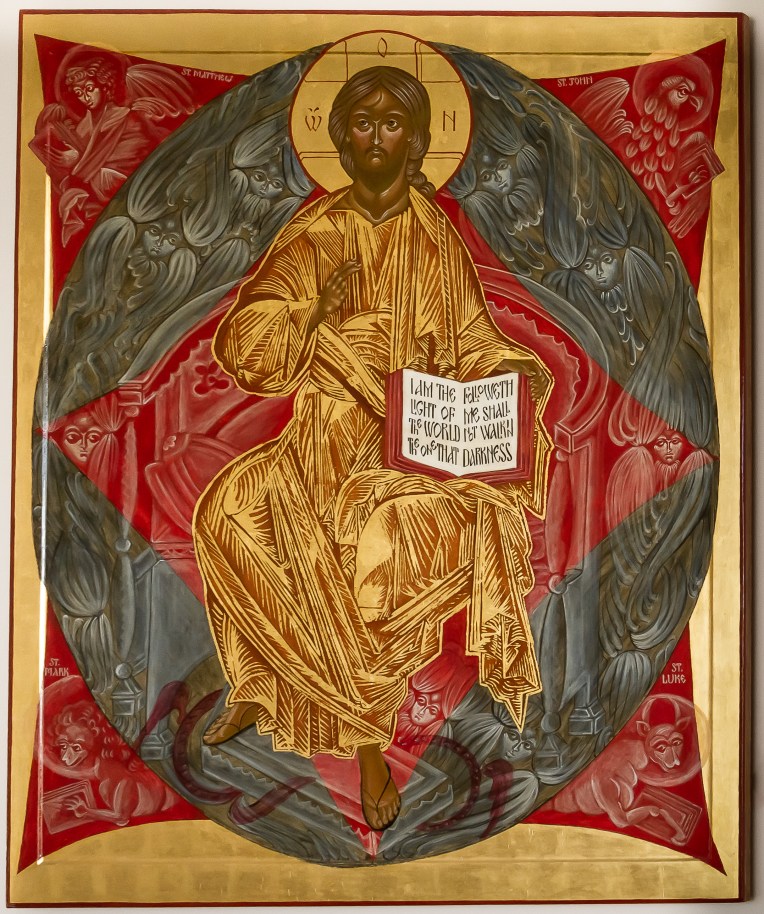
The Parable of the Sower, Mark’s telling of which is a mere six verses, has inspired dissertations hundreds of pages long.  Like the mustard seed (to allude to a different parable), its size belies its potential.  To choose one simple facet of today’s parable:  who is the sower?  There are at least two answers.  The parable can be thought of in terms of the sower being either God the Father, or you as an individual.  Here consider the former scenario.

The sower is God the Father.  He sows His Word (God the Son) prodigally.  What seems like foolishness or imprudence in His manner of sowing is in fact a measure of His love’s depth.  He offers His Word even to those of us whose souls are rocky or otherwise inhospitable.  The challenge here is for each individual to till the soil of the soul, or otherwise clear and tend it as needed to allow the word to take root there.

Jesus_Christ_Parable_of_the_Sower_Hand-Painted_Byzantine_Icon_04

St. Thomas Aquinas, Priest & Doctor of the Church

St. Thomas Aquinas, Priest & Doctor of the Church
II Samuel 6:12-15,17-19  +  Mark 3:31-35
January 28, 2020

“For whoever does the will of God is my brother and sister and mother.”

The heart of today’s Gospel passage is “the will of God”.  Jesus explains that doing the will of God is what forms the bonds of kinship within God’s family.  In doing so, Jesus is not downplaying the significance of His Blessed Mother or any other blood- or legal relatives.

Consider the distinctions that Jesus is and is not making here.  Ask yourself why God the Father chose the young Mary to be the Mother of God.  Wasn’t it because her response at the Annunciation—“Let it be done unto me according to thy word”—is the perfect embodiment of understanding and carrying out the will of God?

When you pray the rosary today and meditate on the Sorrowful Mysteries, ask Our Lady for an outpouring of grace from her Son.  Ask her that you might use this strength not for your own desires, but only to accomplish what the Lord deems necessary in your life to draw you and those you love closer to Him.

Fra Angelico Virgin Mary with Aquinas CROPPED

Today is the obligatory memorial of Saint Thomas Aquinas.  Click HERE to learn more about his sacra doctrina.

Monday of the 3rd Week in Ordinary Time [II]

Monday of the 3rd Week in Ordinary Time [II]
II Samuel 5:1-7,10  +  Mark 3:22-30
January 27, 2020

“And if a house is divided against itself, that house will not be able to stand.”

Jesus’ parables most often describe the Kingdom of God.  But today He preaches about the Kingdom by what in theology is called a “via negativa”:  that is, describing someone or something by what he, she or it is not, rather than what he, she or it is.  Jesus today describes what the Kingdom of God is not in rebutting the claims of the scribes.

The chief point of the parables we hear Jesus preach today is that Satan can have no place in the Kingdom of God.  He begins by debunking the scribes’ claim with simple logic.  But Jesus moves by the end of today’s passage to a “via positiva”, in which He points out why Satan can have no place within the Kingdom:  because the Kingdom is the dwelling place of the Holy Spirit, the new creation in which the Holy Spirit hovers over the face of the Kingdom [see Genesis 1:2].

Still, in our own day we have to put Jesus’ parables in context.  We cannot help but realize that the Kingdom of God which Jesus so often preaches about is not strictly identical with the Church that Jesus founded when He walked this earth.  Would that it were so!  How clearly we can see the sins of members of the Church.  Through these sins, the absence of the Holy Spirit makes itself known.  Our sins can be forgiven, and our charity can point to the Kingdom of God, but both are possible only through the power of the Holy Spirit.

Ot 03-1