Monday of the 2nd Week in Ordinary Time [II]

Monday of the Second Week in Ordinary Time [II]
I Samuel 15:16-23  +  Mark 2:18-22
January 20, 2020

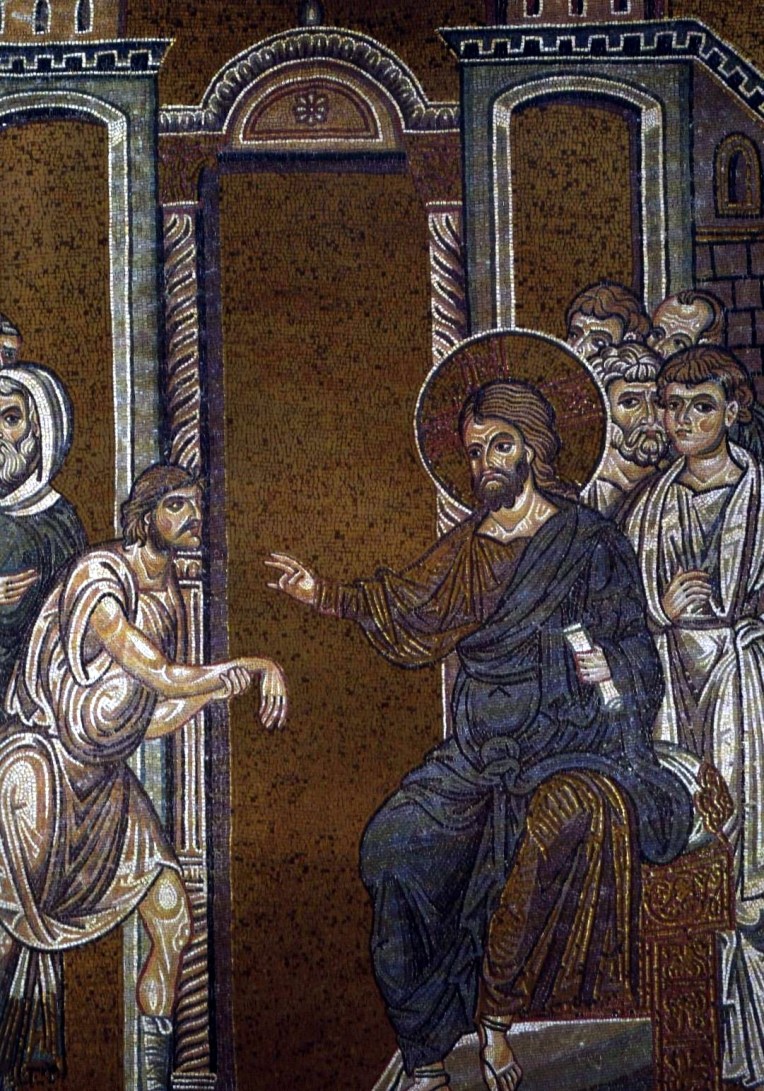
“…the days will come when the bridegroom is taken away from them….”

Today’s Gospel passage might seem confusing to those who wish to be devout Christians.  Along with the contrast between Jesus and John, there is a contrast between feasting and fasting.  Jesus’ disciples in this passage do not fast because He is with them.  Should Christians today, then, take part in the discipline of fasting?  Or would fasting imply a denial of Jesus’ presence in our lives?

Jesus gives us the key to applying this contrast to our own lives as 21st century disciples.  He explains, “the days will come when the bridegroom is taken away from them, and then they will fast on that day.”  But what exactly is “that day”?  In one sense, we could consider “that day” to be Good Friday, when Jesus offered His life to death.

But in a broader sense, you and I need to understand “that day” as referring to the lives of all members of the Body of Christ here below in this vale of tears:  all of us who are members of the Church Militant here on earth.  It’s true that through Baptism and the other sacraments which we worthily receive, Christ dwells in our souls.  Through these sacraments He conforms us as members of His Mystical Body.  Yet as wayfaring pilgrims on earth, we are called to fast.  We fast because our share in Christ’s life is not full.  Only in Heaven may we feast fully on the life of God as members of the Church Triumphant.

OT 02-1

The 2nd Sunday in Ordinary Time [A]

The Second Sunday in Ordinary Time [A]
Isaiah 49:3,5-6  +  1 Corinthians 1:1-3  +  John 1:29-34
January 19, 2020

Here am I, Lord; I come to do your will.

+     +     +

click HERE to hear Scott Hahn’s reflection for this liturgical Sunday (2:59)

click HERE to watch Jeff Cavins’ reflection for this Sunday (5:30)

click HERE to read the homily of Monsignor Charles Pope for this Sunday

click HERE to watch the homily of Archbishop Charles Chaput for this Sunday (26:43)

+     +     +

click HERE to read Pope Francis’ 2017 homily for this Sunday

click HERE to read Pope Emeritus Benedict’s 2007 Angelus address about St. John the Baptist

click HERE to read St. John Paul II’s 2001 Angelus address for this Sunday

+     +     +

Our Scriptures this Sunday help us set our own lives within the grander scheme of things.  That grander scheme is called “Divine Providence”.  One way to describe Divine Providence is to say that it’s what God chooses to do, when He does it, and why He does it.

Divine Providence is at the heart of the Scriptures of Holy Mass during the first several weeks in Ordinary Time.  Following the Season of Christmas, which ended last week with the Baptism of Jesus, we turn to consider our own baptism.

When you were baptized, the promises that were made started a relationship where God is your Lord, and you are His servant.  Or at least, that’s what it’s supposed to be like.  We hear several different examples of this servant-Lord relationship in today’s Scriptures.  Each is a model for us, and the last is also something more.

First, Isaiah was called to serve the Lord as His prophet.  “The Lord said to [Isaiah]:  ‘You are my servant.  …  I will make you a light to the nations, that my salvation may reach to the ends of the earth.’”  Among all the Old Testament prophets who proclaimed the coming of God’s justice, Isaiah had a unique place.  His calling was to prepare for the coming of a Messiah who offers loving mercy that knows no bounds and that would “reach to the ends of the earth.”  Although none of us has been called to be a prophet like Isaiah, there is something in his vocation that ought to be mirrored in our own vocations:  namely, loving mercy that knows no bounds.

Second, Paul was called to serve the Lord as His apostle.  Today’s Second Reading is simply the first three verses of a letter written by Saint Paul:  it’s not the longest of his letters, but it’s one of the more profound.  His self-introduction focuses upon his calling as an “apostle”, which literally means “one who is sent”.  He describes himself this way:  “Paul, called to be an apostle of Christ Jesus by the will of God”.

Paul was sent “by the will of God” to spread the Messiah’s Gospel to the Gentiles, the very people that Isaiah had served by preparing them for the Messiah.  Although none of us has been called to be an apostle like Paul, there is something in his vocation that ought to be mirrored in our own vocations:  namely, serving as “one who is sent”.

That Messiah whose coming Isaiah proclaimed, and whom Paul was sent forth to preach about, is of course Jesus.  Jesus, like Isaiah and Paul, was called by God to serve.  Yet Jesus is not only an example for us, as are Isaiah and Paul.

Jesus was called by God the Father to serve as the Savior of mankind.  We hear about this call within today’s Gospel Reading.  This call connects to today’s Responsorial Psalm, and especially its refrain.  The refrain can help you rest in God’s Divine Providence, instead of wrestling against it.

“Here am I, Lord; I come to do your will.”  Although the word “I” appears twice in this single verse, it’s not the focus of the verse.  The focus is God’s Providential Will and one’s submission to it:  that is, one’s willingness to be His servant.  Most of us, when we pray, actually speak to God as if He’s our servant:  in effect saying, “Here I am, Lord; now come and do my will.”

One of the chief ways that Christians experience God’s Providential Will is unanswered prayers.  In fact, these are often God’s gifts to us, whether we acknowledge them as such or not.  Tragically, some Christians stop following Jesus because their prayers aren’t answered as they want.  But silence on God’s part can be His way of demanding patience and perseverance.  This silence clarifies what’s important to God for the unfolding of His Providential Will.

Yet whether in accepting God’s silence or in moving forward to carry out His Will, we need to recognize a distinction.  Not only are we to imitate Jesus in His example of doing His Father’s Will in all things.  As Christians, we are meant to live in Christ.

We are not meant to live “in Isaiah” or “in Paul”, as much as we ought to follow their respective examples.  But each of us is meant to live “in Christ”.  This is not something that the Christian can accomplish through human effort or good works.  Only God can accomplish this.  His chief means for doing so are the Sacraments and grace given within personal prayer.  For our part, we need to work at disposing ourselves for reception of these divine gifts.  God’s gifts allow Christ to live in us, and allow Christ to say through us:  “Here am I, Lord; I come to do your will.”

St. John the Baptist - Behold 04

Saturday of the 1st Week in Ordinary Time [II]

Saturday of the First Week in Ordinary Time [II]
I Samuel 9:1-4,17-19; 10:1  +  Mark 2:13-17
January 18, 2020

All the crowd came to Him and He taught them.

In today’s Gospel passage from the second chapter of Mark, Jesus lays part of the foundation for his public ministry.  The events of today’s Gospel passage took place not long after Jesus’ Baptism, which inaugurated His public ministry.  The last sentence of the passage holds several clues for us about Jesus’ earthly mission.

“I did not come to call the righteous but sinners.”   If we took these words at face value, we might consider “the righteous” to be the Pharisaic scribes who provoked these words from Jesus.  Obviously the scribes considered themselves righteous.  But like Jesus’ parables and so much else in His preaching, there is a paradox at work.  Jesus turns the popular notions of who is righteous and who is a sinner on their heads.

We could certainly not say that the tax collectors and other “sinners” were made righteous simply by the act of physically dining with Jesus.  But the physical proximity, and the closeness it suggests, symbolize that neither Jesus nor the “sinner” shuns the other’s company.  We cannot receive spiritual and moral righteousness from Jesus if we don’t spend time with Him, especially in the banquet of the Eucharist.  To shun him there would be to stand like the scribes, aloof and self-righteous.

OT 01-6

St. Anthony, Abbot

St. Anthony, Abbot
I Samuel 8:4-7,10-22  +  Mark 2:1-12
January 17, 2020

Many gathered together so that there was no longer room for them ….

In today’s Gospel passage Jesus has many followers.  “Many gathered together so that there was no longer room for them”.  This might seem to make Jesus a popular person, successful in ministry.  But within today’s Gospel passage there is a confusion of aims.  The aim of the friends of the paralytic was his physical healing.  Jesus does not dismiss their effort, but he sub-ordinates it to a higher aim:  the forgiveness of sins.

Jesus could have spent His three years of public ministry only working physical cures and raising people from the dead.  Had he stuck to these aims alone, He would have remained popular.  There’s no telling how successful He might have become in the eyes of the world!

But it was not for fifteen minutes of fame that Jesus came into our world of sin and death.  It was to die that He dwelt among us.  Give thanks that Jesus shows us how to put our mission above popularity, and how to put the aim of death before that of earthly life.

The paralytic lowered from the roof, Jesus and an apostle. Mosaic (6th)

Thursday of the 1st Week in Ordinary Time [II]

Thursday of the First Week in Ordinary Time [II]
I Samuel 4:1-11  +  Mark 1:40-45
January 16, 2020

[Jesus] remained outside in deserted places ….

In today’s Gospel passage, we hear that Jesus “remained outside in deserted places, and people kept coming to him from everywhere.”  Jesus’ “retreat” is not that of a hermit.  Jesus’ frequent journeys to deserted places was a prudential distancing himself from those He came into this world to serve.  Jesus wanted at times simply to be in prayerful communion with His Father.

At the same time, perhaps Jesus knew that the people He was sent to serve needed a “breather”.  It’s hard for us to imagine what it was like to hear the Word of God preach the Good News, or work stupendous miracles.  We may imagine that because we’ve seen movies portraying such events, that we have an idea what it was like for those first-century folk.  If so, we underestimate the power of the Word of God made Flesh, and overestimate the power of cinema.

Often implicitly, and sometimes directly, Jesus says that the crowds are misunderstanding Him, even praising Him for the wrong reasons.  Some distance between Him and them, then, was prudent so that the crowds might reflect in their minds and hearts on the mysteries of Christ.  Of course, in the end, the crowds called for His death:  “Crucify him!  crucify him!”  So also have we ourselves cried by our sins.  But within the desert of Calvary Christ offered His life, so that throughout all ages to come, people might keep coming to Him from everywhere.

OT 01-4

Wednesday of the 1st Week in Ordinary Time [II]

Wednesday of the First Week in Ordinary Time [II]
I Samuel 3:1-10,19-20  +  Mark 1:29-39
January 15, 2020 

Rising very early before dawn, He left and went off to a deserted place, where He prayed.

In the light of Simon’s pursuit of Jesus and his informing Jesus that “everyone” is looking for Him, two actions of Jesus stand out.  Both actions show the falsity of Simon’s claim.

The fact that this passage begins with the cure of Simon’s mother-in-law gives us a glimpse into his way of thinking.  As more persons are cured, and as word spreads, Simon is convinced that “everyone” is looking for Jesus.

But “rising very early before dawn,” Jesus prayed in a deserted place.  In that “desert” He entered into communion with His Father.  His Father is primary to Jesus in an ultimate manner.  His Father is also primary to the crowds that Simon calls “everyone”.

When Simon makes his claim to Jesus, He responds by explaining the need to “go on to the nearby villages”.  Simon is parochial in his thinking, while Jesus wants no one excluded.  At this point in His public ministry, Jesus is preaching and healing “throughout the whole of Galilee.”

As those three years continue, the effects of His ministry spread out in waves.  Ultimately, His ministry culminates in His self-sacrifice on Calvary.  Jesus’ prayer in today’s Gospel Reading foreshadows His prayer in Gethsemane after the Last Supper.  Jesus offers His self-sacrifice on Calvary for all mankind throughout all of human history.  This is the “everyone” whom Jesus was sent by His Father to serve.

OT 01-3

Tuesday of the 1st Week in Ordinary Time [II]

Tuesday of the First Week in Ordinary Time [II]
I Samuel 1:9-20  +  Mark 1:21-28
January 14, 2020

“What is this?  A new teaching with authority.”

Twice in today’s Gospel passage we hear the word “authority”, both times applied to Jesus.  In both cases, astonishment or surprise is evoked by the fact that Jesus teaches with authority.  Why is there this astonishment, and what does it mean for Jesus to teach with authority?

In the culture that surrounds us, every person believes himself to be his own authority.  In effect, this wide-spread belief means that no real authority exists.  In our society there is a great need for clarity about the meaning and purpose of authority.

At its most literal level, the word “authority” comes from the word “author”.  The author of a novel can create worlds of his own design from his imagination.  Laws of physics need not apply.  Strange creatures can exist, and fantastic events are commonplace.  Tolkien, Baum and Rodenberry are all authors in this sense.  They have the authority to create worlds and races of creatures, and to confer life upon individuals and to take it from them.  However, this is merely a fictional form of authority.  In reality, there is only one Author of creation.

Jesus, as God from God and Light from Light, is this divine Author.  Through His divinity He has authority.  He exercises this authority throughout the three years of His public ministry for various persons, and for all mankind on Calvary.  However, in the face of His exercise of divine authority, astonishment arises for varied reasons.

Most cannot believe that a mere man could exercise divine authority.  Jesus, of course, was not merely a man, even though He was fully so.  In our own lives, we should not be astonished by the authority of Jesus.  We should root our daily lives in His desire to grant us His grace.

OT 01-2

Monday of the 1st Week in Ordinary Time [II]

Monday of the First Week in Ordinary Time [II]
I Samuel 1:1-8  +  Mark 1:14-20
January 13, 2020

“Come after me, and I will make you fishers of men.”

Today is a day of beginnings.  Today as we begin the season of Ordinary Time we hear from the beginning of the Gospel account of Saint Mark.  It points us to our ultimate end:  the embrace of God the Father.

Christ sustains all things by his powerful word, whether those things recognize the source of that power or not.  But for those who recognize Christ as the Son of God, He does infinitely more.  For those who all willing to abandon everything in this world—even the earthly fathers who reared them—Christ confers the power to share everlasting life, to be sustained in the life of God the Father forever.

Such men are the apostles Andrew and Simon, James and John.  They leave everything to go off in his company, having received a commission to become “fishers of men.”  They are called to share in the life of Christ, and at this point, they have no idea what this will entail.  This is how beginnings always are:  we have no real idea of what is going to transpire in the future.  If these four men had known that each of them would share deeply in the suffering of Christ—three of them, through martyrdom, and Saint John, at the foot of the Cross—it is unlikely they ever would have left their boats.

At the beginning of this season of Ordinary Time, let us pray for the grace to be faithful to the calling which we entered into through our Baptism.

OT 01-1

The Baptism of the Lord [A]

The Baptism of the Lord [A]
Isaiah 42:1-4,6-7  +  Acts 10:34-38  +  Matthew 3:13-17
January 12, 2020

Here is my servant whom I uphold, my chosen one with whom I am pleased ….

+     +     +

click HERE to watch a Sophia SketchPad video on the Sacrament of Baptism (6:39)

click HERE to read the homily of Monsignor Charles Pope for this Feast

click HERE to watch the homily from the Cathedral in Phoenix, Ariz. for this Feast (16:24)

+     +     +

click HERE to read Pope Francis’ 2017 homily for this Feast

click HERE to read Pope Emeritus Benedict’s 2011 homily for this Feast

click HERE to read St. John Paul II’s 2001 Angelus address for this Sunday

+     +     +

The word “Trinity” does not appear even once in the New Testament.  Of course, that doesn’t mean that the New Testament doesn’t teach us a lot about the Trinity.  Today’s Gospel Reading is a case in point.

In St. Matthew the Evangelist’s description of the Baptism of the Lord Jesus, all three Persons of the Trinity reveal Themselves.  God the Father reveals Himself only by speech.  We know that He’s the Father because He identifies Himself in terms of His relationship with His Son, declaring, “This is my beloved Son, with whom I am well pleased.”

God the Holy Spirit also reveals Himself in terms of His relationship with God the Son.  After Jesus’ baptism, “the heavens were opened for him, and he saw the Spirit of God descending like a dove and coming upon him.”  We might wonder what St. Matthew means by describing the Holy Spirit’s descent as being “like a dove”.  The first quality suggested by this metaphor is gentleness, a quality that through the Holy Spirit’s descent is related to Jesus.

In today’s Gospel Reading, St. John the Baptist alludes to the fact that Jesus does not need to be baptized.  In fact, Jesus no more needed to be baptized than He needed to descend from Heaven to earth.  He did both for the same reason:  “for us men and for our salvation”, as we profess in the Creed.

The whole of today’s feast, reveals to us the gifts that the Christian receives through the Sacrament of Baptism.  Simply put, all of these gifts are shares in the life of the Most Holy Trinity.  Yet some of them could be described as negative; others, positive.  That is to say, the gifts that God gives in Baptism both destroy and build [see CCC 1262].

The former are more simple and, in a sense, less important.  When a human sinner is baptized, all sin within that person is destroyed:  both the Original Sin that is inherited, and any actual sins committed by that individual.

But that washing away of moral and spiritual dirt is only a preparation.  God has something even greater in store for the baptized Christian:  in fact, a new creation [see CCC 1265].

The relationships that we see the Father and the Holy Spirit sharing with the Son in today’s Gospel Reading are also shared with the Christian through baptism.  God the Father adopts the Christian as His own child “in Christ”.  Likewise, the Holy Spirit bestows His fruits and gifts upon the baptized “in Christ”.

More specifically, the Catechism notes three key ways, among others, in which God builds up the Christian through Baptism.  The first is “sanctifying grace, the grace of justification”, which enables the Christian “to believe in God, to hope in him, and to love him through the theological virtues” [CCC 1266].

The second is membership in the Mystical Body of Christ:  the Church.  As one member of Christ’s Body, the Christian shares in Jesus’ priestly, prophetic and kingly missions.  The Catechism specifically notes that “Baptism gives a share in the common priesthood of all believers” [CCC 1268], expanding upon St. Peter’s exhortation:  “like living stones be yourselves built into a spiritual house, to be a holy priesthood, to offer spiritual sacrifices acceptable to God through Jesus Christ” [1 Pt 2:5].

Unfortunately, this “common priesthood”, sometimes called the “baptismal priesthood”, is one of the most misunderstood gifts in the Church today.  Some promote clericalism by encouraging laypersons to act as clerics, instead of giving due honor to the “spiritual sacrifices” proper to the baptismal priesthood:  self-sacrifice in the family’s home, in the business’ boardroom, on the factory’s floor, and in the public square.

The third key gift of Baptism is that the Holy Spirit through Baptism marks the Christian with the “seal of the Lord” [CCC 1274].  This seal marks the Christian as irrevocably being destined for God in Heaven.  Of course, this mark is a mark of the Christian’s destiny, not of her salvation.  The Gospel does not teach that the Christian who is once saved is always saved, or who is once baptized is always saved.  Salvation depends upon perseverance “in Christ”:  both living and dying “in Christ”.  The Catechism attests that no “sin can erase this mark, even if sin prevents Baptism from bearing the fruits of salvation” [CCC 1272].

The Baptism of the Lord in the Jordan River reveals to man the loving relationships that God the Son shared with the Father and the Holy Spirit from all eternity.  At His Baptism, Jesus did not receive but revealed.  He revealed who He is in relation to the other divine Persons of the Trinity.  In this, He revealed the inheritance that’s destined for each baptized Christian who lives and dies “in Christ”.

Baptism of the Lord