The Twenty-eighth Sunday in Ordinary Time [A]

The Twenty-eighth Sunday in Ordinary Time [A]
Isaiah 25:6-10  +  Philippians 4:12-14,19-20  +  Matthew 22:1-14

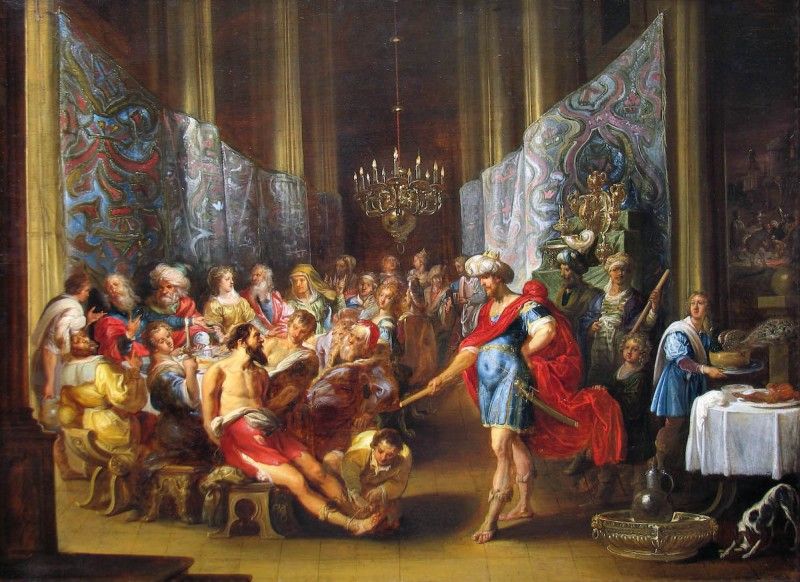
“My friend, how is it that you came in here without a wedding garment?”

+     +     +

references to the Catechism of the Catholic Church cited for this Sunday by the Vatican’s Homiletic Directory:

CCC 543-546: Jesus invites sinners, but demands conversion
CCC 1402-1405, 2837: the Eucharist is the foretaste of the Messianic Banquet

+     +     +

In today’s Gospel Reading we hear of a wedding feast hosted by a king.  As we’d expect, the feast reflects his personality.  We’re given hints of how lavish it was.  Yet this earthly king symbolizes God the Father.  Just as the king’s earthly feast is a feast fit for a king, so the divine feast that it symbolizes is a feast befitting God:  an infinite feast.  In other words, the feast in the parable symbolizes Heaven itself.  Jesus preaches this parable to help those listening imagine what Heaven is like.

In describing “the kingdom of Heaven”, the parable first explains Heaven’s seating capacity, if you will.  God wants everybody there, even though not everyone may end up there.

Yet we also need to focus on an even more important feature of the wedding feast before reflecting on the parable’s action.  The wedding feast is the king’s in the sense that he’s the one who gave it.  However, the wedding feast is given in honor of the king’s son.  This son symbolizes Jesus, of course.

So what does this tell us about the Kingdom of Heaven?  We might turn to the Book of Revelation, where St. John the Evangelist describes Heaven as the wedding feast of the Lamb of God.

The multitudes in Heaven sing eternal praise to the Lamb who was slain.  We ourselves refer to this right before Holy Communion.  The priest elevates the Sacred Host and declares:  “Behold, the Lamb of God ….  Blessed are those called to the supper of the Lamb.”  Our response acknowledges that God’s forgiveness of our sins is our ticket to entering this wedding supper:  sacramentally at Holy Mass, and—hopefully—in Heaven forever.

If you and I make it to Heaven, we will spend the rest of eternity praising the Lamb of God.  This is the Lamb who was slain so that our sins could be washed in His blood.  In other words, God offering us forgiveness is His invitation to share in the wedding feast of Heaven.

With this as background, what are we to make of the violence in the parable?  The violence flies in two directions.  The second is on the part of the king, who acts in retribution.  Jesus issues a warning to us here that His Father is not just some sort of teddy bear, but rather a Just Judge.  On a practical level, though, the first form of violence is more important for us to reflect on.

The parable’s invited guests symbolize all of mankind.  Man has heard God’s desire that “all peoples” and “all nations” enter into the wedding feast of Heaven.  Nonetheless, they may enter only through confession of their sins.  Here we need to understand the parable’s invited guests as including ourselves.

Yet we also need to ask who the servants are, and how we can understand the violence done to them.  Those who deliver to you and me God’s invitation to repentance may be other persons:  for example, a spouse, a parent, a priest, an employer, a neighbor, a grandparent, or a friend.  Unfortunately, we want spouses who compliment us, priests who tickle our ears from the pulpit, and friends who will tell us about the faults of others, rather than our own.

We may not be accustomed to think of Heaven as a wedding banquet.  Most of us are accustomed to think of Heaven as the fulfillment of our own greatest wishes, hopes, and desires.  Nonetheless, there’s one important truth that is left out of today’s parable.  Jesus didn’t leave it out because He was a poor teacher, but because we’re slow learners.

You and I are the bride at this wedding feast.  We are not only invited guests, but we are invited to espouse our selves to the King’s Son!  Although we’re familiar with the idea that the Church is the Bride of Christ, we may not be used to reflecting on ourselves as being espoused to Jesus Christ.  But consider that truth in the light of today’s parable.  Jesus died for His bride.  His invitation to us is to accept His death—the price of our forgiveness—as the means of union with Him.  It’s through this union that He invites us into the eternal wedding feast of Heaven.

Thursday of the Twenty-seventh Week in Ordinary Time [II]

Thursday of the Twenty-seventh Week in Ordinary Time [II]
Galatians 3:1-5  +  Luke 11:5-13
October 8, 2020

O stupid Galatians!

This week and early next, we are hearing from the letter that Saint Paul wrote to the people in the region of Galatia.  It’s not hard to tell that Saint Paul was unhappy when he wrote his Letter to the Galatians.  Saint Paul wrote thirteen of the letters in the New Testament, and only in this letter, to the Galatians, does Saint Paul call people “stupid”.  It must be something very serious that the Galatians have done to be called this by a saintly apostle.

The mistake that Saint Paul is trying to correct is about the Galatians thinking that they are going to get to heaven only because of what they do.  The Galatians think that they are “making” the Holy Spirit present in their lives because of their good choices.

Instead, Saint Paul teaches, echoing the Gospel, that everything begins with God.  Our good works are accomplished only because of the time and talent that God gave us.  The Holy Spirit comes into our lives through the divine virtue of faith.  Even within the Trinity, the Holy Spirit comes from the love of God the Father and God the Son for each other.

Everything begins with God.  Jesus in today’s Gospel passage is teaching us about one specific type of prayer.  There are four basic types of prayer (there are others as well, but these are the four main types).  One way to remember them is to think of the word “pact”, as in an agreement.

The word “pact” has four letters.  Each letter stands for a different type of prayer.  The first of these—“p”—stands for “petition”.  We should ask God for whatever we believe we most need in life.  Sometimes God does not answer our prayers the way we want:  but this helps us grow spiritually, too, because when one of our prayers doesn’t get answered the way we wanted, it’s a chance for us to learn once again that God gives us not what we want, but what we need.

Our Lady of the Rosary

Our Lady of the Rosary
Galatians 2:1-2,7-14  +   Luke 11:1-4
October 7, 2020

“Father, hallowed be your Name, your Kingdom come.”

Every Christian knows by heart the ‘Our Father’:  the only recited prayer that Jesus taught to His followers.  But the ‘Our Father’ that we know in our hearts—which we pray at every Mass before receiving Holy Communion, and which we pray several times throughout the course of a rosary—is not exactly the ‘Our Father’ that we have just heard Jesus teach in today’s Gospel passage.

The version of the ‘Our Father’ that Luke records for us is shorter than the version that we know by heart. Maybe this shorter version is the first version that Jesus taught to his followers, much the same way that a teacher introduces just the key points first, and then later fleshes it out some more.

In this shorter version of the ‘Our Father’, there are three petitions that Jesus teaches us to pray.  In the silence following Holy Communion, of after Mass, or in your home, read and pray this shorter version, and see what the three petitions are.  What are the three things that Jesus teaches us to ask of our Heavenly Father?

Tuesday of the Twenty-seventh Week in Ordinary Time [II]

Tuesday of the Twenty-seventh Week in Ordinary Time [II]
Galatians 1:13-24  +  Luke 10:38-42
October 6, 2020

“Mary has chosen the better part and it will not be taken from her.”

In discussing, or learning about, the Catholic Faith, there’s often talk about how the Faith’s saving mysteries have a “both/and” dynamic at work.  The Church does not believe in reaching Heaven by “faith alone”; nor does she believe that one can earn Heaven by means of good works.  The Church’s perennial approach to the dynamic between faith and good works is “both/and”.  Likewise, Jesus is not a God who appears to be human, nor a human being that appears divine.  Jesus Christ is “both/and”:  fully divine and fully human.

Today’s Gospel passage raises another central duality among the Church’s saving mysteries.  The Church preaches that in the life of each Christian, both prayer and good works are vital to the Christian life.  Yet the point that Jesus makes in this passage is one of primacy.

Prayerful abiding at the feet of Jesus is primary in the Christian life.  Good works—even those done for Christ Himself—are secondary.  In turn, taking Jesus’ lesson here to heart helps us see that within every duality among the saving mysteries, one of the two is always prime.  Faith is primary to good works.  Jesus’ essential divinity is primary to His assumed humanity.  The Old Testament prepares for and is fulfilled by the New Testament.  The Liturgy of the Word prepares for and is consummated by the Liturgy of the Word made Flesh.

Our Christian faith challenges us to give ourselves over fully to all of the Church’s saving mysteries, yet to root our self-sacrifice in what is primary.  Striving to serve and striving to good works demands that we live like the sister of Martha:  beginning all we do with giving all we are in listening to Jesus.

Today is the feast of St. Bruno, founder of the Carthusian Order.

Monday of the Twenty-seventh Week in Ordinary Time [II]

Monday of the Twenty-seventh Week in Ordinary Time [II]
Galatians 1:6-12  +  Luke 10:25-37
October 5, 2020

“Teacher, what must I do to inherit eternal life?”

Today we hear one of the more famous parables of Jesus.  The Parable of the Good Samaritan ought profoundly to shape our spiritual and moral lives.  That order of things is important, however:  spiritual and then moral.

Although in a deeper sense there ought not be a distinction between our spiritual and moral lives, on the practical level, differences do mark the two.  We might say that the two are most sharply distinguished by sin.  The “scholar of the law” who “wished to justify himself” wants to be moral, but not spiritual.  Jesus demands that he be both, and that he be moral by being spiritual.

Mercy is the means by which the moral life is wedded to the spiritual life.  Or rather, mercy is the means by which the spiritual life begets authentic moral choices.  Were we not all children of Adam and Eve, fallen creatures, our moral choices would not demand mercy.  But in this world of sin and corruption, mercy is divine charity’s common currency.

In our spiritual lives, we look on each of our fellow human creatures through the eyes of God the Father.  We love each sinner, beaten and wounded by the sins of himself and others, with the mercy through which the Father sent His innocent Son to be slain for us.  Through this love, we can choose to serve the broken, bind the wounded, and know that in this service we serve God as well.

Saturday of the Twenty-sixth Week in Ordinary Time [II]

Saturday of the Twenty-sixth Week in Ordinary Time [II]
Job 42:1-3,5-6,12-17  +  Luke 10:17-24
October 3, 2020

“… you have revealed them to the childlike.”

It’s rare for Jesus, in any of the four Gospel accounts, to speak directly to God the Father.  Because of this rarity, we ought to privilege those verses where we get to “overhear” Jesus address His divine Father.  We might even consider these verses as models for our own prayers, inasmuch as through Baptism we are adopted children of God the Father.

First, we ought to note the context of Jesus’ words to God the Father.  The 72 disciples have returned to Jesus rejoicing that demons are subject to them because of Jesus’ name.  However, Jesus tells them not to rejoice because of such power over demons, but to rejoice instead because their names are written in Heaven.  Jesus is subordinating the disciples’ ministry—as important as it is—to the relationship that each has with the One Jesus teaches them to address as “Our Father, who art in heaven”.

Also, it’s important to note that St. Luke the Evangelist immediately prefaces the words of Jesus to God the Father with the observation that Jesus “rejoiced in the Holy Spirit”.  This is significant because St. Luke, more than the other three evangelists, stresses the role of the Holy Spirit in the life and ministry of Jesus Christ.  Here, the words by which Jesus praises the Father are spoken “in the Holy Spirit”.  As the Holy Spirit is the love of God the Father and God the Son for each other, so by the Holy Spirit each adopted child of God finds the inspiration to pray to God more fervently and authentically.

The Holy Guardian Angels

The Holy Guardian Angels
Job 38:1,12-21;40:3-5  +  Matthew 18:1-5,10
October 2, 2020

“… their angels in Heaven always look upon the face of my heavenly Father.”

Our Guardian Angels shed light upon the path that we must walk.  When our struggles each day seem too great, they extend a ray of hope down upon us from God.  They allow us to see the face of Our Crucified and Risen Lord, who having shared in our suffering helps us share in His Resurrection, even in the midst of suffering.

Our Guardian Angels guard us from the snares of our enemies.  As the Devil tries time and again to convince us that his way—easier and broader than God’s—is the way that will bring us happiness, our guardians remind us that the Way of the Cross is the only path to the Father.

Our Guardian Angels rule us as we slip from the narrow path.  As we fall prey to the temptations of the Devil, our guardians do not abandon us.  Sharing in the boundless love of our Savior, they do not fail to stand by us even then.  They convince us, as they nurse our consciences back to health, that the Cross is the only true remedy for our constant falling away from God.

Our Guardian Angels guide us by bidding us to share in the sacraments of the Church.  For all their power, our guardians entrust us to the care of Holy Mother Church, since in her care we most truly belong.  For the Church is their Mother, too.  All the angels are fellow members of the Church, and as the Church’s children we imitate the words of Jesus when like little children we recognize and thank those who are our guardians.

The Twenty-seventh Sunday in Ordinary Time [A]

The Twenty-seventh Sunday in Ordinary Time [A]
Isaiah 5:1-7  +  Philippians 4:6-9  +  Matthew 21:33-43

The vineyard of the Lord is the house of Israel.

+     +     +

references to the Catechism of the Catholic Church cited for this Sunday by the Vatican’s Homiletic Directory:

CCC 755: the Church as God’s vineyard
CCC 1830-1832: gifts and fruits of the Holy Spirit
CCC 443: prophets are the servants, Christ is the Son

+     +     +

Parables are often puzzling and intended to get under your skin.  This Sunday’s parable is no exception.

The parable’s setting is a vineyard, which in the words of Sunday’s Responsorial refrain, symbolizes “the house of Israel”:  that is, the great mass of God’s chosen People; or in other words, the “Family of God”.

Within the vineyard are several actors.  The parable’s landowner symbolizes God.  The tenants symbolize those at whom Jesus is aiming the parable:  that is, those whom God had entrusted with the care of the vineyard.  So if the vineyard is Israel, then the tenants are the leaders of Israel.  Among them are the chief priests and elders mentioned as Jesus’ audience.  Why, then, is Jesus trying to get under their skin?  What does Jesus think that they’re doing wrong?

You’ve all heard the saying, “Too many chiefs and not enough Indians.”  Likewise:  “too many cooks spoil the broth.”  Those sayings get at the problem that Jesus was addressing.  The leaders of Israel were no longer listening to the founder of Israel.

But who was the founder of Israel?  Was it King David?  Moses?  Abraham?  No, the founder of Israel is the Lord God of Hosts.  The Psalmist says as much in today’s Responsorial, when he cries out:  “O Lord of Hosts … take care of this vine, and protect what your right hand has planted”.

But the chief priests and elders had forgotten the place of the Lord in their lives.  They thought that they were the masters of Israel, rather than its shepherds; that they were the landowners, rather than the tenants; that they were the lords of the manor, rather than the stewards.  Jesus’ parable warns them to be better stewards.

The action of the parable demonstrates just how topsy-turvy these stewards are.  Believing that they’re the masters of the situation justifies, in their minds, their beating and stoning of the landowner’s messengers, and finally, their murder of his son.

Of course, you and I know how this parable foreshadowed the events of Holy Week.  The chief priests, elders, and other leaders of Israel are not willing to give up the claim to be masters.  So when they come face-to-face with Jesus, who is the rightful heir to the throne of Israel, there’s bound to be conflict.  Like the son in the parable, Jesus is seized and put to death.  Jesus is the “stone that the builders rejected” which “has become the cornerstone”.

At the end of today’s Gospel Reading, Jesus—with divine fore-knowledge—foretells the consequence of Israel’s rejection of Him.  Jesus speaks formally and almost solemnly, declaring:  “Therefore, I say to you, the kingdom of God will be taken away from you[,] and given to a people that will produce its fruit.”  Who is this new people?

This new people is the body of Jesus’ followers:  the Mystical Body of Christ.  Jesus is the cornerstone of this new foundation.  The Church that Jesus founded is the new Israel.  This is the body of Christians to which you and I belong.  Jesus was speaking of you and me when He foretold that the “kingdom of God [would] be… given to a people that will produce its fruit.”

But the question in front of us today is whether we are producing spiritual fruit within the vineyard of the Church.  The Church chose this parable for proclamation at this Sunday’s Mass not so that you and I could learn a history lesson about the opposition that Jesus faced two thousand years ago.  We hear this parable today in order to allow it to get under our skin.

Saying “Yes” to God’s call isn’t the same as bearing fruit.  It’s on the latter that God will judge us at the moment each of us dies.  Merely belonging to Church doesn’t mean entrance into Heaven.  Maybe you and I are taking as much for granted as those elders and chief priests.

To make a good examination of conscience in this regard, and to consider how we might go froth and bear fruit in the Lord’s vineyard, we might reflect on two questions this week.  First how much time do we spend in the Lord’s vineyard; and second, what does it mean to be a steward?

Parable of the Wicked Husbandmen by Marten van Valckenborch the Elder (1535–1612)

St. Thérèse of the Child Jesus, Virgin and Doctor of the Church

St. Thérèse of the Child Jesus, Virgin and Doctor of the Church
Job 19:21-27  +  Luke 10:1-12
October 1, 2020

“The harvest is abundant but the laborers are few ….”

The Church often quotes from today’s Gospel passage in her promotion of vocations.  However, these seventy-two to whom Jesus speaks are appointed and sent for a specific reason.  They are sent “ahead of” Jesus, not in His name or in His person.  They are sent “in pairs to every town and place He intended to visit.”  They are “advance teams”, if you will.  In the general sense in which they are sent ahead of Jesus, we can consider these 72 as symbolizing all baptized Christians.

Jesus offers many brief sayings in today’s Gospel passage.  Many can be singled out and meditated upon for a long period of time; for example:  “behold, I am sending you like lambs among wolves.”  It’s not difficult for a Christian disciple to use these words falsely:  that is, as a justification for self-righteousness in the face of any opposition.  Nonetheless, that possibility doesn’t nullify the meaning of Jesus’ words.  At our best, we disciples are “lambs among wolves”.

While a Christian might be tempted to turn away from this “vocation” to be a lamb, we ought to take solace in two simple Gospel truths.  First, Our Savior is the Good Shepherd [John 10:11].  Second, He is also the Lamb of God who takes away the sins of the world [John 1:29].  Yet both of these titles that Our Savior bears make sense only within the shadow of the Cross.

St. Thérèse of the Child Jesus, Virgin and Doctor of the Church