September 19, 2017

Tuesday of the Twenty-fourth Week in Ordinary Time [I]
1 Timothy 3:1-13  +  Luke 7:11-17

…a bishop must be irreproachable, married only once, temperate, self-controlled, decent, hospitable, able to teach….

Today’s First Reading, from St. Paul’s first epistle to St. Timothy, speaks to the lived reality of Holy Orders in the apostolic church.  There are three “orders” (sometimes called “grades” or “degrees”) of the Sacrament of Holy Orders.  St. Paul speaks today of the first and the last. Continue reading →

September 18, 2017

Monday of the Twenty-fourth Week in Ordinary Time [I]
1 Timothy 2:1-8  +  Luke 7:1-10

“I tell you, not even in Israel have I found such faith.”

With few exceptions, the translation of the Mass introduced in 2011 has been hailed by bishops, scholars and folk in the pews for its advances over the hurried translation made soon after Vatican II.  One of the key improvements in the translation is its greater fidelity to Sacred Scripture.  Today’s Gospel passage offers an example. Continue reading →

The 24th Sunday in Ordinary Time [A]

The Twenty-fourth Sunday in Ordinary Time [A]
Sir 27:30—28:7  +  Rom 14:7-9  +  Mt 18:21-35
September 17, 2017

Wrath and anger are hateful things, yet the sinner hugs them tight.

The great British convert and apologist G. K. Chesterton once said, “Forgiving means to pardon the unpardonable, or it is no virtue at all.”  By contrast, you and I often are willing only to forgive if we deem someone’s sins not too serious or offensive.  Today Jesus challenges us to go further in being instruments of His mercy.

One way to realize to what extent we ought to extend mercy to others is to turn the table.  We ought each day to consider how much God Himself has blessed us in showing us His mercy.  We ought to reflect on how each day we act sinfully, in a way that calls for God’s mercy.

All of us long to find a place where we are at home, where we are trusted.  But even more importantly, we long to find a place where we can be forgiven, for we know that there are times when we fail to live up to the trust that people place in us.  We might ask ourselves, “Which is more important to me:  trust or forgiveness?” Continue reading →

Sts. Cornelius and Cyprian

Sts. Cornelius, Pope, and Cyprian, Bishop, Martyrs
1 Timothy 1:15-17  +  Luke 6:43-49
September 16, 2017

“For every tree is known by its own fruit.”

The first of Jesus’ brief parables today might seem-evident.  He instructs us that a
“good tree does not bear rotten fruit, nor does a rotten tree bear good fruit.”  Yet some reflection suggests an argument against this lesson. Continue reading →

Our Lady of Sorrows

Our Lady of Sorrows
1 Timothy 1:1-2,12-14  +  John 19:25-27
September 15, 2017

“Woman, behold, your son.”

All our joys, all our sorrows, all our glory is only found in Christ:  that is to say, because we are members of Christ’s Body.  It is not true that you have your cross, and I have mine.  We all bear together—as individual members of Christ’s Body—the Cross of Jesus.  We all share in carrying His Cross. Continue reading →

The Exaltation of the Holy Cross

The Exaltation of the Holy Cross
Num 21:4-9  +  Phil 2:6-11  +  Jn 3:13-17
September 14, 2017

…He humbled Himself, becoming obedient to death, even death on a cross.

We know that silence can be deafening.  Sometimes silence is very embarrassing, as when a teacher asks a question about something you’ve been studying for weeks, and no one knows the answer.

On the other hand, silence can be a very good thing.  It is in silence that the highest kind of prayer happens.  St. John of the Cross is supposed to have said that silence is God’s native language.  Regardless, there are many different ways to pray:  one of the first ways that we learn to pray is made up of prayers that others teach us, like the “Our Father”, the “Hail Mary” or the “Glory Be”.  Prayers like these let us pray together as a group, so that we’re praying the same thing at the same time.

Other times, though, we pray on our own, and so we make up our own words in prayer.  In this kind of prayer—which is like a conversation with God—we can say anything we want.  We don’t have to remember the right words to pray:  we just pray from our heart, and offer to God whatever is most on our mind. Continue reading →

St. John Chrysostom

St. John Chrysostom, Bishop and Doctor of the Church
Colossians 3:1-11  +  Luke 6:20-26
September 13, 2017

“Woe to you when all speak well of you.”

“Woe to you when all speak well of you.”  These words of Jesus seem at first hard to reconcile with the honors we confer on the canonized saints of the Church.  If we took the words of Jesus literally, then the praise given the saints would be wrong.  And what of our speaking well of Christ Himself? Continue reading →

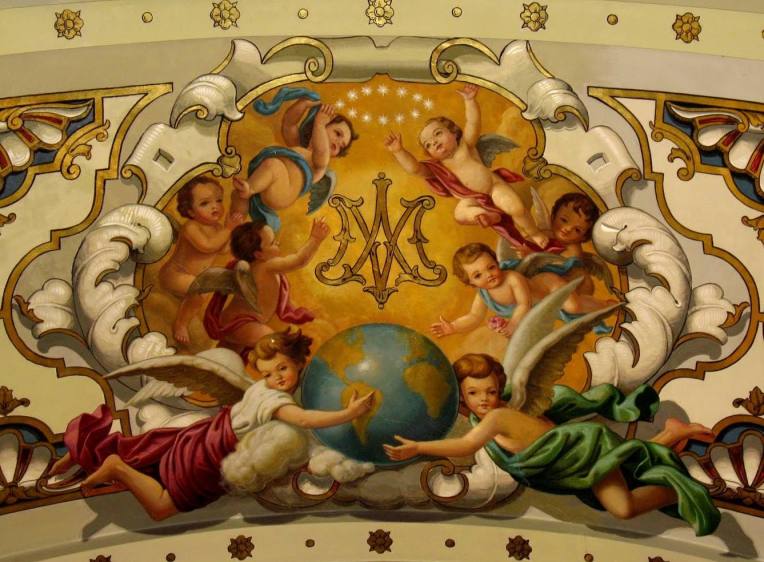
The Most Holy Name of Mary

The Most Holy Name of Mary
Galatians 4:4-7  +  Luke 1:39-47

“Most blessed are you among women, and blessed is the fruit of your womb.”

“From the rising to the setting of the sun is the Name of the Lord to be praised.”  The Third Eucharistic Prayer alludes to this verse of Psalm 113, when the priest prays to the Father: “you never cease to gather a people to yourself, so that from the rising of the sun to its setting a pure sacrifice may be offered to your name.”  “…to your name.”

This liturgical allusion to Psalm 113 is echoed—and magnified—in another passage of Scripture which the Church prays in the Sacred Liturgy.  Every evening, at the setting of the sun when we as individuals grow tired and admit our need for rest, we gather to pray Vespers, during which we offer to God the words that Our Blessed Mother spoke at the time of her Visitation to her cousin.

Mary echoes Psalm 113, where the Psalmist prays that the Lord “raises up the lowly from the dust; from the dunghill he lifts up the poor.”  Mary echoes these words of the Old Testament when she praises the One whom she calls “God my savior, [who] has looked with favor of His lowly servant”, and again later praises Him who “has cast down the mighty from their thrones, and has lifted up the lowly.”  Thanks be to God for lowliness, through which we can see more clearly our need to praise the greatness of the Lord!

In our lowliness we may bless the Name of the Lord for ever.  Mary our Mother calls us, her child, to her side to pray in her words of the Magnificat.  The Lord has looked with favor on His lowly servant.  And she continues to lead us in prayer in these words:  “From this day all generations will call me blessed:  the Almighty has done great things for me, and holy is His Name.”

All generations will call me blessed.”  At every moment, the sun is setting somewhere on the face of the earth.  At every moment, Vespers is being prayed by Mary’s children, and speak her words from the Magnificat:  calling her blessed because of the great things that the Almighty has done for her.

Mary’s Name is holy because of the great things that the Almighty has done for her.  Mary’s Name is Most Holy because the Almighty chose her to bear in her soul and her body the Incarnate Word of the Father.  May her Most Holy Name be praised!  May our Mother draw us closer to herself, so that she might lead us in blessing the Name of the Lord for ever!
The Most Holy Name of Mary.jpg

September 11, 2017

Monday of the Twenty-third Week in Ordinary Time [I]
Colossians 1:24—2:3  +  Luke 6:6-11

In God is my safety and my glory.

We might want to reflect at today’s Mass on our nation commemorating the anniversary of terrorist attacks against our country.  It’s astonishing that religion was a driving force in the hearts of those who committed mass murder.  We ask ourselves how the murder of innocent people could be carried out in the name of God.  It seems like religion turned completely inside out. Continue reading →