The Seventeenth Sunday in Ordinary Time [A]
1 Kings 3:5,7-12 + Romans 8:28-30 + Matthew 13:44-52 [or Mt 13:44-46]
July 26, 2026
references to the Catechism of the Catholic Church cited for this Sunday by the Vatican’s Homiletic Directory:
CCC 407: cannot ignore wound of sin in discerning human situation
CCC 1777-1785: moral decision making in rapport with God’s will
CCC 1786-1789: seeking will of God in divine law in difficult circumstances
CCC 1038-1041: separation of good and evil at Judgment
CCC 1037: God predestines no one to hell
+ + +
Many years ago, an elderly lady in Scotland was so poor that the local townspeople had to support her. Her son had gone off to America, and become very wealthy. The neighbors often whispered to each other, “Why doesn’t John help his old mother?”
One day a neighbor suggested that she ask her son for help. The mother defended her son, saying: “John is thoughtful, but needs all his money. He’s a good boy. He writes to me every month, and with every letter he sends me postcards of America.” The mother reached for her Bible, saying to her visitor, “I save all his letters and put the postcards in the Good Book.”
These “postcards” displayed various scenes from the United States. One pictured Independence Hall in Philadelphia. Others showed the White House, the U.S. Capitol, and the U.S. Treasury. On the front of the “postcards” were portraits of famous Americans such as Benjamin Franklin, Ulysses S. Grant, Andrew Jackson, and Alexander Hamilton. Between the leaves of this mother’s bible, these “postcards” were in fact American currency worth thousands of dollars. She had a treasure but did not recognize it.
+ + +
Our lives are so crowded by activities and possessions that we often do not recognize the first of God’s great gifts to us: the human soul. People often don’t pay much attention to the soul because it’s unlike anything else in the world. It’s not red and shiny, it doesn’t glitter, and it doesn’t draw attention to itself. The greatness of the human soul is not its appearance. The greatness of the human soul is its capacity.
+ + +
The human soul is capable of bearing God’s grace. Grace is what allows us to share directly in the life of God. But if we don’t prioritize the life of grace, our lives will lack the order needed to be a strong Christian.
About 1,500 years ago, St. Augustine cried out to God that our human souls are restless, until they rest in Him. Many persons—even many Christians—spend years pursuing all sorts of material goods and pleasures. However, if we were wise like King Solomon in today’s First Reading, we would learn from experience after experience that nothing finite can satisfy infinitely.
Closer to our day than St. Augustine, the British author C. S. Lewis wrote about the blessing of God’s gift of wisdom. Through this divine wisdom, human persons can recognize—Lewis wrote—that “creatures are not born with desires unless satisfaction for those desires exists. A baby feels hunger,” Lewis explains, “[and] there is such a thing as food. A duckling wants to swim, [and] there is such a thing as water. …” And so, Lewis concluded, “if I find in myself a desire which no experience in this world can satisfy, the most probable explanation is that I was made for another world.”
The human soul is great because it is capable of bearing God’s grace. The human soul is a gift from God. God infuses the soul within the human person at the moment of conception. That soul, created in the Image and likeness of God, makes it possible for that person to receive God’s graces, each grace being a further gift from God. However, on our part, each of us has two responsibilities. Each of us must keep our soul in order, and each of us must seek out God’s graces.
+ + +
I’m sure that many of you watched the World Cup this summer. Competitions at that level of professionalism are awe-inspiring. We admire the talents of such athletes, although of course each victory represents years of tireless effort. Athletes spend hour after hour in practice, perfecting their athletic abilities and their mental concentration. Athletes don’t just hope that they’re going to achieve victory. They work hard to allow their gifts to bear fruit.
The spiritual life requires from you a similar level of dedication. God does not simply pour grace into your soul in the way that you pour gasoline into a car. You are not a machine. You, as a human person created in God’s Image and likeness, have to consciously make the decision to devote yourself each day to your spiritual life. God means for you to do this prayer, penance, the practice of the virtues, and devout reception of the sacraments. Our lives have to be oriented towards that treasure of grace—that pearl of great price—that share in God’s life.
+ + +
So this next week, as you spend time in prayer and reflection, keep these three points in mind. First, your human soul is the first of God’s gifts to you. Second, your human soul is a dwelling place for God’s grace. Third, your human soul must be kept in order.
The first of these two are truths to be grateful for, and are reasons to give thanks to God, especially each time you participate in the Holy Sacrifice of the Mass. The third point—devotion to prayer, penance, the virtues, and worthy reception of the sacraments—makes demands of us. But that effort, when fortified by God’s grace, greatly deepens our share in the life of Jesus Christ.
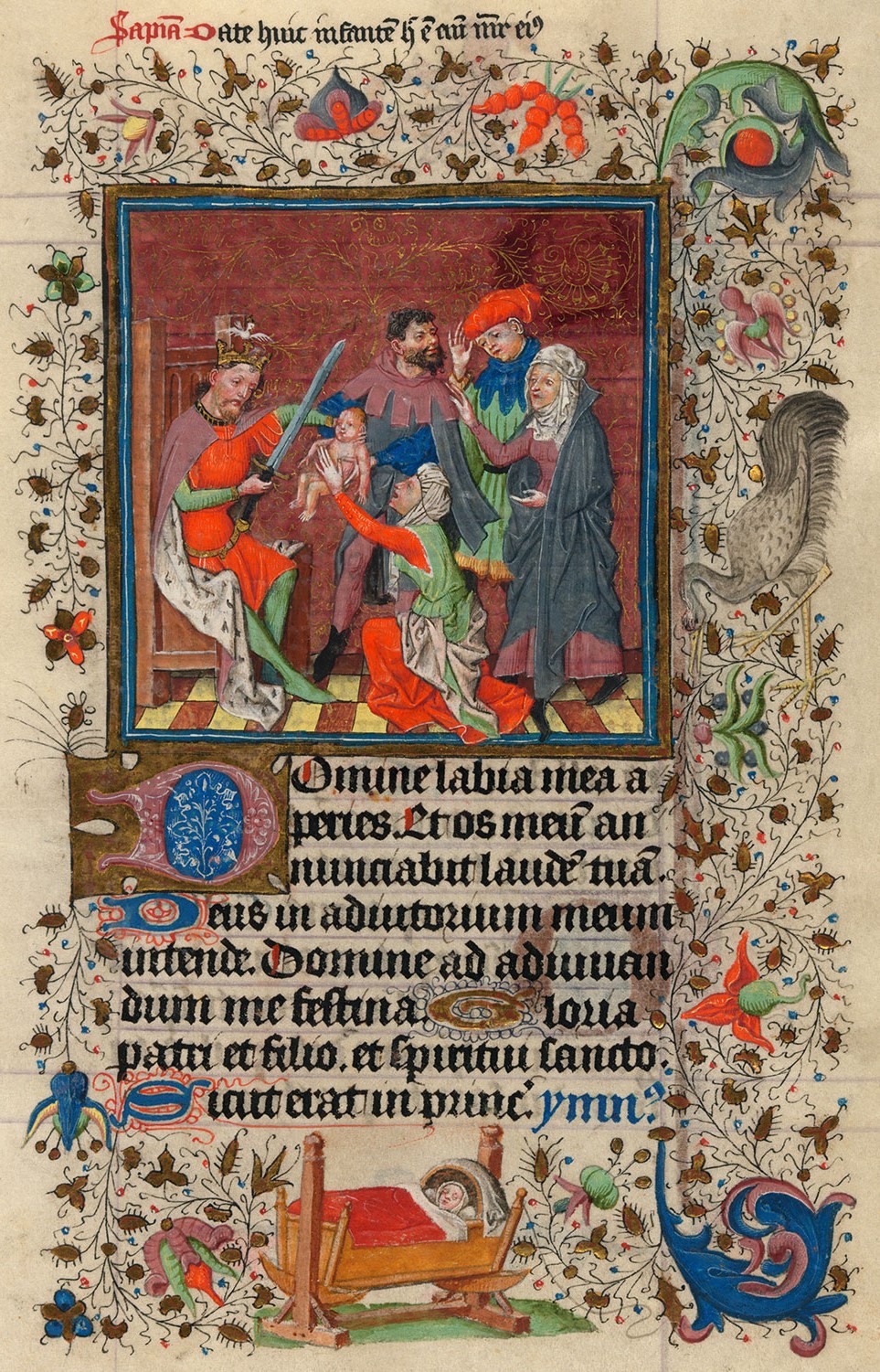
“The Judgment of Solomon” from The Hours of Catherine of Cleves (c. 1440)
The Morgan Library & Museum, MS M.917/945, p. 53

