Wednesday of the Tenth Week in Ordinary Time

Wednesday of the Tenth Week in Ordinary Time
Matthew 5:17-19 

“I have come not to abolish but to fulfill.”

This week we’ve begun to hear Jesus’ Sermon on the Mount, from the fifth chapter of St. Matthew’s Gospel account.  Jesus today sets the framework for the teachings He’s about to offer the disciples.  We could sum up this framework with these words:  “I have come not to abolish [the Law] but to fulfill.” 

Having said that, in the rest of today’s Gospel passage He strictly directs His disciples to integrity in their lives.  There must be integrity between, as we would put it today, what they practice and what they preach.  With this demand Jesus issues a warning and promise:  “whoever breaks one of the least of these commandments and teaches others to do so will be called least in the Kingdom of heaven”, while “whoever obeys and teaches these commandments will be called greatest in the Kingdom of heaven.”

Every Christian is, by virtue of baptism, called to be a teacher.  We remember St. Francis’ admonition to “preach always, and if necessary, use words.”  As each of us makes our nightly examination of conscience, we look for the integrity Jesus has asked of us, in what we’ve taught others by our actions and words.

Tuesday of the Tenth Week in Ordinary Time

Tuesday of the Tenth Week in Ordinary Time
Matthew 5:13-16

“But if salt loses its taste, with what can it be seasoned?”

In today’s passage from the Sermon on the Mount, Jesus calls His disciples “the salt of the earth” and “the light of the world”.  Either of these could serve you as the basis for a long period of meditation.  But consider just one aspect of what Jesus sets before you today.

Salt has long been used as a preservative of food.  So one might be tempted to consider Jesus’ image of “the salt of the earth” as meaning that Christians are called to preserve life.  In other words, Christians are called to preserve what we already have.  But the subsequent words of Jesus suggest otherwise.

Jesus speaks of salt in terms of its taste, as a seasoning.  As most of us know, salt isn’t meant to be tasted by itself.  Most of us would be repulsed by even the idea of putting a spoonful of salt in our mouths.  But it’s common to sprinkle salt liberally on one’s food in order to bring out the taste within the food.

Here we can reflect on Jesus’ image in terms of our own discipleship.  If Jesus’ disciples are “the salt of the earth”, Jesus is complimenting “the earth”.  There is value—taste—in the world because it was created by God.  Even though the world that we live in is fallen, our role as disciples involves bringing out what is good in God’s creation—cultivating that good—so that it might be elevated by God’s supernatural grace.

Monday of the Tenth Week in Ordinary Time

Monday of the Tenth Week in Ordinary Time
Matthew 5:1-12

“When Jesus saw the crowds, he went up the mountain ….”

Today the Church begins to proclaim Jesus’ Sermon on the Mount, found in chapters five through seven of St. Matthew’s Gospel account.  This proclamation at weekday Mass stretches from this day through Thursday of the Twelfth Week in Ordinary Time:  in other words, about two and a half weeks.

The majority of today’s Gospel passage consists of Jesus’ Beatitudes as recorded in Matthew.  St. Luke records a somewhat different version of the Beatitudes, which Jesus preached at another point in His three years of public ministry.  Entire books have been written about what Jesus teaches in these ten verses.  But reflect here upon the two verses that St. Matthew writes as a preface to the Beatitudes.

“When Jesus saw the crowds, he went up the mountain, and after he had sat down, his disciples came to him.  He began to teach them ….”  It might at first seem odd that Jesus goes up a mountain when He sees the crowds.  His ascent might seem to distance Himself from the crowds.  However, the mountains of the Holy Land are not like the Rockies, or even the Alps.  In ascending the mountain, Jesus puts distance between Himself and the crowds in order to project His voice to the whole of the crowd.

At the same time, Jesus’ ascent of the mount presents a spiritual truth.  While Jesus does consider Himself to be a friend of His disciples [see John 15:15], He is at the same time their Master.  As their Master, Jesus teaches His disciples with the authority of God Himself.  Jesus Himself, and His teaching, transcend anyone else and any other teaching found in this world.  In fact, only the teaching of Jesus can show us the Way that leads to the Father in Heaven.

Saturday of the Ninth Week in Ordinary Time

Saturday of the Ninth Week in Ordinary Time
Mark 12:38-44

“‘… but she, from her poverty, has contributed all she had, her whole livelihood.’”

We live in a society where values contrary to the Gospel are canonized.  A person’s value is measured in economic terms.  The poor are shunned as worthless.

God has a different set of values from those of our society.  When Jesus saw the wealthy putting large amounts of money into the collection box of the Temple, He was not impressed.  It was not as if the wealthy should not have given large sums, but Jesus was looking for something else.  He saw that something else in the poor widow who donated only two small copper coins.  He explains to us what He saw:  “[The wealthy] have all contributed from their surplus wealth, but she, from her poverty, has contributed all she had, her whole livelihood.”

It was the generosity of the widow that mattered, not the amount that she gave.  We are called to be generous people, unselfish in all our relationships with others.  God does not value us for giving our money; or, for that matter, for giving our time and talent.  God values us for the generosity from which our giving flows.  Generosity flows from the love that we receive in the celebration of the Holy Eucharist.

Friday of the Ninth Week in Ordinary Time

Friday of the Ninth Week in Ordinary Time
Mark 12:35-37

“The great crowd heard this with delight.”

Today’s Gospel passage is as unusual as it is brief.  The unusual nature of this passage of only three verses (or four sentences) is highlighted by the evangelist’s concluding observation that the “great crowd heard this with delight”.  What is it about Jesus’ words that delights them?

We have a clue to Jesus’ aim in His initial question:  “How do the scribes claim that the Christ is the son of David?”  Jesus’ subsequent words, then, seem a rebuke of the scribes.  Likely, the members of the crowd were not fans of the scribes, so that Jesus’ rebuke allows the crowd to delight in what they wished they themselves could do.

But Jesus never rebukes without wanting those rebuked to turn instead to the Truth.  Consider the content of Jesus’ rebuke.  Jesus is rebuking what the scribes claim about the Christ.  We know from the entire context of the Gospel that this claim is one basis by which Jewish leaders would put Jesus to death.  Jesus indeed is the Christ.  Jesus is the only begotten Son of God.

The delight of the crowd, then, is like the cheers of “Hosanna!” on Palm Sunday.  The crowd’s delight will be short-lived if this Christ who delights them today is tried tomorrow as a criminal.  Perhaps, however, the rebuke that Jesus issues today would ultimately bear fruit in the conversion of a scribe towards faith in the Word made flesh.

The Most Holy Body and Blood of Christ [B]

The Most Holy Body and Blood of Christ [B]
Exodus 24:3-8  +  Hebrews 9:11-15  +  Sequence + Mark 14:12-16,22-26

“This is my blood of the covenant, which will be shed for many.”

references to the Catechism of the Catholic Church cited for this Solemnity by the Vatican’s Homiletic Directory:

CCC 79010031322-1419: the Holy Eucharist
CCC 8059502181-218226372845: the Eucharist and the communion of believers
CCC 1212127514362837: the Eucharist as spiritual food

More than fifty years after the close of the Second Vatican Council, disagreements still simmer over the best way to interpret its teachings.  Disagreement is found is different areas of the Church’s life, such as marital morality and ecumenism.  Yet nothing engenders more disagreement than the celebration of the Eucharist.  Today’s feast of Corpus Christi can help us reflect upon the Church’s teachings about this most blessed of the seven sacraments.

One of the more confused ideas used to interpret the Council is that Holy Mass ought to be entertaining (for example, through its music or preaching).  During summer vacation, if you travel far enough outside our diocese, you might stumble upon Masses animated by the principle of giving the faithful what they want.

By contrast, the Church’s history shows a different approach:  give the faithful what they need, and do so by giving them what God has handed down.  There are two questions that have to be answered, then.  First, what do the Christian faithful most need?  Second, what has God handed down?

We’re not talking here about the sacraments’ inner essence, which is grace, but about their outer form, which the Church has the power to change to some extent.  Concerning the form of Holy Mass, what principle should shape it?  What would be wrong with elements drawn from popular entertainment, which clearly draw crowds marked by outer enthusiasm?

Some seem eager for great crowds and great outer enthusiasm in churches.  Yet the history of the Church, both ancient and modern, shows that when the Church sets the course of her mission according to numbers and outer enthusiasm, the Church bears little lasting fruit for lack of roots.  Consider that during the hours that Jesus was nailed to the Cross, the number of His followers was few, and they had little enthusiasm for the way He had trod.  Nonetheless, the Church knows that she is called to preach nothing but Jesus Christ crucified [see 1 Cor 2:2].

At the heart of this preaching is self-sacrifice.  If we want to know what the Christian faithful most need, then, we need to know self-sacrifice.  Jesus’ words at the Last Supper, when He instituted the Eucharist, reflect this central principle.  “This is my body, which will be given for you; do this in memory of me.”  “This is my blood of the covenant, which will be shed for many.”  These words of Jesus don’t reflect a spirit of entertainment, which indulges whatever the crowd currently cries for.

But how can a principle like self-sacrifice take concrete form within Holy Mass?  Consider the example of hymn lyrics.  Tally the proper nouns and pronouns in any given hymn.  Are most of them first-person (I, me, mine, we, us, ours), or do most of them refer to God?  Who is the focus of the hymn:  man or God?  A hymn that illustrates the principle of self-sacrifice sings more about God than man, and sings about man as fallen and redeemed by Jesus’ self-sacrifice on Calvary.

So if the faithful need chiefly from the form of Holy Mass a spirit of self-sacrifice, what, secondly, has God handed down to the Church to foster this goal?  The simplest answer is that He has given Himself, in Word and Sacrament.  God’s Word and the Sacrament of Corpus Christi shape the form of Holy Mass.  The content of the Mass shapes the form of the Mass.  Form follows function, and one of the functions of Mass is to form us into the likeness of Jesus Christ, and Him crucified.

If that seems a bit abstract, consider practical examples regarding the role of Scripture within Holy Mass.  With a few exceptions, most consider the fact that more of the Bible is read at Mass during the year to be a positive change made after the Second Vatican Council.  Yet two other modern changes distort—towards one extreme or the other—the place of Scripture within Holy Mass.

In some churches built or renovated after the Second Vatican Council, the altar and pulpit are positioned at equal distances from the sanctuary’s midpoint.  This arrangement suggests that the two chief parts of Holy Mass—the Liturgy of the Word and the Liturgy of the Eucharist—are of equal importance.  Yet the Church throughout her history has taught that the structure of Mass—like salvation history itself—contains a dynamism.  The first half of Mass prepares the faithful for the second half, as the Old Testament prepares God’s People for the New, where the Word becomes Flesh and dwells among us.

On the other hand, the modern change that gives prominence to hymns at Mass has come at the cost of the proclamation of Scripture.  In the form of Mass used before the Second Vatican Council, hymns didn’t supplant the singing of the scriptural antiphons (during the Entrance procession, the Offertory, and the Communion procession).  Each of them—antiphons and hymns—had its own place.  But the modern form of Mass allows these scriptural antiphons—which may be sung either in a brief form or in an extended form like the Responsorial Psalm—to be omitted altogether, impoverishing the faithful by substituting the human words of hymns for the divine Word of Scripture.

What the Christian faithful most need is what they most deeply want.  God has handed down to man through the Church what mankind most deeply wants:  self-transcendence through self-sacrifice.  The Church’s Sacred Liturgy inspires us, nourishes us, and fits us for self-sacrifice, and so for fitting praise to God for His own self-sacrificial love.

Thursday of the Ninth Week in Ordinary Time

Thursday of the Ninth Week in Ordinary Time
Mark 12:28-34

“‘There is no other commandment greater than these.’”

In in the Mystery of the Word made Flesh, God makes clear to us—in the flesh—not only His divine nature.  In his human life, God the Son makes clear to us the meaning of the Law of ancient Israel.  In the person of Christ Jesus, we learn how to fulfill the great teaching given our fathers in faith.

In particular, if we listen carefully to Our Lord’s summary of the Torah in today’s Gospel passage, we notice that along the same lines that there are two natures in the one person of Jesus Christ, so these two commands make but one single commandment.

Love, quite obviously, is the common denominator between these two commands:  “Love the Lord completely,” and “Love your neighbor as yourself.”  Understanding these two as one means having Christ at the center of our entire spiritual focus:  seeing in Christ our neighbor, and seeing in Christ our Lord and God.  And so we are to love others as Christ has loved us.  But we must even go one step further.  We are to love others so that others will love as Christ has loved us.  Not merely are we to give our lives for others.  We are to so have an effect on others that they in turn will do the same.  But how is this possible?  We cannot control the decisions of others.  Even if we love them they may hate us in turn.

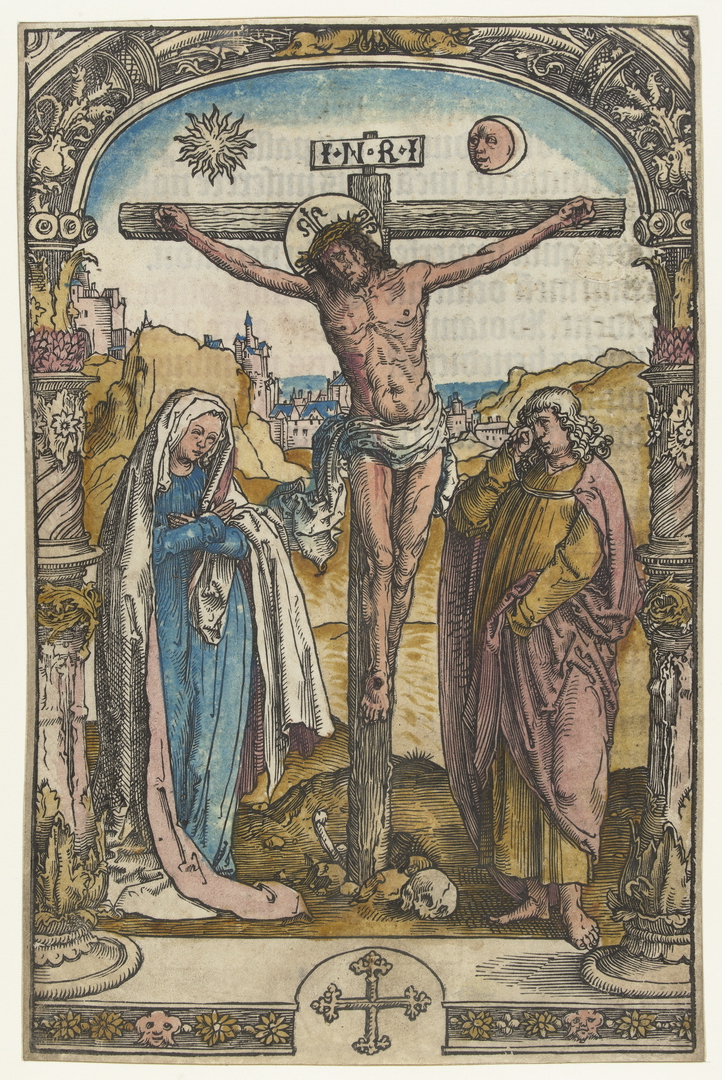
In artistic images of the Crucifixion, we see symbolically what Jesus is teaching in today’s Gospel passage.  In many such images, there are five persons:  two above, two below, and Jesus in the center of them all.  The two below are invariably Mary and John, who represent the human race for whom Jesus died:  Jesus’ human “neighbors”.  The above are only indirectly portrayed usually:  in such images, two angels stand for the other two Divine Persons, God the Father and God the Holy Spirit.  Among them all is Jesus Christ, true God and true man, who on the Cross shows us perfectly how to love God and neighbor at one and the same time.

Wednesday of the Ninth Week in Ordinary Time

Wednesday of the Ninth Week in Ordinary Time
Mark 12:18-27

“‘He is not God of the dead but of the living.’”

In today’s Gospel passage, Our Lord tries to make clear to the Sadducees the meaning of the Resurrection.  We too, however, even if we understand and believe in both the Resurrection of Our Lord and the promise of resurrection that God offers to all who die, perhaps may need to realize what type of claim the Resurrection places upon our Christian faith.

To believe in the Resurrection is to believe in the future fulfillment of God’s grace.  It is to understand that the suffering of the present is as nothing compared to the future glory to be revealed in Christ Jesus.  It is to guard in God’s name what has been entrusted to me until that final Day, which for each of us is the day of our death.

We never find Our Lord going into great detail about the nature of the afterlife.  There are two practical reasons for this.  First, the glory which will be the reward of God’s elect is too far beyond our comprehension.  Second, our only hope for sharing in that glory is to persevere in running the race which God has set before us, to stir into flame the gift of God each of us first received at our baptism, a flame in which we are purified like gold in the furnace.

Tuesday of the Ninth Week in Ordinary Time

Tuesday of the Ninth Week in Ordinary Time
Mark 12:13-17

“‘Repay to Caesar what belongs to Caesar and to God what belongs to God.’”

Jesus trips up the Pharisees and Herodians in today’s Gospel passage because of a dichotomy in their thinking.  They easily recognize the image of Caesar, but fail to see two even more clear images.  Focus on the first.

They fail to see Jesus as the divine Image of God the Father:  in other words, they don’t recognize Jesus’ divinity.  In addressing Jesus they say, “Teacher, we know that you are a truthful man”.  Then they assert of him, “You do not regard a person’s status but teach the way of God in accordance with the truth.”  In both statements they speak of Jesus in regard to truth (he is a truthful man and he teaches the way of God in accord with the truth) without recognizing that Jesus, as the divine Image of the Father, is the Truth made flesh.

We might be willing to pardon this, as no one else in the Gospel (excepting perhaps Mary, Joseph and the Baptizer) seems to recognize Jesus’ divinity, either.  This failure is at the heart of the drama in the Gospel, and reaches a climax on Calvary with Jesus’ cry:  “Father, forgive them, for they know not what they do”  [Luke 23:34].