Monday of the Eighth Week in Ordinary Time [II]

Monday of the Eighth Week in Ordinary Time [II]
1 Peter 1:3-9  +  Mark 10:17-27
February 28, 2022

“How hard it is for those who have wealth to enter the Kingdom of God!”

Why is it hard “for those who have wealth to enter the Kingdom of God”?  The Church does not teach that human wealth is evil in and of itself.  While some mistakenly think that Scripture says that money is the root of all evil, the correct quote from Saint Paul is that “the love of money is the root of all evils” [1 Timothy 6:10].

Nonetheless, that begs the question:  what is it about the love of money that turns the wealthy away from the Kingdom of God?  The Church teaches that pride is chief among the seven “capital sins”.

The “love of money”, then, must directly relate to pride.  Human wealth tempts the wealthy person to sin against both God and neighbor:  against the former because the wealthy person is tempted to feel no need for God; against the latter because the wealthy person is tempted to feel superior to the neighbor with less human wealth.  Money is enticing because so many different things can be possessed and accomplished by it.  But as with every material thing, money is meant to offer the Christian opportunities to serve both God and man.

Saturday of the Seventh Week in Ordinary Time [II]

Saturday of the Seventh Week in Ordinary Time [II]
James 5:13-20  +  Mark 10:13-16
February 26, 2022

“Let the children come to Me; do not prevent them ….”

Today’s Gospel passage immediately follows yesterday’s in Mark.  In yesterday’s passage Jesus spoke the truth that marriage cannot be dissolved by any human power, because through God’s power, husband and wife “are no longer two but one flesh” [Mk 10:8].  In today’s passage Jesus becomes indignant and declares:  “Let the children come to me; do not prevent them, for the Kingdom of God belongs to such as these.”

Is it a coincidence that this passage immediately follows Jesus’ teaching about the sacred integrity of Marriage?  The Church has taught for some two thousand years that openness to the begetting and rearing of children is integral to the growth of every marriage:  the intentional exclusion of this goal dissolves the integrity of the particular marriage.

Some might say that these two Scripture passages should not be linked.  Some might say that the point of today’s passage is that each Christian is called to be “child-like”.  In any case, marriage between two persons truly in love with each other and with God will bear the innocence and love for life seen in the child-like.

Friday of the Seventh Week in Ordinary Time [II]

Friday of the Seventh Week in Ordinary Time [II]
James 5:9-12  +  Mark 10:1-12
February 25, 2022

“So they are no longer two but one flesh.”

Today’s Gospel passage (corresponding to Matthew 19:1-9) is the springboard from which Saint John Paul II began his series of reflections titled “Man and Woman He Created Them: A Theology of the Body”.  This revolutionary series is often commented upon, but rarely read itself.  Even less often read are the words of Jesus at the end of today’s Gospel passage.

Divorce is commonplace in our society.  Many see it as a “necessary evil”, while others see it as a positively good choice or option.  However, Jesus is very clear.  Divorce from a valid marriage and subsequent remarriage is morally equivalent to adultery, with the difference that while adultery is a mortally sinful act, remarriage after divorce results in a mortally sinful state of life.

Nonetheless, Jesus puts this condemnation within a positive context.  He explains why marriage cannot be dissolved by any human person.  To claim the power to dissolve a marriage is to claim power over God.  To claim this power is to deny the essence of marriage:  that two have become “one flesh.”

The Eighth Sunday in Ordinary Time [C]

The Eighth Sunday in Ordinary Time [C]
Sirach 27:4-7  +  1 Corinthians 15:54-58  +  Luke 6:39-45

“Remove the wooden beam from your eye first ….”

When you make your nightly examination of conscience, and prepare monthly for the Sacrament of Confession, there’s a simple way to recollect yourself.  After all, if it’s been a long day or an even longer month, you might feel unsure how best to assess your efforts—and failures—to live your life in Christ.

This simple means of self-recollection is to remember that all the commandments of the spiritual life converge in Jesus Christ.  What does this mean?  Back up a minute and look at the bigger picture of the Ten Commandments.

Remember that God inscribed the Ten Commandments upon two tablets.  One tablet bears the first three commandments, which teach us how to love God.  The other tablet bears the latter seven commandments, which teach us how to love our neighbor.  All the commandments converge in Jesus because Jesus alone is both God and man.

In other words, to love Jesus as God is to fulfill the first three commandments.  If we do this authentically, then we love God the Father and the Holy Spirit with Jesus.  Likewise, to love Jesus as a fellow human is to fulfill the latter seven commandments:  if we do this authentically, then we love all our neighbors in Him.  This isn’t to say that we don’t at times need to focus our love specifically upon God the Father and the Holy Spirit, or upon individual neighbors.  But all of our loves, and all the ways in which we love, converge in Jesus Christ.

This Sunday’s Gospel passage offers a concrete example.  The imagery with which Jesus preaches seems only to be about loving our neighbor:  specifically, a sinful (“blind”) neighbor.  But since the two great commands of Jesus—to love God fully, and to love our neighbor as our self—converge in Him, we are not to look down on our sinful brother, but rather to look up at him.

Looking up to our sinful brother is possible by means of the Christian virtue of humility.  Christian humility is in one sense nothing more than honesty.  Both my brother and I are sinners.  We are equal in this.  But Jesus calls me to serve my brother as if I were serving Jesus Himself.  For this reason, from my state of sinfulness, I look up at my sinful brother.  From this stance, I may help him remove the splinter from his eye.

But how can I see Jesus in a sinner?  Jesus, of course, never sinned, yet God the Father “made [Jesus] to be sin”—in the phrase of St. Paul [see 2 Corinthians 5:21]—so that in my sinful brother I can see Jesus as the one whom I am to serve.

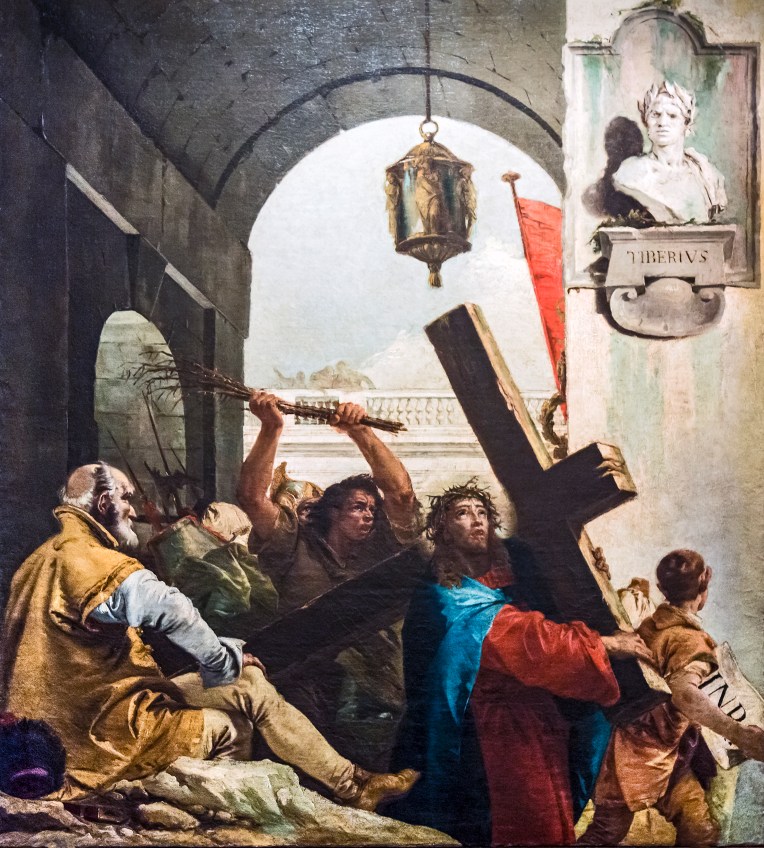
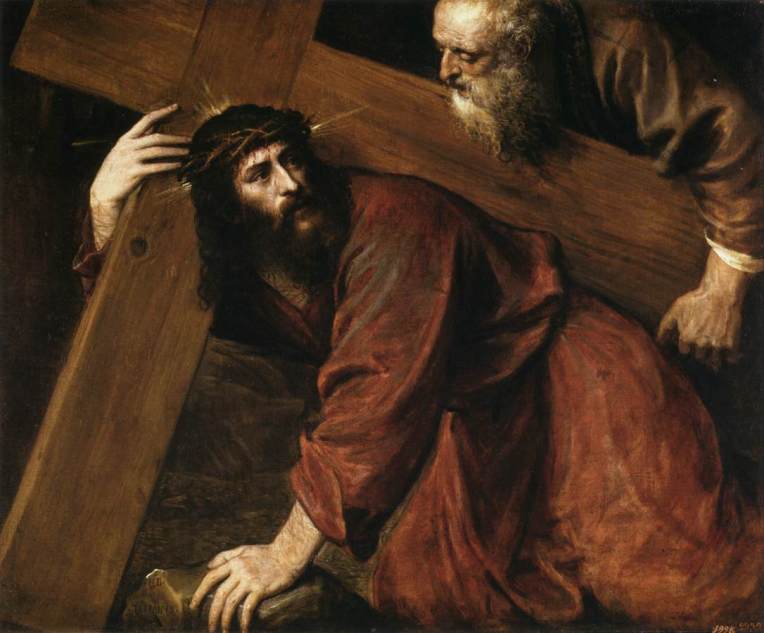
We think of Jesus carrying the Cross so that each of us can love God more easily.  Not as often, likely, do we think of how Jesus carrying the Cross can help each of us love our neighbor more easily.

Consider humility from a different perspective.  After all, it’s easy to be humble before God.  God is the Almighty Lord, eternal and all-knowing.  I, on the other hand, am a sinner whose failures show me every day how weak and ignorant I am.

The latter seven commandments can be more demanding, for we often convince ourselves that we don’t “owe” anything to our neighbors, least of all our love.  But the love who is God can reach down into the human will and conform it to His divine will, so that the human person loves as Jesus loves from the Cross.

G. K. Chesterton once wrote that “Charity means pardoning the unpardonable, or it is no virtue at all.” On Calvary, Jesus sacrificed His Body and Blood, soul and divinity not only for His Blessed Mother, the Beloved Disciple, and St. Mary Magdalen. He just as willingly sacrificed His whole self for those who nailed Him to the Cross, beat the crown of thorns into His Sacred Head, and scourged Him at the pillar.

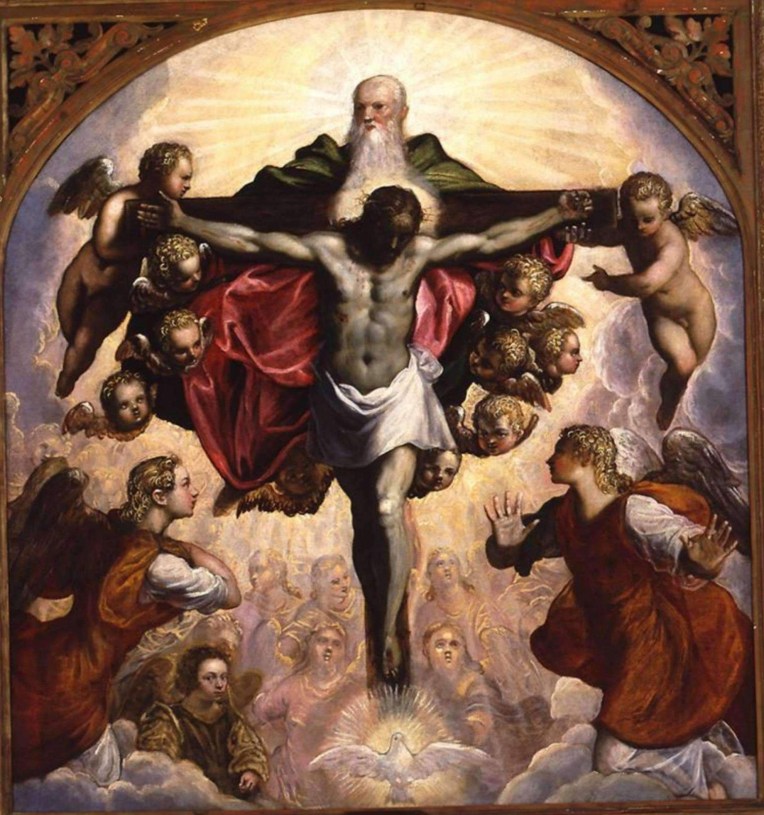
All of the commandments of the spiritual life converge in Jesus Christ.  Jesus reveals to us the love who is the Most Blessed Trinity, and through Jesus we share in that love.  Jesus reveals to us who man is called to be, but Jesus also through His vocation reveals the depths of human sinfulness, and through His love we embrace the sinner in Christ crucified.

Thursday of the Seventh Week in Ordinary Time [II]

Thursday of the Seventh Week in Ordinary Time [II]
James 5:1-6  +  Mark 9:41-50
February 24, 2022

You have fattened your hearts for the day of slaughter.

Today’s First Reading from the Letter of James makes the apostle sound like an Old Testament prophet.  While St. James is eminently practical throughout his letter, today’s passage focuses squarely on a condemnation of wealth.  More specifically, the apostle condemns those who “have stored up treasure”.  He makes clear that this wealth belonged to those who labored on behalf of the rich one.

St. James uses an ironic metaphor in taking aim at the wealthy.  He warns them:  “You have fattened your hearts for the day of slaughter.”  He is comparing them here to the fattened calf, which in the Parable of the Prodigal Son is sacrificed for the penitent sinner, the son who turns back to his merciful father.  They do not realize that their indulgence is preparing them for the slaughter of eternal punishment.  St. James’ warning is a call to repentance:  to convert from being the fattened calf to being the penitent son.

By contrast, “the cries of the harvesters have reached the ears of the Lord of hosts.”  He will be their defense on the Day of Judgment.  This is the Father of the repentant because He is the Father of “the righteous one” who on His Cross has won the victory for the repentant.

St. Polycarp, Bishop & Martyr

St. Polycarp, Bishop & Martyr
James 4:13-17  +  Mark 9:38-40
February 23, 2022

If the Lord wills it ….

Today’s First Reading from the Letter of James focuses our attention on a single phrase that we could profitably reflect on throughout this entire week.  St. James encourages his listeners to preface any announcement of their future plans with the phrase, “If the Lord wills it….”

This is a simple phrase.  But we tend today not to prefer what is simple.  We think that complexity is somehow part of everything that’s successful.  Perhaps such thinking is a variation on the false idea that “more is better”.  The more plans we have, surely the more we will accomplish in life.  Don’t we tend to believe that accomplishments are the goal of our life on this earth?

“If the Lord wills it…” we need to do it.  If the Lord wills a course of action for us, then He is with us in its accomplishment.  Indeed, it is He who accomplishes it, with us as His “accomplices”, or perhaps better, the instruments in His Hand.  If the Lord does not will a course of action, we ought to ask if we are wasting our time.

The middle temptation is to think that the Lord does not really care how we lead our lives, or what courses of action we take.  But when we realize the depth of our Lord’s love for us, we cannot fail to recognize the extent of His direction for our lives.  When we realize this, discernment becomes more important to our earthly lives.

The Chair of St. Peter the Apostle

The Chair of St. Peter the Apostle
1 Peter 5:1-4  +  Matthew 16:13-19

“Whatever you bind on earth shall be bound in heaven ….”

The older a person gets, one of the things that’s harder to think about is the fact that more and more people turn to you.  Just by virtue of being “old”, you become the presumed expert on all sorts of topics.  You’re supposed to have wisdom if you’re old, and no one wants to disappoint another person when he or she turns to you for counsel and insight.

At the same time, as you grow older, there are fewer people older than you around.  As the years go on, the mentors whom you always could count on and turn to go before you in faith.  You have fewer and fewer people whom you can turn to for the sort of wise counsel that each of us needs from time to time.

In both of these regards, it’s no wonder that, as people grow older, they turn more and more to their Faith.  Through our Faith, we can be nourished, strengthened, counseled and comforted by God, who is our Loving, Wise and Compassionate Father.

Our Father’s Plan for mankind included sending us His Son.  His Son Jesus, while on this earth, planned to leave this earth, but not without laying the foundation for a Church that would lead God’s people in His Name.  This is what we hear in today’s Gospel, as a fisherman named Simon is chosen by God to lead this Church.

Today we celebrate the Feast of the Chair of Peter.  In ancient times, teachers taught students in a setting just the opposite of what we grow up with in our modern age.  We’re used to the idea of students sitting in their chairs or desks, while our teacher stands before us and speaks to us.  (This is even the case regarding a preacher who teaches his assembly.)

But in ancient times, it was the students who would stand, while the teacher would sit before them.  The teacher would speak from His chair, and over time, the teacher’s chair, whether a simple wooden chair, or an ornately decorated throne, came to symbolize the teaching authority held by the one who sat there.

This is why a “cathedral” is called a “cathedral”:  the word comes from the Latin word cathedra, which simply means chair.  The Bishop’s chair or throne, which only a bishop may sit in, is the symbol within the cathedral of his authority as bishop.  Likewise, in St. John Lateran Basilica in Rome you will find the throne of His Holiness, the Pope:  the cathedra in which only he may sit, and from which he may preach, and teach the faithful.

On this feast, we pray especially for His Holiness, the Pope, the successor of Saint Peter:  the man given us by Jesus to lead us and to guide us towards Heaven.  In this season of Lent, we ask God to help us turn away from our sins, and to be more faithful in listening to the shepherds whom God has given us.

Perugino_Christ_handing_keyes_to_st_peter detail

Monday of the Seventh Week in Ordinary Time [II]

Monday of the Seventh Week in Ordinary Time [II]
James 3:13-18  +  Mark 9:14-29
February 21, 2022

… they saw a large crowd around them and scribes arguing with them.

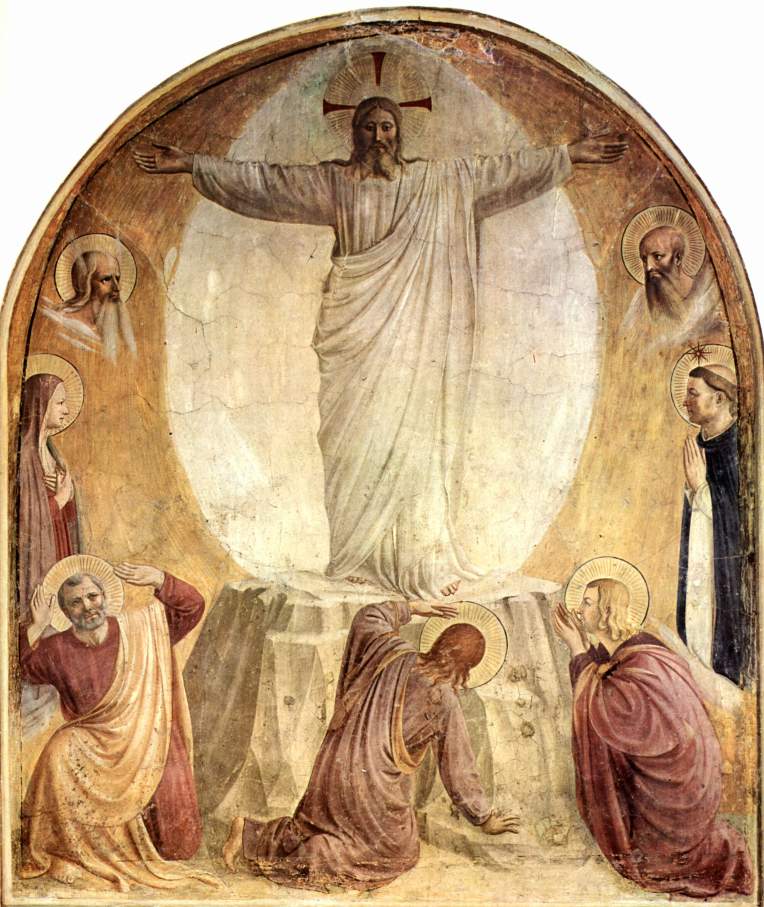
Today’s Gospel scene takes place immediately after the Transfiguration.  There on Mount Tabor Peter had wanted to stay, saying, “Master, it is good for us to be here.  Let us make three booths….”  But Jesus teaches Peter that it was not for transfiguration that He came into this world.  In today’s Gospel passage Jesus descends the mountain and enters into conflict between His disciples and the scribes, resuming the ministry for which He became Flesh and dwelt among us.

To His disciples, who were unable to drive out the mute spirit, He expresses disappointment at their lack of faith and rhetorically asks, “How long will I be with you?  How long will I endure you?”  But Jesus’ criticism on this occasion is not limited to His own disciples.  When the father of the possessed son says to Jesus, “If you can do anything… help us.”  To this, the Lord cries out, “If you can!”

Then Jesus speaks to the heart of the matter:  the lack of faith.  He had moments before described His disciples as a “faithless generation”.  Now He says to the father, “Everything is possible to one who has faith.”  But to this, the father offers an intriguing rejoinder:  “I do believe, help my unbelief.”  Jesus must have thought him sincere since He did help him.  But perhaps today we could pray over this father’s words, make them our own in prayer, and root all of the petitions that we make today in these words.  This father recognizes that in this fallen world, faith is always needed.  One cannot outgrow the need for faith.

©Photo. R.M.N. / R.-G. OjŽda

Saturday of the Sixth Week in Ordinary Time [II]

Saturday of the Sixth Week in Ordinary Time [II]
James 3:1-10  +  Mark 9:2-13
February 19, 2022

Then Elijah appeared to them along with Moses, and they were conversing with Jesus.

St. Peter’s ignorance is on display when he exclaims to Jesus:  “Rabbi, it is good that we are here!  Let us make three tents:  one for you, one for Moses, and one for Elijah.”

Peter’s suggestion is so simple that we might overlook what he means.  Tents means something different to us today than they did to people in the day of Jesus.  Tents to us mean camping, recreation, relaxation in the great outdoors.  Tents in ancient days—when many persons and extended families were nomadic—meant putting down roots, staking a claim, and not moving on.  So tents to Peter meant permanence, and meant having arrived.

The problem for Peter was that Jesus had no plans to rest.  Jesus had a journey to make.  He didn’t come into this world for rest and comfort.  So Peter, likely reluctantly, followed Jesus back down the mountain, knowing that He had to stay with Jesus if he ever wanted to see such brilliance, beauty and glory again.

At this point in their journey, Jesus planted that seed in the apostles’ minds, and it began to germinate during the remainder of Jesus’ public ministry.  Whenever in their memories they saw the sight of the Transfigured Jesus, they also must have heard that strange phrase:  “rising from the dead”.  Jesus helped them always to link these two:  “rising”, and “death”.  In other words, there is no Resurrection without death.  There is no Easter Sunday without Good Friday.  There is no empty tomb, without the tomb.