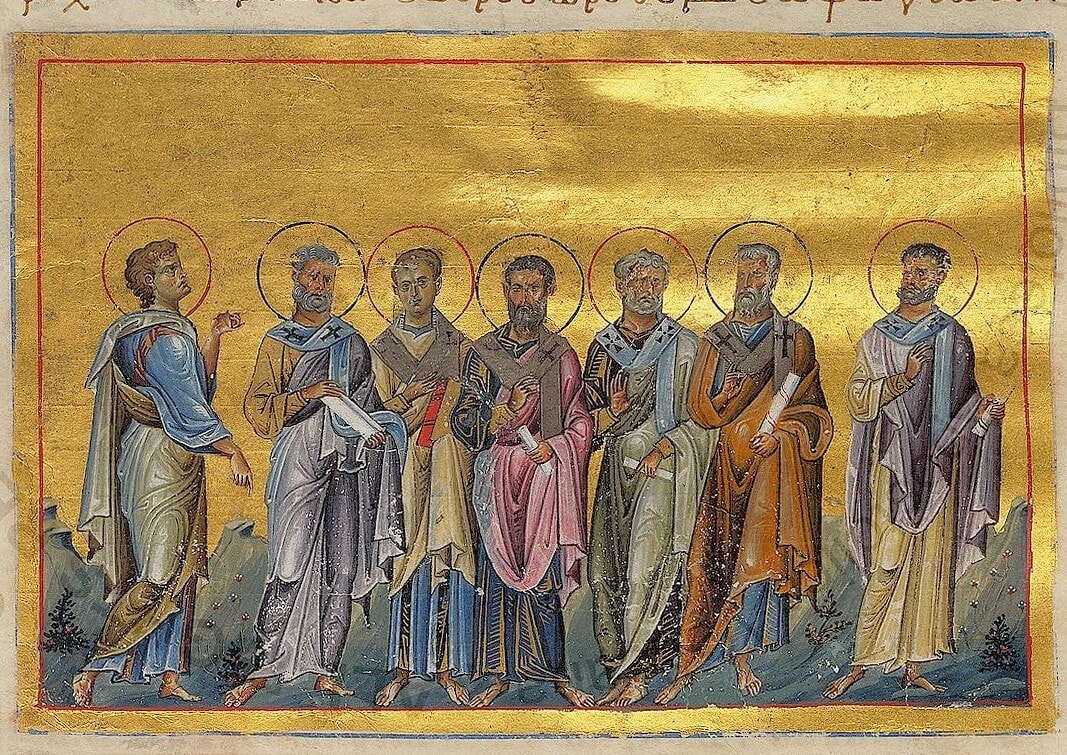

Sts. Cyril, Monk & Methodius, Bishop

Sts. Cyril, Monk & Methodius, Bishop
James 1:1-11  +  Mark 8:11-13
February 14, 2022

“Why does this generation seek a sign?”

Do we search for heavenly signs as assurance that we are on the right path in life?  Today’s Gospel passage, brief and to the point, ought to make us realize how pointless such a search is.  Jesus’ sigh—“from the depth of His Spirit”—speaks volumes.  His departure from the midst of the Pharisees does in fact serve as a sober sign of His recognition that even His divine words do nothing for one unwilling to listen to Him in faith.  Christ asks us to dedicate each day to him in faith.

A life which is not dedicated to God ends up being a selfish life, a life that excludes both God and one’s brothers and sisters.  This sort of life is opposed to the very practical counsel that Saint James offer throughout the course of the epistle that we begin today to hear at daily Mass.  This sort of life leads to one being a “man of two minds, unstable in all his ways”, as St. James writes in today’s First Reading.  Today we begin hearing at weekday Mass from the letter of St. James.  This is letter is full of practical wisdom, and pulls no punches about the fate awaiting the “man of two minds”.

That fate will be ours unless we are willing to cooperate with God’s grace to conquer the power of sin.  Sin is conquered first through faith, and perfectly through charity.  We are invited to share in this perfect love of God through the Mass.  When we are dismissed from Mass, we take and offer this same love to our brothers and sisters within our daily lives.

Saturday of the Fifth Week in Ordinary Time

Saturday of the Fifth Week in Ordinary Time
Mark 8:1-10

Then, taking the seven loaves He gave thanks ….

That the miracle described in today’s Gospel account foreshadows the Sacrament of the Eucharist is clear.  What could get overlooked, however, is an action of Jesus only briefly described in the midst of this miracle.  The evangelist explains that “taking the seven loaves [Jesus] gave thanks, broke them, and gave them”.

Jesus’ act of giving thanks here is described by the evangelist with the Greek verb “eucharisteo”.  It’s from this word that the English word “Eucharist” derives.  Likely we think of the act of thanksgiving as being part of what the Eucharist is about, but it’s another thing to recognize that this most blessed of the seven sacraments is named after the very act of giving thanks.

In contrasting the four basic types of vocal prayer—petition, thanksgiving, contrition and adoration—thanksgiving is not the most selfless.  Adoration focuses more solely on God in His own goodness.  Thanksgiving regards what God has done for me, not purely for His own glory.  Nonetheless, without thanksgiving, we cannot advance to prayer of adoration.  Giving thanks for what God has done for one allows one to grow in the humility needed to adore God authentically.

OT 05-6

Friday of the Fifth Week in Ordinary Time

Friday of the Fifth Week in Ordinary Time
Mark 7:31-37

He ordered them not to tell anyone.

Perhaps the difficulty that many of us modern persons have with prayer is nothing more than the fact that we’ve forgotten how to have a conversation with anyone, much less with the Almighty.  In the Gospel today, we see Jesus take aside a man who is both deaf and mute.  Jesus heals him of his ailments.  Jesus tells those around them not to speak of the miracle.  But immediately, they proceed to do just that, and the more He orders them not to, the more they do it.  These people, maybe, are examples of what happens during our own prayer:  there is praise of God, words spoken about God, and even words spoken to God.  But all these words drown out Jesus’ demand to be silent.

The English word “obedience” comes from the Latin word which means “to listen”.  These people in the Gospel refuse to listen to what Jesus is telling them, and so, even in praising Jesus, they are disobeying Him.

In our prayer, in our conversation with God, we should listen at least twice as much as we speak.  More importantly, we should listen first, before beginning to speak to Him.  Silence, though, can be deafening.  Were we to stop saying what we want to say, we might lose control of the conversation, and there would be no telling what we might hear in that silence.  Perhaps what God has to say to us would be difficult for us to hear, and would demand self-sacrifice from us.

OT 05-5

The Sixth Sunday in Ordinary Time [C]

The Sixth Sunday in Ordinary Time [C]
Jeremiah 17:5-8  +  1 Corinthians 15:12,16-20  +  Luke 6:17,20-26

“Rejoice and leap for joy on that day!”

It’s hard to confuse the choices presented in today’s Scripture readings.  The sharp contrast between the blessings and maledictions proclaimed by the prophet Jeremiah and our Lord Jesus offer only two choices:  life or death, blessing or woe.  Even more important, though, is the fact that the Christian’s choice must be rooted in the divine virtue of hope.  “Blessed are they who hope in the Lord”, we proclaim in today’s Responsorial Psalm.

But are we blessed?  Do we hope in the Lord?  What do we hope for in life?  The answers to these questions lay bare our future:  not only in this life, but also in the life to come.  The things that we hope for in life make clear what we can hope to expect in our future.  Saint Paul in the Second Reading preaches that the Christian can hope only in the resurrected Christ.  The Christian centers his life around the Death and Resurrection of the Messiah, holding them as the pattern of his thoughts, words, and actions.  In other words, whenever we hope for something in this life, we should hope as Jesus hoped for things during His life.

We only need one example to get at the heart of how Jesus hoped during His earthly life.  We need only picture Jesus at one setting in His life:  as He prayed in the Garden of Gethsemane, moments after His Last Supper, and moments before His betrayal and arrest.  Jesus had two choices to pray over in the Garden.  He had two different things He could hope for.  He could hope to escape the destiny that was walking towards Him at that moment, with spears and silver pieces in hand.  Or He could hope to die.

In our own daily lives, if Christ truly lives in us, we live in Him as members of His Body.  His Death and Resurrection are our own, if they are our hope.  Of course, most of us have no difficulty hoping for resurrection in our lives, but can we hope to share in His suffering as well?  We may grow used to accepting suffering as a natural part of life, but can we prayerfully hope for it?

In his Spiritual Canticle, St. John of the Cross writes:  “Would that men might come at last to see that it is quite impossible to reach the thicket of the riches and wisdom of God except by first entering the thicket of much suffering, in such a way that the soul finds there its consolation and desire.”

When we come to this matter of the spiritual life, we have to be very careful.  Of course, it would be foolishness to hope for suffering for its own sake.  Jesus did not will His Suffering and Death on the Cross for its own sake.  The only thing He ever hoped for in life was to do the Will of His Father.  But as He prayed in Gethsemane, He knew that His Father willed for Him to die on the Cross.

Whatever we hope for, we hope in the Lord.  It is not for us to parcel out for ourselves a little suffering here, and a little resurrection there.  The only thing we can hope for in our lives is the Will of our Father in Heaven, and often we are not given to learn what that is far in advance.  Often God asks us to walk step by step through our lives, dependent upon Him each day.  Consider the wisdom of St. Francis de Sales, who said, “We in this life are walking, as it were, on ice.”  At times, we have no idea how thick or thin that ice is.  At times, it seems we are not merely walking but skating on thin ice.

As Christians, we look to the Cross and worship Christ crucified.  We know that His death means our life.  But to grow in our spiritual lives means to realize that at times, our own spiritual suffering is a great source of growth.  At times, neither of the choices which we find ourselves facing in life seem to hold much hope.  But as we pray and ask God to guide us, we cannot expect God always to show us “the light”.  At times, God simply shows us where to walk, and that place may not be any brighter than where we’ve just come from.

St. Scholastica, Virgin

St. Scholastica, Virgin
I Kings 11:4-13  +  Mark 7:24-30
February 10, 2022

“Lord, even the dogs under the table eat the children’s scraps.”

St. Mark the Evangelist tells us that a Greek woman—that is, an outsider—came to Jesus and “begged” Him to help her daughter.  This woman, despite not being a Jew—despite not being among that people of the Covenant, who had been waiting for the Messiah to come—nonetheless cried out to Jesus for help.  But what happened when she cried out to Jesus for help?

Jesus says to this outsider, “It is not right to take the food of the children and throw it to the dogs.”  The “children” Jesus is referring to are the children of Israel, the ones the Father sent Him to teach, while this woman is an outsider, a dog.

This sharp language from Jesus gives us pause.  Perhaps within that pause, however, we have the space to meditate on a particular point.

When we engage in meditation upon Sacred Scripture, a point can be an image, an idea, the person of a saint or a biblical personage, a metaphor, or even—as in this case—a single word:  that is, the word “dogs”.  What does Jesus mean to signify by this word “dogs”?  No synonym can completely capture another word’s meaning, but in this case, we might consider Jesus’ word “dogs” as meaning “outsiders”.  How can we reflect on the word “outsiders”?  What are the outsiders outside of?

In the case of this woman to whom Jesus speaks, she is outside the Old Covenant.  But the Lord, in dialoguing with her and recognizing her faith, prepares for her the New and Everlasting Covenant that He will establish, not just for one people of the earth, but for all peoples, and all who have put themselves outside of God’s love through their sins.

OT 05-4

Wednesday of the Fifth Week in Ordinary Time [II]

Wednesday of the Fifth Week in Ordinary Time [II]
I Kings 10:1-10  +  Mark 7:14-23

The mouth of the just murmurs wisdom.

Today’s Responsorial comes from Psalm 37.  The refrain—“The mouth of the just murmurs wisdom”—is the beginning of one of the Entrance Antiphons for the first Mass from the Common of Doctors of the Church.  Such luminaries as St. Augustine of Hippo and St. Thomas Aquinas inspire us with their dedication to wisdom.  They sacrificed of themselves in order to be instruments by which God could communicate His wisdom to others.  How can we understand this refrain in regard to ourselves on this weekday in Ordinary Time?

One of the notable features of this passage from Psalm 37 is that it actually speaks more directly about the Lord than about “the just”.  Why is this?  The psalm makes it clear that the Lord is the source of all that is good in man.  The refrain demonstrates this:  the just man “murmurs wisdom” and “utters what is right” because the “law of his God is in his heart”.

This message from Psalm 37 stands in a certain contrast to Jesus’ words in the Gospel.  Jesus speaks at length, and quite unflatteringly, about what comes from “within the man, from his heart”.  He mentions 13 evils, though one gets the impression that He could just as easily have continued.  Here Jesus is describing the fallen human heart that does not have the law of God within.  Jesus wants us to realize our utter need for the law of grace if we are to transcend our fallen selves, and serve as instruments of God’s Wisdom.

OT 05-3

Tuesday of the Fifth Week in Ordinary Time

Tuesday of the Fifth Week in Ordinary Time
Mark 7:1-13

“You disregard God’s commandment and cling to human tradition.”

In today’s Gospel passage, the Pharisees are a thorn in the side of Jesus.  They are constantly quoting the Law to Him, and telling Him why He is not a good Jew.  In fact, however, these Pharisees are willing to sacrifice small things in order to say that they have a relationship with God.  Jesus, on the other hand, showed at the end of His life that He was truly faithful to the relationship—the covenant—between God and man, by dying on the Cross.  Through the offering of His life, Christ restored that relationship between God and man.

It is in our relationship with God that He lives in our lives.  Relationships are what the spiritual life is about.  This is what the sacrifice of Christ on the Cross teaches us, and this is what Christ’s words in today’s Gospel passage are trying to teach us.  In today’s Gospel passage Jesus sums up His protest against the Pharisees by saying, “You disregard God’s commandment and cling to human tradition.”

Jesus does not speak of “God’s commandments,” in the plural, as in the Ten Commandments of Moses.  Jesus speaks of “God’s commandment” in the singular.  There is only one commandment, which Jesus tells us elsewhere in the Gospel is “to love the Lord, your God, with your whole heart, whole mind, whole, soul, and all your strength.”  If we truly love God in this way, that love will overflow back into our lives—since God keeps nothing for Himself—and we will naturally love our neighbor as ourselves.

OT 05-2

Monday of the Fifth Week in Ordinary Time [II]

Monday of the Fifth Week in Ordinary Time [II]
I Kings 8:1-7,9-13  +  Mark 6:53-56

Lord, go up to the place of your rest!

Today’s Responsorial Psalm comes from the first half of Psalm 132.  The refrain—“Lord, go up to the place of your rest!”—sounds like a strange thing to say to the Almighty.  Why does the Lord need us to tell Him where to go?  For that matter, why does the Lord need to go to a place of rest?  We need to reflect, then, on a broader point:  that is, what is the broader context for this refrain?

Within the setting of the Old Testament, we could imagine this refrain verse being spoken during the Exodus or one of the exiles from the Holy Land.  In these settings, the place of the Lord’s rest would refer to His final “resting place” on earth:  the Temple in Jerusalem.  It’s there that the priests enter to offer right worship to the Lord, according to the dictates of His Law.  Within this setting we can certainly interpret Psalm 132 according to the original meaning of the human author.

In a further sense, however, we listen to Psalm 132 in terms of its fulfillment in Christ.  The Lord is Jesus, who entered our fallen world for us men and our salvation.  This psalm, then, speaks to the Ascension of the Lord as the completion of the Incarnate Word’s earthly mission.  Our own share in this rest is what we await beyond death, although even now in the sanctuary of the Living God, in the right worship of the Eucharist we may share in the rest of His Real Presence.

OT 05-1

St. Agatha, Virgin Martyr

St. Agatha, Virgin Martyr
I Kings 3:4-13  +  Mark 6:30-34
February 5, 2022

“Come away by yourselves to a deserted place and rest a while.”

In listening to the words of today’s Gospel passage and applying them to our lives, perhaps we have not listened as carefully—or as fully—as we should have.  In this passage Jesus says to us what Jesus says to His apostles:  “Come away by yourselves to a deserted place and rest a while.”  He invites them by His words to imitate Him:  He calls them to follow Him to a deserted place.

Jesus leads the apostles there, but when they arrive at the place, Jesus sees a vast crowd.  What does he do?  Jesus, the Good Shepherd, begins feeding the flock with His teaching.  Again Jesus is speaking to His apostles, but this time He invites them by His actions to imitate Him:  He calls them to follow Him into the midst of the crowd.

Jesus’ life in this passage teaches us the meaning of the words of Saint Francis of Assisi:  “O Divine Master / grant that I may not so much seek to be consoled as to console / to be understood as to understand / to be loved as to love.  / For it is in giving that we receive….”

These words of Saint Francis lead us back again to the scene of the Gospel.  Can we see that Jesus is teaching us that to be a faithful shepherd is to be a faithful steward, to offer everything to God, both our work and our rest?  Nothing, not a thing, is ours, not even the rest that we enjoy in the midst of a busy day, for even the rest we are granted prepares us only to serve both God and others more fully.

OT 04-6