The Sixth Sunday in Ordinary Time [A]
The Sixth Sunday in Ordinary Time [A]
Sirach 15:15-20 + 1 Corinthians 2:6-10 + Matthew 5:17-37 [or Matthew 5:20-22a,27-28,33-34a,37]
February 15, 2026
Three years ago, I made a pilgrimage to Portugal, Spain, and France. Both bookends of the pilgrimage were in honor of Our Blessed Mother, starting at Fatima in Portugal, and ending two weeks later at Lourdes in France. In between, the bulk of the pilgrimage was spent in Spain.
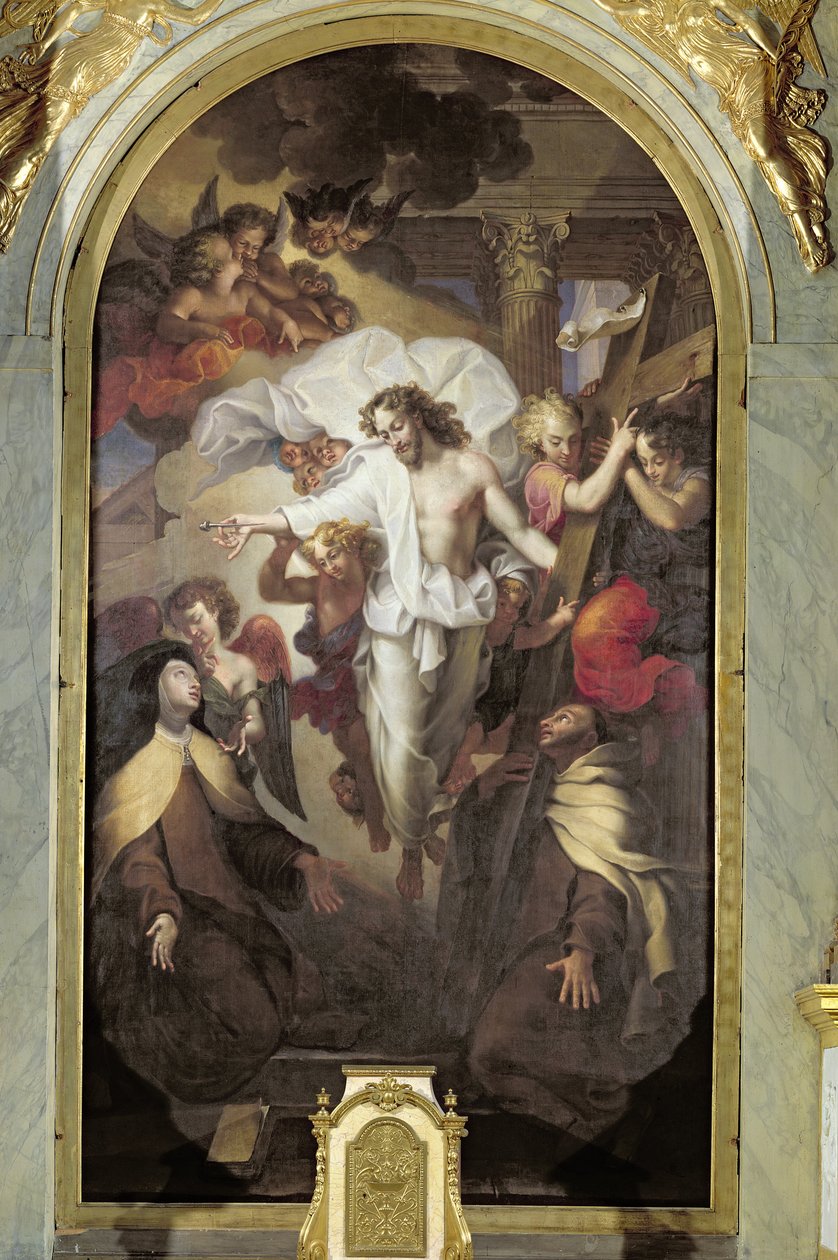
I visited many different places in Spain connected to the lives of two 16th century saints. St. Teresa of Jesus and St. John of the Cross lived at a time of great chaos. Part of this chaos was caused by corruption within the Catholic Church.
St. Teresa of Jesus decided to confront the corruption within the Church differently than the Protestant leaders whose efforts started during the 16th century. Instead of leading Christians out of the Church, she decided to remain within the Church, and to change the Church from within. St. Teresa belonged to the Carmelite religious order, which had grown lax since their foundation in the 12th century. So she started a new branch of the Carmelites called the Discalced Carmelites. (The word “discalced” means “barefoot”, because the Discalced Carmelites, as part of their vow of poverty, went without shoes.)
+ + +
Now, why do some religious orders like the Carmelites grow lax and weak over time, or even corrupt? It’s much the same reason that a relationship grows weak. You cannot take relationships for granted. You have to dedicate time and effort to relationships. Husbands need to take their wives out on “date nights”. Parents and grandparents “make memories” with their children and grandchildren.
Something similar is also true of the spiritual life. This is part of the battle that St. Teresa of Jesus faced in her reform of the Carmelite order. You cannot take your soul’s health for granted. Unless you tend to it, like a gardener or a farmer, weeds will grow, disease will set in, and death will follow. If not tended to in this world, that death will last forever in the next. What’s true of an individual soul is just as true for a religious community of monks or nuns: if growth is not fostered, the spiritual life becomes lax, and decay sets in.
That brings us to the conflict in today’s Gospel passage. This conflict reflects the conflict that St. Teresa of Jesus and St. John of the Cross faced in 16th century Spain. This conflict reflects the struggle that’s present in every Christian’s spiritual life, including your own.
+ + +
Today’s Gospel passage is from the middle of Matthew 5. Jesus’ Sermon on the Mount is found in Chapters 5-7 of Matthew. Today is the third Sunday in a row on which the Gospel Reading comes from Jesus’ Sermon on the Mount. Since Lent starts this week, we won’t hear the rest of the Sermon on the Mount over the next few Sundays. However, at home you can place a bookmark in your bible at the start of Matthew 5. Slowly read and meditate upon Matthew Chapters 5, 6 & 7 over the weeks from now until Easter Sunday.
Now if tackling the entire Sermon on the Mount seems daunting, just take Matthew 5. Even though Matthew 5 is just one-third of the Sermon on the Mount, the chapter is rather self-contained. Matthew 5 starts with the Beatitudes, and ends with Jesus saying, “So be perfect, as your heavenly Father is perfect” [Mt 5:48]. So at the start of Matthew 5, when He starts the Sermon on the Mount, the Beatitudes are the roadmap that Jesus hands to us, so that we can follow Him on a spiritual journey. At the end of Matthew 5, Jesus reveals the goal of our spiritual journey: to “be perfect, as your heavenly Father is perfect”.
In between, Jesus describes several conflicts that we’re likely to face on this spiritual journey: road bumps, you might say, on the path to becoming perfect as our heavenly Father is perfect. The spiritual conflicts that Jesus describes in Matthew 5 are similar to the conflicts that St. Teresa of Jesus and St. John of the Cross faced in their efforts to reform the Carmelite order. Consider what happened to St. John of the Cross in the year 1577.
John was kidnapped by members of the older Carmlite order. They imprisoned him for eight months in a cell that measured ten feet by six feet, and they lashed him once a week. In the midst of this, he was also bribed. The bribes were unsuccessful, John eventually escaped, and the reform efforts of St. John and St. Teresa continued successfully.
+ + +
So consider the conflict in today’s Gospel passage.
Jesus does not describe a conflict between the Jewish Law and His Gospel. In fact, He declares, “Do not think that I have come to abolish the law or the prophets. I have come not to abolish but to fulfill.”
The conflict is between—on the one hand—the righteousness of the scribes and the Pharisees, and—on the other hand—the righteousness that Jesus offers.
The righteousness of the scribes and the Pharisees was limited to the literal meaning of the 613 laws of the Jewish Torah. Jesus demanded more. Jesus demands that if you’re going to follow Him, you have to go to the heart of God’s laws. Ask where evil starts in the human heart. Don’t just consider where it ends. Every man who murders a man commits the murder twice: first in his heart, by way of desire, and then a second time in fact. The Scribes and Pharisees thought they could be righteous if they only murdered a man once, as long as it was only in their heart, because in their reading of God’s Law, God did not make demands of their hearts.
Jesus is making a demand of you: “unless your righteousness surpasses that of the scribes and Pharisees, you will not enter the kingdom of heaven.” As you start the Season of Lent this week, allow God’s demands to reach into your heart, and touch every desire that you hold there. Offer to Christ every desire in your heart that’s contrary to His love, and ask Him in exchange to give you the Love that can re-shape and re-form your heart to be like the Sacred Heart of Jesus.
The Fourth Sunday in Ordinary Time [A]
The Fourth Sunday in Ordinary Time [A]
Zephaniah 2:3;3:12-13 + 1 Corinthians 1:26-31 + Matthew 5:1-12
February 1, 2026
The Bible is not a single book. The Bible is a library. Just as a library has many different types of books in it, so also the Bible. When you visit a library, you find different sections in the library, and each section has different books. If you visit a library, and visit four different sections, and take from different shelves a cookbook, a collection of poems, a presidential biography, and a science fiction novel, you don’t read those four books in the same way. For example, if you open a cookbook expecting it to read like a science fiction novel, you’re going to end up with a very strange supper.
The Bible is the same way, and this variety among the books of the Bible is important to remember during Holy Mass. As you know, the first chief part of the Mass focuses upon passages from the Bible. But when we listen to them, if we don’t understand the differences among the Old Testament Prophets, the New Testament letters of the Apostles, and the four Gospel accounts, we’re not going to get the most out of the Scripture readings.
What’s more, when it comes to the four accounts of the Gospel—written by Matthew, Mark, Luke, and John—we need to recognize the many differences among these four books of the Bible. One way to understand these many differences is to think of your own life. Let’s say that I myself wanted to commission a biography of your life. I hire four different journalists to write four different biographies of your life. But each of these four journalists interviews a different person. One journalist interviews your spouse. Another interviews one of your bosses from the jobs you’ve had over the years. Another interviews one of your sisters, and the last journalist interviews one of your high school friends. Do you think that those four biographies are going to say the same thing? Or are these four biographies going to illustrate different aspects of your life? In fact, they are going to illustrate four different aspects of your life. In a similar manner, each of the four Gospel accounts illustrates Jesus’ life, death, and Resurrection from different vantage points because the four different authors had four different sources.
I mention all this because we are early in the Season of Ordinary Time, and have just heard today one of the most important passages of the Bible. Before reflecting specifically on this passage—from Matthew 5—we need some context.
Lent starts early this year, on February 18. So including today, we only have three Sundays in Ordinary Time before Lent begins. On these three Sundays, the Gospel passage comes from Matthew Chapter 5. This chapter is the first of three chapters that give us Jesus’ Sermon on the Mount. If you’d like a recommendation for spiritual reading during these next three weeks before Lent begins, I’d encourage you to read the Sermon on the Mount from the Gospel according to St. Matthew.
+ + +
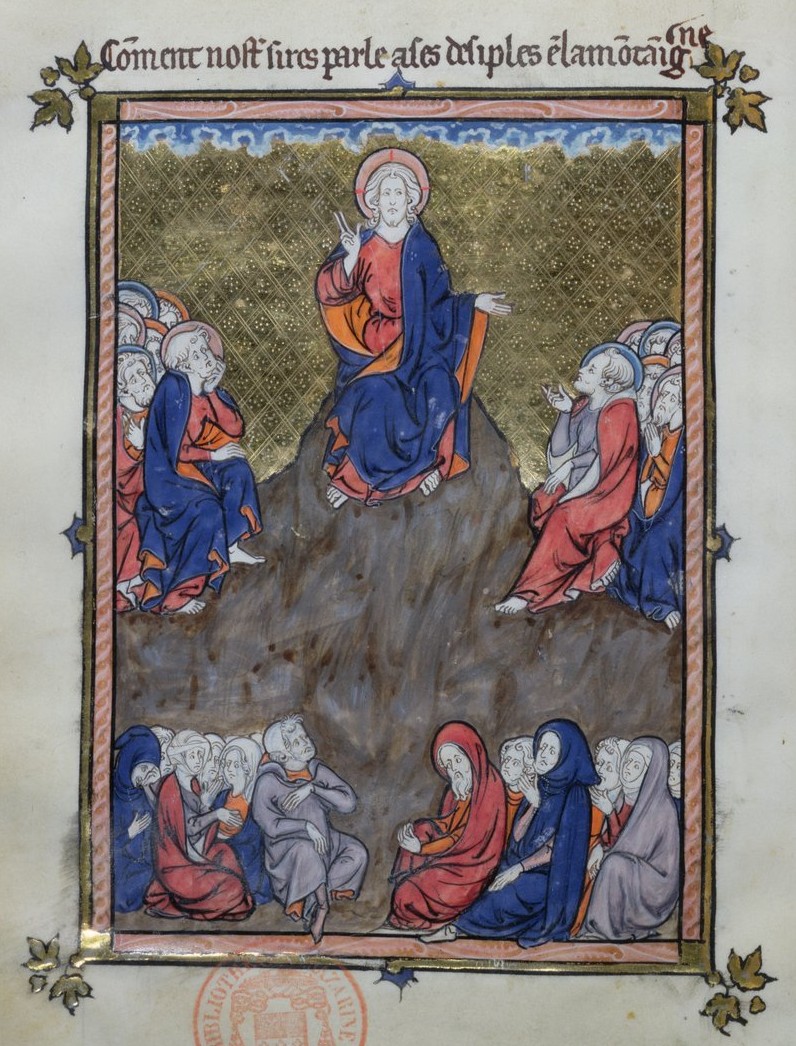
Today’s Gospel passage is the first twelve verses of Matthew Chapter 5: the very beginning of the Sermon on the Mount. In our own day, preachers often begin a sermon with a story or a joke. Jesus decided to begin His Sermon on the Mount with the Beatitudes.
However, before he starts giving us Jesus’ sermon, St. Matthew the Evangelist mentions a few interesting details about Jesus. The evangelist mentions that when “Jesus saw the crowds, He went up the mountain, and after He had sat down, His disciples came to Him.” Consider just two points here: that Jesus went up the mountain, and that He sat down there.
Why did Jesus have to go up a mountain in order to preach a sermon? Obviously, He did not have to. Jesus preached many sermons during the three years of His public ministry, and most of them were preached in all sorts of settings. But in St. Matthew’s account of the Gospel, the Sermon on the Mount is Jesus’ first sermon, so Jesus is teaching us here not only by His words, but also by the setting that He chose, and by the choice to sit down.
So why did Jesus choose a mountain to be the site of His first sermon? St. Matthew clarifies this throughout the course of his Gospel account. Through the words and works of Jesus that St. Matthew includes, and in the way he structures his Gospel account, St. Matthew portrays Jesus as a “New Moses”. One reason St. Matthew does this is that unlike many other New Testament writings, Matthew’s Gospel account was written for converts from Judaism.
So here you need to notice another difference among the four accounts of the Gospel. The four accounts of the Gospel differ because the four evangelists were writing for four difference audiences. Imagine again the biography of your own life. Instead of myself commissioning four different journalists to write four biographies, imagine that four different persons commission four biographies of your life. Furthermore, imagine—and granted, this will take quite a bit of imagination—that the four persons who commission these four biographies are four very different persons. The first of those who commissions a biography of you is a farmer from Kingman County. The second is a businessman from New York City. The third is a tribesman from the Amazon of South America. And the fourth—again, use your imagination—is an astronaut from the 26th century who lives in a colony on Saturn.
When those four different biographies of your life are written for those four very different people who commissioned the biographies, the authors are going to have to write differently. The author writing for the tribesman from the Amazon is going to have to explain details and circumstances about your life that the farmer in Kingman County is not going to need to have explained. The audiences of the books shape the way that the same story is told. It’s similar with the four accounts of the Gospel.
Matthew’s Gospel account was written for converts from Judaism. This is why Matthew “refers to Jewish customs and institutions without explanation” of their backgrounds, because the original Jewish audience of Matthew’s Gospel account would already have known those backgrounds. That’s also why St. Matthew “works nearly two hundred references to the Jewish Scriptures into his narrative”.[1] That’s also why St. Matthew draws parallels between Jesus and Moses.
Moses was, for the Jewish people, the greatest Old Testament Prophet. His life as a prophet including working signs and wonders during the Exodus. But during that Exodus came the most important event of Moses’ life as a prophet. During the course of their Exodus from Egypt to the Promised Land, God’s People stopped at Mount Sinai. There, while the rest of God’s People remained below, Moses alone ascended Mount Sinai to receive from God His Ten Commandments. Moses then had to descend the mountain to give to God’s People this Law. This Law was the means by which His People could—we might say today—“keep right” with God. That key truth about Moses is reflected in how St. Matthew records his account of the Gospel, portraying Jesus as a “New Moses”. Jesus is like Moses in many ways, but also fulfills and completes the ministry of Moses.
In today’s Gospel Reading, it’s not only Jesus who ascends the mountain. Jesus draws His disciples up with Him. And it’s not a voice from the heavens that speaks there to a prophet. Instead, the New Moses—God in the Flesh—speaks to His people face to face. And Jesus gives to us, His people, not ten commandments, but nine beatitudes.
+ + +
Jesus put the Beatitudes at the start of the Sermon on the Mount in order to put the most important lesson first. Likewise, the first of the nine Beatitudes is the key to understanding and living out all nine. So we ought to consider the first of the nine beatitudes as being the first for a reason.
“‘Blessed are the poor in spirit, for theirs is the Kingdom of Heaven.’” St. Augustine preaches about this first—this key—beatitude by asking what “poor in spirit” means. He answers that it means “[b]eing poor in wishes, not in means. One who is poor in spirit, you see, is humble; and God hears the groans of the humble, and doesn’t despise their prayers. That’s why the Lord begins His sermon with humility, that is to say with poverty. You can find someone who’s religious, with plenty of this world’s goods, and not [because of that] puffed up and proud. And you can find someone in need, who has nothing, and won’t settle for anything. … the [former] is poor in spirit, because humble, while [the latter] is indeed poor, but not in spirit.”[2]
The Lord Jesus has given us what we need to reach Heaven. He has given us life; grace to strengthen us for the journey; and the roadmap in these nine beatitudes. The first, upon which all the others rest, is humility: poverty of spirit. Ask the Holy Spirit to help you to make a concrete resolution regarding the practice of humility, maybe by serving those in need through either the Corporal or Spiritual Works of Mercy, or by giving up something that you have and do not need.
[1] “Introduction to the Gospel according to Saint Matthew”, in The Ignatius Catholic Study Bible (San Francisco: Ignatius Press, 2010), 4.
[2] St. Augustine of Hippo, Sermon 53A, in The Works of Saint Augustine, Part III, Vol. III, 78.
The Third Sunday in Ordinary Time [A]
The Third Sunday in Ordinary Time [A]
Isaiah 8:23-9:3 + 1 Corinthians 1:10-13,17 + Matthew 4:12-23
January 25, 2026
This Sunday’s Gospel Reading is a good reminder to pray often for one member of our parish who—God willing—will be ordained to the priesthood at the end of May. Deacon Peter Bergkamp is nearing the finish line of the long marathon called “seminary”. Of course, in the spiritual life, where one spiritual marathon ends, another begins.
It’s not an easy road to enter the seminary. Before being admitted, the young man has to take intelligence tests, a psychological examination, and a physical. But the most grueling requirement is saved for last: the candidate has to play a round of golf with the Bishop, and shoot under 80.
There are many things about a young man entering the seminary that are misunderstood. One important point that many people are not clear on is why exactly a young man enters the seminary. He does not enter the seminary because he’s decided to be a priest. A young man enters the seminary to find out if he’s being called to the priesthood.
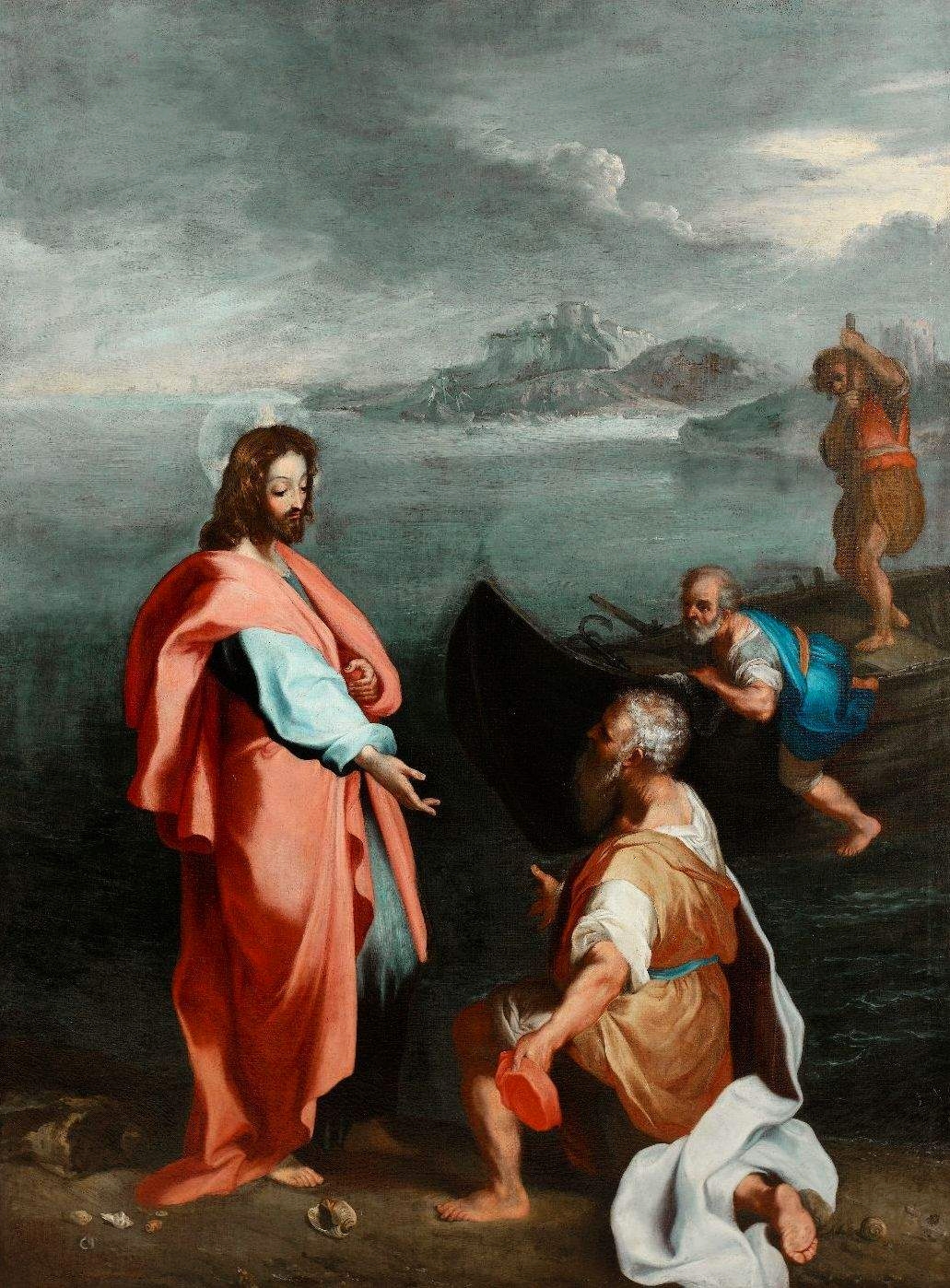
To put this differently: the Lord calls out to every young man, “Come after me….” What differs from one young man to another is the phrase that follows “Come after me….” To some young men, the Lord says, “Come after me, and I will give you the grace needed to be a strong and virtuous husband and father.” To other young men, Jesus says those words by which we hear him calling Simon and Andrew: “Come after me, and I will make you fishers of men.” Through a seminarian’s prayers while in the seminary, the Lord clarifies just which call the Lord has made to him.
“Fishers of men”. This is a metaphor, of course: one that Simon and Andrew readily understood, since their livelihood was being fishermen. Regardless of the kind of life which they had chosen for themselves, Jesus called them to a very different way of life. They had no idea what to expect, and if Jesus had tried to explain what following Him would mean, they still would have been largely in the dark. That’s why following Jesus demands the virtue of faith. Following Jesus is not for those who insist on controlling everything, or knowing exactly what’s coming down the pike.
The fact is that Jesus can call men from any sort of livelihood, at any age in their lives, to serve His Church as priests. For the last four years of my formation in the seminary, Bishop Gerber sent me and another young man named Sam Pinkerton to Mundelein Seminary in Chicago, which at the time was the largest seminary in the United States. It served forty-five dioceses throughout the world, educating men from the countries of Uganda, Zaire, Colombia, Poland, China, Vietnam in addition to U.S. dioceses from Paterson, New Jersey to El Paso, Texas, and of course a large contingent of native Chicagoans, who are a breed all their own.
Among the 150+ men with whom I studied at Mundelein, I can guarantee you that no two of us had traveled along the same path to get to the seminary. I can also guarantee that the Lord did not use exactly the same words to call any of us, to help us understand the need we had to enter the seminary.
Before entering the seminary, I had spent only one year at Kansas State. Many young men enter the seminary the summer after graduating from high school. But some men enter the seminary after graduating from college and starting careers. At the seminary I attended in Chicago, one seminarian had graduated from law school and practiced law before entering the seminary. Another seminarian had finished medical school and practiced medicine before entering the seminary. No two young men have the same path to the priesthood.
It’s also important to realize that God calls young men of many different temperaments and with many different outlooks on life to enter the seminary. Some years ago there was a book published that illustrated this truth. It offers portraits of about a dozen different priests, one of whom—Father Ned Blick—is a priest of our diocese.
Father Ned’s words in this book ring very true. He states:
“Since I have been ordained, I have been surprised, no, astonished, by the effect on people of things that require such a small effort on my part. … I had no idea such small things would be so much appreciated. Why that happens to priests is interesting. It may be because we confront the spiritual dimensions of people, while most other professions do not. People have deep spiritual needs. When they see them met, however inadequately, they respond.”
To me the key of this quote is Father Ned speaking about the spiritual nature of man: a dimension of human nature that’s often ignored. Again, Father Ned states: “we confront the spiritual dimensions of people, while most other professions do not. People have deep spiritual needs. When they see them met, however inadequately, they respond.”
This spiritual side to human nature is where the great gift of the priesthood rests. We need to pray for vocations to the priesthood. But we also need to encourage young men to offer themselves to the spiritual nature of man that gives our lives their final and ultimate meaning.
The Second Sunday in Ordinary Time [A]
The Second Sunday in Ordinary Time [A]
Isaiah 49:3,5-6 + 1 Corinthians 1:1-3 + John 1:29-34
January 18, 2026
In Abilene, Kansas, across the street from the Eisenhower presidential library, and the resting places of Dwight and Mamie Eisenhower, is a Catholic church by the name of St. Andrew’s. In that church, on December 17, 1967, I received the Sacrament of Baptism. Hopefully you, also, know the date of your baptism, and honor that day each year with prayers of thanksgiving to God.
That’s important to do because on the day you were baptized, God made promises to you, and you made promises to God (or your parents did on your behalf). These two-way promises founded a relationship where God is your Lord, and you are His servant. Of course, whenever someone serves the Lord, he does something specific for him. So we hear several examples of this servant—Lord relationship in today’s Scriptures. Each is a model for us, and the last is also something more.
+ + +
First is the Old Testament prophet Isaiah. What specific job did God call Isaiah to do for Him? God called Isaiah to serve Him as His prophet. We hear this in the First Reading. “The Lord said to [Isaiah]: ‘You are my servant. … I will make you a light to the nations, that my salvation may reach to the ends of the earth.’” Among all the Old Testament prophets, Isaiah had a unique place. His call was to proclaim the coming of a Messiah who offers a loving mercy that knows no bounds and that would “reach to the ends of the earth”, meaning even to the Gentiles. Although none of us has been called to be a prophet like Isaiah, his vocation mirrors our own vocation as a baptized Christian: namely, to love others with a mercy that knows no bounds.
+ + +
Second is the New Testament apostle Paul. What specific job did God call Paul to do for Him? God called Saul (renaming him Paul) to serve Him as His apostle. Today’s Second Reading is simply the first three verses of a letter written by Saint Paul: it’s not the longest of his letters, but it’s one of the more profound. Paul’s self-introduction focuses upon his calling as an “apostle”, which literally means “one who is sent”. He describes himself this way: “Paul, called to be an apostle of Christ Jesus by the will of God”.
Paul was sent “by the will of God” to spread the Messiah’s Gospel to the Gentiles, the very people that Isaiah had served by preparing them for the Messiah. Although none of us has been called to be an apostle like Paul, his vocation mirrors our own vocation as a baptized Christian: namely, serving as “one who is sent”, or in other words, serving as one who takes his cues from God.
+ + +
Now that Messiah whose coming Isaiah foretold, and whom Paul was sent forth to preach about, is of course Jesus. In fact, Jesus—like Isaiah and Paul—was called by God to serve. Yet Jesus is not only an example for us, as are Isaiah and Paul. Jesus’ call is unique. He’s an example, and something more.
Jesus was called by God the Father to serve as the Savior of mankind. We hear about this call within today’s Gospel Reading. This call connects to today’s Responsorial Psalm, and especially its refrain. That refrain can help you rest in God’s will for your daily life, instead of wrestling against it.
“Here am I, Lord; I come to do your will.” That’s a good verse to memorize, and to pray often. You can recite it slowly as your make a Holy Hour before the Blessed Sacrament. You can recite it slowly as you drive to work. You can recite it (very) slowly at 2:00 am on Saturday morning as you wait for your teenager to get home.
“Here am I, Lord; I come to do your will.” Although the word “I” appears twice in this single verse, it’s not the focus of the verse. The focus is God’s Providential Will and an individual’s submission to it: that is, an individual’s willingness to be God’s servant. Unfortunately, many of us when we pray actually speak to God as if He is our servant: in effect saying, “Here I am, Lord; now come and do my will.”
+ + +
Throughout the first several weeks of Ordinary Time, our Scriptures at Holy Mass help us set our own lives within the grander scheme of things. That grander scheme is called “Divine Providence”. One way to describe Divine Providence is to say that it’s what God chooses to do, when He does it, and why He does it.
Although it might sound odd, one of the chief ways that Christians experience God’s Providential Will is unanswered prayers. In fact, these are often God’s gifts to us, whether we acknowledge them as such or not. Unfortunately, some Christians stop following Jesus because their prayers aren’t answered as they want. But silence on God’s part can be His way of demanding patience and perseverance. This silence clarifies what’s important to God for the unfolding of His Providential Will.
Nonetheless, whether in accepting God’s silence for the gift that it is, or in moving forward to carry out His Will, it’s important to recognize a distinction. We are not only to imitate Jesus in His example of doing His Father’s Will. As Christians, we are meant for something even greater: we are meant to live in Christ.
We are not meant to live “in Isaiah” or “in Paul”, as much as we ought to follow their respective examples. But each of us is meant to live “in Christ”. This is not something that the Christian can accomplish through human effort or good works. Only God can accomplish this. His chief means for doing so are the Sacraments and grace given through personal prayer. For our part, we work at disposing ourselves to God’s graces and charisms. These gifts from God allow Christ to live within us, and allow Christ to say through us: “Here am I, Lord; I come to do your will.”
The Baptism of the Lord [A]
The Baptism of the Lord [A]
Isaiah 42:1-4,6-7 + Acts 10:34-38 + Matthew 3:13-17
January 11, 2026
“Childhood” is a key theme of Christmas. First, we focus on the Christ Child. But like everything in Jesus’ earthly life: Christ’s childhood is for us. Christmas also focuses upon you and me being called to adoption as God’s very own children. In St. John’s first New Testament letter, he writes about this divine adoption, proclaiming: “See what love the Father has bestowed on us that we may be called the children of God. And so we are. … Beloved, we are God’s children now” [1 John 3:1-2].
That’s not just a mystery. It’s also a profound paradox. It’s hard enough to imagine how a tiny baby could be the All-Powerful Creator of the universe. But it’s even harder to imagine how a sinner such as you or me could become, not just a saint, but a very child of God the Father! But “so we are”, St. John proclaims: “we are God’s children now”.
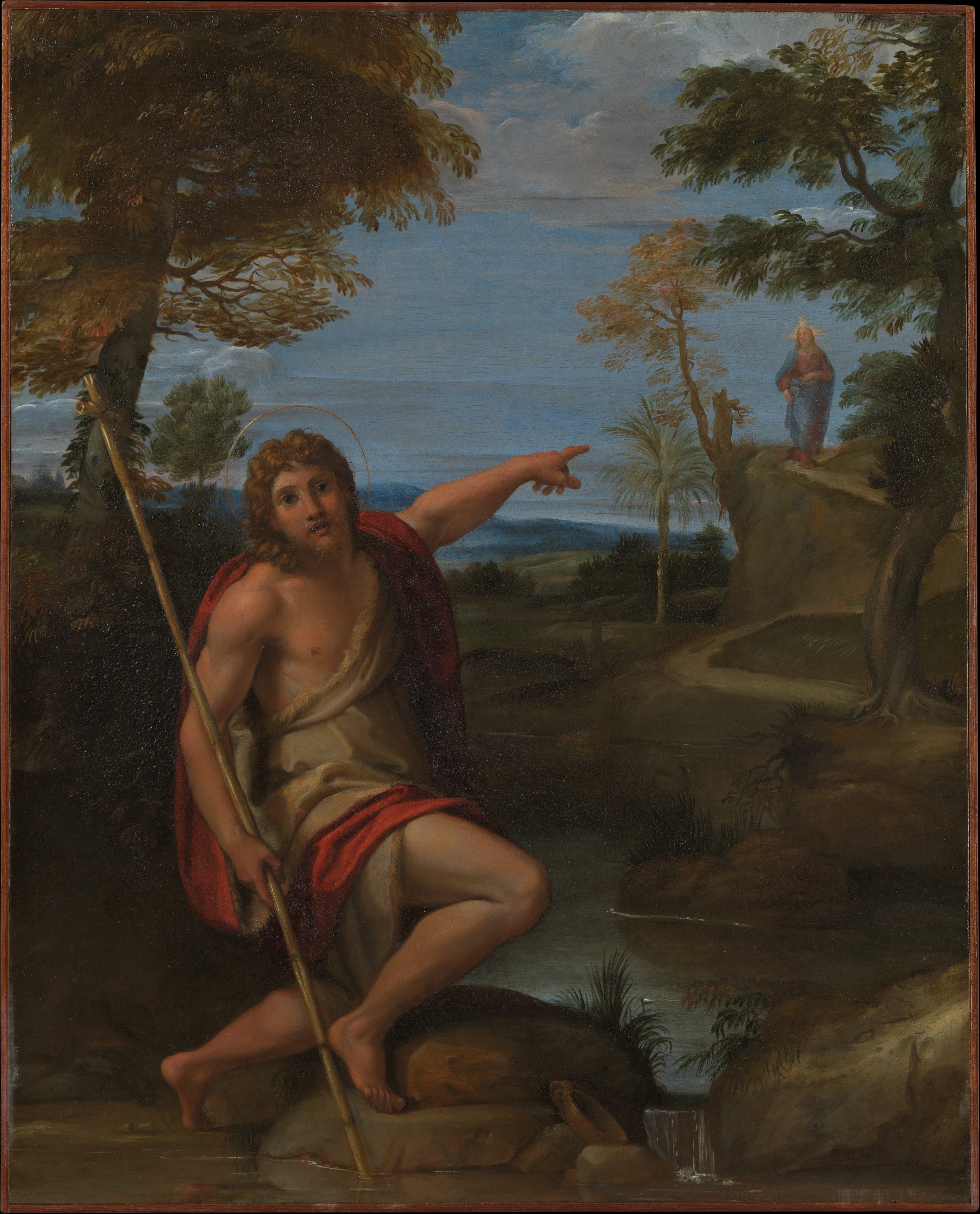
The Sacrament of Baptism is how we become God’s children. But our own baptism was made possible by the Baptism of the Lord Jesus in the Jordan River. This is the sacred mystery that the Church celebrates on last day of Christmas. Today we reflect on the mystery of Jesus’ baptism in order to understand your and my baptism.
So what difference does being baptized make to the life of a Christian in this world? St. Paul gives an answer in his New Testament Letter to the Romans. He explains to the first Christians in Rome that “we were buried… with [Jesus] by baptism into death, so that… we too might walk in newness of life” [Romans 6:4].
What is St. Paul saying here about your daily life as a Christian? What does it mean to “walk in newness of life”, and how does that connect to being “buried… with [Jesus] by baptism into death”?
Imagine someone baptized as an adult. What is different about the way that that adult walked through life before baptism, over and against the way that he walks through life after baptism? The answer is that after baptism, the Christian walks through life by means of death. But what exactly does that mean, that by virtue of your baptism, you are meant to walk through life by means of death?
One way of explaining it is that your life is not about your self. Your life as a Christian is about God first, your neighbor second, and your self third. The living of the Christian life means loving God and loving your neighbor, and living for God and living for your neighbor. This is instead of rooting your life in your love of your self, and living for the good of your self and your comfort: in a word, the Christian life is the process of becoming “self-less”.
To live a “self-less” life means to live your daily life through the strength of your baptism, by means of death. If this seems abstract, the saints of our own day and time give us clear examples. Take St. Teresa of Calcutta. If you’ve never watched a documentary of her life in Calcutta, watch one on YouTube. Watch Mother Teresa in the slums of Calcutta, loving God at the Holy Sacrifice of the Mass and in Adoration of the Blessed Sacrament early each morning. Then, during the rest of the day, through the strength she received in Adoration and Holy Mass, she loved the “poorest of the poor”, as she called her neighbors. She tended to their needs by carrying out the corporal and spiritual works of mercy.
Saints like Mother Teresa are easy to admire, but how does the average Christian go about opening her or his life to God’s grace more fully? One simple question that helps is to ask yourself whether you can name from memory the seven corporal works of mercy and the seven spiritual works of mercy. If not, find them listed in the Catechism, write them down on a sheet of paper, and pray over this list of fourteen simple actions: two columns of seven works of mercy.
So here are three action items for this coming week. Choose just one of these, unless you feel really enthusiastic about doing all three. (1) Find out, if you don’t already know, the date of your baptism, and put a note in your 2026 calendar to observe your baptismal anniversary with prayer and maybe even going to Mass. (2) Watch a documentary about St. Teresa of Calcutta. (3) Write out longhand the seven corporal works of mercy and the seven spiritual works of mercy, and choose one out of those fourteen to focus on during the rest of this month. Pick a different work of mercy for each month.
Albert Einstein is supposed to have stated that genius equals 1% inspiration and 99% perspiration. Something similar is true of holiness. In the case of holiness, God the Holy Spirit offers us the inspiration. Your work after accepting that grace is the 99% of perspiration through acts of love for God, and acts of love for your neighbor, dying to your self, so as to live completely within the Mystical Body of Christ.
The Fourth Sunday of Advent [A]
The Fourth Sunday of Advent [A]
Isaiah 7:10-14 + Romans 1:1-7 + Matthew 1:18-24
December 21, 2025
Christmas, of course, is a time for giving gifts: gifts which are signs of our love. Spiritually, Christmas is a time for us to give gifts to God. Christmas is a time for us to give God signs of our love for Him. So naturally, we want to give God our best.
After all, that’s what He did for us. God the Father gave us His only Son. His most precious possession did God the Father give us as the first Christmas gift.
Spiritually, because God is a loving Father, He doesn’t want us only to give Him gifts. He wants His children to shower each other with gifts, also. Just as Jesus summed up what it means to be His disciple in two great commands—to love God with all your heart, mind, soul and strength, and to love your neighbor as yourself—so our own gift-giving during Christmas must also bear this two-fold mark: giving gifts to God, and giving gifts to our brothers and sisters.
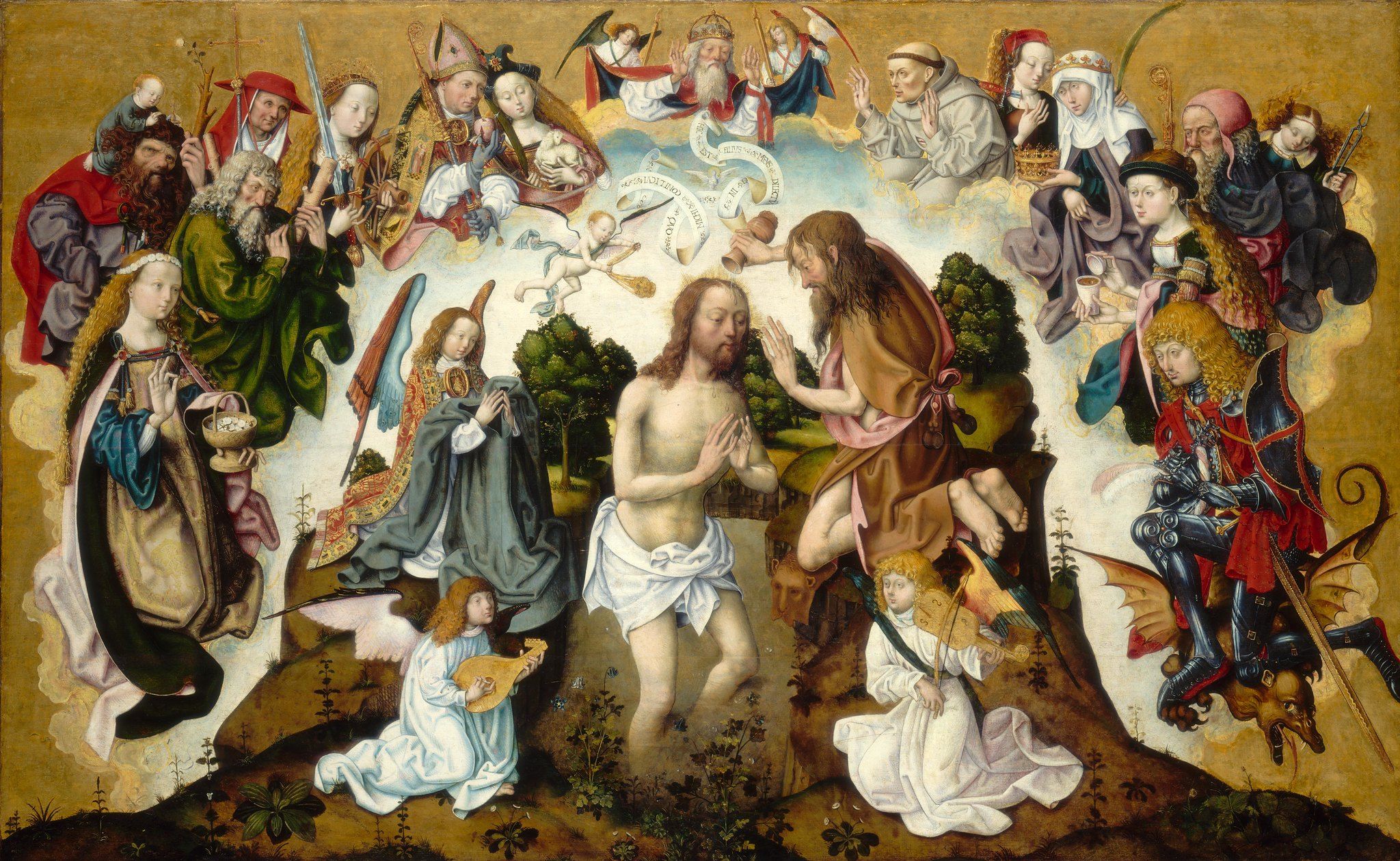
Advent is a season that helps us to do just that. During Advent, there are three key figures who show us how to prepare for the birth of Christ: that is, the Father’s gift to us. Whether and how we accept this Gift from the Father determines how well we can give gifts to God and our brethren. These three key Advent figures and St. John the Baptist, the Blessed Virgin Mary, and St. Joseph. Today’s Gospel passage focuses our attention on the last of these three.
+ + +
Saint Joseph is a curious figure in the Gospel. You may actually have heard people at times dismiss the significance of St. Joseph’s vocation. After all, they ask, how hard could Joseph’s life have been? His wife was sinless, and his foster-child was the Son of God! What husband and father could possibly have it easier than Joseph?
But that sort of dismissal of St. Joseph overlooks one very important principle of the Christian spiritual life. On this Fourth Sunday of Advent—just days before the start of Christmas—the Church wants us to reflect upon St. Joseph, and ponder his vocation within the Holy Family, so that you and I can see how that same principle needs to be observed in our own spiritual lives.
+ + +
St. Joseph was a very blessed man. He was blessed to have Mary as his wife, and he was blessed that God gave him and Mary custody of God’s Only-Begotten Son. But with God’s gifts inevitably come challenges. The two cannot be separated. In God’s way of living life, God’s gifts and God’s challenges cannot be separated. This is a bedrock principle of our Christian faith.
Put another way (which might sound a little strange at first), God’s gifts are equipment. God’s gifts are equipment. What does that mean? It’s to say that when God gives us gifts, His gifts equip us to carry out some work on God’s behalf.
So it was with St. Joseph. Yes, Joseph was greatly blessed by God with tremendous gifts. But these tremendous gifts were given to Joseph because God had tremendous plans for him. Joseph’s vocation involved tremendous sacrifices (perhaps the greatest example of which was the flight to Egypt because of the threat to the life of the infant Jesus). God was calling Joseph to tremendous service on God’s behalf, and thanks be to God, Joseph was a “just man” (or “righteous man” as today’s Gospel passage puts it). Joseph knew that it’s in giving God His due that any of us find peace in this life and in the next.
In today’s Gospel passage, what we hear gives us only a small idea of Joseph’s vocation. Here, as in all four Gospel accounts, Joseph is never recorded as saying a single word. You might say that Joseph is the “strong, silent type”. He prefers actions to words. He’s a man of just deeds rather than a man of just words, like so many of us men are: just words.
+ + +
We might ask, then, “Where does that leave us?” What does St. Joseph have to teach us? As a teacher, he will have to teach us by his example, since we have none of his words to learn from. Although God issued Joseph great challenges, Joseph faced many smaller ones, also. Joseph’s small challenges, and his corresponding small sacrifices, can be a mirror for us to look into, to see what our daily lives might look like with greater faith.
It is as the spouse of the Blessed Virgin Mary that we honor Saint Joseph. When Matthew, at the beginning of his gospel account, introduces Joseph, he calls him “the husband of Mary.” It is the spousal nature of Joseph’s life that mirrors in the sort of fidelity that God asks of us. The life of Saint Joseph is one of silent fidelity to the Lord. In him, we see that we are called to be people of faith even when appearances suggest that we should give up on others, ourselves, or even God.
Like his wife Mary, Joseph has an open ear. He listens for the Lord to speak to him. As we make our final spiritual preparations for the Christmas season, we should rest in the fact that the Jesus whom God invites us to receive in our lives is indeed Emmanuel: He is God, who is with us, who is born for our salvation, and who has Good News for us to listen to.

The Third Sunday of Advent [A]
The Third Sunday of Advent [A]
Isaiah 35:1-6, 10 + James 5:7-10 + Matthew 11:2-11
December 14, 2025
In today’s Second Reading, the apostle Saint James encourages us to: “[t]ake as an example of hardship and patience … the prophets who spoke ….” Then the Gospel Reading sets before us the greatest of the prophets: Saint John the Baptist, whose life reveals the wisdom of what St. James encourages us to take up.
“Hardship and patience” don’t come easily to most of us. Of course, most people can see the value of patience more easily than the value of hardship. We know from daily experience how much we need patience in order to get along in this world (not to mention in order to have a shot at Heaven!). As we grow up, we need patience with our brothers, and with our sisters. Parents need patience with their children, and children with their parents. Employees need patience with their bosses, and bosses with their employees.
We even need to have patience with God! Maybe that sounds strange. Of course, the reason for needing patience with God is very different than why we need patience with our children, parents, boss, and so on. For the most part, we need patience with our brothers and sisters because of their imperfections, faults, and sins. But with God we need patience for different reasons.
We need patience with God first of all because His time is not our time. God looks at us and our lives from the perspective of eternity, while we—like children—look only at a very narrow span of time. In other words, our field of vision is restricted by blinders that we have placed upon ourselves.
Or we might say that we need patience with God because God is a farmer, while for our part, we—all too often—only want to reap what we have not sown. So patience is one of the key virtues of Advent, and we beg God for an increase in the virtue of patience, with both God and neighbor.
+ + +
But on the other hand, do we really need the hardship that St. James speaks about in the Second Reading? Or is hardship just something that has to be tolerated? Is hardship actually of value, or should we instead work to cultivate a soft, comfortable, easy, restful life?
We know, of course, that some penance is inevitable in this world where we live. In His Sermon on the Mount, Jesus reminds us that God makes the rain to fall on the just and the unjust.
Saint John the Baptist speaks about the hard fact that hardship is necessary. In fact, hardship is not just necessary. Hardship has great value. Saint James says the same. Both saints point our attention to Jesus, who shows us repeatedly that hardship is a precious means by which to draw closer to the Father. Hardship is a means of allowing Him to embrace us as a father embraces his little child.
+ + +
Of course, another word for “hardship” is “penance”. But the word “penance” is not always fully appreciated. For some Catholics, the word “penance” suggests only the Sacrament of Penance, with all of the examination of conscience, confession, and amendment of life that are part and parcel of that sacrament. For other Catholics, the word “penance” suggests a medieval monastery, where monks use whips and cords, a diet of hard bread and cold soup, and allow themselves three hours of sleep on a hard floor in order to tell God, year after year, how sorry they are for being such miserable wretches. Unfortunately, false caricatures of “penance” such as that medieval monastery lead some Christians to the opposite extreme, where the grace of Christ, which has already won the victory over human sin, leads them to reject penance as having any place within the spiritual life.
Holy Mother Church, however, not only teaches her children to practice some penance on Fridays in honor of that Good Friday when Jesus carried His Cross and died upon it for us. The Church not only offers the Sacrament of Penance every week of the year so that sins, both large and small, mortal and venial, can be washed away by the Blood of Christ. In fact, the Church goes further in sowing the seeds of penance in our spiritual lives. The Church each year sets aside two seasons of the year as seasons of penance. Advent and Lent are seasons of preparation: Lent prepares us for Eastertide, and Advent prepares us for Christmastide. Penance, then, is one of the tools with which to prepare for the great seasons of Christmas and Easter.
However, although Advent and Lent are similar in many ways, they focus our hearts and minds differently. Lent will come again in a few months, and during Lent we can reflect on how Lent is unique in calling Christians to penance. But Advent’s unique “take” on penance has its origin in the experience of new life: new life, of course, being what lies at the heart of the Christmas mystery.
Those of you who are mothers can recall all the sacrifices involved in bearing new life, and bringing it into the world, not to mention the countless sacrifices involved in shepherding your child through the first decades of his or her life. New life and sacrifice are part and parcel of each other. New life and sacrifice go hand in hand. You can’t have one without the other.
But you will still find some Christians who insist that new life in the spiritual life is different: they insist that because grace is free, that it demands no sacrifice of the one to whom it’s given. As Catholics, though, we know better, because the Church leads us in the practices of penance throughout the year, but especially during Advent and Lent.
Along with the practices of poverty and silence, the practice of penance helps us prepare to celebrate Christmas in a deeply spiritual manner. If you’d like an image to reflect on throughout this third week of Advent, here are three images: picture our Blessed Mother at the Annunciation, during the journey to Bethlehem, and in the stable after Jesus’ birth. Reflect on our Blessed Mother practicing poverty, silence, and sacrifice, and give thanks that through the grace of her Son, you and I can draw closer to God the Father.

The Immaculate Conception of the Blessed Virgin Mary
The Immaculate Conception of the Blessed Virgin Mary
Genesis 3:9-15,20 + Ephesians 1:3-6,11-12 + Luke 1:26-38
December 8, 2025
The Blessed Virgin Mary needed a Savior. This is important to recall when reflecting upon the Immaculate Conception: that is, Mary being conceived by her mother, St. Anne, without inheriting Original Sin. This is important, among other reasons, because some of our separated brethren within the Body of Christ make a false claim about Mary. They argue that believing in Mary’s being preserved from Original Sin means that the salvation that Jesus won for fallen man on Calvary was not universal: in other words, that Mary had no need for salvation. She was sinless, so Jesus did not save her: that’s the false claim that we have to be able to answer.
In truth, we have Mary’s own testimony in the Bible. The scene of the Visitation of Mary to her cousin Elizabeth is recorded in the first chapter of St. Luke’s Gospel account. In that scene, Mary proclaims the hymn called the Magnificat, which starts with Mary declaring: “My soul magnifies the Lord, and my spirit rejoices in God my Savior, for he has regarded the low estate of his handmaiden” [Luke 1:46-48; see Acts 4:12].
Mary speaks of her “Savior”, because Mary was saved by God from sin. But she was not saved from sin like you and I, through the grace of Baptism and Confession.
Consider an example of what it means to be saved. Imagine this: imagine that you’re standing at the edge of a very large lake. In front of you is a pier that extends a long way into the lake. At the end of the pier, the water is fifty feet deep.
Now imagine that two friends are with you. These persons are both blind, and unable to swim. Now you’re setting up your campsite, when suddenly you hear a splash: one of your friends walked all the way to the end of the pier and fell into the water. Naturally, you run to the end of the pier, dive in, and drag the friend to safety. You have saved your first friend from drowning.
The next day, you’re scavenging near the campsite for firewood. At one point you pause, and look up. Your other friend has walked down the pier, and is close to its end. You make a mad dash for the pier, and you reach its end just as your friend is about to step off and fall into the fifty-foot deep water. You grab your friend by the back of his shirt and pull him back to safety before he can fall in. You have saved your second friend from drowning.
That second friend is like the Blessed Virgin Mary, who was saved by preventing her from ever falling into sin. The rest of the human race is offered salvation in the first way, by being pulled out of sin after having already fallen into it. Mary was never stained by sin, but she was saved from it.
So that analogy helps us understand how God saved Mary. However, it’s far more important to understand why God saved Mary in this unique way.
The Blessed Virgin Mary was immaculately conceived, and filled by God with grace, for the moment of the Anunciation. In fact, Mary was “full of grace” for the sake of her entire vocation, which began at the moment of the Annunciation, and then extended throughout her earthly life, and continued (and continues) after the end of her earthly life and her assumption into Heaven.
However, the rest of her vocation—the Visitation, the Nativity of her Son, the Sorrows of Jesus’ infancy and public ministry, her intercession at the wedding at Cana, her fidelity at Calvary, and her motherly care for the Church starting on the day of Pentecost—was entirely dependent upon this moment of the Annunciation. This moment was for Mary what the decision in the Garden was for Eve. But Mary’s choice was the opposite of Eve’s. Through Eve’s choice, sin entered the world, while through Mary’s choice, the Word of God became Flesh and dwelt among us.
This is why throughout history, the Church has addressed the Blessed Virgin Mary as the New Eve. Mary is our Mother, and also our model. She is “full of grace”, and the first of those graces was the grace of her Immaculate Conception. By means of God’s graces, Mary models for us the way of discipleship, the way to accept Christ into our lives. The first step upon that way is for us to say at the start of each day: “Behold, I am the [servant] of the Lord. May it be done to me according to your word.”