Monday of the Nineteenth Week in Ordinary Time

Monday of the Nineteenth Week in Ordinary Time
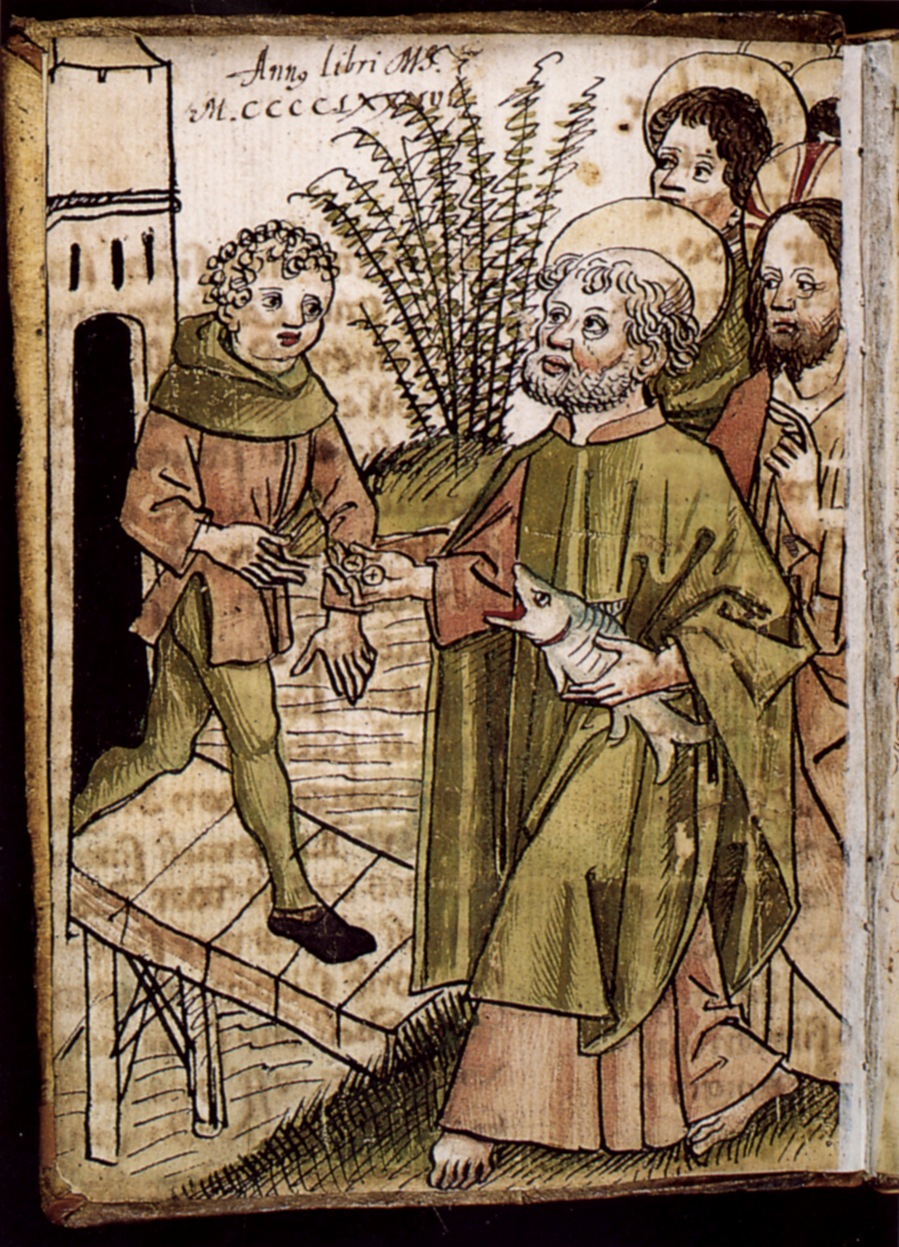
Matthew 17:22-27

“Give that to them for me and for you.”

When Jesus walked this earth—Jesus, the one whose life and ministry fulfilled the prophecies of the Old Testament—there were three ways in which He spoke and acted as a prophet.  Through these three, He teaches us not only how to be His disciples, but also how to teach in His name.

The sort of grand spectacle that Jesus worked through miracles such as multiplying the loaves or walking on water were complemented by sacred events such as Jesus’ Transfiguration on Mount Tabor, when He shone in glory before three of His disciples.  But as impressive as those scenes were, spectacle was not the norm for Jesus.

Though many like to pretend otherwise, Jesus also preached “fire and brimstone” when the occasion called for it.  This second way of being a prophet, of course, is one of the reasons that Jesus was led to the Cross.

The third way in which Jesus acted as a prophet is a kind which is very rare in the Old Testament.  But it is uncommonly common in the life of Jesus.  In the life of one of His saints—St. Thérèse the Little Flower—it was called the “Little Way”.  It is a way of simplicity and humbleness that goes overlooked by those looking for spectacles.  It is a way that is ignored by those who are looking out for themselves, instead of others:  by those who justify their actions by claiming that they’re just doing what everyone else is doing, walking down the broad path, instead of trying to walk the narrow way that following Jesus demands.

The simplicity and humbleness of Jesus in today’s Gospel is a very good meditation for those setting out again to begin a new school year.  Jesus is not obligated to pay the tax that is demanded of Peter, but Jesus explains—“that we may not offend them”—that He will pay the tax anyhow.

The miracle by which Jesus accomplishes this almost goes unnoticed, because it’s not the point.  Jesus’ point is to teach by humility, to teach by doing that which is not necessary, but which can lead others to see the Little Way.  This is the way that, after a long journey through a life of service in this world, leads to the vision of eternal life with God and His saints.

The Transfiguration of the Lord [C]

The Transfiguration of the Lord [C]
Daniel 7:9-10,13-14  +  +  2 Peter 1:16-19  +  Luke 9:28-36

And behold, two men were conversing with Him… [speaking] of His exodus ….

Suffering is part and parcel of following Jesus.  He teaches us this lesson through His Transfiguration.

There’s a simple contrast in today’s Gospel passage.  Peter stands in contrast to Jesus.  Peter says, “Master, it is good that we are here”, while Jesus does not reply.  In fact, the evangelist does not quote Jesus at all in this passage.  Not that Jesus doesn’t speak in this passage:  we’re told that Jesus was conversing with Moses and Elijah, but we are not allowed to overhear their conversation.

Did Peter hear the conversation among Jesus, Moses and Elijah?  It doesn’t seem so.  Had Peter heard them, it’s not likely that he would have said what he did:  “Master, it is good that we are here”.  Peter certainly perceived the glory of Jesus, His changed face, and the brilliance of His white clothing.  But had Peter heard the conversation of Jesus and His prophets, it’s unlikely that Peter would have said what he did.

Jesus, Moses and Elijah “spoke of Jesus’ exodus that He was going to accomplish in Jerusalem.”  This exodus is not from the power of a pharaoh, or from the persecution of pagan prophets, but from the power of sin and death.  You and I know the rest of the story:  that Jesus accomplished this exodus on Calvary.  We know that through His sin and death, you and I might have life to the full.  Had Peter understood all this, he may have turned away from following Jesus.

Suffering is part and parcel of following Jesus.  If we shy away from suffering for the good, we remove ourselves from Jesus’ presence.  Only by remaining in the presence of Jesus can He lead us to the glory of the Father.

Transfiguration - Titian

Transfiguration by Titian [c. 1488 – 1576]

Friday of the Eighteenth Week in Ordinary Time

Friday of the Eighteenth Week in Ordinary Time
Matthew 16:24-28

“Whoever wishes to come after me must deny himself, take up his cross, and follow me.”

Our souls need nourishment and healing before we spend our selves trying to solve the problems of our own lives and those of the world.  We must be willing to admit, first of all, that we are sinners, and that our sins seriously wound our souls.  Our souls need not only the nourishment of prayer, but the healing that comes from the forgiveness of our sins.  After all, it is in this regard that Jesus is our Messiah, our Savior.  God the Son became human not to save us from the Caesar, or from the IRS, or from our neighbors:  Jesus died to save us from the snares of the Devil.  God the Son became human not to take away our worries, or our financial debts, or our arguments with others:  Jesus died to take away our sins.

Once we regain this perspective in our lives, we realize how truly we need Christ’s help.  Yet at the same time, we hear Christ’s words to his disciples in today’s Gospel passage:  “Whoever wishes to come after me must deny himself, take up his cross, and follow me.”  Christ has died for us on the Cross, but we must join in His saving work.  We must do penance.  We must organize the time and energies of our lives so that they draw others closer to God.  In our speech, in the patience with which we do things and deal with others, through our charitable deeds, we can deny our sinful selves and become more like Christ.  And in doing all this, we should never underestimate or believe that we can imagine what graces God will bestow upon us through acting by means of His grace.

Tintoretto, La crocifissione, Sala dell'albergo, Scuola di San R

Thursday of the Eighteenth Week in Ordinary Time

Thursday of the Eighteenth Week in Ordinary Time
Matthew 16:13-23

“You are the Christ, the Son of the living God.”

Today’s Gospel passage is well-known for revealing Jesus’ intention of founding His Church on the rock of faith, personified both in the individual Simon Peter, and in the office of the papacy.  What sometimes is overlooked is what immediately follows.  These latter verses also reveal something important about the Church, the office of the papacy, and the men who hold that office.

When Jesus “began to show His disciples that He must” suffer and be killed, the newly appointed Peter begins to “rebuke” Jesus!  The word “rebuke” is not a soft one.  But Jesus immediately and forcefully corrects Peter, revealing to us that Peter’s office is not subject to the personal concerns, insights or doubts of him who holds the office.  Nor is the officeholder of the papacy unable to err.

Peter’s error here reverses the profession of faith after which Jesus named him “Peter”.  Jesus praised Peter’s confession of faith, pointing out to him that “flesh and blood has not revealed this to you, but my heavenly Father”.  Contrast these words with what Jesus says following Peter’s scandalous rebuke:  “You are thinking not as God does, but as human beings do”.

This contrast between the divine and the human is juxtaposed by Peter’s confession of Jesus and his rebuke of Jesus.  Peter’s confession is of Jesus’ divinity, but his rebuke is based on refusing to accept Jesus’ humanity as the means of His mission.  Each of us needs to accept Jesus’ mission of offering His Body and Blood on the Cross.  Through this mission, Jesus will fully share divine life with those of us who place their faith in Him.

Wednesday of the Eighteenth Week in Ordinary Time

Wednesday of the Eighteenth Week in Ordinary Time
Matthew 15:21-28

“Please, Lord, for even the dogs eat the scraps that fall from the table of their masters.”

We are not God’s children by right.  There is an infinite distance, naturally speaking, between us and God, between Heaven and Earth.  That is why the woman in the gospel represents each one of us:  she is a Gentile.  Up to Jesus’ day, God had promised salvation only to the Jews.  Gentiles were by definition outsiders.

Everything in our lives is a gift.  This is the opposite side of the coin:  on the one hand, we know that we do not deserve what we have in life.  So then, we are called to give thanks to God constantly, and all of our acts of thankfulness are rooted in faith.

Faith itself is the greatest gift we have in life.  Without faith, these acts of thanksgiving—culminating in the Holy Eucharist—make no sense.  The worst cynic or atheist would be justified in being rude and hard-edged about life, if God did not exist.  But we have to recognize that faith is a gift, which some people do not have during their earthly lives.

The faith that God wants from us is not passive; it’s active.  God does not want from us the sort of faith that just says, “God is going to take care of everything, so I can sit back and coast.”  This is not our Catholic understanding of faith.  Faith is something active on our part.  It demands constant prayer.  It demands the sort of dialogue, the sort of banter, that we hear between Jesus and the Gentile woman.  We might even say, God wants us to challenge Him in our prayer.  In this, we have no better example than Saint Teresa of Jesus.

OT 18-3

Tuesday of the Eighteenth Week in Ordinary Time [Year A]

Tuesday of the Eighteenth Week in Ordinary Time [Year A]
Matthew 15:1-2,10-14

“If a blind man leads a blind man, both will fall into a pit.”

Jesus’ words in today’s Gospel passage might seem harsh. We might say that He’s calling a spade a spade. He describes the Pharisees as “blind guides of the blind”. Regarding precepts that the Pharisees had commanded, Jesus states: “Every plant that my heavenly Father has not planted will be uprooted.”

Jesus is making a distinction here between commands that are divine in origin and those that are human in origin. A slightly different distinction that might be made is between commands that are of permanent duration and those that are temporary because they are circumstantial.

We’re familiar with such distinctions in the world around us. For example, the command against murder is objective in nature and may not be transgressed by any person or “repealed” by any court of legislature. However, a traffic sign stating that the speed limit on a ten-block stretch of road is 35 mph may be changed by a local authority if a good reason arises.

Although Jesus speaks harshly about the Pharisees, we cannot assume that originally there may not have been good reasons for the commands that the Pharisees taught. However, Jesus’ words make it apparent that the commands no longer had purpose and ought not to be followed.

Within the life of Jesus’ Church, there is a similar principle at work. Jesus speaks to this principle when He says to St. Peter, “I will give you the keys of the kingdom of heaven, and whatever you bind on earth shall be bound in heaven, and whatever you loose on earth shall be loosed in heaven” (this passage will be proclaimed at Mass this Thursday).  Jesus is not speaking here about rules concerning such things as murder or the nature of marriage. But He is giving Peter – and his successors – wide latitude in making changes for the sake of a Church whose mission already has spanned twenty centuries and every continent of the earth. Yet regarding rules that may be changed, the Holy Spirit’s guidance is needed to ask whether rules ought to be changed, or in other words whether they continue to guide Jesus’ disciples along His Way.

The Nineteenth Sunday in Ordinary Time [C]

The Nineteenth Sunday in Ordinary Time [C]
Wisdom 18:6-9  +  Hebrews 11:1-2,8-19  +  Luke 12:32-48
Catechism Link: CCC 359

“Much will be required of the person entrusted with much ….”

When Jesus says these words about us, two questions immediately arise.  First, what has Jesus entrusted us with?  Second, what therefore will be required of us?

Each of us, naturally, has been given the gift of life.  You’ve probably seen the bumper sticker that says, “Smile:  your mom chose life!”  In our day and age, this is not a gift that we ought to take for granted.  Still, when we thank God each day for the gift of life, what exactly are we giving thanks for?

Human nature has two parts to it:  body and soul.  Like the simpler types of animals, we have bodies that are subject on the one hand to hunger and physical pain, and on the other hand to the pleasures of good meals and the process of physical healing.

However, unlike the lower animals, we humans can find meaning even in bodily suffering and pain.  Yet we can discover this meaning only through our souls.  The human soul is the means through which we can, if we choose, rise above being merely an animal.  “Much will be required of the person entrusted with much ….”  God has entrusted each of us with a human soul, and that’s not a gift to be underestimated.

“In the beginning”, “God said, ‘Let us make man in our image, after our likeness ….’”  In those words, we hear how much God has entrusted us with in giving each of us a human soul.  The human soul is given to a person at the moment of his or her conception:  that moment when the human body starts to exist from the gifts given by the father and the mother.  But while the human body comes from a child’s parents, the human soul comes directly from God at that moment of conception.  So what about that soul:  what kind of gift is it that God gave each of us at the moment of conception?

If there’s a single word that sums up the power, the meaning, and the aim of the human soul, it’s the word “transcendence”.  The human soul allows man to transcend himself.  There’s nothing more boring, numbing, and deadly than to live for oneself.  Unfortunately, the message of the world around us is to do just that:  to live for oneself.  But Christ calls us to live for others.  The powers of the human soul, when animated by God’s grace, allow us to live for others and to rejoice in doing so.  In doing so, we imitate the self-sacrificial love of the three Persons of the Trinity for each other.

Here, then, is what God requires of us:  to transcend ourselves by living for others, both the others who are our neighbors, and the Other who is God.  Living for others means loving those others.  This is a high bar, of course, that God has set for us.  Everything that’s sinful in us inclines us to live for ourselves, because living for ourselves is so much more comfortable.  But God did not make us for comfort.  If you doubt that, look at the crucifix.  As a saint once said, “The crucifix is the true answer to every heresy.”

The fathers of the Church at the Second Vatican Council declared that “it is only in the mystery of the Word made flesh that the mystery of man truly becomes clear” [Gaudium et Spes 22].  This divine Word became flesh and blood so that He might offer His self—His divinity and humanity—upon the Cross.

You see this when you gaze upon the crucifix.  If you want to know what it means to be human; if you want to know what man is meant for; if you want to know the antidote to human misery, selfishness, and frustration with the meaningless of living the good life of comfort:  look at the crucifix.

The soul is a vessel of grace.  Grace is the power of God’s life that makes us strong enough to clear that very high bar that God has set for us:  the bar of living for others instead of for ourselves.  “Much will be required of the person entrusted with much ….”  God has entrusted each of us with soul and body in order to offer them up each day for others.  The crucifix shows us how.  The Eucharist gives us the strength to do so.

Catechism Link

A new feature now appears in the header of Father Hoisington’s Sunday reflections.  In the line under the Scripture citation is a reference to a passage from the Catechism of the Catholic Church.  This passage relates to one of the themes discussed in the reflection.  Many of these Catechism Links will come from the Vatican’s 2014 Homiletic Directory, which builds upon Pope Benedict XVI’s Apostolic Exhortation Verbum Domini.  Clicking on the hyperlink will take you to that section of the Catechism.

Tuesday of the Eighteenth Week in Ordinary Time [Years B & C] *

Tuesday of the Eighteenth Week in Ordinary Time [Years B & C]
Monday of the Eighteenth Week in Ordinary Time [Year A]
Matthew 14:22-36

Please note:  In year A, when the Gospel Reading for the 18th Sunday in Ordinary Time is Matthew 14:13-21, the Gospel Readings for Monday and Tuesday of the week are different than in the Years B & C.

+     +     +

Those who were in the boat did Him homage, saying, “Truly, you are the Son of God.”

The Church’s treasury of Scripture interpretation is based upon a four-fold view of the Holy Bible.  The first view of the Bible looks at the literal meaning of a Scripture passage. In the case of today’s Gospel passage, for example, the literal meaning of the passage is an historical event involving Jesus interacting with His disciples, and miraculously walking on water.  One could make a long and spiritually fruitful meditation focusing only upon the literal meaning of this passage.

However, the other three views of Scripture consider different “spiritual senses” of a given passage.  That doesn’t mean, of course, that the literal meaning doesn’t deal with spiritual matters.  But the three spiritual senses of Scripture relate the literal meaning to a broader meaning that the passage doesn’t directly touch upon.

For example, at the end of today’s Gospel passage, those who were in the boat did Jesus homage, saying, “Truly, you are the Son of God.”  Above and beyond the literal meaning of this action, one can “see” the boatful of disciples confessing the divinity of Jesus as symbolizing the Church Militant (that is, the Church on earth).  Around this basic symbol are several complementary symbols:  for example, the water on which the boat rests, as well as the weather surrounding the boat, as the turbulent world in which the Church Militant lives.  Then again, the action of confessing faith in Christ is a symbol of the Church’s Sacred Liturgy, which receives Jesus into the Church’s “boat” in the sense of the faithful receiving during the Sacred Liturgy God’s Word and His Word made Flesh.

It is easier to ponder the literal sense of Scripture than the three spiritual senses.  But with the guidance of the Church’s saints and magisterium, the spiritual senses invite us into great theological riches, and a more profound encounter with the Word of God made Flesh.