The Presentation of the Blessed Virgin Mary Revelation 14:1-3,4-5 + Luke 21:1-4 November 21, 2016
“‘… but she, from her poverty, has offered her whole livelihood.’”
We live in a society in which values that are contrary to the Gospel are canonized. A person’s value is measured in economic terms. The poor are shunned as worthless. Continue reading →
“‘Amen, I say to you, today you will be with me in Paradise.’”
Very likely, the moment of your death will have something in common with Jesus’ death on Calvary, which we hear of in today’s Gospel. If you prayerfully consider what took place in this scene, you might gather something to help you prepare for that moment when your everlasting life will be judged by Christ the King.
Luke 23:35—“The people stood there watching….”
Who were these people? Where were they from? Why were they there at the top of Calvary? Were they there simply out of curiosity about Jesus, out of hatred of Him, or out of compassion? Surely there was a mix of people gathered there, just as in the world today people have different reactions to Christ and His Gospel. Even within an individual Christian’s soul, there is often a mixture of motives and feelings about following Christ. Sometimes we are passionate about the beliefs of our faith. At other times we may be fearful of the reactions we will draw from others for standing up for our faith. At other times we may be simply bored about anything that has to do with the Church.
Luke 23:38—“There was an inscription over [Jesus’] head: ‘This is the King of the Jews.’”
There were many who did not take this description of Jesus seriously. And in one sense, we might see their point, especially if we contrast the scene of Calvary with the scene of the First Reading, where David is anointed the King of all the Jewish people. Though there had been many Jewish kings before David, he was the first to unite the entire people under a solitary king.
How could this Jesus, dying on a cross, be descended from King David, much less have a right to his throne? The answer goes back once again to what sort of kingdom we believe Jesus came to earth to exercise. Does he want possession of all our earthly goods, or does he want possession of our spiritual souls?
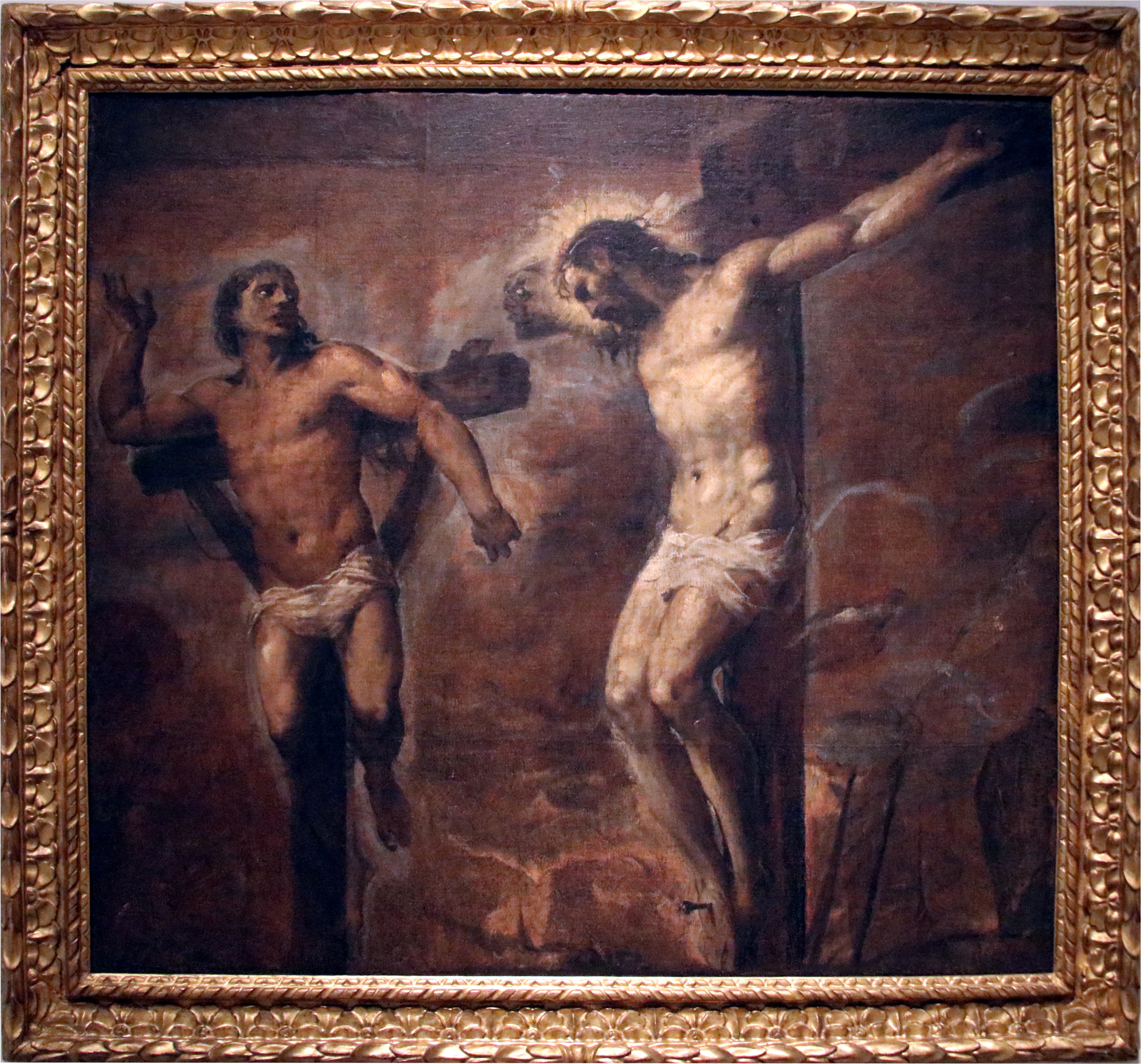
Luke 23:39—“One of the criminals hanging in crucifixion blasphemed him, ‘Aren’t you the Messiah? Then save yourself and us.’”
Saint Luke, in telling us of this scene of Christ’s Passion and Death, turns from describing those in the crowd to those who are hanging near death. He focuses his lens, as it were, for a close-up on these three persons. First he tells us of the words of one of the criminals, who mocks Jesus even as he faces his own death.
Jesus, for his own part, does not choose to respond to this criminal’s mockery. Instead, the other criminal, whom tradition identifies as Saint Dismas, rebukes the first criminal. He comes to the point when he says that:
Luke 23:41—“…this man has done nothing wrong.’”
This fact is one that few people in this scene of Calvary are willing to admit: that Christ has done nothing wrong. So why did he allow Himself to be nailed to the Cross? Why was He willing to suffer the disgrace and humiliation of such a death? It all goes back to the fact that in His human life, Jesus was never His own prime concern. He suffered and died in order to open the gates of heaven to God’s children.
This selfless love is the power by which the Kingdom of God works and flourishes. This love for others shows us what sort of King we have in life. And if this is how He leads His life, we are surely subject to the same sort of life as subjects of Christ the King.
Saturday – 33rd Week – Ordinary Time [II] Revelation 11:4-12 + Luke 20:27-40 November 19, 2016
“And they no longer dared to ask Him anything.”
In today’s Gospel passage, Our Lord tries to make clear to the Sadducees the meaning of the Resurrection. We too, however, even if we understand and believe in both the Resurrection of Our Lord and the promise of resurrection that God offers to all who die, perhaps may need to realize what type of claim the Resurrection places upon our Christian faith. Continue reading →
Friday – 33rd Week – Ordinary Time [II] Revelation 10:8-11 + Luke 19:45-48 November 18, 2016
“‘“…but you have made it a den of thieves.”’”
Lots of people in Jesus’ day were fed up with the materialism and commercialism that had crept into the practices of the Temple in Jerusalem. This place, the Temple, was the holiest place in the entire world for Jews. One of the obligations of a good Jew in the time of Jesus was to go to Jerusalem at the time of Passover, and offer a sacrifice in the Temple: those who were wealthy offered an entire ox or sheep; those with less means offered turtledoves. And so there grew up a very large market during the time around Passover, a system within which many abuses developed. Jesus undoubtedly had many people cheering for Him as He told off the Jewish officials and the money-makers in the Temple. Continue reading →
St. Elizabeth of Hungary, Religious Revelation 5:1-10 + Luke 19:41-44 November 17, 2016
“‘Worthy are you to receive the scroll / and break open its seals….’”
Today’s passage from the Book of Revelation focuses on Jesus Christ. Not surprisingly, then, it teaches us something important about His Bride, the Church. The entire Book of Revelation is not only profoundly Christo-centric, but also eccleiso-centric (that is, focused on the Church). Continue reading →
Wednesday – 33rd Week – Ordinary Time [II] Revelation 4:1-11 + Luke 19:11-28 November 16, 2016
“After He had said this, He proceeded on His journey up to Jerusalem.”
Those who think of Jesus as a “teddy bear” are challenged by the last sentence of Jesus in today’s Gospel Passage. These words conclude a lengthy parable, which St. Luke the Evangelist prefaces with a clear explanation of the motive for the parable: Jesus “proceeded to tell a parable because He was near Jerusalem and they thought that the Kingdom of God would appear there immediately.”Continue reading →
Tuesday – 33rd Week – Ordinary Time [II] Revelation 3:1-6,14-22 + Luke 19:1-10 November 15, 2016
“‘For the Son of Man has come to seek and to save what was lost.’”
Zacchaeus is a rich collector of taxes. Each of us, like him, is attached to worldly things. Zacchaeus, like you, wants to see who Jesus is. But Zacchaeus has two strikes against him. Continue reading →
Monday – 33rd Week – Ordinary Time [II] Revelation 1:1-4;2:1-5 + Luke 18:35-43 November 14, 2016
“When they saw this, all the people gave praise to God.”
Today we begin hearing at weekday Mass from the Book of Revelation. We will continue to hear from this book through the last day of the Church year. This is fitting, of course, since Revelation is the last book of the Bible, and treats of the “Last Things”, although in a highly mysterious manner. Continue reading →
“‘By your perseverance you will secure your lives.’”
On this last Sunday before the feast of Christ the King, Jesus teaches us that we can better understand when “that day” (that Malachi speaks of in our First Reading) will occur, if we think about two other days: today and tomorrow.
In the Gospel passage, Jesus’ “today” was an ordinary day on which “some people were speaking of how the temple was adorned with precious stones.” These people were thinking only of “today” in the secular sense: that is, only of material things. Such people become trapped in “today”. They have no real future: neither a tomorrow, nor hope for “that day.” They are caught up in the present moment, encouraged to do so by a secular culture.
Jesus points out that while this sort of “today” may enthrall, it will not last forever: “the day will come when not one stone will be left on another, but it will all be torn down.”Suddenly, on “that day” these people will be shocked: they will be taken from their “today”, from their fixation on this world. Every secular today comes to an end.
Most of us Christians, hopefully, are not fixed solely on today. We know, even regarding worldly concerns, that it’s important to focus on “tomorrow”. Needs such as retirement planning, children’s education, and meetings next week all require attention to our tomorrows.
For most of us, “tomorrow” helps give focus to each “today”. We realize soberly that we never know how many tomorrows we might get. So there is a constant balance that we strive for between the two. “Tomorrow” might mean many things: next week, next year, or the year we turn 65. Regardless, it is a time we can see in the future, and fix in our minds. It is a secular tomorrow, which may well bear importance, but which certainly will come to an end. It is a tomorrow that does not yet exist, but which will eventually pass away as surely as today.
Jesus points our attention, however, beyond every earthly “tomorrow” imaginable. Jesus points our attention to “that day”. “That day” is the day on which you will die. “That day” is also the end of the world: at least, the end of yours.
So many people grow fearful thinking about a cataclysmic end of the planet, even though the vast majority of us will never face such an event. But not many seem to worry much about the end of their own personal lives, which everyone is guaranteed to face. Many in the mass media and society draw interest from describing the end of the planet, yet these are often the same ones who hide the reality of human death, and the brevity of this world and its goods.
Ask Jesus for the courage, trust, and simplicity of heart to live today, and plan tomorrow, with “that day” always in your mind and heart. That day is a door that opens to eternity.
 Reflections on the Sacred Liturgy