Today’s Gospel passage shows us God’s passion for His temple, and for the sacrifice offered there. Priests often hear people confess anger, and it’s usually necessary to ask questions when someone confesses “getting angry”. In light of Jesus’ action in this passage, it’s important to remember not only that merely “getting angry” is not necessarily a sin. Also, even acting in anger is not necessarily a sin. Acting in anger, or fostering anger in oneself or others, certainly can be a sin. But Jesus acts in anger in today’s Gospel passage, and with good reason. When reflecting on a state of anger, and actions that flow from it, it’s important to ask what the object of one’s anger is. This object can make all the difference in the morality of such an act.
In the passion of anger, Jesus purifies the Temple. In the passion of love, He purifies the temple of the human body of sin on Calvary, by offering up His own body in sacrifice. St. John the Evangelist makes this point clearly. When Jesus challenges His opponents, saying, “Destroy this temple and in three days I will raise it up”, the evangelist explains that Jesus “was speaking about the temple of His Body.” The Church’s belief in the great goodness of the human body is based in large measure on this Gospel truth. The Church’s challenging ethic of purity of body stems not from a belief that the human body is bad, but that the human body’s purity ought to concern us as much as the purity of the Temple concerned Jesus. Both temples ultimately belong to God, for His purposes and for His glory. The temple of the human body is meant for the offering of sacrifices, small and large.
In today’s First Reading, Saint Paul speaks about the second of Jesus’ two great commandments. As you know, Jesus taught His disciples that the Law of God could be simply expressed in two great commandments. Before Jesus, with the Ten Commandments that God had given Moses, and the hundreds of moral prescriptions developed by rabbis to explain them, Jewish morality had become complex, and to many, overwhelming. Jesus profoundly simplifies matters for His disciples.
Love God with your whole heart, mind, soul and strength, and love your neighbor as yourself. Jesus teaches us that these two sum up the entire law of God. St. Paul in our First Reading explains that “love is the fulfillment of the law.” Love is not simply the summary of the Law, but its fulfillment.
When we are young, our parents make sure that we memorize the Ten Commandments. It’s important to memorize these ten, as each of the ten touches on a key manner in which we must love God and our neighbor. But we should not lose sight that all of them are about love. Today’s First Reading helps us focus on what it means to love our neighbor as our self. Pray for the grace to bring your love for your neighbor into focus through your love for God.
Saint Paul’s Epistle to the Romans touches on nearly every theme of the Christian life. Today’s passage from Romans proclaims the mystery of the Church as Christ’s Body. The diversity of the Church’s members serves her unity. The Church’s diversity is willed by God for the sake of her unity, to foster that unity.
From this consideration of the Church as one body with many members, St. Paul moves to a rapid-fire consideration of many virtues that mark the Christian life.
Many of the virtues that ought to mark a Christian’s life come through simple fidelity to one’s calling from the Lord. Yet we know that each person is called in many different ways. Whether one reflects on a calling that takes the form of a vocation such as marriage or consecrated life, or a more specific and perhaps temporary calling based upon work, such as teaching or works of mercy, these varied callings are “near occasions of grace”, so to speak. They all and always find their proper measure within the setting of the Church.
Other virtues that ought to mark a Christian’s life come from struggles and challenges common to all Christians. Many of these struggles are due to sin. St. Paul addresses these also in today’s First Reading. “Endure in affliction.” “Persevere in prayer.” “Bless those who persecute you.” Through these common challenges, we are called to have compassion on our brothers and sisters in Christ. We are called to recognize our common struggles as sinners: children of Adam and Eve. Thanks be to God for the New Adam, Jesus Christ, into whose life He calls us.
“For you will be repaid at the resurrection of the righteous.”
Although Jesus’ words today take the form of a command (“do not invite…”) to us as His disciples, we can reflect today on His words through a process of inversion. That is, we can consider ourselves as those invited to a banquet. The one inviting us is the Lord Jesus. The banquet is the sacramental celebration of the Last Supper: the Holy Sacrifice of the Mass.
Shortly before the distribution of Holy Communion, the priest—holding aloft the Sacred Host—proclaims that “[b]lessed are those called to the supper of the Lamb.” The response of the faithful is, “Lord, I am not worthy that you should enter under my roof… .” In this, both priest and faithful gaze on the One who has called us to Him. We are “the poor, the crippled, the lame, the blind” of whom Jesus speaks in today’s Gospel passage.
For God Himself, of course, it’s not that He will be blessed because of our inability to repay Him. It is from the Lord’s own divine goodness—eternal and infinite—that He bestows on us the blessing on being called to the banquet of the Eucharist. Although we are unable to repay the Lord “in kind” for this invitation, we can nonetheless repay Him with our lives: with the self-gift of our own body and blood, soul and humanity as Jesus’ disciples.
CCC 2044: moral life and Christian witness CCC 876, 1550-1551: priesthood for service; human frailty of leaders
+ + +
Chief among the principles hammered home by the leaders of the Protestant Revolt five hundred years ago is a principle that some still assert today. It’s the principle that no one should come between me and God. Put more formally, it’s the principle that no member of the Church ought to act as a mediator between God and man: not Mary, not the saints, and certainly not priests.
This principle of rejecting mediators within the life of the Church might seem warranted by today’s Gospel passage. Jesus seems to caution against three different roles of mediator: “do not be called ‘Rabbi’.… Call no one on earth your father…. Do not be called ‘Master’”. It’s hard to imagine being faithful to what the Word of God states here without following the principle of rejecting mediators.
Yet the Apostle Paul claims to be faithful to the Word of God. In his second letter to Timothy, St. Paul insists: “All Scripture is inspired by God and profitable for teaching, for reproof, for correction, and for training in righteousness, that the man of God may be complete, equipped for every good work” [2 Tim 3:16].
Since this is true of “all scripture”, it’s true of what St. Paul says in another of his letters. In writing to the Corinthian people, he explains how they have one father. He squarely states, “You might have thousands of guardians in Christ, but not more than one father […] it was I who begot you in Christ Jesus” [1 Cor 4:15].It’s hard to imagine—if you were to interpret Holy Scripture in a literalistic sense—any words that more directly contradict Jesus’ command to “call no one on earth your father”than what St. Paul says of himself: “You might have thousands of guardians in Christ, but not more than one father […] it was I who begot you in Christ Jesus”.
Trying to make sense of this seeming contradiction is made even more difficult by St. Paul’s next words: “Be imitators of me, as I am of Christ” [1 Cor 4:16].Why doesn’t St. Paul just say instead, “Be imitators of Christ”? Why is Paul making himself out to be a middle-man, which is to say, a mediator between the Corinthian people and God?
Here we must be mindful of a key Catholic principle of reading and reflecting upon the Bible. Since “all Scripture is inspired by God and profitable”, whenever one passage of Scripture seems to contradict another, the problem lies in the human interpretation of one or both passages. So in the seeming contradiction between Jesus’ words about mediators and St. Paul pointing to himself as a mediator, we have an example from the Apostle to the Gentiles [see Romans 11:13] of how to interpret the Word of God faithfully and fruitfully.
Saint Paul—who is not only a faithful spiritual father, but also a faithful spiritual teacher (that is, “rabbi”)—leads us deeper into the mystery of living the Christian Faith. St. Paul’s words don’t contradict Jesus’ command concerning fathers, teachers, and masters. St. Paul’s words deepen the revelation of Jesus.
Christian fathers, whether in the home or in the sanctuary, whether through the Sacrament of Holy Matrimony or through the Sacrament of Holy Orders, are called to say—by their example if not also by their words—what St. Paul proclaims to the Corinthians: “Be imitators of me, as I am of Christ.” Christian fathers are called to draw their children each day and each week into the life of Christ.
Christian fathers, in other words, recognize that what St. Paul said of human families is true also of human fathers: “I bow my knees before the Father, from whom every family in heaven and on earth is named” [Ephesians 3:14-15]. Every human father derives his power and significance as father from God the Father. Every human father is meant to lead his children to God the Father. What Jesus warns us against in today’s Gospel passage is any human father—or teacher, or master—who acts on his own authority, and who leads his children away from God.
Human fatherhood, and teaching, and mastery of every sort, are rooted authentically in the life of God. Children are not made for their human fathers. Human fathers, rather, are made to reveal to their children and lead their children to the everlasting love who is God the Father.
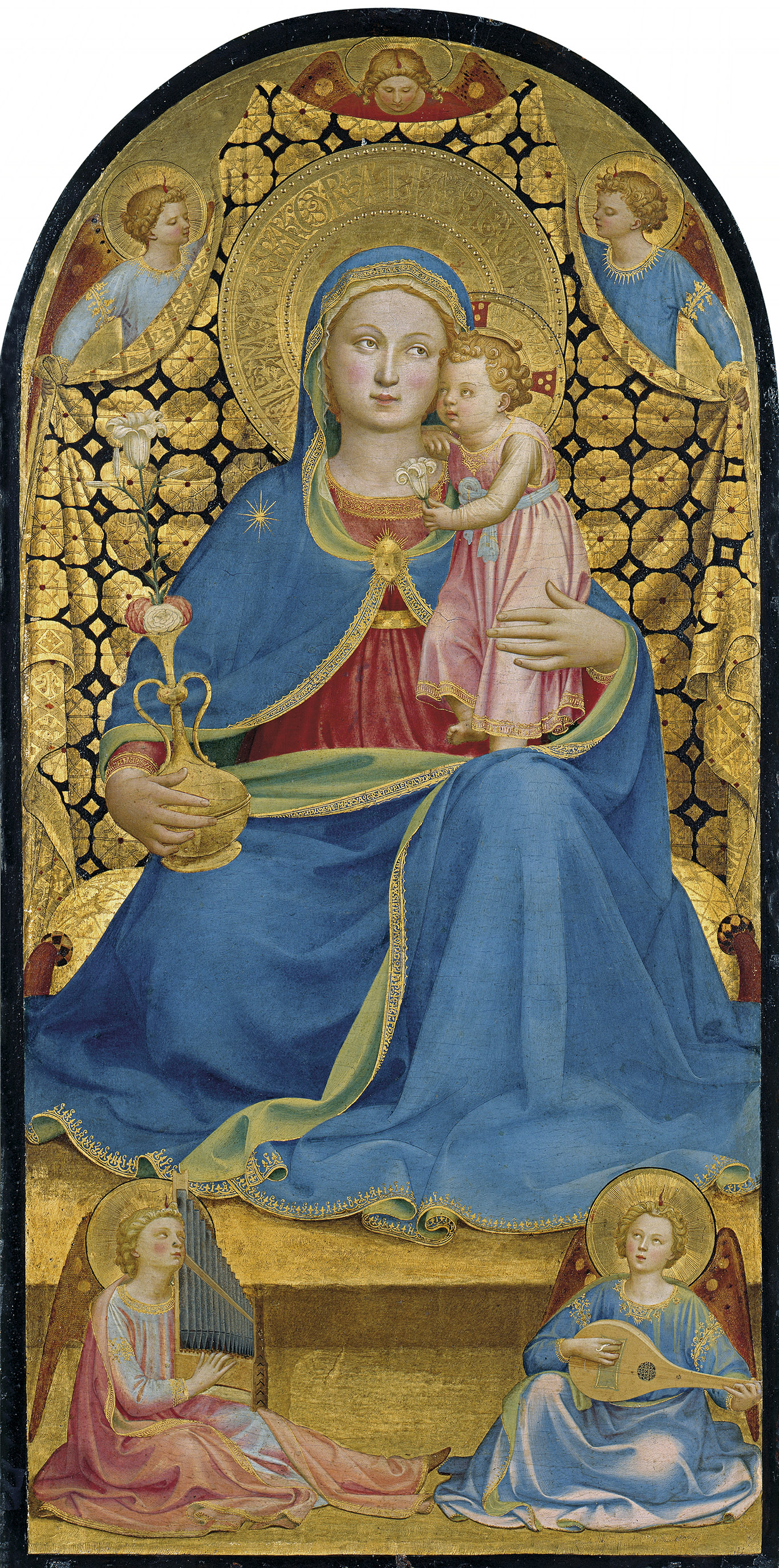
Madonna of Humility by Fra Angelico (c. 1395–1455)
The virtue of humility is a thread that runs through today’s Scriptures. Jesus weaves this thread through the parable that He tells after noticing that His fellow dinner guests were choosing the places of honor at the table (Luke 14:7). They were not content to receive a sumptuous meal. They wanted also to receive honor.
These dinner guests were looking only to receive gifts. They were not thinking of giving. This is natural, on the one hand, since when you accept a dinner invitation, you’re accepting a gift. On the other hand, when you go to a dinner party, you might take a token gift such as a bottle of wine. But your token gift would seem out of place if it were greater than the banquet itself.
But here is the metanoia—the change of heart and mind—which Jesus effects in His disciples through His saving words and deeds. He wants His disciples—including us—to recognize every gift, every invitation to receive, as an opportunity to give.
“My sheep hear my voice,” says the Lord; “I know them, and they follow me.”
Can you imagine a homilist only ever preaching upon the Gospel antiphon? Sacred Scripture is so rich and deep in presenting the Word of God to us that it’s certainly possible for a homilist to preach upon only the day’s Gospel antiphon. Today, the Church proclaims in this antiphon: “My sheep hear my voice,” says the Lord; “I know them, and they follow me.”
There are three distinct statements that the Lord makes here. First, He states: “My sheep hear my voice”; Second, that “I know them”; and third, that “they follow me.” Any one of these three could serve as matter for spiritual meditation. Or one could take any two of the three and compare and contrast them.
In holding up all three of these statements to the light of God’s Word, the role of the Lord’s “voice” seems to link them. The Shepherd calls to the sheep, whom He knows, by means of His voice. Thus they follow Him. Reflect simply, then, on the Lord’s voice: what does it sound like, what does it say, and what must we turn away from in order to hear it?
The belief we celebrate today is part of the “communion of saints.” That’s a familiar phrase—we recite it in the Apostles’ Creed—but the “communion of saints” isn’t just those who are canonized saints in Heaven, but also the members of the Church who are in Purgatory, and on earth. Today we who are members of that third group pray for those in the second, so that joined through prayer, we all may become members of the first.
Sometimes we feel torn like Saint Paul, because while it’s better to be in heaven, God wants us here for His purposes. Those purposes call each of us to help others in many ways. One of the most important of these is prayer for others, which is formally called “intercession”.
Even in heaven, saints are given missions by God. Saints are not simply fixed on God, without regard for others. Saints in heaven pray for the rest of the “communion of saints”.
We on earth are like the saints in Heaven in this regard. While we might want to fix our attention on God alone, God wants us to offer our lives for others, because this is often where we find God revealed in our lives. So it is through our prayers of intercession, both for fellow pilgrims on earth, and for those in Purgatory.
Does this take away from God? No. God wants us to turn to each other. Intercessory prayer is a form of that command to “love your neighbor as yourself”. If it’s valid in God’s eyes to pray for oneself, why wouldn’t it be to pray for others? When a family suffers a tragedy, they draw closer together. Part of this occurs through prayer, and they all are stronger afterwards, and more closely knit.
Our prayer for others draws us closer to those we pray for. Those in heaven, in purgatory, and on earth are drawn closer together through intercession. When we intercede for another—or ask someone’s intercession—we don’t believe that that person is God. We ask another to take our prayers to God. When we call our mother and ask her to pray for us, we’re doing the same as when we kneel and pray a rosary: we are asking our mother to pray to God for us.
Through all prayers of intercession, the Body of Christ grows stronger. In the person of Christ, God and man are united. Within Christ, we live as members of his Body. Within Christ, we build others up, and find God’s love for us.
See what love the Father has bestowed on us, in letting us be called children of God!
“Children of God.” That is what it means to be a saint: to be a child of God.
We all know that a child resembles his or her parent, for good and for ill. So in telling us that we can be called “children of God”, St. John the Beloved Disciple is telling us that there’s something in us that resembles God, that is inherently good, since of course there is nothing bad in God. From Adam we inherit Original Sin and its consequences.
As we celebrate the feast of All Saints with the Church throughout the world, we ask: “What does it mean to be a saint?” “What is that something in us that resembles God?”
At the moment that each of us was conceived, as our parents shared in the power of God the Creator, that very God called each one of us into existence, and gave us life.
But it’s not the fact that we are alive that makes us children of God, for God could have given us any form of life He wanted. He could have made us a plant, or a lower form of animal on the ladder of created things. All these things have life, but they are not children of God.
We tend to think that it’s our gifts of personality, intelligence, social status, our salaries, or the size of our homes that makes us who we are. And sad to say, in the eyes of other people that may be true. Other people may rate us as persons according to these things. But God’s ways are not our ways.
In the eyes of God, what makes you human is your capacity to be transformed: your capacity to be transformed into something other than what you began life as. This doesn’t simply mean the ability to change form: all animals change shape and size from being an embryo, to an infant, to a youngster, to an adult. We are a human being throughout, and are the same person throughout.
But to put this in a single word, human life is marked by the possibility of “transcendence”. As humans, God has given us the power to change our position on that ladder: we can climb that ladder, and reach for Heaven. We can approach God and become like Him. As children of God, we resemble God to the extent that we are holy.