The Solemnity of the Most Holy Trinity [C]

The Solemnity of the Most Holy Trinity [C]
Proverbs 8:22-31  +  Romans 5:1-5  +  John 16:12-15

“I have much more to tell you, but you cannot bear it now.”

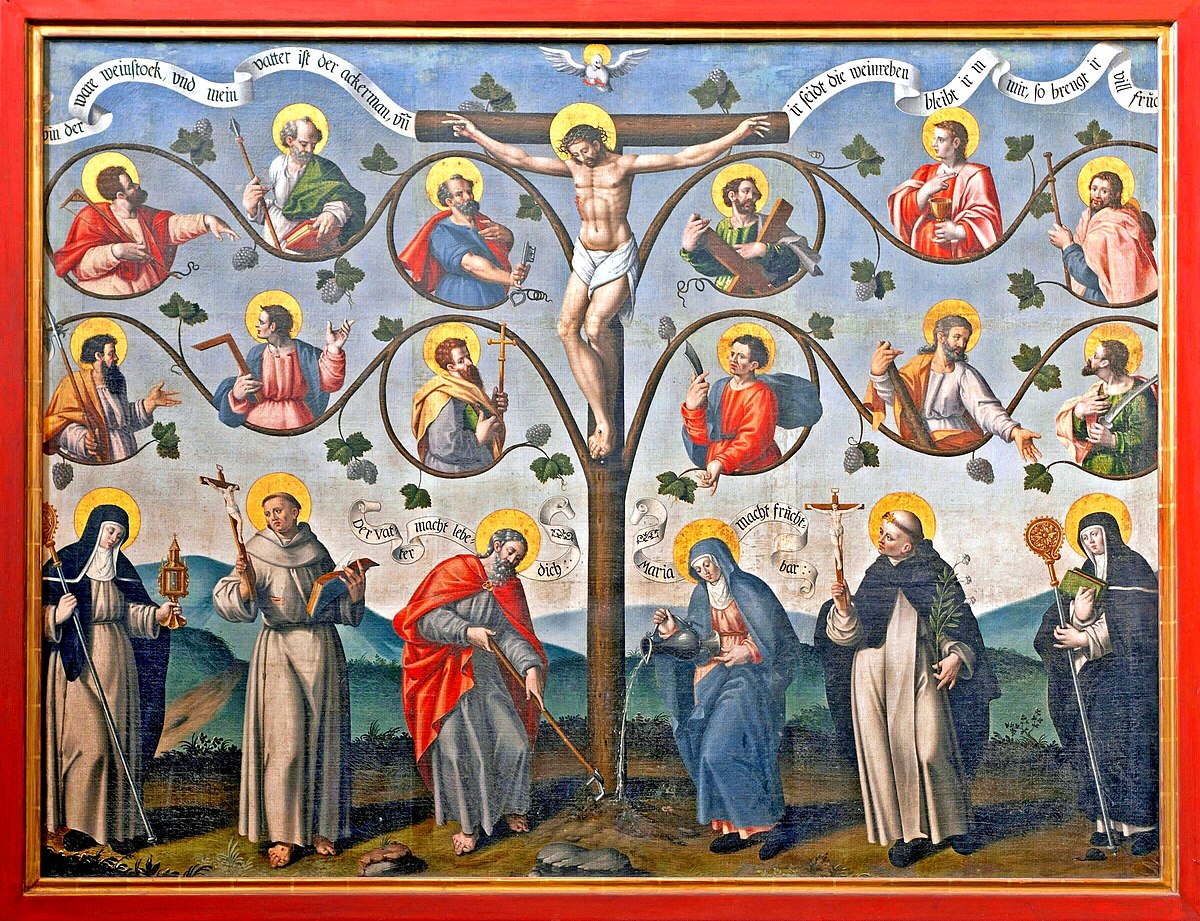
The Church celebrates today the central mystery of our Christian Faith.  The life of the Most Holy Trinity is the mystery from which all the other mysteries of our Catholic Faith flow.  Yet the mystery of the Most Holy Trinity is difficult to wrap our heads around.

The Church, however, has learned over the centuries a simple means by which to explore this awesome mystery.  The Church reflects upon who God is by looking at what God has chosen to do.  This principle has a very technical name:  “The Apple Doesn’t Fall Far From The Tree”.

This principle is readily seen in families.  You have a parent, and you have a child, and about the child you say, “That apple didn’t fall far from the tree”.  When you say that, everyone knows what you mean.  The child resembles his parent.

We hear a divine example of the “apple principle” in today’s First Reading from the Old Testament Book of Proverbs.  In this passage is a discourse given by “the wisdom of God”.  In the second half of the discourse, we hear two intriguing statements.  Wisdom not only says, “When the Lord established the heavens I was there,” but also, “then was I beside Him as His craftsman… and I found delight in the human race.”

Wisdom is the Lord’s “craftsman”, who “found delight in the human race.”  Everything God created in the universe was created with wisdom—that is, was created in an ordered way—because God Himself is All-Wise, and His apples don’t fall far from the tree.

Nonetheless, out of all of God’s creation, it’s “in the human race” that wisdom takes particular delight.  In the beginning—in the Book of Genesis—we hear the Lord say, “Let us make man in our image, after our likeness” [Genesis 1:26].  In other words, the apple that is the human race didn’t fall far from the tree, and in fact is the apple of God’s eye [see Psalm 17:8].

In today’s Responsorial Psalm the psalmist cries out in wonder to God, asking, “When I behold Your heavens, the work of Your fingers… What is man that You should be mindful of him… ?  [Yet] You have made him little less than the angels…  You have given him rule over the works of your hands”.  In other words, because God created mankind in His Image and likeness, God gave mankind a share in His “rule over the works of [God’s] hands”.  Or as we might rather put it today, God entrusted to man the stewardship of the works of God’s hands.

All this, of course, begs two questions that lead us into the heart of today’s feast:  #1: what is the Image and likeness of God; and #2: what is God’s work?  The answer to both is simple, because the answer to both is the same:  to love.  The image and likeness of God is love, and God’s work is the work of love.

“God is love” [1 John 4:8].  Because God is love through and through—because God is 100% love—everything that God does is loving.  There’s no divorce between who God is and what He does.  The divine Image is to be love, and so we also are called always to do what is loving in every circumstance.

To help us in this regard, Holy Mother Church teaches us by means of the Sacred Liturgy.  We could say that last Sunday, this Sunday, and next Sunday form a triptych:  a three-paneled icon that focuses our devotion.  Pentecost, Trinity Sunday, and Corpus Christi display before us the Holy Spirit within the Church, the Father Who is the Source of the Trinity, and the Blessed Sacrament of Our Savior’s Real Presence.

Prepare for next Sunday’s feast of Corpus Christi with an eye to growing in your capacity to love:  to be love through your daily choices.  The Sacrifice of Christ on Calvary, made present sacramentally through the Holy Sacrifice of the Mass, shows us sinners our clearest example of what it means to “be love” through a human will and heart.  Rather than love only those who are lovable, and only when circumstances make it easy to do so, Christ calls and strengthens us through the Eucharist to live and love from within His sacrificial love, and so enter more deeply into the Life of the Trinity.

Thursday of the Tenth Week in Ordinary Time [II]

Thursday of the Tenth Week in Ordinary Time [II]
I Kings 18:41-46  +  Matthew 5:20-26
June 9, 2022

“But I say to you, whoever is angry with his brother will be liable to judgment ….”

In yesterday’s Gospel passage, Our Lord stated that He had come not to abolish the Law, but to fulfill it.  Beginning today, in the Gospel at weekday Mass we hear examples of Jesus fulfilling the Law.

Jesus uses a phrase today that He repeats several times throughout the fifth chapter of Matthew.  The phrase “You have heard that it was said…” signals that Jesus wants to present a contrast to us.  First, Jesus presents a basic teaching that comes from the Jewish Law:  for example, in today’s Gospel passage, “You have heard that it was said… ‘You shall not kill; and whoever kills will be liable to judgment.’”

Then, Jesus explains how such a teaching of the Law is to be fulfilled.  He declares today:  “But I say to you, whoever is angry with his brother will be liable to judgment….”  The rest of today’s Gospel passage is Jesus’ unpacking of His new teaching, which again, is the fulfillment of an ancient teaching from the Law.

Today, then, we strive to reflect on Jesus’ specific example of anger.  What is the means by which Jesus teaches His disciples to enter into the fulfillment of this teaching?  The means is reconciliation.  Jesus, in the examples He cites, gives two commands:  “go first and be reconciled with your brother”, and “Settle with your opponent quickly while on the way to court with him.”  Meditate, then, on reconciliation with your neighbor as a form of love of neighbor, and thus as a means to the love of God.

Wednesday of the Tenth Week in Ordinary Time [II]

Wednesday of the Tenth Week in Ordinary Time [II]
I Kings 18:20-39  +  Matthew 5:17-19
June 8, 2022

“I have come not to abolish but to fulfill.”

This week we’ve begun to hear Jesus’ Sermon on the Mount, from the fifth chapter of St. Matthew’s Gospel account.  After the Beatitudes (in Monday’s Gospel) and the similes of the disciples as salt and light (in yesterday’s Gospel), Jesus today sets the framework for the teachings He’s about to offer the disciples.  We could sum up this framework with these words:  “I have come not to abolish [the Law] but to fulfill.” 

Having said that, in the rest of today’s Gospel passage He strictly directs His disciples to integrity in their lives.  There must be integrity between, as we would put it today, what they practice and what they preach.  With this demand Jesus issues a warning and promise:  “whoever breaks one of the least of these commandments and teaches others to do so will be called least in the Kingdom of heaven”, while “whoever obeys and teaches these commandments will be called greatest in the Kingdom of heaven.”

Every Christian is, by virtue of baptism, called to be a teacher.  We remember St. Francis’ admonition to “preach always, and if necessary, use words.”  As each of us makes our nightly examination of conscience, we look for the integrity Jesus has asked of us, in what we’ve taught others by our actions and words.

OT 10-3

Tuesday of the Tenth Week in Ordinary Time [II]

Tuesday of the Tenth Week in Ordinary Time [II]
I Kings 17:7-16  +  Matthew 5:13-16
June 7, 2022

“But if salt loses its taste, with what can it be seasoned?”

Yesterday at weekday Mass we began hearing from the Sermon on the Mount, which is found in the fifth through seventh chapters of the Gospel account of Saint Matthew (5:3—7:27).  In today’s passage from the Sermon on the Mount, Jesus calls His disciples “the salt of the earth” and “the light of the world”.  Either of these could serve you as the basis for a long period of meditation.  But consider just one aspect of what Jesus sets before you today.

Salt has long been used as a preservative of food.  So one might be tempted to consider Jesus’ image of “the salt of the earth” as meaning that Christians are called to preserve life.  In other words, Christians are called to preserve what we already have.  But the following words of Jesus suggest something further.

Jesus speaks of salt in terms of its taste, as a seasoning.  As most of us know, salt isn’t meant to be tasted by itself.  Most of us would be repulsed by even the idea of putting a spoonful of salt in our mouths.  But it’s common to sprinkle salt liberally on one’s food in order to bring out the taste within the food.

Here we can reflect on Jesus’ image in terms of our own discipleship.  If Jesus’ disciples are “the salt of the earth”, Jesus is paying a compliment to “the earth”.  There is value—taste—in the world because it was created by God.  Even though the world that we live in is full of sin, our role as disciples involves bringing out what is good in God’s creation—cultivating that good—so that it might be elevated by God’s supernatural grace.

OT 10-2

The Blessed Virgin Mary, Mother of the Church

The Blessed Virgin Mary, Mother of the Church
Genesis 3:9-15,20 [or Acts 1:12-14]  +  John 19:25-34

And from that hour the disciple took her into his home.

On the feast of Our Lady of Lourdes in 2018, Robert Cardinal Sarah—the prefect of the Congregation for Divine Worship and the Discipline of the Sacraments—announced the institution of a new obligatory memorial for the Ordinary Form of the Roman Rite of the Catholic Church.  This memorial is to be celebrated every year on Pentecost Monday, which is to say, the day following Pentecost Sunday.  In the Extraordinary Form of Holy Mass, this is the second day of the Octave of Pentecost.

In his decree inscribing this new memorial into the General Roman Calendar, Cardinal Sarah noted the following:

“The joyous veneration given to the Mother of God by the contemporary Church, in light of reflection on the mystery of Christ and on His nature, cannot ignore the figure of a woman (cf. Gal 4:4), the Virgin Mary, who is both the Mother of Christ and Mother of the Church.”

“Indeed, the Mother standing beneath the cross (cf. Jn 19:25), accepted her Son’s testament of love and welcomed all people in the person of the beloved disciple as sons and daughters to be reborn unto life eternal. She thus became the tender Mother of the Church which Christ begot on the cross handing on the Spirit. Christ, in turn, in the beloved disciple, chose all disciples as ministers of his love towards his Mother, entrusting her to them so that they might welcome her with filial affection.”

“This celebration will help us to remember that growth in the Christian life must be anchored to the Mystery of the Cross, to the oblation of Christ in the Eucharistic Banquet and to the Mother of the Redeemer and Mother of the Redeemed, the Virgin who makes her offering to God.”

Mary the Mother of the Church

Saturday of the Seventh Week of Easter

Saturday of the Seventh Week of Easter
Acts 28:16-20,30-31  +  John 21:20-25

I do not think the whole world would contain the books that would be written.

This morning’s Gospel passage consists of the final six verses of the Gospel according to John.  The Easter Season draws to a close, then, with an almost parenthetical reminder that the Gospel accounts of Jesus’ earthly life are by no means exhaustive.  Nor are they meant to be.

Matthew, Mark, Luke and John, in composing their accounts of the Gospel, did not aim to give an exhaustive record of Jesus’ saving words and deeds.  For that matter, even if all of the words spoken—and deeds carried out—by Jesus during His earthily life were recorded, that account of the Gospel would not be the “final word”.

Does this assertion sound blasphemous?  Does it reduce the power and beauty of the Incarnate Word?

In truth, it reveals the full intent—the full vocation and mission—of the Incarnate Word.  God’s providential, covenantal, saving Work blossoms through the life of the Mystical Body of Christ:  the Church.  The life of the Church—from her conception in the Sacred Triduum, to her birth at Pentecost, until her consummation on the Last Day—is the Way, the Truth, and the Life of Jesus on this earth.

Easter 7-6 Ascension

Friday of the Seventh Week of Easter

Friday of the Seventh Week of Easter
Acts 25:13-21  +  John 21:15-19

Peter was distressed that He had said to him a third time, “Do you love me?”

On these last two weekdays of Easter, our Gospel passage comes from the epilogue of John’s Gospel account.  In these final days, we hear John’s account of Jesus’ “final word”, which echoes what John records time and time again throughout his Scriptural writings (the Book of Revelation, his three epistles, and his Gospel account).

Jesus’ “final word” is Love—caritas—which in fact is the very nature of the Triune God, and so then also of the “Word made Flesh”.  As we prepare to celebrate the Sundays and other solemnities that flow forth from the Easter Season, we meditate on the meaning of the Caritas Who Is God.  In the weeks following the Easter Season, the Church will celebrate the Solemnities of the Most Holy Trinity, Corpus Christi, and the Most Sacred Heart of Jesus.  Through each of these, the Church reflects and liturgically celebrates the goodness of God’s very nature:  the Love that the Risen Jesus extends to us.

Today, Jesus calls Peter, the Rock of the Church, to accept this divine caritas as the heart of his own life and ministry.  We pray for our Holy Father, the Pope.  We also pray for ourselves, that no matter what our vocation may be, our lives will also reflect this divine outpouring of love.

Easter 7-5 Ascension

Pentecost

PLEASE NOTE:  In addition to the Mass for Pentecost Sunday, Pentecost has a proper Vigil Mass and an extended Vigil Mass with five Scripture readings before the Gospel.  For the shorter Vigil Mass, the First Reading may be taken from any of the Old Testament passages proclaimed at the Extended Form of the Pentecost Vigil Mass.

Pentecost Vigil Mass—Extended Form
Genesis 11:1-9  +  Exodus 19:3-8a,16-20b  +  Ezekiel 37:1-14  +  Joel 3:1-5  +  Romans 8:22-27  +  John 7:37-39

Pentecost Sunday
Acts 2:1-11  +  1 Corinthians 12:3-7,12-13  +  John 20:19-23

When the time for Pentecost was fulfilled, they were all in one place together.

Almost 2000 years ago on this day, the Church was born.  The Church would be nothing without the Holy Spirit.  The Church couldn’t have been born without the Holy Spirit, and she could not live today without the Holy Spirit.  Where the Church is strong, it’s because of the Holy Spirit.  Where the Church is weak, it’s because the Holy Spirit is not given His due.

When I say “where”, I don’t just mean in different parts of the world.  It’s true that the Church is stronger in some parts of the world than others.  Certainly the Church in the Western world is not as strong—doesn’t live the Gospel with as much fidelity—as the Church in many third-world countries.  In countries where the Church has fewer material resources, the Church tends to be stronger, for opportunities to experience the suffering Christ are more present, whereas the West fosters an antiseptic culture in which many wear blinders.

When the event of Pentecost occurred almost 2000 years ago, the apostles were greatly changed by their “encounter” with the Holy Spirit.  How were they changed?  The Holy Spirit didn’t make them taller, richer or stronger.  The Holy Spirit doesn’t try to change us in these ways, because He isn’t interested in our bank accounts, or the vehicles we drive, or our looks, but only the state of our souls.

So how were the apostles changed?  What did the apostles “get out of” their encounter with the Holy Spirit?  It was a spiritual change, certainly, but we need to be more specific.  The apostles didn’t receive the Holy Spirit in order to help them feel good about their relationship with God.  The apostles didn’t receive the Holy Spirit in order to tickle the ears of others by preaching about sunshine and daffodils, but instead to call others to an adult faith:  that is, to a catholic faith that preaches and lives out even the hard teachings of the Church.

This is just as true today.  The gifts of the Holy Spirit are given to apostles and prophets, clergy and lay people, in the first and twenty-first centuries, in order to build the Church on earth by means of self-sacrifice.  There are different works but the same God who accomplishes all of them in every one.  To each person the manifestation of the Spirit is given for the common good.  To each person the Holy Spirit is not given to make him feel better about himself.  The Holy Spirit is given to make possible greater self-sacrifice.

We receive the Holy Spirit in simple ways.  Among other examples, we receive the Holy Spirit when devoutly reading Scripture, and by carrying out the corporal and spiritual works of mercy.  But as we receive Him—as we grow spiritually—the gifts and graces of the spiritual life that we receive are to be laid at the feet of others.

We see this when we look at the sacraments of Baptism and Confirmation.  Through Baptism, a person becomes a member of the Church:  an individual member of the Body of Christ.  Through Confirmation, a person is prepared to offer his or her life in service for the sake of the Church, for the sake of that Body of which he or she is one member.

The Holy Spirit leads us in our spiritual life.  He leads us in making decisions about how to serve the needs of others.  There are countless opportunities to do good each day of our lives.  But we cannot do them all.

Likewise, we sometimes ask God to help us accomplish something:  to help us see how to get something done that we want to do.  We often need to realize, though, that the Holy Spirit is not going to show us how to do something that He has no interest in us doing in the first place.  If we do not feel that God is guiding us, it may be because that path would lead us in a direction that God does not want us to travel.

At this conclusion of Eastertide, ask God to help you to be open to the Presence of the Holy Spirit in your life.  Ask this not simply for your own sake, but to help you seek and serve the needs of others, because no one can find salvation on his own.

Thursday of the Seventh Week of Easter

Thursday of the Seventh Week of Easter
Acts 22:30;23:6-11  +  John 17:20-26

“… so that they may all be one, as you, Father, are in Me and I in You.”

There are many types of unity.  For example, if two persons agree about a political issue, and join a common party, these two persons have political unity.  If two persons agree about a moral teaching, or agree to act in common on behalf of a moral goal, these two persons have moral unity.  If two students study for doctorates in physics, specializing in the same topic, and become the two foremost experts in the world about that topic, these two persons bear a certain intellectual unity.

Two persons can also be united by far less significant matters:  their nationality, the clothes they wear, or the physical space they share (whether in an elevator, a house, or a courtroom).  Two siblings are united by their parentage, and identical twins enjoy an even more specific genetic unity.  Beyond physical traits, siblings—or a parent and child—can be united by psychological traits, temperament, or even predispositions towards certain virtues and vices.

None of these is what Jesus is preaching about in John 17:21.  Jesus is preaching about something far more profound.

The tiny word “as” in Jesus’ petition to the Father unlocks the petition’s meaning:  “that they may all be one, as you, Father, are in Me and I in You.”  Reflect, meditate, and contemplate the meaning of the Unity that the Three Persons of the Blessed Trinity not merely have or share, but essentially are.

Ascension medieval 6