Saturday of the Twenty-first Week in Ordinary Time

Saturday of the Twenty-first Week in Ordinary Time
Matthew 25:14-30

“A man going on a journey called in his servants and entrusted his possessions to them.”

It’s helpful to remember that the parables proclaimed at Holy Mass yesterday and today come from Chapter 25 of Matthew.  This is the final chapter before Matthew’s account of the Last Supper and the events that follow.  The section from which these parables come is sometimes called “the Olivet discourse”, in which Jesus’ attention is fixed on the judgment of Jerusalem.

We should not be aloof, though, in listening to Jesus’ words of judgment against Jerusalem.  The city of Jerusalem in the Old Testament is roughly analogous to the Body of Christ in the New Testament.  Jerusalem was meant to be the dwelling place of God on earth, where His holy people would dwell in unity.  In this light we ought to listen to this parable and consider how God will judge us.

The multiplicity of servants in today’s parable offers us hope, as well as room for cautious consideration.  We might ask, “Which of these servants do I most resemble?”  Perhaps, for example, we need to be jarred from self-complacency, and look hard at the last servant.

To avoid hearing the ultimate sentence of today’s parable, we ought to reflect on the penultimate sentence:  “For to everyone who has, more will be given… but from the one who has not, even what he has will be taken away.”  These words give focus to this parable, and can help us use it as an examination of conscience.

Friday of the Twenty-first Week in Ordinary Time

Friday of the Twenty-first Week in Ordinary Time
Matthew 25:1-13

… but we proclaim Christ crucified ….

Have you ever noticed in regard to weddings how many of those who are invited don’t come to the wedding ceremony, but do show up later for the free food, free booze, and the dance?  To grasp the significance of how disrespectful this is of the dignity of the wedding, consider the analogy of being invited to someone’s home for an evening.  Would you sit at someone’s supper table and only eat the dessert, pushing away the vegetables and the main course?

In all honesty, in our moral and spiritual lives we’re probably more like those wedding invitees than we’d like to admit.  We want the joys of being married to Jesus, but we don’t want our lives literally to be wedded to the life of Jesus.  This is where we need to reflect further on St. Paul’s words in today’s Epistle:  “Jews demand signs and Greeks look for wisdom, but we proclaim Christ crucified[:] … to those who are called, … Christ the power of God and the wisdom of God.”

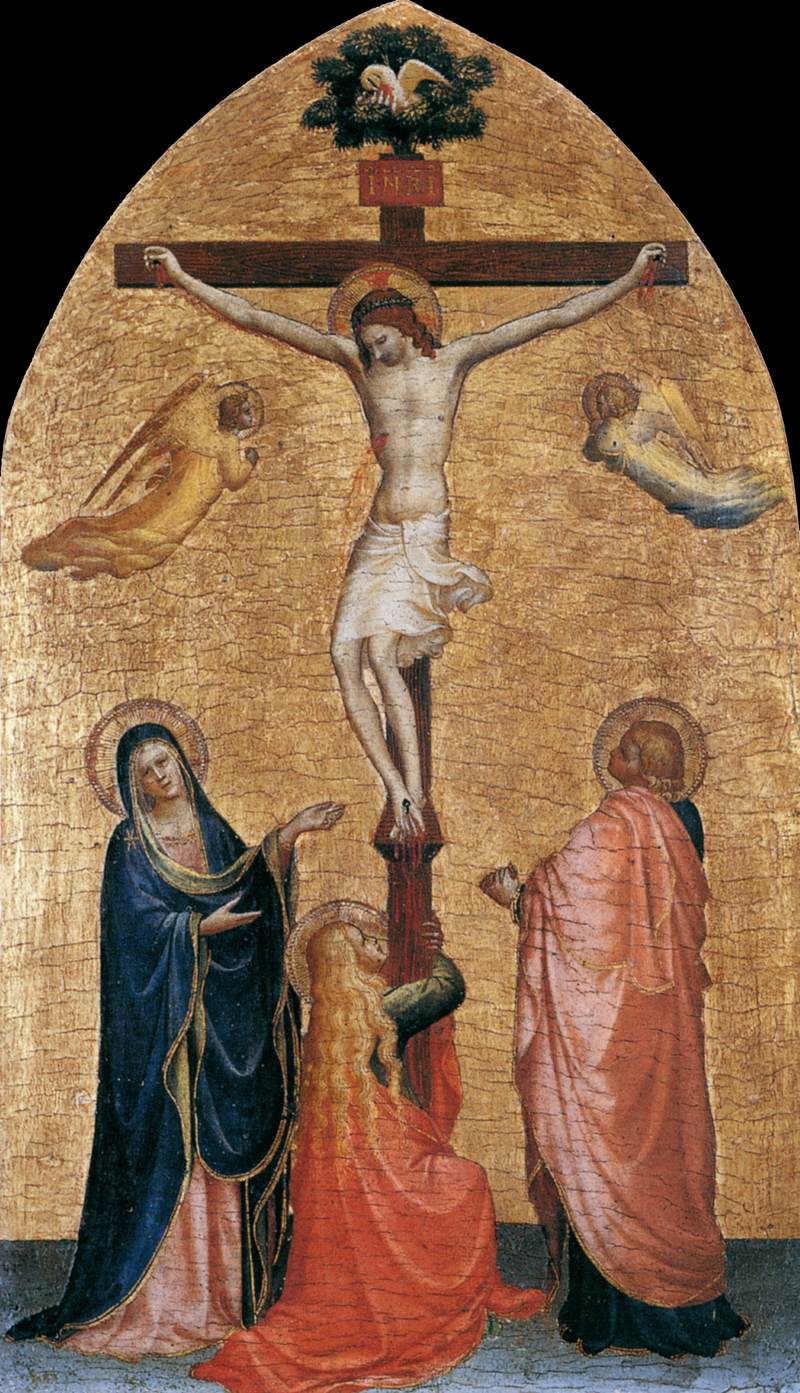
On this Friday—the day of the week of Jesus’ Passion and Death—we need to meditate on the scene of Calvary as the wedding ceremony between God and fallen man.  Do we want to be hear the Good News on Easter Sunday morning without having shared in the Passion and Death of Christ?  Are we like those eleven apostles who betrayed Jesus by their faithless words or by their flight from Jesus?  Or are we willing to imitate Our Lady and the Beloved Disciple at the foot of the Cross?

Thursday of the Twenty-first Week in Ordinary Time

Thursday of the Twenty-first Week in Ordinary Time
Matthew 24:42-51

“Stay awake!”

“Stay awake!” Our Lord tells us.  Surely you’ve had experiences where you struggled to stay awake.  Maybe during those experiences you were waiting for someone to return home late at night.  In such a case, you might have experienced any number of emotions:  joy, fear, or perhaps anger.  Maybe the experience was driving late at night in order to reach a far-off destination, making you anxious and exhausted.  Maybe the experience was finishing a project, paper, or report for school or the office:  such an experience may have been fraught with fear.

There is a wide variety of emotion which can accompany the experience of trying to stay awake.  But if we consider the two events that Jesus’ words today concern—the coming of Christ in salvation history, and Christ coming to us at the moment of our deaths—we see that these two things share something in common.  They are both unexpected.

To stay awake for these two things is to stay awake for the unexpected.  Do not expect Christ to be part of your life in the way that you expect, or even perhaps in the way that you would prefer.

St. Bartholomew, Apostle

St. Bartholomew, Apostle
Revelation 21:9-14  +  John 1:45-51

“Come and see.”

When Philip points out Jesus as the promised Messiah, what does Nathaniel—also known as Bartholomew—say?  We can almost see Nathaniel shrugging his shoulders as he says, “Can anything good come from Nazareth?”  In this one sentence, he insults both Jesus and Jesus’ hometown.  Clearly, he does not have faith at this point.

But we see that Nathaniel is like Peter:  a slow learner, but someone who, once he realizes what’s going on, is completely “in”.  When Nathaniel hears Jesus call him, he realizes who Jesus is, and confesses this truth, declaring:  “Teacher, you are the Son of God; you are the king of Israel.”  So if any of us are slow to learn, we should remember that Jesus does not give up on us.  Jesus will still call each of us to live out his vocation each day, and give him whatever is needed to carry it out.

Yet we should also note something else in this “vocation story”:  that is, the role of Philip.  When God calls a young man to be a priest, or a young woman to the consecrated life, He usually calls him or her through other people.  We need not only to encourage vocations:  we need also to encourage those “other people” like Philip to encourage vocations.

After all, Philip said just three words:  “Come and see.”  But if Philip had not said these three simple words, Nathaniel might never have met Jesus, and the Church would not have been built up by this holy apostle Bartholomew.  Little words can do a lot for God’s great glory.

St. Bartholomew LORES

The Twenty-second Sunday in Ordinary Time [C]

The Twenty-second Sunday in Ordinary Time [C]
Sirach 3:17-18,20,28-29  +  Hebrews 12:18-19,22-24  +  Luke 14:1,7-14
Catechism Link: CCC 2544

Humble yourself the more, the greater you are, and you will find favor with God.

In the Catechism’s discussion of the Tenth Commandment—forbidding the coveting of thy neighbor’s goods—humility is mentioned.  You might wonder what humility has to do with not coveting thy neighbor’s goods.  To illustrate the connection, the Catechism quotes the fourth-century saint Gregory of Nyssa.

St. Gregory points out how Jesus “speaks of voluntary humility as ‘poverty in spirit’; the Apostle [Paul] gives an example of God’s poverty when he says:  ‘For your sakes He became poor’” [CCC 2546, quoting 2 Corinthians 8:9].

St. Gregory’s key point is that humility is a kind of poverty.  This key can help us reflect upon today’s Scriptures.

As you know, Jesus speaks about this “poverty in spirit” in the very first sentence of His Sermon on the Mount.  In the sermon’s very first verse Jesus declares:  “Blessed are the poor in spirit, for the Kingdom of Heaven is theirs” [Matthew 5:3].  That first verse of Jesus’ greatest sermon sheds further light on those words of St. Gregory of Nyssa.

The first point to focus on is the importance of the word “voluntary”.  Jesus is speaking about “voluntary humility” in praising poverty of spirit.  Here we must consider that there are two kinds of humility:  voluntary and involuntary.  On the one hand, there’s the kind of humility that we freely choose.  On the other hand, there’s the kind of humility that’s forced upon us.

Poverty in spirit can only be the kind of humility that we freely choose.  In fact, this is the goal that Jesus is driving us toward in today’s parable:  the voluntary humility which is poverty of spirit.

In today’s Gospel Reading, “Jesus went to dine at the home of one of the leading Pharisees”.  Note how at this home, everyone is watching everyone else.  On the one hand, “the people there were observing [Jesus] carefully”.  But on the other hand, the reason that Jesus addresses His parable “to those who had been invited” is because He had noticed “how they were choosing the places of honor at the table”.  They were not choosing humility, but self-promotion.

Jesus illustrates the two kinds of humility through His parable.  Jesus first describes someone seating himself “in the place of honor”, and then being forced by the host to embarrass himself by moving down to “the lowest place”.  This is what’s called “humble pie”:  involuntary humility.

But then Jesus describes the kind of humility that originates in God.  What does Jesus tell us to do?  “[T]ake the lowest place[,] so that when the host comes to you[,] he may say, ‘My friend, move up to a higher position.’”  In other words, practice the virtue of voluntary humility.  Don’t get frustrated with how often life serves you “humble pie”.  Take the initiative:  practice the virtue of voluntary humility, and you’ll find yourself eating much less, and more spiritually healthy in the bargain.

Yet if we understand the need to practice humility voluntarily, we still have a problem:  humility is difficult to practice.  As in Jesus’ parable, there’s often embarrassment connected to acting humbly.  How can we overcome the difficulties connected with acting humbly?

The answer, of course, is Jesus.  But not just following His example.  Certainly, Jesus gave us two great examples of humility:  being conceived at the Annunciation and dying on Calvary.  In other words, He left the glory of Heaven to become human and walk in this valley of tears, walking finally to His self-sacrifice on the Cross.

These examples, of course, are important for our meditation.  It’s important to imagine these mysteries and ponder their meaning.  Yet how could we be strong enough to imitate such examples?

The answer is to enter into Jesus’ life:  His Body and Blood, soul and divinity.  Only through the grace of Jesus’ sacramental life can you share in Jesus’ own humility and make His humility your own.

In today’s First Reading, Sirach counsels you to “[h]umble yourself the more, the greater you are”.  Through Baptism, you are a child of God.  That is a profoundly great vocation, yet also a demanding one.  To be faithful to that vocation, your humility must be the humility of God’s only-begotten Son.  Thanks be to God, He has called His children to the head of the Banquet Table, to be strengthened by Jesus’ own life.  Blessed are those called to the Supper of the Lamb.

Tuesday of the Twenty-first Week in Ordinary Time

Tuesday of the Twenty-first Week in Ordinary Time
Matthew 23:23-26

“Blind Pharisee, cleanse first the inside of the cup ….”

In today’s Gospel passage, we hear Jesus rather harshly commanding that exterior and interior religious practices be integrated.  The right way in which to integrate them is to put first things first:  that is, to tend first to the inner dispositions of the soul, and then from the soul’s strength to practice virtuous acts.

Jesus condemns the “blind Pharisee” who appears clean on the outside, but inside is full of plunder and self-indulgence.  His actions may appear virtuous, but they are not.  They are deeds that may have good effects.  But these actions worsen a division in the soul of the one who carries them out.

Similarly, Jesus’ first condemnation here—of the scribes and Pharisees—concerns a different form of “dis-integration”.  These “hypocrites” are doing certain good works, but not the works that are far better and more central to a life given to God.  This dis-integration suggests that even the good works are being done for bad reasons.

Jesus doesn’t condemn the scribes and Pharisees for tithing:  indeed, He says they should have tithed.  But He uses a purposefully ridiculous metaphor to describe what they’re doing:  they are straining out the gnat, but swallowing the camel!  The latter part of the metaphor ought to remind us of another quote from Jesus:  “it is easier for a camel to pass through the eye of a needle then for a rich man to enter the Kingdom of Heaven.”

OT 21-2

The Queenship of the Blessed Virgin Mary

The Queenship of the Blessed Virgin Mary
Isaiah 9:1-6  +  Luke 1:26-38

“May it be done to me according to your Word.”

Today’s feast of Mary’s Queenship falls one week after the feast of her Assumption. Seven days ago, we celebrated the fourth glorious mystery of the Rosary, and today we celebrate the fifth (Mary being crowned as the Queen of Heaven and earth). These two feasts of Mary are connected, and teach us about who Mary our Mother is. The Assumption and the Queenship of Mary also teach us what being a Christian is about.

Mary being assumed, body and soul, into heaven is really nothing other than her share in the Resurrection of Jesus: her body and soul sharing in the glory of her Son’s Resurrection. This is something that we all look forward to sharing at the end of time. Mary has received the fullness of everything that Jesus promises. The humble handmaiden has been made radiant—Mary is the Queen standing at Christ’s right hand, clothed in gold, as one of the Psalms says. All of Mary’s limits have been removed. All her weaknesses have been cured. We speak to Mary with the honor due to a Queen, because she is the first of the disciples to pass body and soul into the palace of the King.

Saint John writes in his first epistle that we do not know what we will look like in heaven, because we will become like Jesus in His Resurrection: almost glowing. Mary has already undergone that change. She looks on the beauty of God’s face not just through her soul—as all the saints do—but with her own eyes. This is what we mean by her Queenship: she is the Queen Mother of all the faithful, because she was perfectly faithful, and the first (of many eventually) who will be admitted body and soul into heaven.

Mary is our Queen, and we give our prayers to her powerful intercession: she will take all our prayers to God. We look to Mary as the example of the perfect disciple. We find consolation in her mother’s heart. She surpasses all of us in her faithfulness to Christ. But her Queenship is also the hope that we have a promise: we have from God the promise of our own Resurrection, when we too will be crowned with glory. In this way, we can see that her majesty and glory is something that we, too, hope one day to receive in some degree. We thank Mary for showing us how good God is, and how God always gives grace and strength to those who follow Him.

Saturday of the Twentieth Week in Ordinary Time

Saturday of the Twentieth Week in Ordinary Time
Matthew 23:1-12

“… you have but one Father in Heaven.”

Today’s Gospel passage contains a verse that some Christians quote to “prove” that one of Catholics’ most common practices is “unbiblical”.  Jesus declares, “Call no one on earth your father; you have but one Father in heaven.”  These words of Jesus would seem to disqualify the Catholic practice of addressing a priest as “Father”, as well as referring to the Pope as the “Holy Father”.

Those who make this argument might be taken aback, then, if it were pointed out to them how many passages from Saint Paul’s letters show the Apostle referring to himself as a spiritual father.  For example, Paul explains how the Corinthians have one father.  He squarely preaches to them, “You might have thousands of guardians in Christ, but not more than one father […] it was I who begot you in Christ Jesus…” [1 Cor 4:15].  It’s hard to imagine—if you were to interpret Holy Scripture in a literalistic sense—any words that more directly contradict Jesus’ command to “call no man on earth your father” than what St. Paul says of himself:  “You might have thousands of guardians in Christ, but not more than one father […] it was I who begot you in Christ Jesus….”

What are we to make of this seeming contradiction?  St. Paul’s following words only seem to heighten the contradiction against Jesus’ command.  St. Paul commands those listening to him:  “Be imitators of me, as I am of Christ” [1 Cor 4:16].  Why doesn’t St. Paul just say instead, “Be imitators of Christ”?  Some Christians will argue over and over again that the Catholic priesthood is a corruption of the Word of God because it puts a middle-man—a mediator—between Christ and the individual believer.  They will say instead that the individual Christian can go straight to Christ, without needing men in between.  (Of course they’ll turn a blind eye to the plain fact that the act of preaching—which is so prominent in Protestant denominations—is an act of a man mediating the Word of God to his listeners.)

It’s here that the teachings of Saint Paul—found, of course, in the Holy Bible—lead us deeper into the mystery of the Christian Faith.  St. Paul’s words don’t contradict Jesus’ command to call no man on earth your father:  St. Paul’s words deepen the revelation of Jesus.  Christian fathers, whether in the home or in the sanctuary, whether through the Sacrament of Marriage or through the Sacrament of Holy Orders, are called to say—by their example if not by their words—what St. Paul proclaims here:  “Be imitators of me, as I am of Christ.”  Christian fathers are called to lead their children each day and each week deeper into the life of Christ.

St. Paul Baptizes His Jailer [Acts 16:29-34]
Stained Glass Window in St Paul’s Church in Jericho, Oxford
Photographed by Fr. Lawrence Lew, O.P.

Friday of the Twentieth Week in Ordinary Time

Friday of the Twentieth Week in Ordinary Time
Matthew 22:34-40

“The whole law and the prophets depends on these two commandments.”

When we were little we were expected to memorize the basic truths of our Faith.  At the top of the list were the Ten Commandments, which are difficult for a child to memorize.  Today’s Gospel passage offers a clue to help us to remember—or to teach—the Ten Commandments more easily.

If not pointed out, we may never have noticed that in many pictures of Moses bringing down the two tablets from Mt. Sinai, the Ten Commandments are not divided five and five.  Rather, the first tablet has the first three commandments, and the other tablet the remaining seven.  This illustrates Jesus’ teaching today:  that there are, in fact, simply “two commandments”.

On the Cross most especially, in His very Person, Jesus embodies the unity of these “two commandments”.  True God and true man, Jesus’ teaching today merely foreshadows what He teaches us on Calvary.  Some people teach a piety that promotes complete devotion to God, but ignores or even disdains the corrupted human race.  Others teach an ethic that promotes an apotheosis of human nature, but disdains or even altogether denies God.  But neither of God’s “two commandments” can stand or be understood thoroughly without the other.  Jesus reveals the meaning of each of these commandments in His divine Person, and in His Self-sacrifice on Calvary.

Schnorr von Carolsfeld (1860) Digital restoration: gldburger