
Pentecost
Acts 2:1-11 + 1 Corinthians 12:3-7,12-13 + John 20:19-23
May 24, 2026
Who is the Holy Spirit? Today’s feast of Pentecost—sometimes called the “feast day of the Holy Spirit”—helps us answer that question.
Even the color of today’s feast helps us see who the Holy Spirit is. The feast of Pentecost is marked by the color red. The chalice and the priest (and in some churches, also the tabernacle and the altar) are vested in red. In some places, it’s customary for laypersons to wear red on the feast of Pentecost.
What does the color red tell us about the Holy Spirit? Think about it this way: On St. Valentine’s Day, if a child is given a picture of a heart to color, what color crayon will he reach for? The connection between love and the color red is deeply ingrained in our Western culture. This points to an important truth about the Holy Spirit.
God the Holy Spirit is the love that God the Father and God the Son bear towards each other. That’s what we mean in the Creed, when we profess that the Holy Spirit “proceeds from the Father and the Son”. From all eternity, the Father loves the Son, and the Son loves the Father. The Holy Spirit is their love.
However, God did not keep this love to Himself. God wants every human person to abide in this love: both on earth, and forever in Heaven. Of course, mankind makes this difficult because of his sins. That’s one reason why God sent the Holy Spirit down from Heaven to earth. God sent the Holy Spirit in order to bring about God’s will for fallen man.
+ + +
You might picture it this way. God sends the Holy Spirit down from Heaven in order to carry out missions on earth. The Holy Spirit’s most important missions are carried out: first, during the Old Testament; second, during the time of the four Gospel accounts; and third, during the life of the Church.
In the Creed, we profess that the Holy Spirit “has spoken through the prophets.” These are the prophets of the Old Testament, such as Isaiah, Jeremiah, and Ezekiel. Why does the Holy Spirit speak through the prophets? Despite how prophecy is often portrayed, prophecy is not chiefly about foretelling the future. The chief purpose of prophecy is keeping the People of God on track.
Think of the Old Testament as a pilgrimage through the first part of salvation history. The Holy Spirit is the pilgrimage guide. He guides God’s Chosen People from the slavery to sin that started in the Garden of Eden, towards the goal of freedom in Heaven.
The Holy Spirit’s mission is to keep the People of God on course. The People of God throughout salvation history wander off the straight and narrow. So the Holy Spirit’s mission is to course-correct the People of God by means of the prophets’ words. In doing this, the Holy Spirit helps God’s People get back on the path leading towards the Promised Land.
+ + +
The second chief mission of the Holy Spirit is the Incarnation of the Son of God. We profess this during the lines of the Creed when we bow at Sunday Mass. This mystery of the Incarnation stands at the center of salvation history. We profess that our “Lord Jesus Christ”, “by the Holy Spirit[,] was incarnate of the Virgin Mary, and became man.”
Reflect on what happened at this moment. Naturally, a virgin cannot conceive. But supernaturally, Mary does conceive a child. Through the Power of the Holy Spirit, the Blessed Virgin Mary conceives the Son of God. However, the role of the Holy Spirit in this mission was not over once Mary conceived. The Holy Spirit empowered everything that Jesus carried out on earth. This is most especially true of Jesus’ self-sacrifice on the Cross.
+ + +
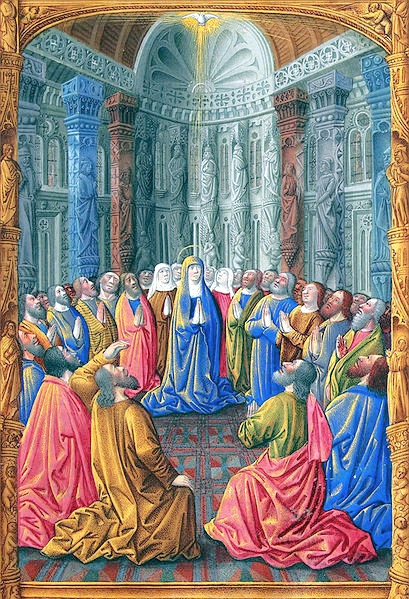
Then, after Jesus’ Resurrection and Ascension, there is a final chapter of salvation history. The first two chapters make this third one possible. The final chapter starts on the day of Pentecost, when the Church was born. This third chapter of salvation history will not end until Jesus’ Second Coming at the end of time. Here we see the third chief mission of the Holy Spirit: animating the Church and her work.
We hear about the life of the Church in the New Testament books that follow the four Gospel accounts. We hear about the Church in the Acts of the Apostles, the letters written by the Apostles, and the Book of Revelation. Throughout these books, we hear about God the Holy Spirit at work within the Church. In fact, without God the Holy Spirit, the life of the Church is not possible.
With God the Holy Spirit, however, sinners can become saints. The Church’s history, from the day of Pentecost to the present day, is the story of sinners become saints. In this story, God the Holy Spirit is the main protagonist. His mission within the Church is to empower sinners to live a life so Christ-like that Christ lives within them.
This includes yourself.
God asks a great deal from you as a Christian, as one member of Christ’s Mystical Body, the Church. God sets the bar very high, and He expects you to clear that bar. Yet everything that God asks of you, no matter how demanding, is possible through the Power of the Holy Spirit. In fact, the more that God demands from you, the greater the growth that He has in store for you. The greater the sacrifice that He asks, the more blessings that God wants to share with you and those in your life.