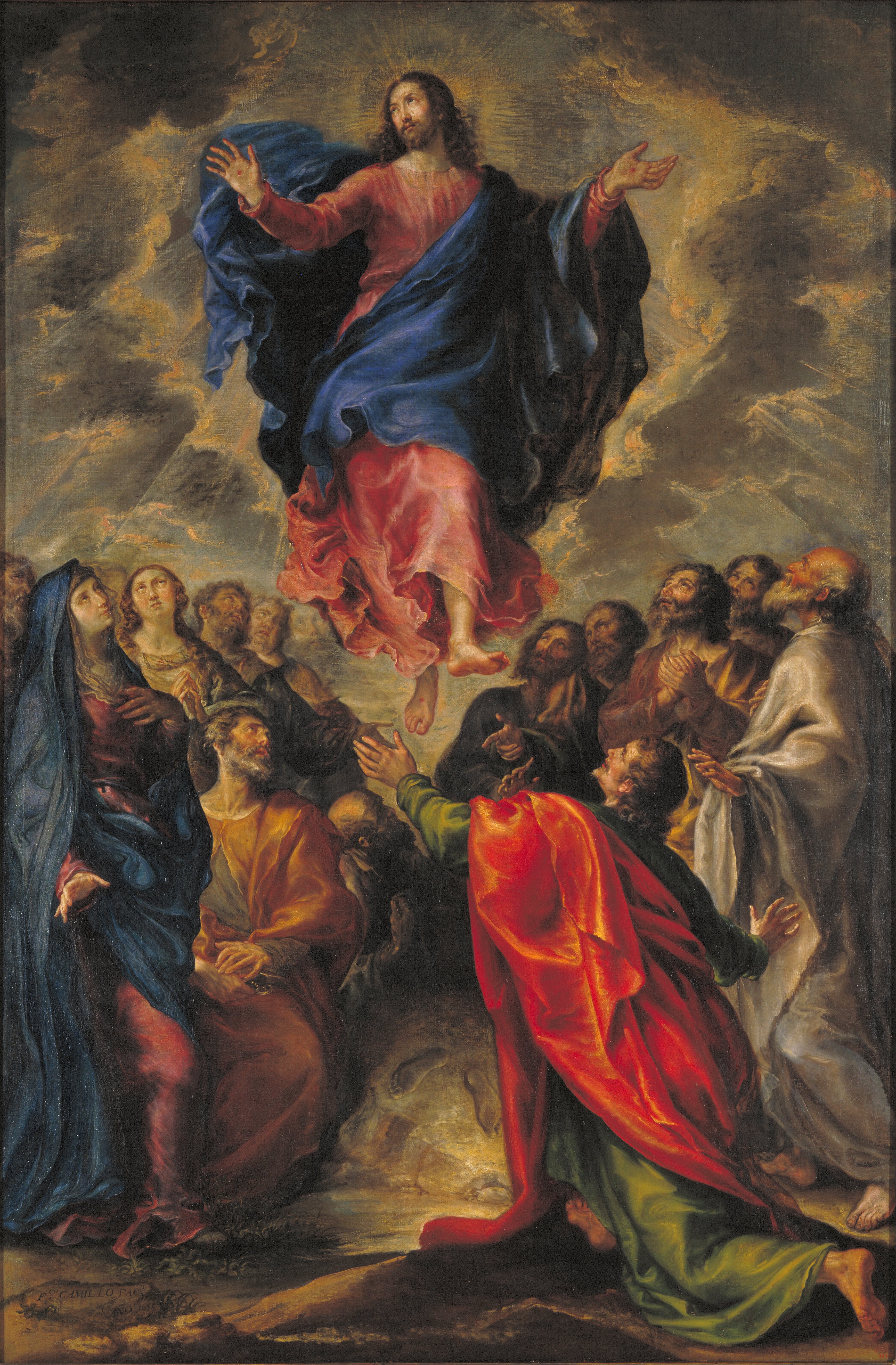

The Ascension of the Lord [A]
Acts 1:1-11 + Ephesians 1:17-23 + Matthew 28:16-20
May 17, 2026
Christians eager to grow spiritually sometimes request spiritual direction. The spiritual director sometimes gives encouragement. But sometimes the spiritual director has to challenge. To use an analogy: having a spiritual director is like having a personal trainer at the gym. If your personal trainer did nothing but tell you how good you look, you would not make much progress. The personal trainer has to push you outside of your comfort zone, to help you make efforts that you would rather not make.
It’s similar with spiritual direction. One of its more challenging demands is related to the mystery of Jesus’ Ascension to Heaven. Summed up in a single word, what the Ascension and authentic spiritual direction both demand is “detachment”.
+ + +
At His Ascension, Jesus demanded detachment from His disciples. In fact, Jesus had spoken to this demand just hours after He rose from the dead. Jesus on Easter Sunday morning said to Mary Magdalen, “Stop holding on to me, for I have not yet ascended to the Father. But go to my brothers and tell them, ‘I am going to my Father and your Father, to my God and your God.’”[1] In some translations of this verse, Jesus says, “Do not cling to me, for I have not yet ascended to the Father.” Jesus demanded that Mary Magdalen exercise spiritual detachment. Even though Jesus has risen from the dead, there is something greater on the horizon. Mary Magdalen must have wondered what this might be.
In a similar way, on the day of Jesus’ Ascension, the apostles must have felt bewildered. Think about all the ups and downs they’d faced over the past several weeks. On Palm Sunday, Jesus had been acclaimed as the Messiah. Then He was crucified as a common criminal. Days later Jesus had risen from the dead and started appearing to His disciples. But what was going to come next? Was the Risen Jesus going to rule as the Messiah on earth forever?
On the day of Jesus’ Ascension, when it became clear to the disciples that Jesus was about to leave them, some of them likely felt as if Jesus was abandoning them. But He was not. He was leaving them so that something greater could occur on the day of Pentecost. Jesus demanded from His disciples that they let Him go.
The detachment—that letting go of Jesus—was a means to a greater goal. Jesus was preparing His disciples for the day of Pentecost. Jesus in His risen and glorified body ascended to Heaven. In His place, the Holy Spirit descended from Heaven to join the disciples into one Mystical Body. This Mystical Body of Christ is the Church.
In your life as a Christian, God is calling you to live as one member of the Church: as one member of Christ’s Mystical Body. However, to live that calling faithfully, you must practice the virtue of detachment.
+ + +
So what is the first step? The first step is to practice detachment from material things. It’s important to note that being detached from material things does not necessarily mean that we remove them from our lives. It might be true that we need to remove certain things from our lives altogether. This would be especially true if those things prey upon faults or vices that we bear.
However, being detached from most created things does not demand that we remove them from our lives. Certain created things can be part of our lives, and we can still be detached from them.
What being detached from created things demands is that we admit that eventually, we will leave those things behind. Saint Paul wrote to St. Timothy: “we brought nothing into the world—it is certain that we can take nothing out of it.”[2] Monsignor McGread, the long-time pastor of St. Francis Parish in Wichita, put it differently. He would often note: “I’ve never seen a U-Haul attached to a hearse.”
We can detach ourselves from created things in several ways. The most practical way is through simple acts of penance, or what the Church calls self-mortification.
Some Christians only practice self-mortification on Fridays of Lent, and only by not eating meat. However, the more intentionally we want to follow Jesus, the more we will broaden our practice of self-mortification. You need to ask yourself, “What are my favorite creature comforts?” Whatever they are, they need to be the object of your practice of self-mortification, especially each Friday, the day of the week on which Our Lord died for your sins.
Detaching ourselves from material things is demanding. However, much more demanding is the need to detach ourselves from other human beings. As with material things, being detached from someone does not mean removing someone from our life. It does not mean not loving them. Nor does it mean being inattentive to them.
Detachment from others, rather, is a disposition of the soul. It means recognizing that each person in our life is a gift: a gift from God, and a gift who has a calling—a destiny—beyond this world. Whenever we practice the virtue of detachment, we are giving God the room to work in our lives, and in the lives of others as He wills.
+ + +
Keep in mind that the practice of detachment is a means to an end. Detachment helps us to love as God loves. This divine love is necessary to celebrate the Church’s birth at Pentecost, and to live out the mission of the Church. To live this mission means to love both our God and our neighbor, as God loves.
Having a detached heart means being able to love more freely, more readily, and as God Himself loves.
[1] John 20:17.
[2] 1 Timothy 6:7. St. Paul here echoes Job 1:21.