St. Elizabeth of Hungary, Religious

St. Elizabeth of Hungary, Religious
II Maccabees 7:1,20-31  +  Luke 19:11-28
November 17, 2021

“… from the one who has not, even what he has will be taken away.”

Those who think of Jesus as a “teddy bear” are challenged by the last sentence of Jesus in today’s Gospel passage.  These words conclude a lengthy parable, which St. Luke the Evangelist prefaces with a clear explanation of the motive for the parable:  Jesus “proceeded to tell a parable because He was near Jerusalem and they thought that the Kingdom of God would appear there immediately.”

The “king” speaks and acts harshly.  He refers to himself as “a demanding man”, but his greatest demand comes at the end of the parable.  Of his enemies he declares, “bring them here and slay them before me.”  The question is to whom this character in the parable refers in real life?  Can he possibly symbolize Jesus or God the Father?  The king’s demand is reminiscent of practices found in the Old Testament.  God Himself seems in the Old Testament to demand the murder of innocents.  Surely such ideas have no place in the teaching of Jesus?

However, the parable’s own inner logic suggests that the servants did have a choice.  This points to the choice that each servant of God has to follow Him or not.  At the end of each person’s life is a fork.  One branch leads to eternal life and the other to eternal death.  This is where the Kingdom of God comes to its fulfillment.

OT 33-3

Tuesday of the Thirty-third Week in Ordinary Time [I]

Tuesday of the Thirty-third Week in Ordinary Time [I]
II Maccabees 6:18-31  +  Luke 19:1-10
November 16, 2021

“… today I must stay at your house.”

Zacchaeus is a rich collector of taxes.  Each of us, like him, is attached to worldly things, no matter how simple.  St. John of the Cross says that just as it does not matter if a bird is tied down by a thick rope or a thin string, so it does not matter if a Christian is tied down by wealthy goods or simple desires.  An attachment is an attachment, and any attachment—no matter how slight—keeps us from union with God.

On the other hand, Zacchaeus, like you, wants to see who Jesus is.  But Zacchaeus has two strikes against him.

The first strike against Zacchaeus is the crowd, because everyone wants to see Jesus.  It’s easy to get lost and not to be loved in a crowd.  One might ask himself, “How can Jesus love everyone?”

The second strike against Zacchaeus is his small size, which may represent the size of one’s own soul.  One might feel unworthy of God’s love, and ask himself, “How could Jesus love little old me?”

So Zacchaeus climbs up into a sycamore tree to see Jesus.  This is all Zacchaeus wants:  to see Jesus.  But that’s not enough for Jesus, so large is Jesus’ Sacred Heart.

Here’s the turning point in this Gospel passage.  When Jesus reached the tree that Zacchaeus had climbed, Jesus looked up and said, “Zacchaeus, come down quickly; for today I must stay at your house.”  Jesus takes the initiative to reach out to the individual sinner.  Just as He reached out to this little sinner, so He asks entry into the fullness of your heart, mind and soul.

OT 33-2

Monday of the Thirty-third Week in Ordinary Time [Years I & II]

Please note:  two reflections are given below, each based on the First Reading or Responsorial Psalm of the day.  The Year I readings apply to years ending in an odd number (for example, 2023), while the Year II readings apply to years ending in an even number, such as 2024.  The Gospel Reading is the same in both years.


+     +     +

Monday of the Thirty-third Week in Ordinary Time [I]
I Maccabees 1:10-15,41-43,54-57,62-63  +  Luke 18:35-43

Then the king wrote to his whole kingdom that all should be one people, each abandoning his particular customs.

At this week’s Masses, the First Reading is taken from the Old Testament books of Maccabees.  These books describe the persecution and perseverance of the Jewish people.  While the particular persecution that they faced may not seem easy to relate to, we need today to relate to the perseverance that they demonstrated.

In today’s First Reading, the king of Greece “wrote to his whole kingdom that all should be one people, each abandoning his particular customs.  All the Gentiles conformed to the command of the king, and many children of Israel were in favor of his religion”.  The parallel of this situation to the plight of Christians in the United States today is clear.

Today’s passage ends focusing on those Jews “who preferred to die rather than to be defiled… and they did die.  Terrible affliction was upon Israel.”  But we ought to be clear on what leads to this affliction:  the demand for a people to be falsely united.

To what extent may a government demand that a religious body of persons conform their teachings, practices and rituals to a norm established by and in support of that government?  The conflicts in this week’s readings from the Books of Maccabees will help us reflect on this important question.

Maccabeean brothers 01

+     +     +

Monday of the 33rd Week in Ordinary Time [II]
Revelation 1:1-4;2:1-5  +  Luke 18:35-43

When they saw this, all the people gave praise to God.

Today we begin hearing at weekday Mass from the Book of Revelation.  We will continue to hear from this book through the last day of the Church year.  This is fitting since Revelation is the last book of the Bible, and treats of the “Last Things”, although in a highly mysterious manner.

The Book of Revelation is literally the book of the “revelation of Jesus Christ” to the Beloved Disciple.  In turn, this same Saint John “gives witness to the word of God”, the same Word of God of whom John wrote in the prologue of his Gospel account.  Given the mysterious manner in which the Book of Revelation is recorded, the link between these two books of the New Testament is important to keep in mind as one reflects on John’s “witness to the word of God”.

Also, the evangelist calls this witness a “prophetic message”.  As such, we note a correspondence between the structure of the Old and New Testaments.  In each Testament, there are four types of books.  In both testaments, the fourth type of book is prophetic.  The Old Testament contains eighteen books of prophecy, but the New Testament contains only the Book of Revelation.  All books of prophecy look to the future:  those in the Old Testament to the first coming of God’s Word made Flesh, but the Book of Revelation to His Second Coming, as well as to His becoming Flesh and dwelling among us in the Holy Eucharist.

St. Frances Xavier Cabrini, Virgin

St. Frances Xavier Cabrini, Virgin
Wisdom 18:14-16;19:6-9  +  Luke 18:1-8
November 13, 2021

Jesus told His disciples a parable about the necessity for them to pray always without becoming weary.

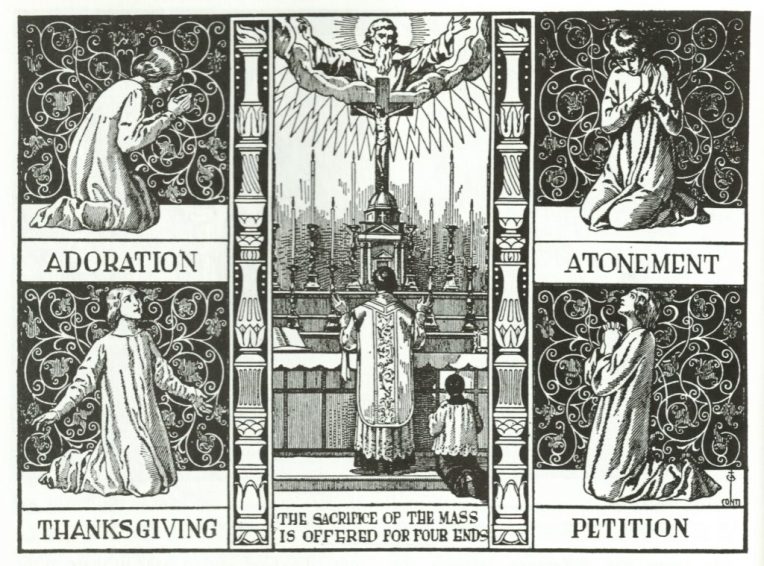
In the first verse of today’s Gospel passage, St. Luke the Evangelist is unusually direct in explaining the exact meaning of Jesus’ parable.  “Jesus told His disciples a parable about the necessity for them to pray always without becoming weary.”  It is important to note that this parable is about one specific type of prayer to God:  prayer of petition.

Sometimes prayer is defined as “a conversation with God”.  That’s unfair to God for two reasons.  First, conversations normally take place between two persons of more or less equal standing.  While it’s true that prayer involves a dialogue with God, we have to keep in mind that what He has to say to each of us is far more important than what any of us might wish to say to Him.  In prayer, it’s far more important to listen to God than to speak to Him.

Second, prayer at its summit transcends what could be termed a conversation.  The form of prayer in which the believer and God dialogue is meant to be surpassed.  Dialogue is meant to lead to a loving silence, a form of prayer in which God and the believer rest in the goodness of His presence.  Dialogue or conversation is a means to getting there.

Nonetheless, in today’s Gospel passage Jesus teaches us about prayers of petition.  Petition is one specific form that prayer takes during the “conversational” stages of prayer.  In this stage, however, we pray not only with God’s almighty Power in mind (because He can get us what we want), but also with His providential Love in mind.  That is to say, God answers our prayers of petition not only for our own good, but for His goodness as well, so as to lead us into that goodness.

OT 32-6

St. Josaphat, Bishop & Martyr

St. Josaphat, Bishop & Martyr
Wisdom 13:1-9  +  Luke 17:26-37
November 12, 2021

“As it was in the days of Noah, so it will be in the days of the Son of Man”.

To His disciples, Jesus speaks of “the Son of Man”.  Regarding the Son of Man, Jesus explains that His presence is elusive, like lightning that “flashes and lights up the sky from one side to the other”.  Jesus downplays the desire somehow to “pin down” the Son of Man.

At the end of yesterday’s Gospel passage, Jesus spoke about this Son of Man suffering greatly and being rejected by this generation.  Here Jesus is making clear how much His hearers’ expectations will be shattered.  What we hope for is often not what God has in store for us.  In today’s Gospel passage, we hear some of the context of “the days of the Son of Man”.  The context is dire, which shouldn’t surprise us given what the Son of Man Himself suffers.

Jesus’ final words today do not seem hopeful:  “‘Where the body is, there also the vultures will gather.’”  Yet Jesus is hopeful, of course.  He is simply not hopeful for the fate of this world.  Everything in this world must finally decay, so we must not be attached to such things.  Our hope must be for God alone, who draws us through this world, not to it.

OT 32-5

The Thirty-third Sunday in Ordinary Time [B]

The Thirty-third Sunday in Ordinary Time [B]
Daniel 12:1-3  +  Hebrews 10:11-14,18  +  Mark 13:24-32

“At that time there shall arise Michael, the great prince, guardian of your people ….”

When we step back from the normal press of daily life, breathe deeply, and reflect on everything in order to gain some perspective, we can look backwards to the past or forward to the future.  Either perspective can prove helpful.  A great deal of our spiritual lives as Catholics focuses on the past:  the saving events of the Old and New Testaments, and the history of Jesus’ Church with all her saints.

But what about the future?  There’s only one Sunday of the Church year that reflects upon a future event.  For us Christians, then, how do we reflect upon the future?  To a large degree, the average Christian connects the future with getting his own soul to Heaven.  Prayer and the sacraments help in this regard.

But there’s another sense in which we look to the future.  This second sense of the future is not about Heaven, though, but about the same earth on which our feet are planted now.  Jesus teaches that the Gospel is not only for us to reach Heaven.  The Gospel is also about the earth, as we pray in the “Our Father”:  “Thy Kingdom come, Thy will be done, on earth as it is in Heaven.”  The basic game-plan for making this future hope a present reality consists in the Corporal and Spiritual Works of Mercy.  These good works are part and parcel of the path God means for us to take to Heaven.

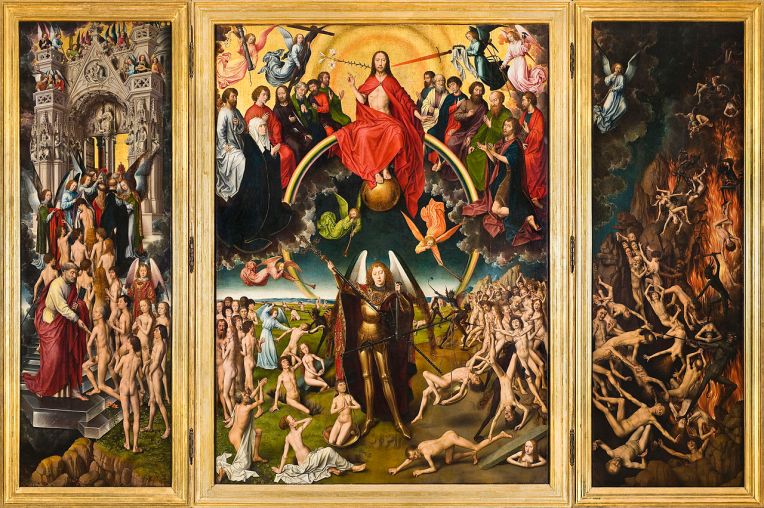
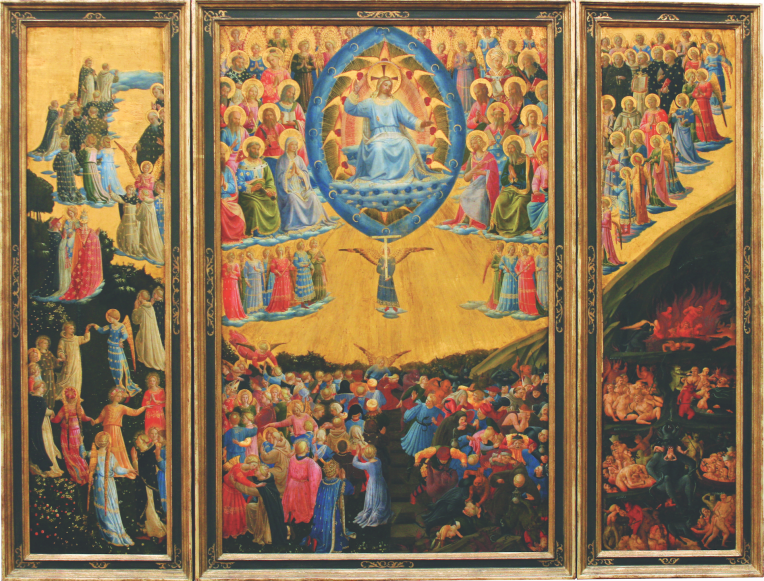
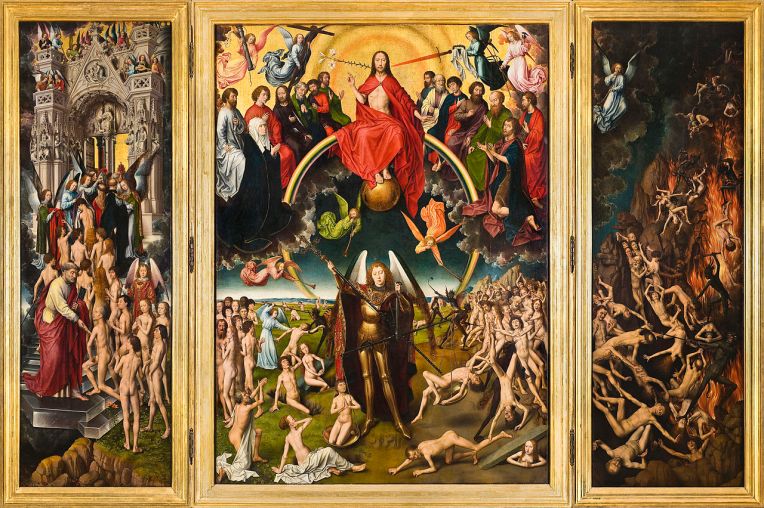
But there’s also a third sense in which Christians look to the future.  This third sense is the rarest in the lives of most Christians.  We tend to think of this third sense only around the time of the Solemnity of Christ the King, which the Church throughout the world will celebrate next Sunday.  This third sense is an event in which all mankind will participate:  the Final Judgment of mankind by Christ the King at the end of time.

In today’s First Reading, Daniel prophesies about “a time unsurpassed in distress”, and Jesus in today’s Gospel Reading describes for us “those days after… tribulation [when] the sun will be darkened, and the moon will not give its light, and the stars will be falling from the sky”.  These verses sound like apocalyptic science fiction.  Yet God tells us that every human being—including yourself—is going to participate directly in something just as earth-shattering as these events.

This Sunday the Church proposes a question in order to help you begin each day with your end in mind.  Next Sunday on the Solemnity of Christ the King, the Church will offer her answer.  This Sunday’s question is given in our First Reading from the Book of Daniel.  As strange as it may sound, this question comes in the form of a person.  Did you know that the name “Michael” is actually a question?

The name “Michael” literally means, “Who is like God?”  It’s a rhetorical question, of course, because no one is like God.  But Satan is blinded to that simple fact by his pride.  St. Michael is often pictured as the great warrior among God’s archangels.  But St. Michael’s power comes from his humility:  his power lies in allowing himself to be an instrument in the Hand of God.  As the English author G. K. Chesterton wrote, “Angels can fly because they take themselves lightly.”

As one prays privately after Holy Mass, thanking God for the graces received and asking God to help one bear fruit in the world as one goes forth from the Mass, it’s a venerable custom to pray the Prayer to Saint Michael.  This prayer reminds one not only of how important the virtue of humility is, but also of the stakes involved in the “Christian battle” of the spiritual life [see CCC 1496].

Some people trust that strength lies in numbers.  Some trust that strength lies in knowledge.  The saints trust that strength lies in humility, which opens oneself to the Love who is God.  When you begin each day with an act of humility by handing the day over to God, He will give you all the strength needed to accomplish His holy Will:  not your will, but His.  We beg from God the grace to conform our wills to His.  In this, God’s children can become united with each other and with God Himself.  The two great commandments—to love God and neighbor—become united.

St. Martin of Tours, Bishop

St. Martin of Tours, Bishop
Wisdom 7:22—8:1  +  Luke 17:20-25
November 11, 2021

“For behold, the Kingdom of God is among you.”

In today’s Gospel passage, Jesus describes the phrases “the Kingdom of God” and “the Son of Man”.  The meanings of both are elusive, and that’s Jesus’ point.

In the Pharisees, who ask “when the Kingdom of God would come”, we can see many in our own day who exert great effort in predicting and spreading news of the time of this coming.  Jesus splashes cold water on them all:  this coming “‘cannot be observed, and no one will announce, “Look, here it is”’”.  Along the same line, Jesus soberly explains to the Pharisees that while they “‘will long to see one of the days of the Son of Man,’” they “‘will not see it.’”

However, in the midst of this sobering up, Jesus declares something provocative, if not confusing.  “‘For behold, the Kingdom of God is among you.’”  So while the coming of the Kingdom “‘cannot be observed,’” it already “‘is among you.’”  How are we to understand what seems on the surface like a contradiction?  Perhaps such understanding ought only be sought by the Pharisees of old.  Perhaps our part is simply to live within the Kingdom of God, under the shepherding of the Son of Man.

OT 32-4

Wednesday of the Thirty-second Week in Ordinary Time

Wednesday of the Thirty-second Week in Ordinary Time
Luke 17:11-19

“Jesus, Master, have pity on us!”

We may not feel inclined to think of ourselves as lepers.  It’s not an appealing image.  But that’s the plain meaning of these ten persons in today’s Gospel passage.  The ten lepers represent us.

In fact, we’re much worse off than lepers.  Leprosy ends with earthly death.  But the effects of sin—alienation and estrangement from God and neighbor—are unending, ever-lasting, without end if we die in mortal sin.  Without a Redeemer to save us from sin, our suffering will not end with earthly death, but only begin in earnest.

Jesus saves the ten from leprosy with little more than a few words, such is His divine power.  But Jesus saves all of mankind from the far greater penalty of eternal death.  Jesus offers salvation to you not by speaking a few words, but by sacrificing up His complete self—Body, Blood, soul and divinity—to a Passion and Death on the Cross that He suffered out of love:  not out of compulsion, or to get something back in return, or to impress anyone, but simply and completely out of love for us.  If this doesn’t inspire gratitude in each of us, it’s hard to imagine what might.

OT 32-3

The Dedication of the Lateran Basilica in Rome

The Dedication of the Lateran Basilica in Rome
Ezekiel 47:1-2,8-9,12  +  1 Corinthians 3:9-11,16-17  +  John 2:13-22
November 9, 2021

… you are the temple of God ….

Today’s Gospel passage shows us God’s passion for His temple, and His passion for the sacrifice offered there.  In the confessional, priests often hear people confess anger.  A priest might find it necessary to ask questions when someone confesses “getting angry”.  In light of Jesus’ action in this passage, it’s important to remember not only that merely “getting angry” is not necessarily a sin.  Also, even acting in anger is not necessarily a sin.

Acting in anger, or fostering anger in oneself or others, certainly can be a sin.  But Jesus acts in anger in today’s Gospel passage, and with good reason.  When reflecting on a state of anger, and actions that flow from it, it’s important to ask what the object of one’s anger is.  This object can make all the difference in the morality of such an act.

While experiencing the passion of anger, Jesus purifies the Temple.  In the passion of love, He purifies the temple of the human body of sin on Calvary, by offering up His own body in sacrifice.  St. John the Evangelist makes this point clearly.  When Jesus challenges His opponents, saying, “Destroy this temple and in three days I will raise it up”, the evangelist explains that Jesus “was speaking about the temple of His Body.”  The Church’s belief in the great goodness of the human body is based in large measure on this Gospel truth.  The Church’s challenging ethic of purity of body stems not from a belief that the human body is bad, but that the human body’s purity ought to concern us as much as the purity of the Temple concerned Jesus.  Both temples ultimately belong to God, for His purposes and for His glory.  The temple of the human body is meant for the offering of sacrifices, small and large.

St. John Lateran.jpg

Click HERE to take a virtual tour of the Papal Basilica of St. John Lateran in Rome