Monday of the Thirty-second Week in Ordinary Time [Year I]

Monday of the Thirty-second Week in Ordinary Time [Year I]
Wisdom 1:1-7  +  Luke 17:1-6

Love justice, you who judge the earth; think of the Lord in goodness, and seek him in integrity of heart ….

At weekday Mass during this second-to-last week in Ordinary Time, the Church’s First Reading is taken from the Old Testament Book of Wisdom.  Not surprisingly, the Book of Wisdom is part of the Old Testament group of books called the “Wisdom Literature” (the other three groups of Old Testament books being the Pentateuch, the Historical Literature, and the Prophetical Literature).  There are seven books that make up the “Wisdom Literature”.

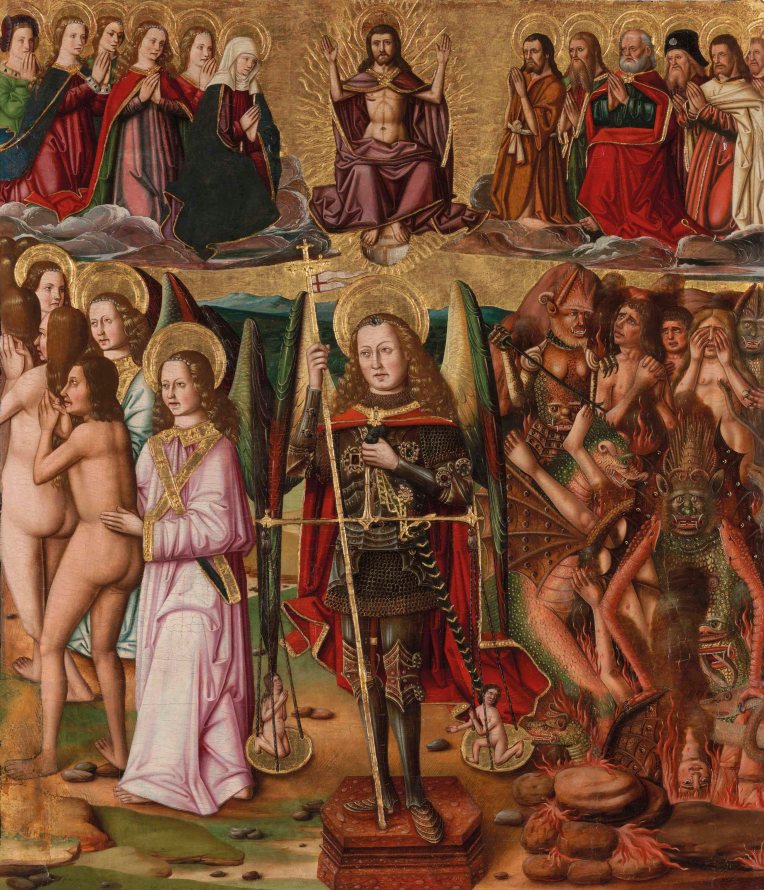
This book is fitting for us to listen to as we draw near to the end of the Church year.  Towards the end of the Church year, the Sacred Liturgy draws our attention to the Last Things:  Heaven, hell, death and judgment.  You and I need wisdom to think rightly about these four last things.

Today’s First Reading consists of the first seven verses of Wisdom.  It might surprise some just how “earth-bound” this passage is.  It is not “pie in the sky”, meditating abstractly on ideas and theories about God’s wisdom.  The passage is very concrete.

The first two words of the book are “Love justice”.  A good retreat master could develop an entire week-long retreat exploring just these two words, so profound are they.  Love and justice are both virtues:  the former the greatest of the theological virtues, and the latter one of the moral (or “cardinal”) virtues.  To love justice is to devote one’s self to a right ordering of one’s thoughts, words and actions:  giving to God what is His due, and recognizing God in our neighbors, whom He created for us to love.  In attending to the simple matters of daily life with divine love, we cannot fail to grow in wisdom.

OT 32-1.jpg

Saturday of the Thirty-first Week in Ordinary Time [I]

Saturday of the Thirty-first Week in Ordinary Time [I]
Romans 16:3-9,16,22-27  +  Luke 16:9-15
November 6, 2021

“You cannot serve God and mammon.”

This sentence of Jesus is sometimes falsely and simplistically interpreted to mean that you cannot have both God and money in your life.  In other words, this false interpretation says that there’s a sort of competition in your life between God and money which is a zero-sum game.  Or to use a picture metaphor:  this false interpretation says that there’s a see-saw in your life:  God and money are sitting at opposite ends of the see-saw.  If one goes up, the other goes down.  The holier you are, the less money you will have, and the more money you have, the less holy you must be.  This interpretation of Jesus’ words is false.

Our spiritual well-being and our financial well-being are not in competition with each other.  Rather, when Jesus plainly tells you that “You cannot serve both God and mammon”, the key is the word “serve”“You cannot serve both God and mammon.”  You can serve God, or you can serve mammon.  But you cannot serve both.

The beautiful thing about serving God is that through this form of love, we become more like Him.  After all, “God is love”, as St. John taught the first Christians.  So in the very act of loving God, we become like Him:  that is to say, we enter into His very way of life, His very way of being.  This is as God wants, and in fact this is as each of you wants, in the deepest center of your heart, because God planted that desire there when He created your heart:  the desire to serve Him, and so become more like Him.

Friday of the Thirty-first Week in Ordinary Time [Year I]

Friday of the Thirty-first Week in Ordinary Time [I]
Romans 15:14-21  +  Luke 16:1-8

… because of the grace … in performing the priestly service of the Gospel of God ….

There are differences among Christians, and then there are disagreements.  Differences can be of various types, including those willed by God Himself for the sake of the Church.  Saint Paul has preached about “diversity for the sake of unity” in the First Readings of recent days.  Differences can come about through human sin, contrary to the will of God.  But disagreements often point to something more difficult to reconcile:  beliefs that are contrary to the mind of God.

There are disagreements among Christians about Christians serving others as priests.  A priest, of course, is a mediator:  in more common parlance, a “middle man”.  He stands between God and another human person in order to serve that person:  in order to bridge the gap between God and the other.  Is there such a thing as an authentic Christian priesthood?  If so, what form or forms does it take?

Saint Paul in today’s First Reading shows us that the answer to the first of these questions is “Yes”.  Speaking to the Romans about himself, St. Paul speaks of his “priestly service of the Gospel… so that the offering up of the Gentiles may be acceptable”.

Among Christians who speak regularly against Catholic teaching and practice about the priesthood, you will often hear that there is only one mediator, Jesus Christ.  Therefore, there ought to be no human mediators between “me and Jesus”, as they might put it.  But St. Paul’s words today—inspired as they are by the Holy Spirit—clearly show such an idea to be contrary to the mind of God.  This is only the first principle by which to understand Christian priesthood, but it’s good for us to reflect on it today.

OT 31-5

The Thirty-second Sunday in Ordinary Time [B]

The Thirty-second Sunday in Ordinary Time [B]
I Kings 17:10-16  +  Hebrews 9:24-28  +  Mark 12:38-44

“… she, from her poverty, has contributed all she had, her whole livelihood.”

Tithing is a biblical tradition by which one can carry out the Precept to support the Church materially (CCC 2043).  Yet tithing demands more from some than others.  To illustrate, say that the currency that the characters in today’s Gospel passage put into the treasury was dollars.  And let’s say that one of those “rich people” earned $100,000 a year, and that in today’s Gospel passage, this rich person put $10,000 into the treasury:  in other words, 10% of his annual income.  Certainly that’s a large sum.

So then imagine that the “poor widow” had an annual income of 20 small coins.  The “two small coins” that she put into the treasury was ten percent of her annual income.  But at the time of today’s Gospel passage, those “two small coins” were all she had in her possession.  She had no savings or checking account, no mutual funds or IRA, no annuity, stocks, or bonds.  She had no husband, no children or extended family, no Social Security or Lord’s Diner.  This widow, “from her poverty, … contributed all she had, her whole livelihood.”

By contrast, the rich person who put ten thousand dollars into the treasury had more where that came from.  As Jesus said, the rich person “contributed from [his] surplus wealth”.  So while the rich person and the poor widow both may have given equal percentages of their income, the rich person still gave from his surplus, while the poor widow gave “from her poverty”.

Jesus points our attention towards—and wants us to imitate—this “poor widow” giving “from her poverty”.  That’s easier said than done.  But there are at least two ways to make this easier.  The first is a virtue to be cultivated, and the second is a practice to be followed.

First is the virtue of trust:  specifically, putting one’s trust in God.  The virtue of putting trust in God first means acknowledging that God is your providential Father.  God has made you for Himself, and you can only reach Him in Heaven by surrendering each day to the One who is your providential Father.

What practice, then, might help us concretely to give like the “poor widow”?  It’s the practice of giving “first fruits”.

Giving God one’s first fruits is rooted in Sacred Scripture.  Of course, the examples in the Bible of giving from one’s first fruits are literal, based on harvesting different grains grown by many of God’s People.

Consider a farmer with 1000 acres.  In ancient times, having only primitive tools meant that it would take him a long time to harvest 1000 acres.  At any point during that stretch of harvest time, bad weather could destroy the remaining crops.  So for a farmer to give the fruits of the first hundred of his acres to be harvested—not knowing how much of the remaining 90% would ever be harvested—was a concrete act of trust on the part of that farmer.

So how would a modern person relate such a biblical example to giving one’s treasure to God?  How could one today imitate the “poor widow” in giving one’s “first fruits”?

Maybe the simplest way would be—to use a modern expression—by giving to God off the top.  If you haven’t gone green when it comes to paying bills, and if you don’t pay all your bills by means of automatic withdrawal, then each month you have a stack of paper bills to pay.  Many Christians are tempted to give God from their “leftover treasure”:  if, that is, there is any treasure left over after the bills are paid.  Instead, you can metaphorically offer God the first fruits of your monthly treasure by giving to God a sacrificial amount before even touching the first bill that needs to be paid.

There are many other practical ways to include one’s personal finances within the sphere of one’s spiritual life, rather than falsely thinking that the two have nothing to do with each other.  This inclusion—your finances within your spiritual life—demands the virtue of trust.  The foundation of this trust is the wisdom that the “poor widow” demonstrated:  knowing oneself to be nothing without God.  Knowing oneself to be nothing without God is the foundation that allows us to give from our poverty, and allows God to bear abundant fruit through our lives.

St. Charles Borromeo, Bishop

St. Charles Borromeo, Bishop
Romans 14:7-12  +  Luke 15:1-10
November 4, 2021

“This man welcomes sinners and eats with them.”

Jesus’ first parable in today’s Gospel is heartfelt, offering us hope of God’s compassion for the wayward.  Jesus offers a “moral” to the parable in explaining that “there will be more joy in Heaven over one sinner who repents than over ninety-nine righteous people who have no need of repentance.”

Although Jesus’ “moral” seems straightforward enough, there is something about it that seems paradoxical.  Wouldn’t it make sense for the “righteous” to rank higher in Heaven than the repentant?  Why isn’t there such rejoicing in Heaven over the righteous?  There are at least two responses that might be offered.

First, the “righteous” of whom Jesus is here speaking are defined by the righteous themselves.  Yet such self-righteousness is a false righteousness.  Only God can make a human person righteous.

Second, those who are righteous in the true sense of the word are so only through their repentance.  A saint is a sinner who knows he’s a sinner.  In this sense, all human beings in Heaven (excepting, of course, Our Lord and Our Blessed Mother) are righteous through their self-repentance.  You and I as sinners rejoice that the Lord has not left us in our sins, but has offered us His grace, which is the means to righteousness in God’s sight.

OT 31-4

Wednesday of the Thirty-first Week in Ordinary Time

Wednesday of the Thirty-first Week in Ordinary Time
Luke 14:25-33

“Whoever does not carry his own cross and come after Me cannot be My disciple.”

The Catholic approach to following Jesus is not “either/or”, but “both/and”.  Throughout the course of the Church’s two thousand year history, various heretical groups have tried to split apart aspects of the Catholic Faith that God means to be wedded to each other.  For example, regarding the person of Jesus Christ, some heretics have falsely taught that Jesus is only a human being, and not divine.  In turn, other heretics have falsely taught that Jesus is only divine, and not human.  There are serious consequences to believing in either of these falsehoods.  By contrast, salvation is only possible if Jesus Christ is both fully divine and fully human.

In today’s Gospel passage, Jesus speaks to an area of the Christian life that calls for another “both/and”:  faith and good works.  There are some who claim that faith in what Jesus accomplished two thousand years ago on Calvary is enough to reach Heaven.  Jesus insists, however, that both faith and good works are needed.  Not only must a Christian have faith in Christ’s saving work on Calvary.  One must also conform the whole of one’s life – heart, mind, soul, and strength – to what Christ accomplished on Good Friday.  This is what He refers to when He insists:  “Whoever does not carry his own cross and come after Me cannot be My disciple.”

The phrase “his own cross” distinguishes that the disciple is an individual with free will:  he may choose to carry his own cross, or not to carry his own cross.  Nonetheless, when the disciple – with faith in the power of Jesus’ saving death and resurrection – carries “his own cross”, he is not merely following Jesus at a distance.  Carrying one’s own cross is not only a moral act.  For the Christian, carrying one’s own cross after Jesus is one of the chief means of entering into Jesus’ saving sacrifice on Calvary.

OT 31-3

All Souls

All Souls
Wisdom 3:1-9  +  Romans 5:5-11  +  John 6:37-40
N.B.  There is a wide selection of Scripture readings for today.
November 2, 2021

The souls of the just are in the hand of God.

The belief the Church celebrates today is part of the “communion of saints”.  That’s a familiar phrase—we recite it in the Apostles’ Creed—but the “communion of saints” isn’t just those who are canonized saints in Heaven, but also the members of the Church who are in Purgatory, as well as those on earth.  Today we who are members of that third group pray for those in the second, so that joined through prayer, we all may become members of the first.

Sometimes we feel torn like Saint Paul.  While it’s better to be in heaven, God wants us here on earth for His purposes.  Those purposes call each of us to help others in many ways.  One of the most important of these is prayer for others, which is formally called “intercession”.

Even in heaven, saints are given missions by God.  Saints are not simply fixed on God, without regard for others.  Saints in heaven pray for the rest of the “communion of saints”.

We on earth are like the saints in Heaven in this regard.  While we might want to fix our attention on God alone, God wants us to offer our lives for others, because this is often where we find God revealed in our lives.  So it is through our prayers of intercession, both for fellow pilgrims on earth, and for those in Purgatory.

Does this take away from God?  No.  God wants us to turn to each other.  Intercessory prayer is a form of Jesus’ command to “love your neighbor as yourself”.  If it’s valid in God’s eyes to pray for oneself, why wouldn’t it be to pray for others?  When a family suffers a tragedy, they draw closer together.  Part of this occurs through prayer, and they all are stronger afterwards, and more closely knit together.

Our prayer for others draws us closer to those we pray for.  Those in Heaven, in Purgatory, and on earth are drawn closer together through intercession.  When we intercede for another—or ask someone’s intercession—we don’t believe that that person is God.  We ask another to take our prayers to God.  When we call our mother and ask her to pray for us, we’re doing the same as when we kneel and pray a rosary:  we are asking our mother to pray to God for us.

Through all prayers of devout intercession, the Body of Christ grows stronger.  In the person of Christ, God and man are united.  Within Christ, we live as members of his Body.  Within Christ, we build others up, and so find God’s love for us.

The Solemnity of All Saints

The Solemnity of All Saints
Revelation 7:2-4,9-14  +  1 John 3:1-3  +  Matthew 5:1-12
November 1, 2021

“After this I had a vision of a great multitude, which no one could count, from every nation, race, people, and tongue.”

In two great commands, Jesus summed up all that God asks of us.  At their simplest, we are to love God, and love our neighbor.

God asks a lot of us as Christians.  But like any good father, God equips us for success.  God equips us so as to be able to fulfill what He commands.  That’s one of the reasons why God bestows His grace upon us.  Through His grace, God the Father equips us to succeed as his adopted children.  But there are other gifts by which God also equips us.

One of the greatest of the Father’s gifts to us is the Communion of Saints.  We profess our belief in the Communion of Saints whenever we pray the Apostles’ Creed.  The Nicene Creed, which we proclaim together at Sunday Mass after the homily, does not speak specifically of the Communion of Saints, but it does profess belief in “one, holy, catholic and apostolic Church”.  The Church that Jesus founded is an expression of the Communion of Saints.  The Church manifests the life of the Communion of Saints, with Christ Jesus as its Head.

We can reflect on today’s feast of all the saints as an encouragement for ourselves.  The feast of All Saints gives us hope that, where the saints are now, we also might be after our deaths, if we persevere in the virtues of faith, hope and divine charity on this earth.

Saint Bernard of Clairvaux, a great teacher of the Faith who lived during the twelfth century, was very blunt about the fact that today’s feast does far more for us on earth than for those we honor.  He asked:

“Why should… the celebration of this feastday mean anything to the saints?  What do they care about earthly honors when their heavenly Father honors them by fulfilling the faithful promise of the Son?  What does our commendation mean to them?  The saints have no need of honor from us; neither does our devotion add the slightest thing to what is theirs.  Clearly, if we venerate their memory, it serves us, not them.  But I tell you, when I think of them, I feel myself inflamed by a tremendous yearning.”

St. Bernard goes on by describing how today’s feast is a benefit to those of us on earth who would like someday to be saints in Heaven.  He continues:

“Calling the saints to mind inspires, or rather arouses in us, above all else, a longing to enjoy their company, so desirable in itself.  We long to share in the citizenship of Heaven, to dwell with the spirits of the blessed, to join the assembly of patriarchs, the ranks of the prophets, the council of apostles, the great host of martyrs, the noble company of confessors and the choir of virgins.  In short, we long to be united in happiness with all the saints.” [1]

What St. Bernard in this sermon does not discuss, though, is a common objection from some of our fellow Christians.  The objection is made that every moment we spend in devotion to the saints is a moment taken away from God Himself, who should be the object of all our devotion (as they claim).  However, this is one of many topics about the Faith where we can learn about God from the blessings God has given us:  in this case, the gift of the family.  The life of a human father can reveal the life of God the Father.

Does a loving human father object when brothers and sisters turn to each other in their needs?  A loving human father does not object; in fact, he encourages and fosters relationships among brothers and sisters.  This shows one of the reasons that God gives us brothers and sisters.

God doesn’t give us brothers so that we can develop our punching skills.  God doesn’t give us sisters so that we can have a larger wardrobe.  God gives us brothers and sisters to teach us how to help brothers and sisters when they’re in need, and on the flip side, to turn to them when we ourselves are in need.  This is the first and most practical way for children to practice the corporal and spiritual works of mercy.

Likewise, on this holy feast of All Saints, we give thanks to God for giving us our elder brothers and sisters in the Catholic Faith.  They strengthen us by the example of their struggles on earth in following Jesus.  They strengthen us by their prayers from Heaven, through which they turn to the same God who helped them reach Heaven, that God’s grace will strengthen us to be faithful on earth, to dwell eternally with God and all His holy saints.


[1] St. Bernard of Clairvaux, Sermo 2: Opera Omnia, Edit. Cisterc. 5 [1968], 364-368, quoted in The Liturgy of the Hours, vol. IV (New York: Catholic Book Publishing Co., 1975), 1526-7.

Saturday of the Thirtieth Week in Ordinary Time [I]

Saturday of the Thirtieth Week in Ordinary Time [I]
Romans 11:1-2,11-12,25-29  +  Luke 14:1,7-11
October 30, 2021

“… do not recline at table in the place of honor.”

The virtue of humility is a thread that runs through today’s Scriptures.  Jesus weaves this thread through the parable that He tells after noticing that His fellow dinner guests were choosing the places of honor at the table (Luke 14:7).  They were not content to receive a sumptuous meal.  They wanted also to receive honor.

These dinner guests were looking only to receive gifts.  They were not thinking of giving.  This is natural, on the one hand, since when you accept a dinner invitation, you’re accepting a gift.  On the other hand, when you go to a dinner party, you might take a token gift such as a bottle of wine.  But your token gift would seem out of place if it were greater than the banquet itself.

But here is the metanoia—the change of heart and mind—which Jesus effects in His disciples through His saving words and deeds.  He wants His disciples—including us—to recognize every gift, every invitation to receive, as an opportunity to give.