Sts. Simon and Jude, Apostles

Sts. Simon and Jude, Apostles
Ephesians 2:19-22  +  Luke 6:12-16
October 28, 2019

   …with Christ Jesus Himself as the capstone.   

St. Paul, at the beginning of today’s First Reading, declares to the Ephesians:  “You are no longer strangers and sojourners”.  But St. Peter, in his first epistle, admonishes his disciples:  “conduct yourselves with reverence during the time of your sojourning” [1 Peter 1:17-21].  How should we understand this discrepancy?  Were St. Paul and St. Peter speaking to different groups of disciples?  Were their words about sojourning in reference to differing circumstances?

Another name for the Church Militant—which is to say, the Church on earth—is the Pilgrim Church.  It’s important that we teach every disciple on earth to have this focus:  namely, that we do not live for this world, even as we take our faith into the world.  So on this feast of two holy apostles, what are we to make of St. Paul declaring, “You are no longer strangers and sojourners”?

In the second phrase of the first sentence, St. Paul makes his intent more clear.  The first half of today’s First Reading is a single sentence:  “You are no longer strangers and sojourners, but you are fellow citizens with the holy ones and members of the household of God, built upon the foundation of the Apostles and prophets, with Christ Jesus Himself as the capstone.”

St. Paul is setting down before the Ephesians his vision of the Church’s nature:  what we would call his “ecclesiology”.  He’s preaching about the Church’s essence.  Although we, like the Ephesians, are sojourning in faith each day, we also share now—by grace—in the eternal life that the Church Triumphant enjoys fully in Heaven.  The role of the apostles—and in turn their successors, including the bishop of one’s own diocese—is to foster our faith, to fix our hearts and minds, and all our apostolates and ministries here on earth, upon the eternal life of Heaven.
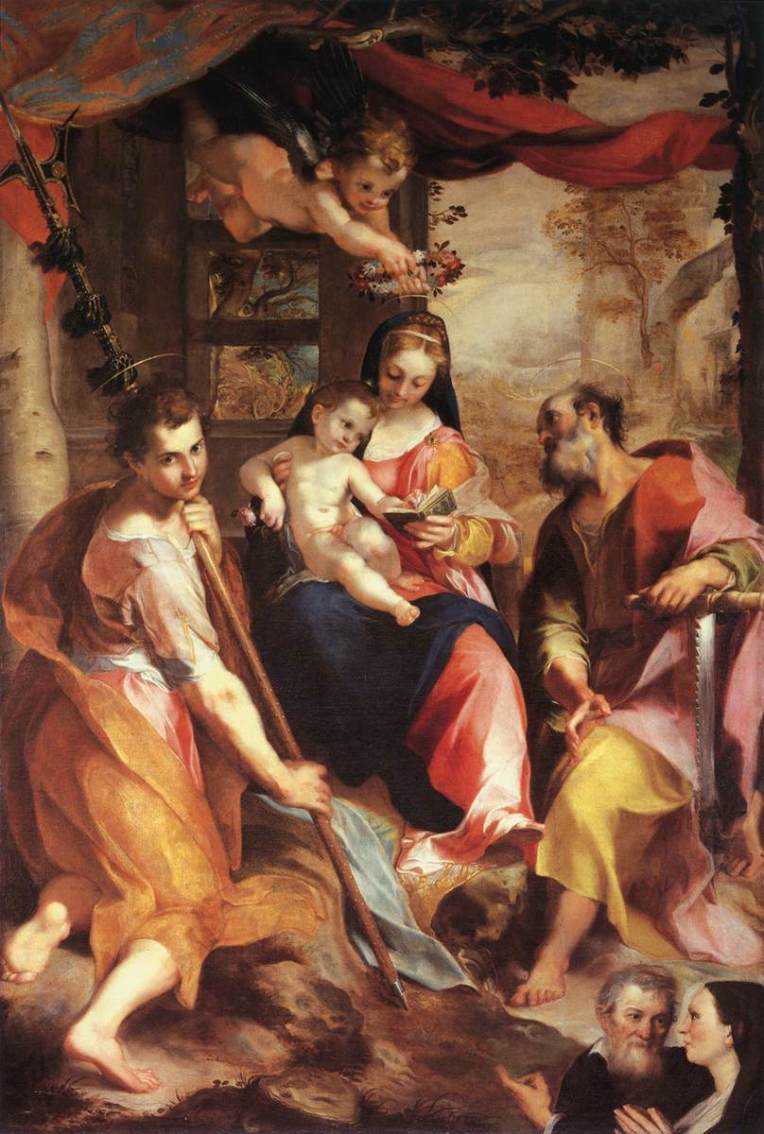
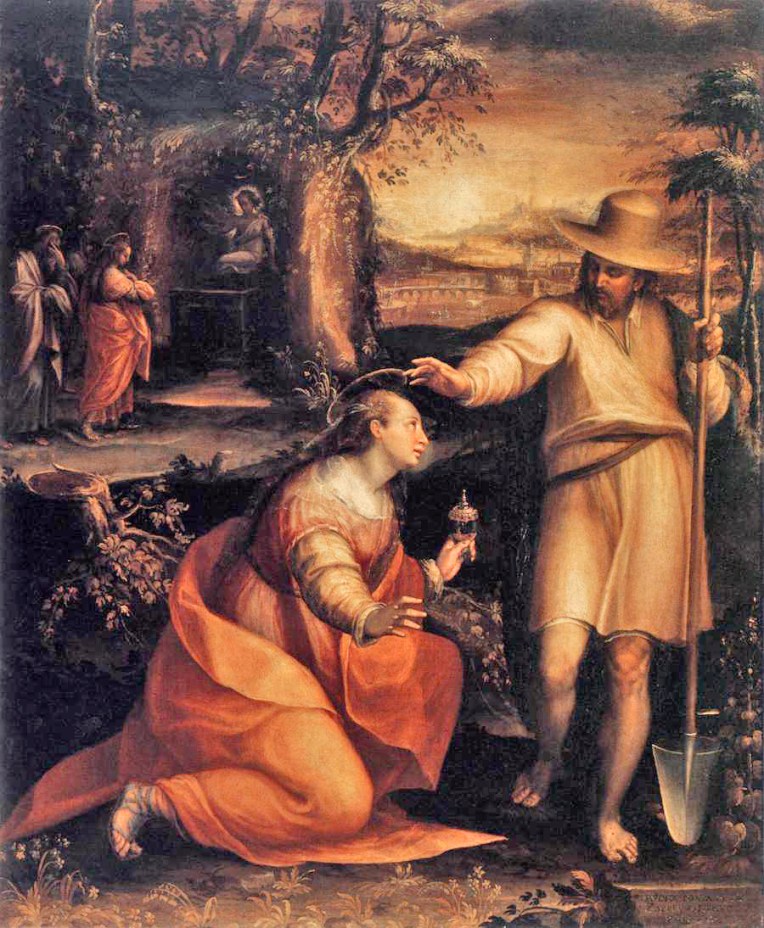
Sts. Simon and Jude with Virgin and Child

Virgin and Child with Sts. Simon and Jude by Federico Barocci [1535-1612]

The Thirtieth Sunday in Ordinary Time [C]

The Thirtieth Sunday in Ordinary Time [C]
Sirach 35:12-14,16-18  +  2 Timothy 4:6-8,16-18  +  Luke 18:9-14

   “… the one who humbles himself will be exalted.”   

The link between humility and divine charity helps you and me to follow Jesus.  Humility is not the most important of the virtues.  Divine charity—in Latin, caritas, meaning the love that is God’s very nature—is the most important virtue.  Divine charity is the summit towards which we Christians climb.

Humility, on the other hand, is the base of the mountain.  While divine charity is the goal that our last step brings us into the presence of, humility is the first step.  The old saying reminds us that “Every great journey begins with a simple, single step.”

But if humility is so simple, why do we find it so difficult to practice?  God reveals to us in Sacred Scripture that one reason why humility is so difficult is the split in the human person that’s caused by sin.

Sin splits man in two.  Saint Paul explained this to the Romans in his long letter about sin and grace.  St. Paul taught the Romans from his own experience as a sinner, telling them, “I do not do the good I want, but I do the evil I do not want” [Rom 7:19].  He’s very blunt about his own moral failures, saying, “I do not understand my own actions.  For I do not do what I want, but I do the very thing I hate” [Rom 7:15].  Most of us, when we take a good long look at ourselves (perhaps with the help of a written examination of conscience) identify with St. Paul in this.  There is the problem.

What is the solution?  God is the solution, of course.  But the trick is, we have to acknowledge and own the problem before God can do us any good.  God so respects your free will that he allows you to remain in sin should you choose to do so.  But if you open your heart even the slightest to Him, a flood of grace can transform you.

Unfortunately, sin has so great a hold on us that even doing this is tremendously difficult at times.  That’s how perverse sin is:  what should be the most natural thing in the world—opening our heart to our loving Father—becomes one of the great struggles of the spiritual life.  Jesus gives us a parable to help us see the link between humility and divine charity, and to take up the struggle to open our hearts to the Father.

The Pharisee and the tax collector are opposites.  It’s true that neither of them is at the summit.  They’re both at the base of the mountain.  But they are opposed to each other as they stand at that base because they are facing in opposite directions.

As a result, because the Pharisee stands and looks away from the mountain, every step he makes will remove him farther from the mountain’s summit.  But the tax collector is facing the mountain, looking up towards God and the summit that he has yet to climb.

He has a long road before him.  But his first step forward is an act of humility.  He is doing what you need to do:  to face the divine Father who loves you in your sins, and who calls you to Himself by your offering Him a confession of your sins.

If you listen closely to the words of today’s Gospel Reading, you hear Jesus carefully point to the difference between these the Pharisee and the tax collector.  Jesus explains that the Pharisee “spoke this prayer to himself”.  He wasn’t truly praying at all.  The Pharisee was speaking a prayer to himself, not to God.  But the tax collector teaches us how to pray because he prays with humility.

The link between humility and divine charity helps you and me to follow Jesus.  This is true not only in our prayer, but in everything we do.  In everything we do, before we even take our first step, we have to act with humility by facing the right direction and looking up to God, instead of acting for our own sake.  Humility is the beginning, and divine charity—the life of God—is the end.  But without the right beginning, we cannot reach the right end:  the end for which God made us.

OT 30-0C

The Coronation of the Virgin by Diego Velázquez [1599-1660]

Saturday of the 29th Week in Ordinary Time [I]

Saturday of the 29th Week in Ordinary Time [I]
Ephesians 4:7-16  +  Luke 13:1-9
October 26, 2019

   “‘Sir, leave it for this year also….’”   

Both in the Old Testament and the New Testament, gardens, plants and trees of all sorts are used as symbols of growth—and decay—in the spiritual life.  The very first story of the Bible takes place in a garden called Eden.  And today in the Gospel, Jesus tells us a parable along the same lines.

Your spiritual life is the fig tree, and you are the gardener.  Your spiritual life is planted in the Lord’s orchard.  What we have to come to grips with is the fact that we are accountable to the Lord, just as in today’s parable the gardener is accountable to the owner of the orchard.  We are accountable for bearing spiritual fruit in our lives on this earth.

That’s why we’re here on this earth.  If we believed, as some of our fellow Christians do, that the entire point of our relationship with Christ is to be “saved”, then we would be better off dying as soon as we’re baptized.  But the whole truth is that salvation comes to us only at the end of our life on this earth, if we have been faithful to tending our spiritual life, and bearing fruit through the many ways that our spiritual life nourishes our daily life.

OT 29-6

Friday of the 29th Week in Ordinary Time [I]

Friday of the 29th Week in Ordinary Time [I]
Romans 7:18-25  +  Luke 12:54-59
October 25, 2019

   The willing is ready at hand, but doing the good is not.   

Saint Paul’s epistle to the Romans is considered the most profound of all his epistles.  The breadth of themes and the depth to which he explores them is profound.  Today’s First Reading from the seventh chapter of Romans explores how the human person experiences division within himself.  St. Paul describes this as “the principle that when I want to do right, evil is at hand.”

Perhaps the most intriguing phrase in today’s First Reading is St. Paul’s admission that “I do not do the good I want, but I do the evil I do not want.”  His words call out the division in fallen man between what the “I” wants, and what it wills.  This is not a mere putting of one’s wants and desires to the side, and acting in spite of them.  St. Paul speaks of what modern thought might term a “compulsion” that drives the ego.  However, he ascribes this acting out of evil to the work of “sin that dwells in me.”

St. Paul is not seeking to cast blame away from himself.  He’s not trying to say, “The devil made me do it.”  He does indeed admit that this struggle is within his very self:  “I see in my members another principle at war with the law of my mind, taking me captive to the law of sin”.  Regardless of how fierce this struggle is, or how deep the division it causes, the remedy is clear and at hand.  St. Paul’s entire epistle to the Romans is full of thanksgiving to God for the grace of Christ our Savior.

OT 29-5

Thursday of the 29th Week in Ordinary Time [I]

Thursday of the 29th Week in Ordinary Time [I]
Romans 6:19-23  +  Luke 12:49-53
October 24, 2019

   “No, I tell you, but rather division.”   

Both the rhetoric and substance of Jesus’ proclamation in today’s Gospel passage are challenging.  It’s challenging to know how rightly to interpret His words.  The fire of His baptism is the source of the division that He has come to establish.  How can we understand these words and images in our own daily lives as disciples?

The most obvious interpretation of the fire that Jesus mentions is in light of God the Holy Spirit.  Through the graces that first were given at Pentecost in the Upper Room, the Holy Spirit inflames the hearts and minds of those called to be members of Jesus’ Mystical Body on earth.  Formed by the Holy Spirit into one Body, these members live out the baptism of Jesus.  Jesus’ baptism in the Jordan was a foreshadowing of His baptism on Calvary.  This latter baptism is the one which the Body of Christ today lives out.  As His members, you and I have to bear our share in this baptism if the Holy Spirit might use us as the Father’s instruments.

If we are faithful to the Father—allowing the baptism of Jesus’ suffering to be the vessel for the outpouring of the Holy Spirit through us—division will result, as Jesus describes in today’s Gospel passage.  This is not division for the sake of division, but for the sake of unity.  We pray in the midst of all division, that every person may recognize and accept his share in the life of the Trinity.

St. Anthony Mary Claret

Today is the optional memorial of St. Anthony Mary Claret, Bishop

Wednesday of the 29th Week in Ordinary Time [I]

Wednesday of the 29th Week in Ordinary Time [I]
Romans 6:12-18  +  Luke 12:39-48
October 23, 2019

   “Much will be required of the person entrusted with much, and still more will be demanded of the person entrusted with more.”   

St. Luke the Evangelist presents many “stewardship parables”.  Today’s Gospel passage offers two, one much longer than the other.  The upshot of both is an explicit moral that lets no Christian off easily:  “Much will be required of the person entrusted with much, and still more will be demanded of the person entrusted with more.”  How do these words apply to an ordinary Christian?

No Christian is ordinary.  At the moment of a person’s baptism, God infuses grace into that adopted child’s soul.  The graces given include the divine virtues of faith, hope and charity.  God entrusts this grace to His adopted child.  Consider this fact in light of Jesus’ words at the end of today’s Gospel passage.  God entrusts His own divine life to His adopted children.  And of course, the graces received at Baptism are but the “first installment” of our inheritance.  As we continue to grow as His children, God continues to bestow grace upon us through the sacraments and prayer.

“Much will be required of the person entrusted with much”.  What will be required of us, then, as sharers in the divine life?  Are you a “faithful and prudent steward”?  Both of these virtues—fidelity and prudence—are required to be stewards of the graces that God gives us.  Both help keep our attention on our Master:  the beginning and end of all the graces of our lives.

OT 29-3

Tuesday of the 29th Week in Ordinary Time [I]

Tuesday of the 29th Week in Ordinary Time [I]
Romans 5:12,15,17-19,20-21  +  Luke 12:35-38
October 22, 2019

   “Blessed are those servants whom the master finds vigilant on his arrival.”   

 In the Lord’s parable today He proclaims that “blessed are those servants”.  He’s wanting us to identify ourselves with them, and imitate them so that we might share in their blessedness.  How can we connect our lives to the lives of those servants?

Perhaps you’ve heard the old adage, “Always begin with your end in mind.”  “End” in this case refers to one’s goal.  Many people, of course, wander through life aimlessly, but Christians are meant to have Heaven as their goal, or end.  In this case, repeating that adage to ourselves each day helps us to live each day for God, by recalling that we can only get to Heaven by living out our faith in God.  This way of thinking approximates what Jesus is getting at in His parable.

However, there’s an immediacy to Jesus’ parable that’s missing in that adage.  His parable reminds us of a sobering fact:  that we know not the day nor the hour when our lives will end.  The Master may come at an unexpected time.  Therefore, we need not only always to be focused, but also to be vigilant, since the end we have in mind may confront us today.

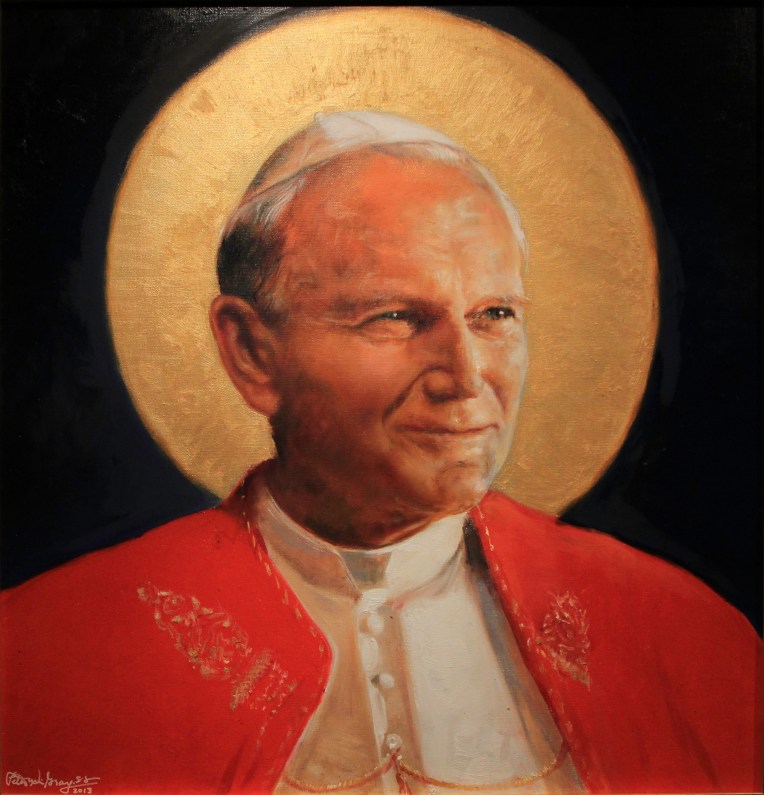
St. John Paul II 02

Today is the Optional Memorial of Pope St. John Paul II

Monday of the 29th Week in Ordinary Time [I]

Monday of the 29th Week in Ordinary Time [I]
Romans 4:20-25  +  Luke 12:13-21
October 21, 2019

   “…one’s life does not consist of possessions.”   

In our little corner of the world, celebrations of harvests take place roughly this time of year.  Even if most in industrialized nations don’t live directly off the land, our celebrations of thanksgiving help us relate to today’s Gospel passage:  both Jesus’ interaction with the jealous brother, and His parable to the crowd.

Consider the parable.  It illustrates Jesus’ previous explanation of the relationships among “one’s life”, “greed”, and “possessions”.  Material possessions are not inherently bad.  Even those with religious vows of poverty possess their “own” clothing, even if they do not “own” them.  But possessions always tempt one—through the vice of greed—to more possessions, either in quantity, quality, or even mere novelty.

The rich farmer in Jesus’ parable is the antithesis to Ecclesiastes’ Qoheleth.  The rich farmer cries out to himself, “rest, eat, drink, be merry!”  This is in contrast to the king of Israel who confesses that “I said in my heart, ‘Come, now, let me try you with pleasure and the enjoyment of good things.’  See, this too was vanity.”  While the rich farmer has not the wisdom of Qoheleth, even Qoheleth in Old Testament times did not know Christ, the one who possesses all the riches of the Father’s love.

OT 29-1.jpg

The Parable of the Rich Fool by Rembrandt van Rijn [1606-1669]

The Twenty-Ninth Sunday in Ordinary Time [C]

The Twenty-Ninth Sunday in Ordinary Time [C]
Exodus 17:8-13  +  2 Timothy 3:14—14:2  +  Luke 18:1-8

   “… proclaim the word; be persistent whether it is convenient or inconvenient ….”   

In Sunday’s Second Reading, Saint Paul describes how God’s Word speaks to us through the words of the Bible.  But the “Word of God” is found not only in the Bible.  We listen to the Word of God in the Bible in order to receive an even greater gift:  the Word of God made Flesh.  Opening our selves to this greater gift is one of the chief dynamics of the Christian life.

The very structure of the Mass invites us into this spiritual dynamic.  It’s not a coincidence that Holy Mass follows the pattern that it does.  The two main parts of the Mass—in the Ordinary Form called the “Liturgy of the Word” and the “Liturgy of the Eucharist”—are not interchangeable.  That is to say, the Mass would not make sense if the Liturgy of the Eucharist were celebrated first, and then the Liturgy of the Word.  After all, the Word is proclaimed and preached as a preparation for the Word made Flesh.

We see this if we superimpose the outline of the Mass upon the outline of salvation history.  Consider what we might call the “first half” of salvation history:  the time of the Old Testament.  During this long period of time, “God spoke” his Word “in partial and various ways to our ancestors through the prophets” [Hebrews 1:1].  But in the “second half” of salvation history—the time of Christ and His Church—“God spoke to us”, and speaks to us today, “through [His] Son” [Hebrews 1:2], the Word made flesh, who proclaimed to His followers:  “Take this, all of you, and eat it.  This is my Body, which will be given up for you.”

Catholics are at times accused of being ignorant of the Scriptures.  Unfortunately, there are times when this criticism is justified.  To that extent, we must dispel our ignorance, for St. Jerome’s words are just as true today as when he lived:  “Ignorance of Scripture is ignorance of Christ.”

But if our devotion to Scripture does not lead us to a deeper devotion to the Eucharist, we miss the entire point of God becoming human:  the point of the divine Word becoming flesh and blood.  After all, what did God the Son say on this earth that God the Father could not have said from the heavens?  Couldn’t God the Father have spoken the Beatitudes from Heaven, rather than Jesus speaking them during the Sermon on the Mount?  Couldn’t God the Father have taught His People from Heaven how to pray to Him, rather than Jesus teaching us the “Our Father”?  What words had to be spoken by one who is both fully divine and fully human?  “Take this, all of you, and eat it.  This is my Body, which will be given up for you.”

Jesus calls us to the Supper of the Lamb—the sacrifice of the divine Word made Flesh—for two reasons.  The second and more ultimate is to give us while on earth a foretaste of what we would experience in the Banquet of Heaven if we were to persevere in the Faith until death.

The first and more immediate reason is to strengthen us through the Eucharist for the difficult work of our vocations within this world.  If our devotion to the Eucharist—whether in Adoration, or weekday Mass, or even only our Sunday obligation—does not deepen our Christian service, we’re missing an important point of the Word becoming flesh.

In Sunday’s Second Reading, St. Paul writes about the nature of the Word of God as found in the Bible.  He makes three specific points.  First:  “All Scripture is inspired by God”.  Second, Scripture “is useful for” four purposes:  “for teaching, for refutation, for correction, and for training in righteousness”.

But then St. Paul explains that those four purposes serve a larger, overarching purpose.  All Scripture is inspired and useful “so that one who belongs to God may be competent, equipped for every good work.”

As faith is meant by God to express itself in a Christian’s good works, so Scripture also orients the Christian to good works.  As the Word becomes Flesh in the Eucharist, the Eucharist strengthens the members of the Body of Christ for service in this world.  That service aims to call even more persons into the life of the Church, and through the Church’s life with Christ, into Heaven.

Holy Sacrifice of the Mass 3