So they tried to arrest him, but no one laid a hand upon Him, because His Hour had not yet come.
Today’s Gospel Reading might not seem very dramatic. There is more said about Jesus than there is said by Him. A good part of the reading is the evangelist describing Jesus’ moving about and avoiding conflict. Yet the final sentence of this passage heightens the setting of all that is said and done here.
In the Gospel Readings this past Tuesday and Wednesday, we heard two reasons for His enemies to threaten Him. Today’s passage sees Jesus acting and speaking in the face of this danger. Yet despite attempts to arrest Jesus, “no one laid a hand upon Him, because His Hour had not yet come.”
This “hour” is key to St. John’s account of the Gospel. The evangelist isn’t referring to a chronological hour of sixty minutes. He’s talking about the point within human history when God will destroy the power of sin and death. Each of the signs that Jesus works during the “Book of Signs” foretells the events of Jesus’ Hour, and all of His teaching describes His reason for undertaking His Hour out of love.
“…these works that I perform testify on my behalf that the Father has sent me.”
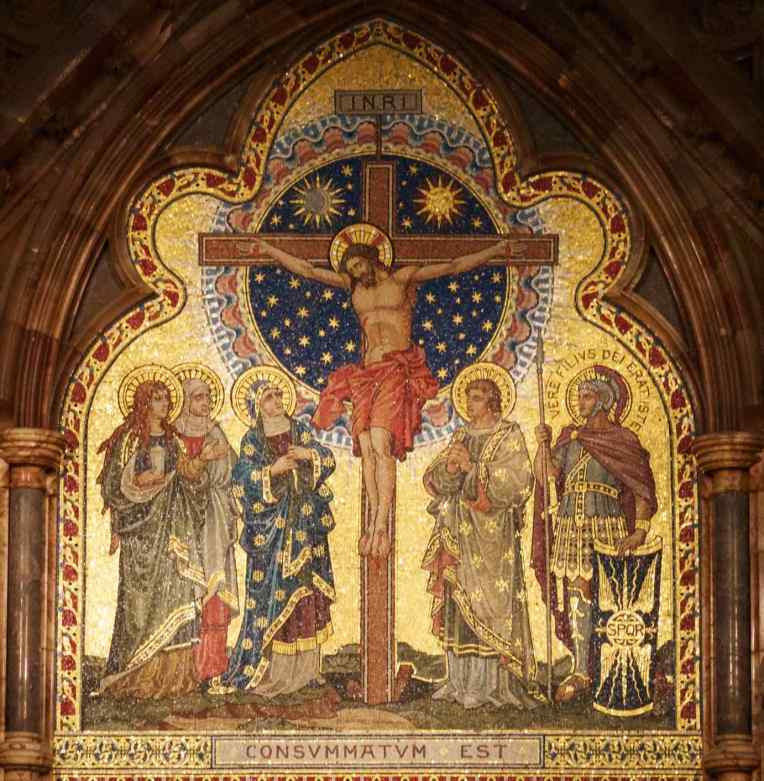
Jesus’ words today seem somewhat harsh, as they often seem in St. John’s Gospel account. Jesus’ words to the Jews confirm that they are lacking in faith, unwilling to believe in the Good News that Jesus is preaching. As we, the members of the Church, draw closer to Good Friday, we ought to ask whether we fully believe in the power of the Cross in our lives. Do we believe that in suffering we can find redemption? Do we believe that there is a meaning to all the suffering that we are constantly experience (often, of our own making)?
Jesus asserts that there is meaning in suffering, and that His Cross most perfectly reveals that meaning. But to those with weak faith, Jesus’ words don’t suffice, so He offers four witnesses who testify to the Truth of who Jesus is. John the Baptist, the miracles of Jesus, the Scripture, and God the Father each testify to what Jesus is saying, just as they will each testify to the sacrifice that Jesus will offer on Good Friday. Saint John the Baptist, Jesus’ miracles, and the Scriptures all foretold the mystery that Jesus would in time reveal on the Cross, but it is God the Father Himself who will give ultimate meaning to the Cross. The Father grants this meaning in raising Jesus from His suffering and death.
In saying all this in today’s Gospel passage, Jesus is preparing us to receive the Eucharist: that is, to share in the Sacrifice of the Cross sacramentally. He knew that many people would reject His teaching on the Eucharist, and that in doing so they would be rejecting Jesus Himself. In the Cross we find our redemption, and in the Holy Eucharist we have the opportunity to willingly and lovingly participate in Christ’s self-offering to the Father. We must have the confidence that the Father loves us—his adopted sons and daughters—as He does His only-begotten Son. In our own lives, we must have confidence that our sacrifice will be acceptable to God the Father.
… the virgin shall be with child, and bear a son, and shall name him Emmanuel….
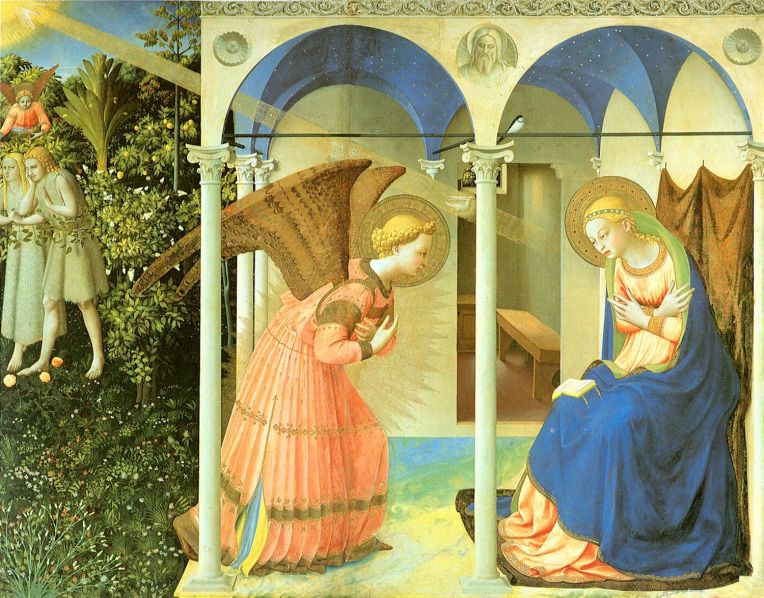
In the person of Jesus Christ, God and man are united. This is the good news that Saint Gabriel came to announce to Mary: that she would bear in her womb the one through whom all human beings could find eternal life. The profundity of this news overwhelmed Mary, and made her fearful. What would this mean for her life?
Throughout the world and throughout history, human beings have sought to find meaning in their lives in many ways. Similarly, human beings have always searched for love in their lives. We know that there are many different things which people in the world call love, but Jesus Christ and the Church He established upon this earth clearly teach us that there is only one real type of love. It is that love which over many years would lead Mary to Calvary. Only this real love is strong enough to destroy death.
If Mary had understood the fullness of her vocation, she would likely have feared the annunciation of Saint Gabriel even more than she did. Both the Annunciation and its consummation on Calvary are sacred events which call us to consider how God expects us to accept the Holy Spirit in humble submission to the will of God. Mary is the greatest disciple of Our Lord. Beyond her questions she says “Fiat”:“letit be done unto me according to yourword”. She accepts the fullness of the Holy Spirit and bears the Body of Christ. She is the model for us who strive faithfully to say, “Into your hands, O Lord, I commend my spirit.”
Those who have received the gifts of the Holy Spirit in Baptism and have had them strengthened in Confirmation turn to Mary, asking her intercession during their journey towards Calvary, and asking for perseverance to pray beneath the Cross. As each of us shares in the offering of the Holy Sacrifice of the Mass, may we be transformed in mind and heart, in order to bear the real love of Christ in the world: in the midst of those around us who are seeking God more deeply in their lives, or who do not yet know Him.
Therefore, the Jews began to persecute Jesus because he did this on a sabbath.
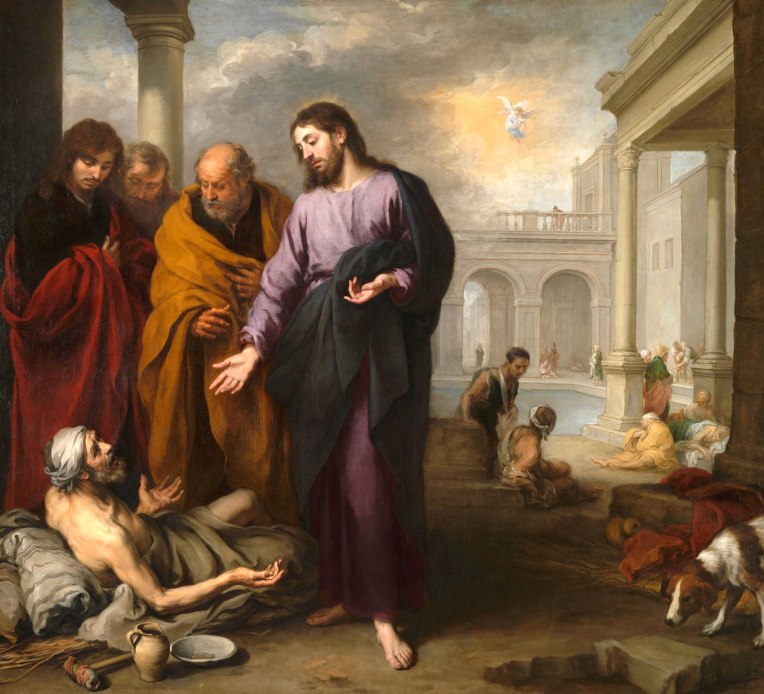
It was divine love that moved Jesus to heal the sick man in today’s Gospel passage. It was this love that motivated Jesus to risk incurring the wrath of the Jewish people by healing this man on the Sabbath. Sadly, even the man who is healed by Jesus does not quite understand Him. When the healed man is confronted by the Jews about the “inappropriateness” of this miracle being performed on the Sabbath, he does not give faithful witness to Jesus’ love for Him. Instead, he lamely tries to pass the buck to Jesus so that he himself is not blamed.
The irony of these events is that there is no “blame” here, except for that manufactured by those who wish to condemn Jesus. Nonetheless, this guilt, like the true guilt of all mankind, is passed on to Jesus, and He accepts it, for He can make all things new in Himself. He can even use an occasion such as this to bring glory to God.
Saint John is not, in narrating this “third sign” of the Book of Signs, focusing upon a miracle of physical healing, though that is what this passage seems to be about at first glance. Certainly the man in today’s Gospel passage is healed of his ailment. But on the other hand he incurs a much more serious moral ailment in accepting false guilt for Jesus’ miracle and passing that guilt along to Jesus.
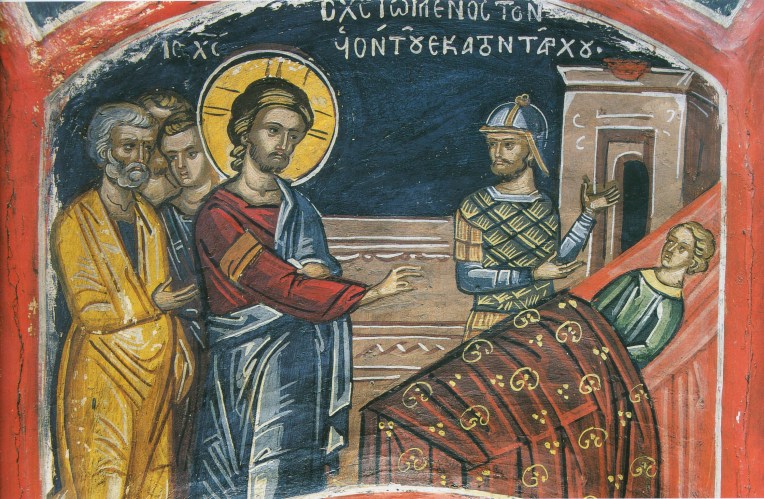
It is in the Temple that Jesus confronts this man for a second time—as He spoke twice to the royal official in yesterday’s gospel. In the first encounter between these two men, Jesus speaks the truth but is not understood. In the second encounter, something even more powerful takes place. It is in the Temple—the scene of today’s First Reading—that Jesus speaks a much more important truth, reminding the healed man that he has sins that must be given up.
It was not for physical healings that Jesus came into this world. The Word of God became flesh so that He could offer His Flesh and Blood on the Cross for the forgiveness of our sins.
“Unless you people see signs and wonders, you will not believe.”
The Fourth Sunday of Lent—sometimes known by the Latin name “Laetare Sunday”—is roughly the mid-point of Lent. Before this mid-point, at the weekday Masses of Lent the Gospel Readings are taken from non-sequential chapters among the first three Gospel accounts. For example, on the first four days of Lent, the Gospel Readings are taken from Matthew 6, Luke 9, Matthew 9, and Luke 5, respectively.
During the Fourth Week of Lent, the respective Gospel Readings are taken from John 4, John 5, John 5, John 5, John 7, and John 7. If you notice a pattern, you see what the Church is up to. In fact, this pattern continues through Monday of Holy Week, when the Gospel Reading is taken from John 12.
How do these chapters—from John 4 to 12—prepare us for the sacred events of Holy Week? Jesus’ words in today’s Gospel Reading offer a clue: “Unless you people see signs and wonders, you will not believe.” Following the prologue of St. John’s Gospel account, the first half of the account is often called “The Book of Signs”. In a better world, where people held stronger faith, signs and wonders would not be needed. But with compassion for our human weakness, Jesus works signs throughout the chapters of John 4 to 12. The signs point to an even greater work that Jesus will accomplish through the Sacred Triduum, which the Lord foretells in today’s First Reading: “Lo, I am about to create new heavens / and a new earth”.
CCC 280, 529, 748, 1165, 2466, 2715: Christ the light of the nations CCC 439, 496, 559, 2616: Jesus is the Son of David CCC 1216: baptism is illumination CCC 782, 1243, 2105: Christians are to be light of the world
+ + +
A tiny baby is completely dependent upon its parents for giving it life and sustaining that life. Yet we do not expect that baby to give thanks for what he or she receives. In general, the younger a person is, the more his needs are met by others, and the less grateful he tends to be. But as a child grows more independent and self-sufficient, we expect him to grow in gratitude.
Yet as odd as it might seem, the average adult is often tempted to return to the state of that little child who believes that he or she is completely self-sufficient and needs to give thanks to no one. This happens when one focuses on material things and loses sight of the spiritual life.
If we grow not only older but also wiser, we begin to recognize how little in our lives comes solely through our own efforts. In fact, the greatest maturity in life comes when we see that every talent and ability we possess is a gift from God that we no more deserve than the gifts a child receives at Christmas.
The prophet Samuel in the First Reading reminds us of this, that “God does not see as man sees, because man sees the appearance, but the Lord looks into the heart.” The Church chose this First Reading because “sight” is the theme that runs through all of the Sacred Liturgy today. More to the point, the theme is blindness: the lack of sight that derives from losing sight of God in one’s life.
In last Sunday’s Gospel Reading, Jesus drew an outcast into conversation. The world of Jesus’ time and place looked upon this sinful Samaritan woman as someone to be avoided. But Jesus saw in this outcast a heart which, though hardened, wanted to offer love to God. Jesus drew that love out of her heart.
During these middle weeks of Lent, the Gospel Reading comes from Saint John’s Gospel account. We ought to notice that in John, intermediaries (or “middlemen”) play an important role in hearing the Gospel, and consequently in people placing their faith in Jesus.
In John, it is not always Jesus Himself who inspires others to place their faith in Him. Certain persons throughout John—such as the Samaritan woman from last week’s Gospel Reading, the blind man in today’s, and Mary the sister of Lazarus in next week’s—who bring people closer to Jesus.
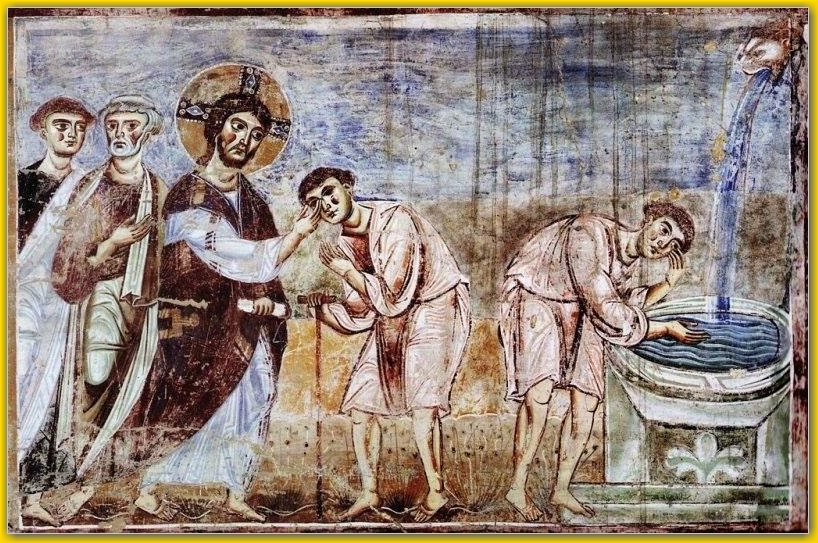
In today’s Gospel Reading from John, the man born blind is one of us. When Jesus approaches him, Jesus does not ask if he wants to be cured, and the blind man does not request that Jesus cure him. This dynamic is rare within the four Gospel accounts, so we ought to attend to it. Jesus simply walks right up to the blind man, and heals him with a completely unmerited and unrequested gift.
The gift itself, though, is not the chief point of the Gospel Reading. John’s point is seen when we look at the response of people to this miracle. Some are drawn to Jesus and begin to place their faith in Him because of the miracle He worked for the blind man.
However, others are Pharisees. The Pharisees, like the Samaritan woman, have hearts darkened and hardened by sin. But the Pharisees, unlike the Samaritan woman, refuse to open their hearts to the gifts God wants to place within their souls. The Pharisees are blind.
When God works a miracle in their midst, the response of the Pharisees is to condemn the miracle-worker. Through the course of this Gospel Reading, we see the man born blind become more courageous, though: even he begins to confront the blindness of the Pharisees.
Hopefully each of us is a messenger as the man born blind was: that is, an intermediary between God and other persons. God wants to bestow His graces in our lives every day. First we have to recognize how dependent we are upon God, and in how many ways we are blessed by Him.
Yet we must also be willing to tell others about God’s graciousness. Sometimes, speaking of our faith in God’s goodness will bring others to recognize God working in their own lives. Others, however, will only push God further from them, and may very well shun us, also. In fact, this cost of discipleship may leave us alone at times with no one other than our Lord.
“… for everyone who exalts himself will be humbled….”
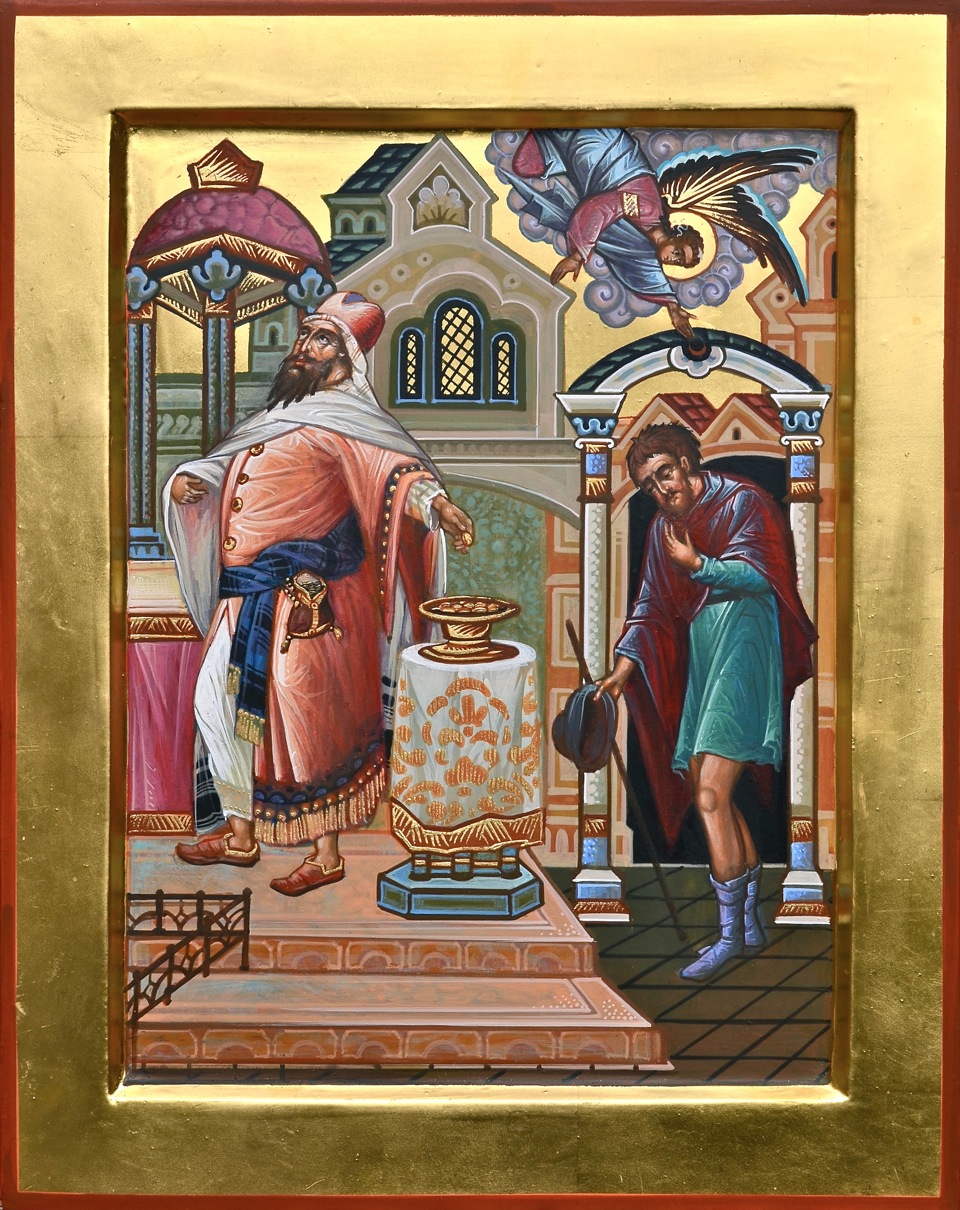
Jesus cautions us in this morning’s Gospel passage. Even as we pray to God, our words of thanks can easily turn in on ourselves. The Pharisee did not give thanks to God for the gifts God have given him. The Pharisee did not give thanks to God for the good that the Pharisee had been able to do for others. The Pharisee gave thanks for himself, because in his own eyes he was “not like the rest of men.”
In the person of the tax collector, Jesus is teaching us of the primacy that humility plays in the spiritual life. Before the tax collector can give thanks, he knows he must first beat his breast and ask pardon from God. Unlike the Pharisee, the tax collector realizes that he is just like “the rest of men”. In humility he pleads God for mercy.
Through this parable, Jesus is teaching us a basic lesson about the spiritual life. In his own person, however, he teaches us something even more important. Jesus himself was not at first “like the rest of men”. Rather, “for us men and for our salvation / he came down from heaven: / by the power of the Holy Spirit / he was born of the Virgin Mary, and became man.” Before he came down from heaven he was true God; after the Annunciation, He was both true God and true man.
Before we give God thanks for our salvation, we plead to Him for mercy. But before we plead to God for mercy, we give Him thanks for having sent His sent to become human, to show us how to be humble.
When the scribe challenges Jesus to identify the prime commandment of God, Jesus quotes from Deuteronomy the prayer known as the Shema. This prayer, which is as important to Jews as the “Our Father” is to Christians, commands you when you pray it to “love the Lord your God with all your heart … soul … mind, and … strength.” Consider this strength that Jesus is directing our attention towards.
Have you ever had the experience of praying to God for the strength—or the wisdom or perseverance—to accomplish some specific goal, only to hear silence from God in response? “Where is God?” we ask. “Why isn’t God here for me?” If you ever feel like God’s not here for you, and that He’s standing remote and silent over there, at a distance, you might reflect on that distance between here and there. Ask yourself, and then ask God, if maybe He’s wanting you to move from here to there. Maybe where you are, isn’t where God wants you to be.
Relating that to the biblical virtue of strength, we have to get it through our heads that God is not going to give us the strength to accomplish a goal that He has no interest in us reaching. It’s not as if we set the goals, and God gives us whatever we need to reach our goals. If our goals are not God’s goals, we shouldn’t be surprised when we call on God, and hear silence on the other end of the line.
In the midst of our ascent to Calvary, we pause to take a deep breath and sing of “the favors of the Lord”. Like King David, we dare to chant that “through all generations my mouth shall proclaim your faithfulness”. On this feast of Saint Joseph, the husband of Mary, all of our readings draw our minds to the enduring nature of the covenant between the Lord and His People.
On a day-to-day basis, most of us have difficulty even remembering the small things that we promise to do for others. Of course, all of the small promises that we make are concrete examples of the promises by which we have consecrated our lives to the Lord: first in baptism, and then—many of us—by means of more specific vows or promises.
This promise of oneself—this faithful handing over of one’s own earthly life to another—is the greatest covenant we can establish as individuals. It is by this that we become more than individuals. As such, we bow in homage before the Lord who wishes to make this covenant with every human person.
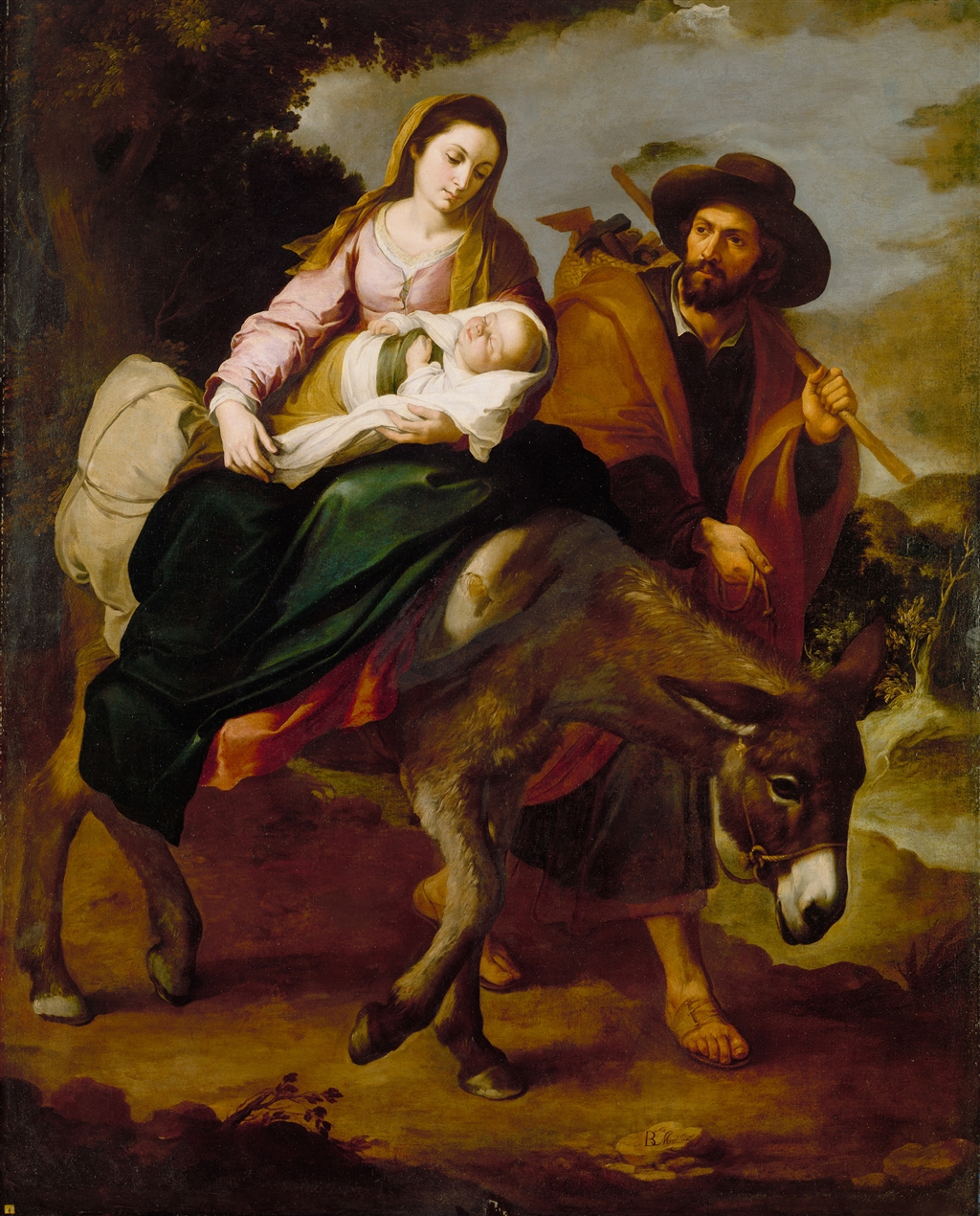
It is specifically as the spouse of the Blessed Virgin Mary that we honor Saint Joseph today. Today, in a manner of speaking, is a Marian feast. It is the spousal nature of Joseph’s life that mirrors in his earthly life the enduring fidelity of the Lord. From his place in Heaven, St. Joseph is the patron of the universal Church, that instrument through which the Lord wishes to make a covenant with each member of the human race, making each person a member of His divine Son’s Body. It is the Church that proclaims to the world yet converted the faithfulness of the Lord, and it is to the Church that the Lord promises that He will strengthen us in all our trials.
The life of Saint Joseph is one of silent fidelity to the Lord. We have in Scripture no words of St. Joseph recorded. Even the words that are spoken by others to St. Joseph are words that measure by measure call for ever-growing trust in the Lord’s plan. Step-by-step: that’s the only way to reach Heaven. As we continue to step up the path to Calvary, let us pray that Saint Joseph’s spousal trust and fidelity will be our own.