Monday of the Seventeenth Week in Ordinary Time Matthew 13:31-35
All these things Jesus spoke to the crowds in parables.
Jesus today proclaims two parables about the Kingdom of Heaven. In wanting to understand these parables, we might wonder what exactly the Kingdom of Heaven is. Is the Kingdom of Heaven the realm of Heaven? Is it the Church, or some measure of both the Church and Heaven, or something else entirely, such as the individual Christian’s soul?
Jesus never directly answers this question. But even without defining “the Kingdom of Heaven”, we can say that the kernel of each “Kingdom parable” describes in some way the reality of Heaven, and/or the Church, and/or the Christian’s soul.
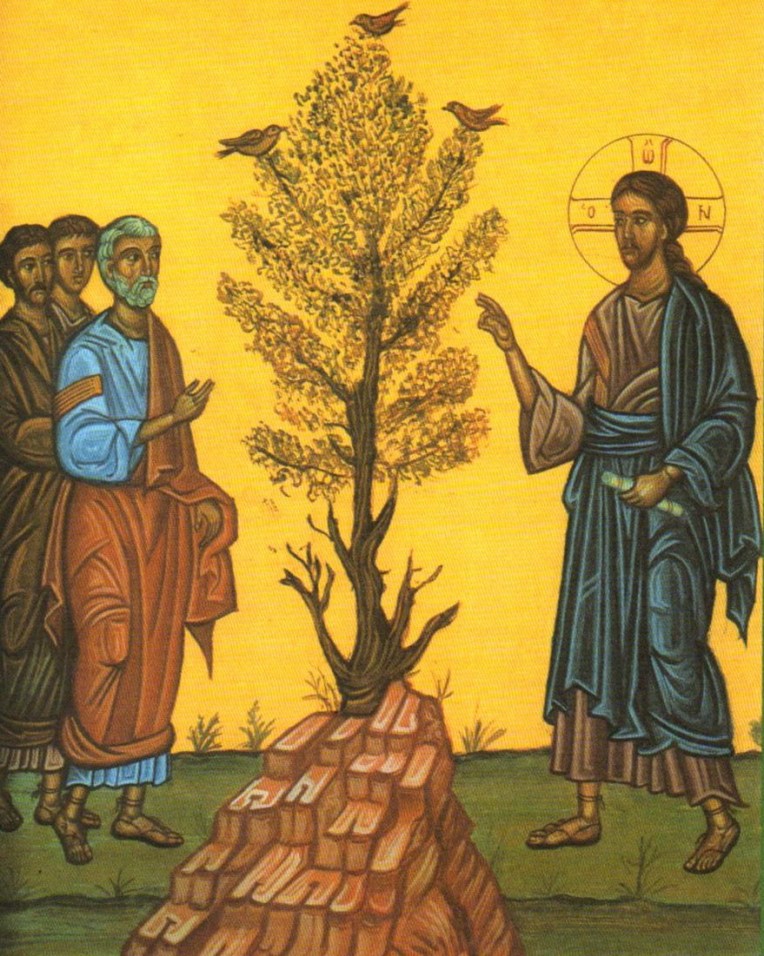
Take Jesus’ first parable in today’s Gospel passage. The change from the “smallest of all the seeds” to “the largest of plants” seems more easily applied to the Church and the Christian soul than to Heaven. Tertullian wrote that “the blood of the martyrs is the seed of the Church”, a phrase through which we can see how this parable applies to the Church. With God, all things are possible: from a natural death springs supernatural life. Or as the Church prays to God the Father in one of the prefaces for martyrs at Holy Mass: by “your marvelous works” “in our weakness you perfect your power / and on the feeble bestow strength to bear you witness….”
… so that the life of Jesus may be manifested in our mortal flesh.
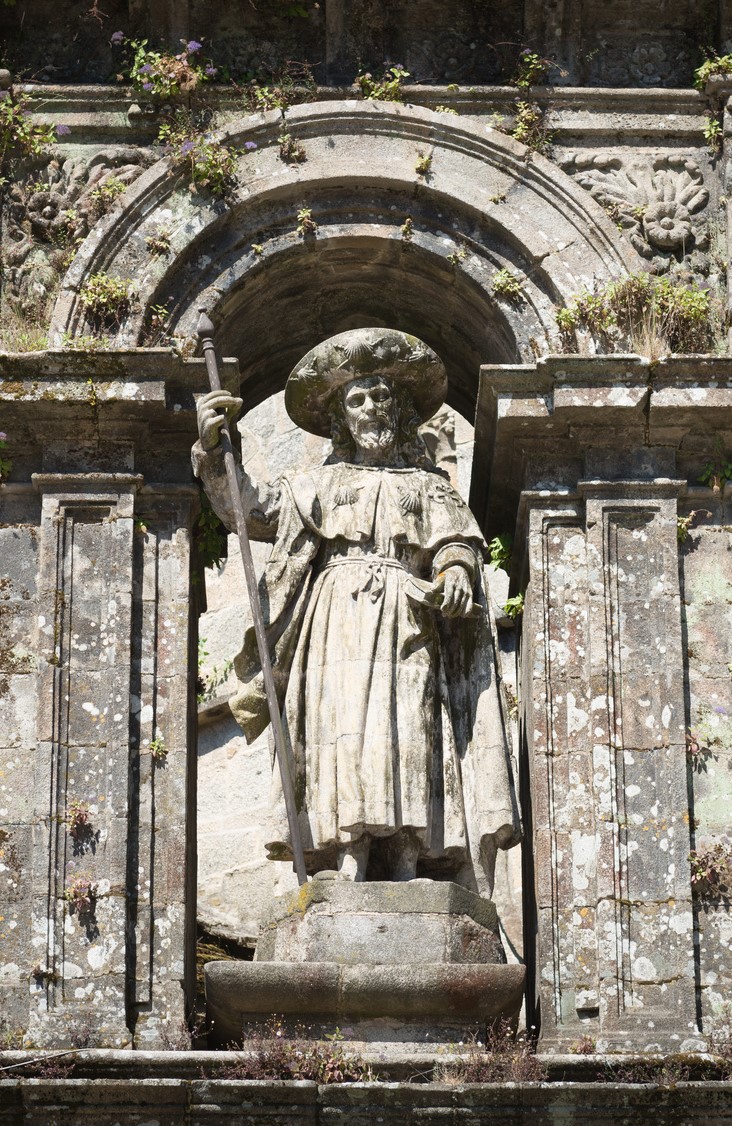
Today the Church celebrates the feast of the apostle James. But two of the apostles were named James. The apostle whose feast we celebrate today is usually called “James the Greater”. This James was the brother of St. John the Apostle.
Saint James the Greater was “greater” than the other James because he followed Jesus for a longer time. But even though this “Great James” followed Jesus for so long a time, he still didn’t exactly understand who Jesus was. We can tell that from today’s Gospel passage.
James and John, the apostle-brothers, have a mom who wants what’s best for them. She knows that Jesus is a great person, very important, and even believes that Jesus is some sort of king. That’s why she asks Jesus if her sons can sit right next to Jesus’ throne. She wants her sons to be important.
But Jesus says something that none of them expects. Jesus says that if you want to be with Him in Heaven, you have to drink from the chalice that Jesus was going to drink from during Holy Week. When Jesus says this, He’s not only talking about the chalice that He’s going to use at the Last Supper. Jesus is also talking about the cup of suffering: He’s talking about the Cross. Remember that after the Last Supper, Jesus went to the Garden of Gethsemane, and prayed to God the Father about the cup of suffering that He knew was coming very soon.
You will actually grow stronger in your life whenever you suffer for Jesus’ sake. Jesus taught us this in the Beatitudes: “Blessed are you when people revile you and persecute you and utter all kinds of evil against you falsely on my account” [Matthew 5:11]. Always remember that this is one of the ways that God will give you grace throughout your life: by sticking with Jesus, even when it’s very difficult.
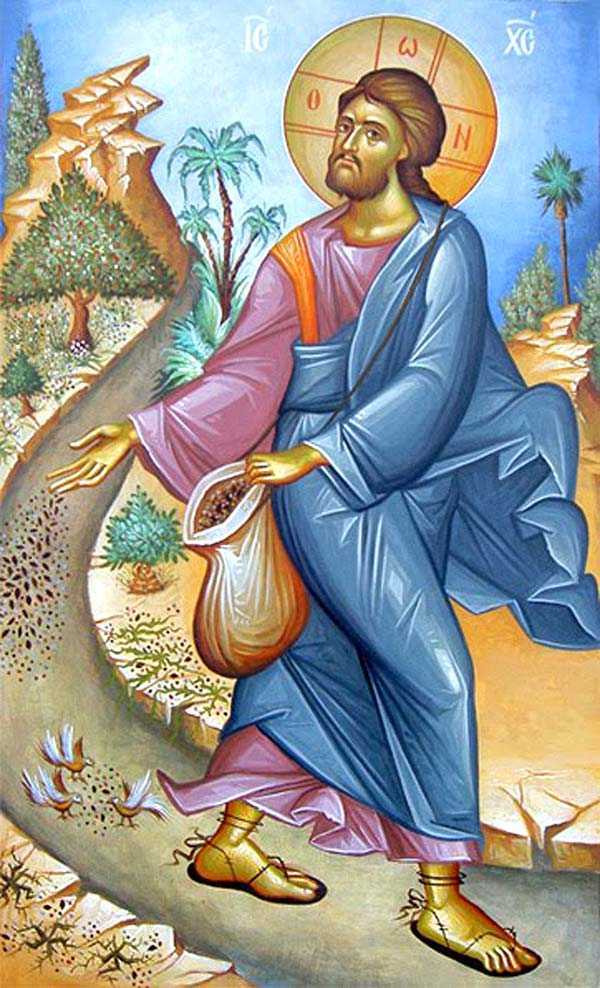
“But the seed sown on rich soil is the one who hears the word and understands it ….”
If you use a computer at all, you know how many different things you can accomplish with it. Computers can help us with our homework, with our finances, with preparing a talk, and with sending messages and pictures to our loved ones. The list seems endless.
The more we get used to working with computers, the more we get used to doing what the professionals call “multi-tasking”: that is, trying to do several things at once. With computers, this means printing one thing, sending an email, downloading a file, and so on and so forth, all at once. With computers, the more you can multi-task, the smarter you are. Or so the theory supposes.
Jesus is saying something very different in today’s Gospel passage. The parable that He tells us has a simple point: we need to focus on God in order to love Him. In a way, Jesus’ parable reminds us of what Jesus said to Martha when He visited the home of Martha and Mary. Martha and Mary were very different sisters. Mary sat at the feet of Jesus, listening to His words, while Martha was multi-tasking all over the house. Mary focused her attention on Jesus, while Martha did not.
Your soul is like a field. Jesus wants to sow good seed in your soul so that, at the end of your life in this world, He can find a rich field of grace to harvest. But the parable that Jesus tells us shows that even though Jesus takes good seed everywhere He goes, some fields—some souls—are better than others. The good soul, ready to accept the seed of God’s Word, is the soul that focuses on God. This is the person who prays daily to God, asks His help, and knows that God will forgive all sins. When we look at the crucifix, and pray to Jesus, focusing on His love for us, we see the One who will lead us to life forever with Him in Heaven.
CCC 407: cannot ignore wound of sin in discerning human situation CCC 1777-1785: moral decision making in rapport with God’s will CCC 1786-1789: seeking will of God in divine law in difficult circumstances CCC 1038-1041: separation of good and evil at Judgment CCC 1037: God predestines no one to hell
Ten centuries before Christ, the son of David became the King of Israel. Solomon was a young man. He recognized his lack of experience and lack of ability to govern Israel. Yet the Lord told Solomon that any gift he asked for would be given to him.
Solomon could have asked for absolute wealth, since with such wealth he could buy off any kingdom that got in his way. Or he could have asked for absolute power, since then he could destroy any opposing kingdom. He could have asked for any number of things. He decided to ask for wisdom.
Wisdom is insight into the ultimate meaning of things. This becomes clearer when we reflect upon the differences among wisdom, intelligence, and what we might call “smarts”. Even computers can be smart in terms of recalling facts and calculating equations. But intelligence transcends smartness, while a computer cannot transcend its programming. Intelligence goes beyond what is known by means of a desire to explore the unknown.
Wisdom, however, transcends intelligence because it ponders the ultimate meaning of things. Wisdom explores the origin, the nature, and the goal of everything that is, culminating in the contemplation of the Most Holy Trinity. Divine wisdom is a gift of God the Holy Spirit.
It is through the power of the Holy Spirit that St. Paul’s words in today’s Second Reading ring true: “all things work for good for those who love God, who are called according to His purpose.” We need to recognize this purpose as God the Father’s providential will. This divine, providential will converges in Christ. St. Paul explains this as he continues: “those He foreknew He also predestined to be conformed to the image of His Son, so that He might be the firstborn”.
However, before the advent of this firstborn, the Jewish Scriptures already held seven books called “Wisdom Literature”: the Books of Job, Psalms, Proverbs, Ecclesiastes, Wisdom, Song of Songs, and Sirach. The wisdom expressed in these books of the People of Israel was unlike the wisdom taught by many ancient cultures. It’s also unlike the conventional wisdom according to which Western culture operates today.
The wisdom that God revealed to Israel isn’t based upon self-interest or self-promotion. It is founded upon nothing and no one other than the Lord God Himself. If God is part of our lives, then even if our life seems a puzzle, we have reason to hope. It doesn’t matter if we don’t understand every piece of the puzzle. God teaches us, over time, to move one piece of the puzzle over here, and another piece there. Over time the picture God has had in His Mind all along emerges.
This might make divine wisdom sound rather lofty, other-worldly, and as a consequence, impractical: good for monks and nuns, but not so for the layperson on the street. But wisdom is not some “pie in the sky” virtue. It’s eminently practical, especially in our world today.
When individuals live for themselves, discord grows: first in families and then in communities and nations. This is why St. Thomas Aquinas in his Summary of Theology ascribes the seventh beatitude—“Blessedare the peacemakers, for they shall be called the children ofGod”—to the Holy Spirit’s gift of Wisdom [ST II-II 45,6]. In our world today the teaching of St. Thomas on this point is sorely needed.
He notes first that a peacemaker is one who makes peace either within himself or in others. In either case peace results from setting all matters in due order. The highest form of order can only be seen, however, and therefore set in place, in view of divine wisdom.
Second, the reward of peacemakers is that they become children of God. St. Thomas here quotes from this Sunday’s Second Reading. In making peace, one shares in the likeness of God’s only-begotten Son: or in the words of Saint Paul, one is “conformed to the image of his Son, so that he might be the firstborn among many brothers and sisters.” This divine Son is “Wisdom Begotten”, St. Thomas points out. On the Cross, Jesus makes peace between His Father and sinful man. Blessed are those who are called to the Supper of this “Wisdom Begotten”.
When the disciples in today’s Gospel passage ask Jesus why He speaks to “the crowd” in parables, He responds with what we might call a “theology of parables”. Jesus contrasts the disciples with the crowd. The disciples, He explains, have been granted “knowledge of the mysteries of the Kingdom of heaven”. But the crowd has not. Jesus also points out that the crowd “look but do not see” and “hear but do not listen or understand”. So given this two-fold deficit on the part of the crowd, why is it fitting for Jesus to speak to them in parables?
Since Jesus then reveals that Isaiah 6:9-10 has been fulfilled in the midst of the crowd, parables seem to be a sort of pabulum. By way of analogy, we might consider Saint Paul’s explanation of his own preaching to the Corinthians, who had been torn by jealousy and strife: “I, brethren, could not address you as spiritual men, but as men of the flesh, as infants in Christ. I fed you with milk, not solid food; for you were not ready for it; and even yet you are not ready” [1 Corinthians 3:1-2].
In other words, parables are for the weak of spirit, for those not yet ready for the full strength of the Gospel message, nor for living this message through their own lives. Aren’t we ourselves often among their number?
Early in the morning on the first day of the week… that is to say, in the beginning… we see Mary Magdalene huddled at the tomb weeping. We must give her credit for this, since the apostles themselves were not faithful to the Crucified Lord in this way. For ourselves, we pray for the grace to persevere in the midst of suffering, to allow our souls to thirst for Our Lord and God without despair in the midst of suffering. We pray for the ability to hope during those times when we cannot see the Lord present before us.
Only in the midst of such suffering, of such weeping, of such self-emptying, can the Lord be seen clearly, as He calls us by name. We recognize Christ, and we accept the commission He offers us. He has news for Mary Magdalene to report: namely, that He is ascending to His Father and our Father. Perhaps, though, this is even more difficult: to rejoice at someone’s return when he tells you he’s getting ready to leave you forever.
After all, on that Easter morning, who wants to hear about the Ascension? We want to glory in the Resurrection of Our Lord Jesus Christ from the dead! And yet that is not where Jesus points us. Throughout His life, and in His death, he always points away from Himself toward the Father, even on the very morning of His Resurrection.
For at least two reasons, today’s Gospel Reading may be used (erroneously) to criticize Catholic beliefs. The first is that Jesus seems to downplay the significance of His birth mother, Mary. The second is that Jesus refers to His “brothers”, which seems to contradict the Church’s teaching about Mary’s perpetual virginity. In replying to both concerns, we can not only help those with misunderstandings, but we can ourselves move closer to the heart of Jesus’ words.
First, is Jesus downplaying the significance of Mary in saying that “whoever does the will of my heavenly Father is my brother, and sister, and mother”? On the contrary, Mary is the perfect example of what Jesus is talking about here. It’s true that Jesus doesn’t go out of His way on this occasion (at least, as recorded by the St. Matthew the Evangelist) to point to Mary as the perfect embodiment of doing the will of God the Father. There are several possible reasons why Jesus did not think it prudent on this occasion to highlight Mary’s human perfection, but none of these suggest that Mary is not the perfect human creature that all the Church’s Marian dogmas describe her as being.
Second, the word in today’s Gospel passage that is translated into English as “brothers” is the Greek word “adelphoi”. Apologists have noted that other New Testament uses of this word show that the word can have meanings other than the strict sense of “siblings”. Others have noted the logical fact that Jesus having brothers doesn’t mean that Mary had other children besides Jesus, since Jesus’ “brothers” may have been step-brothers from an earlier marriage of Joseph, who may have been a widower. Ultimately, however, such arguments can turn Jesus’ very intention in this Gospel passage on its head: Jesus is trying to get us to move away from worrying about His blood relations, so that you and I might be His brethren through the Church.
If one were to choose a saying of Our Lord from elsewhere in the Gospel to summarize today’s Gospel passage, one might choose: “Every one to whom much is given, of him will much be required” [Luke 12:48]. A more mundane way to express Jesus’ disapproval of the request for a sign would be to say that the scribes and Pharisees don’t know what they’re asking for. It’s dangerous to ask for a sign, because with the sign comes the responsibility to follow that sign. Signs command us to stop, or yield, or put a limit on our speed.
At the end of today’s passage, Jesus contrasts the scribes and Pharisees with “the men of Nineveh” and “the queen of the south”. This isn’t meant to flatter the scribes and Pharisees. The men of Nineveh and the queen of the south were not upstanding characters. Nonetheless, the men of Nineveh were given the sign of “the preaching of Jonah”, and they responded to the sign of the prophet by repenting. The queen of the south was given the sign of the “wisdom of Solomon”, and she responded by coming from “the ends of the earth to hear” him.
Jesus’ bottom line puts the scribes and Pharisees in their place. As bad as the men of Nineveh and the queen of the south were, they repented when given signs by Jonah and Solomon. Since the scribes and Pharisees will be given a far greater sign, by one who is far greater than Jonah and Solomon (not only a prophet and king, but the divine priest as well), they will be judged by a far higher standard. Should they not repent (as up to this point in the Gospel account they had not), the conclusion is that their culpability would be far greater. All of this reminds each of us, a Christian who has Jesus as our Way, our Truth, and our Life, how much responsibility we bear to order our life with Christ at its center.
The latter half of today’s Gospel passage is a quotation from the Old Testament. St. Matthew the Evangelist cites Isaiah 42:1-4, a passage which echoes God the Father’s declaration at the Baptism of Jesus. One way to reflect on these words—“my beloved in whom I delight….”—is to imagine God the Father addressing them to you. Of course, that is only possible if your life is lived in Christ. Understanding why God the Father might say these words to you demands reflecting on why the Father naturally says them to God the Son.
This quotation highlights a contrast between the Pharisees’ harsh opposition to Jesus and the delight God the Father takes in His servant and Son. One of the causes of the Pharisees’ opposition is Jesus serving both the Gentiles and the Jews. The first sentence of the quoted passage has God the Father speaking of Jesus (as the quote is applied by the evangelist) as His chosen servant. However, the last sentence points to the relevance of Jesus’ service to the Gentiles. It is the Father’s will that Jesus serve the Gentiles.
Of course, Jesus came not primarily to cure the sick, but to destroy the power of sin and death. Part of the power of sin is the division between the Jews and Gentiles. It is the power of the Spirit whom the Father “places upon” Jesus that can reconcile the races and nations of the earth.