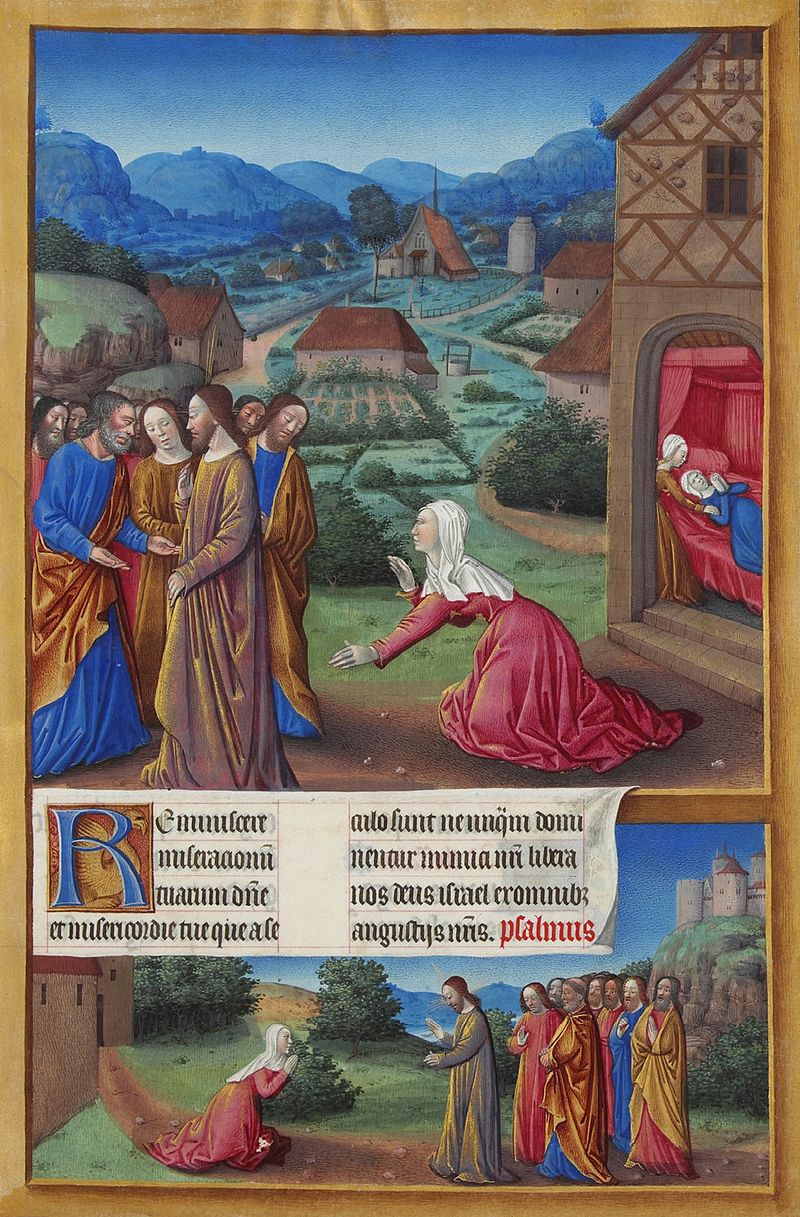

“Please, Lord, for even the dogs eat the scraps that fall from the table of their masters.”
We are not God’s children by right. There is an infinite distance, naturally speaking, between us and God, between Heaven and Earth. That is why the woman in the gospel represents each one of us: she is a Gentile. Up to Jesus’ day, God had promised salvation only to the Jews. Gentiles were by definition outsiders.
Everything in our lives is a gift. This is the opposite side of the coin: on the one hand, we know that we do not deserve what we have in life. So then, we are called to give thanks to God constantly, and all of our acts of thankfulness are rooted in faith.
Faith itself is the greatest gift we have in life. Without faith, these acts of thanksgiving—culminating in the Holy Eucharist—make no sense. The worst cynic or atheist would be justified in being rude and hard-edged about life, if God did not exist. But we have to recognize that faith is a gift, which some people do not have during their earthly lives.
The faith that God wants from us is not passive; it’s active. God does not want from us the sort of faith that just says, “God is going to take care of everything, so I can sit back and coast.” This is not our Catholic understanding of faith. Faith is something active on our part. It demands constant prayer. It demands the sort of dialogue, the sort of banter, that we hear between Jesus and the Gentile woman. We might even say, God wants us to challenge Him in our prayer. In this, we have no better example than Saint Teresa of Jesus.
“If a blind man leads a blind man, both will fall into a pit.”
There are two options for this weekday’s Gospel Reading. This reflection is based upon the latter option.
Jesus plainly criticizes the Pharisees in this Gospel Reading, calling a spade a spade. Yet His words go beyond the first-century setting in which He lived. His words offer us in the twenty-first century points for reflection regarding the need of fallen man for a Savior.
Throughout the history of the Church the Faith has been attacked in many different ways. But every attack upon the Faith is, directly or indirectly, an attack upon the person of Jesus Christ.
One manner of attack upon Christ is the diminishment of what He accomplished for fallen man, and at the same time, an attack upon the uniqueness of His role in salvation history. Fallen man cannot raise himself up by his own bootstraps, no matter how many good works he accomplishes and no matter how grand any of his accomplishments are.
Good works flow only through the power of God. Salvation is only possible through the Self-sacrifice of Jesus Christ on Calvary. Fallen man cannot save himself. Only Jesus Christ can. Our good works are the fruit of His Cross.
Being compassionate, Jesus was certainly concerned with the physical well-being of the people who had come to hear him preach. Just how deep Christ’s compassion was is made obvious when we consider again something the first verse of this passage tells us: Jesus is told about the hunger of the crowds right after he had heard of the death of John the Baptist, and had withdrawn by boat to a deserted place by himself. If we were to take time to imagine this, we could very clearly see just how human Christ was, responding in grief and perhaps anger at the death of his own cousin. He withdrew from others to be by himself. And yet, even at this point in his life, the needs of others pressed upon him. His response was that of God himself: he turned to help those in need.
Jesus was certainly concerned with the physical well-being of the people who had come to hear him preach. But he knew the people in the crowds better than they knew themselves. Christ had a much deeper concern for their spiritual well-being. He had reminded them that their ancestors, whom God had fed in the desert by sending bread in the form of manna, had died. His divine Father, Jesus told them, had sent him to be their spiritual bread which would allow them to live for ever. If they would eat this bread by accepting him and following his commandments they could enter into God’s eternal kingdom of love.
His head was brought in on a platter and given to the girl, who took it to her mother.
On August 29 the Church celebrates the Passion of St. John the Baptist, and on that memorial we hear the passion narrative according to Saint Mark. Today’s Gospel Reading offers us this narrative according to St. Matthew the Evangelist.
Jesus does not appear in today’s Gospel passage. His name is mentioned twice. Focus on the latter instance, where His name is in fact the last word of the passage. This is fitting. In terms of the life and Passion of St. John the Baptist, Jesus is the last word.
John is often considered the last of the Old Testament prophets. Like many prophets, he was killed because of his witness to God’s Word. The uniqueness of John’s life and martyrdom lay in how they intertwined with those of the Word made Flesh.
You and I, as Christian disciples, have been baptized into the role of prophet. It is part of our baptismal commitment to profess the truth of the Gospel no matter what the cost to us. At times we profess this Truth through our actions; at other times, through our words. How often do we count the cost first before deciding whether to profess the Truth? It’s certainly necessary to exercise the virtue of prudence is proclaiming the Truth. But we ought to ask St. John’s the Baptist’s intercession if we’re ever tempted by fear to refrain from professing the Truth.
“A prophet is not without honor except in his native place ….”
The last sentence of today’s Gospel passage presents something of a conundrum. No matter how we interpret the fact that Jesus “did not work many mighty deeds there because of their lack of faith”, we are challenged.
Some might interpret these words to mean that Jesus’ power to work miracles was constrained by the lack of faith of those in His hometown. More sensible, however, is to see Jesus’ lack of miracles as a prudent choice on His part. It doesn’t require faith on the part of people for God to work miracles. It requires faith on the part of people for God’s miracles to bring about their primary goal. God’s goal when He completely cures someone who had been diagnosed with terminal cancer is not to give that person immortal life on earth. His goal is to bring the one cured and those around him to a greater practice of love for God and neighbor, so as to give them immortal life in Heaven.
We are challenged, then, to admit where we lack faith in our own lives. We are challenged to allow the miracles that God works to bear fruit in our lives. We are challenged not to live for ourselves, but for others, beginning with the Other who calls us to share in His life of love.
CCC 2828-2837: give us this day our daily bread CCC 1335: miracle of loaves prefigures the Eucharist CCC 1391-1401: the fruits of Holy Communion
What do you think is the meaning of Jesus feeding a crowd of more than five thousand people with only a few loaves of bread and a couple of fish? Was Jesus simply showing his power to work a miracle: demonstrating his power over material things? Of course, that was part of it. But this miracle of feeding the five thousand has far more to tell us about Christ than just this.
Being compassionate, Jesus was certainly concerned with the physical well-being of the people who had come to hear Him preach. Just how deep Christ’s compassion was is made obvious when we consider again something the first verse of this passage tells us. Jesus is told about the hunger of the crowds right after hearing of John the Baptist’s death, and withdrawing by boat to a deserted place by Himself. If we were to imagine this, we would see just how human Christ was, responding in grief and perhaps anger at the murder of His cousin. He withdrew from others to be by Himself. Yet even at this point in His life, the needs of others pressed upon Him. His response was that of God Himself: He turned to help those in need.
We could look at this compassion of Jesus and see in it an example for ourselves. As Christians, we are called to walk in the footsteps of Christ and imitate Him. We are especially to imitate the sort of self-sacrifice that He shows in this passage, the sort of self-sacrifice that came to full expression in His death on the Cross.
But this passage is not chiefly about our need to imitate Christ. We all have our limits. Very likely, if we learned of the murder of a close relative, we’d be of little help to others. None of us can expect to match the depth of Christ’s self-sacrifice.
But again, that’s not the chief point of this passage. Within this event, the example that ought to be our chief focus is not the response of Jesus, but the request of the crowds. The crowds seek out Jesus because they know that they are in need. But exactly what kind of need do they have?
Being compassionate, Jesus was certainly concerned with the physical well-being of the people who had come to hear Him preach. But He knew the people in the crowds better than they knew themselves. Christ had a much deeper concern for their spiritual well-being. He had reminded them that their ancestors, whom God had fed in the desert by sending bread in the form of manna, had died. His divine Father, Jesus told them, had sent Him to be their spiritual bread which would allow them to live forever. If they would eat this bread by accepting Him and following His commandments, they could enter into God’s eternal kingdom of love.
In today’s First Reading, Isaiah says in the name of the Lord, “Come to me heedfully, listen, that you may have life.” This is the same message which Jesus conveyed to those people gathered near the Sea of Galilee. He brought His meaning home to them in a concrete way by giving them physical bread to satisfy their bodily hunger. But at the same time, He revealed that He was the spiritual bread which God had sent to bring them eternal life. His miracle used what was physical in order to point towards what is spiritual.
The crowds naturally had a spiritual hunger. Perhaps some of them were not even aware of this hunger inside their souls. Unfortunately, many of us today also are not aware of the hunger in our souls. Instead, we are distracted by many things such as our work, our leisure, and our possessions. We are worried about many things without giving heed to the one needful thing. Jesus, then, calls us first to recognize the greatest hunger in our lives, and then to seek the One who alone can fill it.
Multiplication of the Loaves and Fish by Ambrosius Francken I (1544–1618)
Can I not do to you, house of Israel, as this potter has done?
In the Catholic press, much has been said recently about an idea called the “Benedict Option”. The idea is that Christians would opt to imitate the example of Saint Benedict of Norcia in the face of the disorder within civil society. Is the example of St. Benedict apropos to our day? To what extent is Western culture vulnerable to collapse?
Regardless, only an ostrich would be unable to notice the red flags that the high priests of secular culture wave in the faces of everyone. So ought Christians flee as much as possible from civil society, and form small communities of dedicated Christians? Or ought Christians engage the secular culture as much as possible in the public square, even until the dying day of that culture?
Regardless of whether Christians choose the “Benedict Option”, or the “Dominican Option”, or the “Gregorian Option”, or any other option, today’s First Reading places before us a salient reminder. If secular culture is subject to decay and collapse, so also is the spiritual life of a child of God, and of His entire People. The image of the potter, and the Lord’s message regarding the potter’s work, is an Old Testament complement to Jesus’ exhortation to remove the plank from one’s own eye before attempting to remove the speck from another’s. “Indeed, like clay in the hand of the potter, so are you in my hand”.
“Martha, Martha, you are anxious and worried about many things.”
On this feast of Saint Martha, the Gospel Reading must come from the feast day. The other readings may come from the day in Ordinary Time, which the feast supersedes. However, there are two options for the Gospel Reading on this feast. Both, of course, feature Martha.
The first option offers a bit more flattering portrait of Martha. The occasion is the death of Lazarus, the brother of Martha and Mary. Martha goes out to meet Jesus, while Mary sits at home, which is an interesting contrast to the sisters’ respective roles in the other Gospel Reading for the feast. Martha’s words to Jesus express not only her love for her deceased brother, but also for Jesus, as well as faith in Jesus. Yet Martha is missing something. When Jesus declares to Martha, “Your brother will rise”, she does not understand fully what Jesus means. Jesus is promising that her brother will return to her, not on “the last day”, but on that very day when Jesus and Martha are speaking. It’s to Martha’s credit that when Jesus makes more clear His intention, Martha makes clear her faith in Jesus. This faith in Jesus, who is “the resurrection and the life”, is a model for our own faith.
The second option for the feast’s Gospel Reading is perhaps the better-known Gospel story about Martha. Martha is overshadowed by her sister Mary, the latter being an example of putting “first things first”. Nonetheless, perhaps the example of Martha in this passage is more like most of us Christians. To identify with Martha in this passage is to humble ourselves and to recall that our good works are empty if they don’t proceed from a faith that’s nourished by the Word of God.
In today’s Gospel passage Jesus offers a point-by-point explanation of the parable that He had preached about the weeds in the field, proclaimed at Holy Mass on Saturday of this past week. The evangelists rarely offer us examples of Jesus explaining one of His parables. So today’s passage is insightful both in terms of the parable’s content, and also in terms of understanding how Jesus uses parables.
We might wonder, to start with, what the significance is of the evangelist telling us that it’s after “Jesus dismissed the crowds” that “His disciples approached Him” to ask for an explanation of the parable. This is an important distinction that the evangelist didn’t have to note for Jesus’ explanation of the parable to make sense. Perhaps the evangelist is highlighting the importance of petitioning God for deeper insight into His revealed Word.
Jesus then explains the meanings of seven persons or things within the parable. This allegorical explanation of the parable is important because it’s in accord with the method of interpreting Jesus’ parables commonly found in the writings of patristic and medieval saints. The allegorical method of understanding Sacred Scripture is often rejected today by scholars who prefer to use only rationalistic forms of the historical-critical method. Nonetheless, central to all the elements of Jesus’ allegorical interpretation is His call for each of us to be among the “good seed”, sown by the Son of Man in His preaching, Passion, Death and Resurrection.