The Temple was the holiest place in the entire world for Jews of Jesus’ day. Catholics have a very different sense of God’s Presence in the world because of the abundance of God’s graciousness in the New Covenant. But use your imagination to picture a world where every Catholic church in the world has been destroyed except one. Every priest in the world except one has died. There is only one tabernacle in the entire world, and only in that one place does Jesus dwell in the Most Blessed Sacrament. In that world, how would Catholics approach that single tabernacle of the Most High? That thought experiment helps us grasp somewhat the sacredness of the Temple for Jews of Jesus’ day.
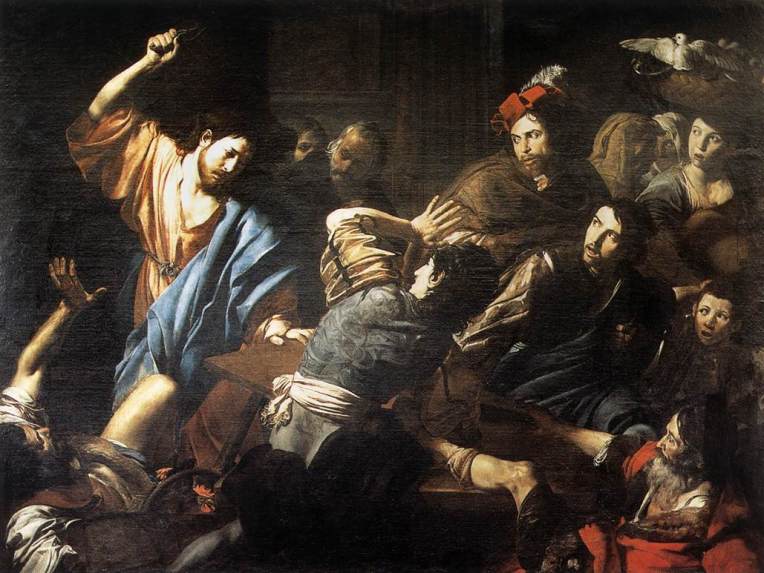
In Jesus’ day, one of the obligations of a good Jew was to go to Jerusalem at the time of Passover, and to offer a sacrifice in the Temple. Those who were wealthy offered an entire ox or sheep, while those with less means offered turtledoves. So there grew up a very large market during the time around Passover, a system within which many abuses developed.
Jesus undoubtedly had people cheering for Him as He chastised the Jewish officials and money-makers. But how many cheered for Him when the Jews asked for a sign from Jesus, and He replied, “Destroy this temple, and in three days I will raise it up”? Probably some were baffled: here He had purified the Temple, and now He wanted to destroy it?
For ourselves, Christ is the Temple, of which we are part through the Church. We need to purify ourselves—in thought, word and deed; mind, spirit, and body—just as Jesus cleansed the Temple, so that right sacrifice might be offered there.
If a poll were taken this month asking, “Do you like the fact that it’s now getting dark in the late afternoon?”, most of us would quickly respond, “No!” Yet we know that the descent of darkness and diminishing days are a natural part of the year’s cycle. With Winter’s approach, the leaves on our trees are dying, animals need shelter, and the influence of the sun weakens.
As the end of the year closes in upon us, part of us rebels. We don’t like the darkness, cold, and death that we experience. Yet we know that death is natural. Death is part of life.
Death and life go hand-in-hand. That truth is part of what the Church proclaims on the Solemnity of Christ the King. The feast of Christ the King is the last Sunday of the Church year. The Church year itself dies this week, so to speak. Next Sunday a new year begins in order to help us celebrate the birth of God made man.
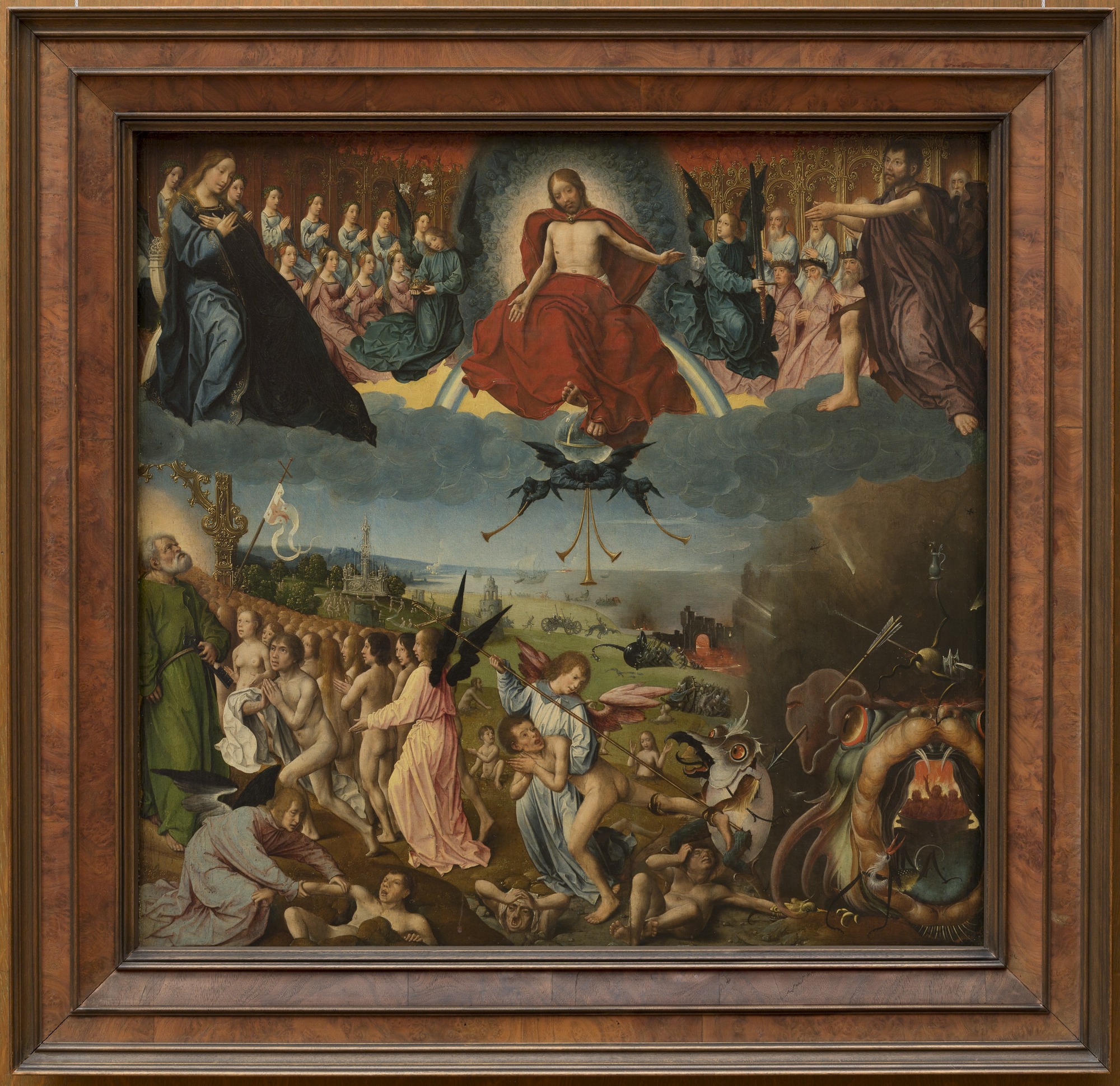
Yet while Advent—the first season of the Church year—focuses upon the birth of God as man in this world, the last Sunday of the year—today’s Solemnity of Christ the King—focuses upon the Last Judgment, the means by which fallen and redeemed man can be borne body and soul into eternal life. At the Last Judgment Jesus will hold up our lives to His.
At the Last Judgment, Christ the King will call all the peoples of all the nations throughout the course of history to Himself, and judge each person one-by-one. If you ever thought the line for confessions during Holy Week was long, just imagine what this line is going to look like!
Of course, time in the afterlife is not quite like time experienced on earth. Nonetheless, as we wait in that line, we might think that we’ll never reach the front. We might think that our time will never come. This is similar to how many of us lead our lives on earth: as if we will never die and never be judged.
In the midst of this wait, we are blessed in that we have the words of Christ to give us some idea about what this judgment will be like. Did you ever have a teacher who gave you quizzes (or even worse, tests) without giving you any idea what you were going to be examined on? Have you ever had to come up for an evaluation at work without any idea about what part of your performance would be scrutinized? Not knowing makes the experience all the more difficult.
While we’re blessed to know what our final judgment will look like, this blessing is a two-edged sword. Because we have heard the Gospel proclaimed, we’ll never be able to say that we didn’t know what God asked from us, and how our faith was meant to shape our earthly days. Jesus makes it very clear that whether we will be admitted into the Kingdom of God depends in large measure upon whether or not the Corporal and Spiritual Works of Mercy were the measure by which we sought to love Christ the King in our needing neighbor.
“Worthy are you to receive the scroll / and break open its seals ….”
Today’s passage from Revelation focuses on Jesus Christ. Yet it also teaches us something important about His Bride, the Church. The entire Book of Revelation is not only profoundly Christo-centric, but also centered on the Church, because the whole book has a spousal message.
In today’s passage we hear of “a scroll in the right hand of the one who sat on the throne”. It’s fair to say that the one on the throne is God the Father, seated in His majesty. The scroll is the Good News of His Son. We might even say that this scroll is the Gospel.
But this scroll is sealed seven times over. A mighty angel rhetorically asks, “Who is worthy to open the scroll and break its seals?” The answer is the “lion of the tribe of Judah, the root of David”. These two metaphors represent Jesus Christ in regard to His earthly authority, suggesting that only Jesus Himself can authoritatively reveal Himself to others.
Then the Lamb who is slain is seen. This image of Christ crucified shows us that it’s through the Cross that Jesus reveals who He is to others. The Crucifixion of the Word made Flesh is the “glory” which St. John’s account of the Gospel builds up to.
The end of today’s passage speaks of those for whom the Lamb was slain. We hear the Church’s leaders singing “a new hymn”, during which they cry out to the Lamb: “with your Blood you purchased for God those from every tribe and tongue, people and nation.” This is the universal Church who is the spouse of the Bridegroom who gave His life on Calvary.
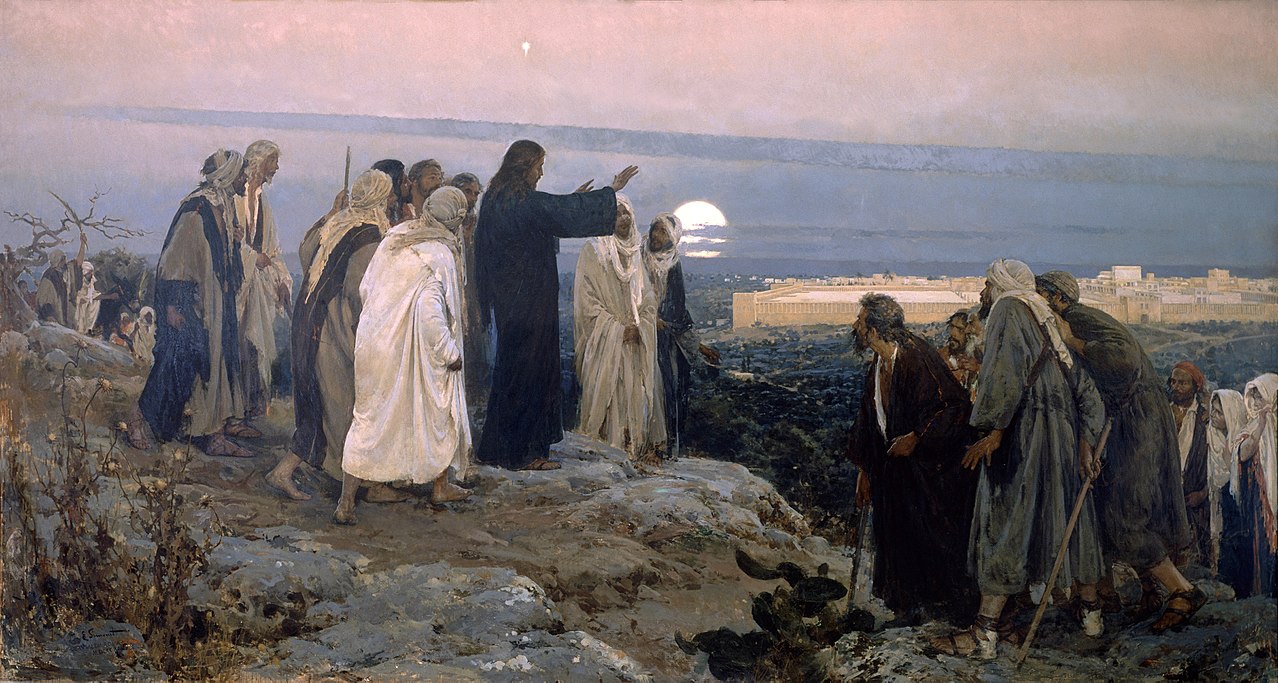
After He had said this, He proceeded on His journey up to Jerusalem.
Those who think of Jesus as a “teddy bear” are challenged by the last words of Jesus in today’s Gospel Passage. These concluding words—“…as for those enemies of mine… bring them here and slay them before me”—conclude the parable which the evangelist prefaces by explaining Jesus’ motive: He “proceeded to tell a parable because He was near Jerusalem and they thought that the Kingdom of God would appear there immediately.”
The “king” speaks and acts harshly. He refers to himself as “a demanding man”, but his greatest demand comes at the end of the parable. Of his enemies he declares, “bring them here and slay them before me.” The question we have to grapple with is this: to whom does this character in the parable refer in real life? Can he possibly symbolize Jesus or God the Father? The king’s demand is reminiscent of practices found in the Old Testament. God Himself seems there to demand the murder of innocents. Surely such ideas have no place in the teaching of Jesus?
However, the parable’s own inner logic suggests that the servants did have a choice. This points to the choice that each servant of God has to follow Him or not. At the end of each person’s life is a fork. One branch leads to eternal life and the other to eternal death. This is where the Kingdom of God comes to its fulfillment.
“For the Son of Man has come to seek and to save what was lost.”
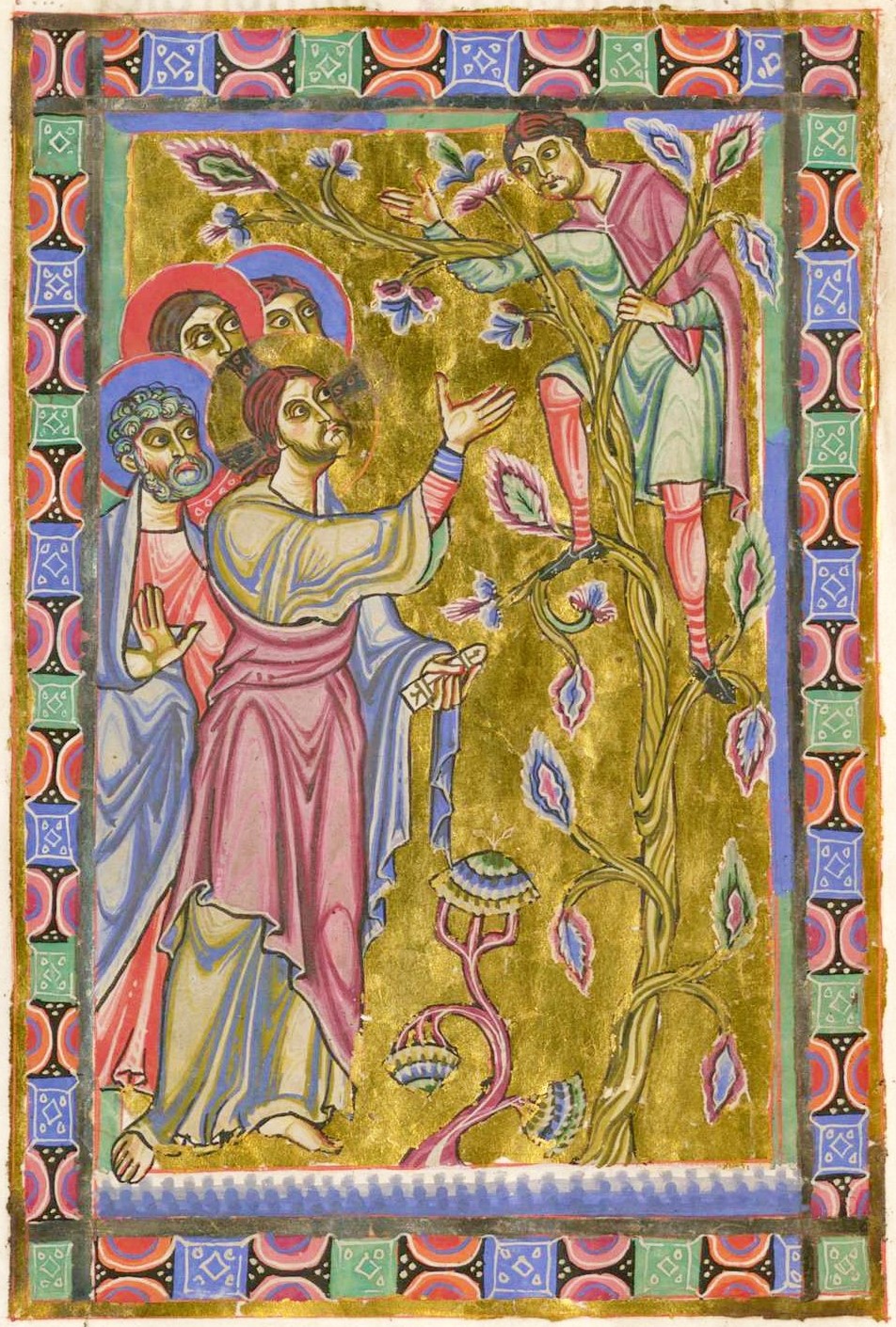
Zacchaeus is a rich collector of taxes. Each of us, like him, is attached to worldly things. Zacchaeus, like you, wants to see who Jesus is. But Zacchaeus has two strikes against him.
The first strike against Zacchaeus is the crowd, because everyone wants to see Jesus. It’s easy to get lost and not to be loved in the crowd. One might ask himself, “How can Jesus love everyone?”
The second strike against Zacchaeus is his small size, which may represent the size of our souls. One might feel unworthy of God’s love, and ask himself, “How could Jesus love little old me?”
So Zacchaeus climbs up into a sycamore tree to see Jesus. This is all Zacchaeus wants: to see Jesus. But that’s not enough for Jesus.
Here’s the turning point in this Gospel passage. When Jesus reached the place where Zacchaeus had climbed the tree, Jesus looked up and said to him, “Zacchaeus, come down quickly; for today I must stay at your house.” Jesus takes the initiative to reach out to this individual. Likewise, just as He reached out to this little sinner, He is trying to reach into your life.
When they saw this, all the people gave praise to God.
Today we begin hearing at weekday Mass from the Book of Revelation. We will continue to hear from this book through the last day of the Church year. This is fitting since Revelation is the last book of the Bible, and treats of the “Last Things”, although in a highly mysterious manner.
The Book of Revelation is literally the book of the “revelation of Jesus Christ” to the Beloved Disciple. In turn, this same Saint John “gives witness to the word of God”, the same Word of God of whom John wrote in the prologue of his Gospel account. Given the mysterious manner in which the Book of Revelation is recorded, the link between these two books of the New Testament is important to keep in mind as one reflects on John’s “witness to the word of God”.
Also, the evangelist calls this witness a “prophetic message”. As such, we note a correspondence between the structure of the Old and New Testaments. In each Testament, there are four types of books. In both testaments, the fourth type of book is prophetic. The Old Testament contains eighteen books of prophecy, but the New Testament contains only the Book of Revelation. All books of prophecy look to the future: those in the Old Testament to the first coming of God’s Word made Flesh, but the Book of Revelation to His Second Coming, as well as to His becoming Flesh and dwelling among us in the Holy Eucharist.
Saturday of the Thirty-second Week in Ordinary Time [II] 3 John 5-8 + Luke 18:1-8 November 14, 2020
“But when the Son of Man comes, will He find faith on earth?”
In the first verse of today’s Gospel passage, St. Luke the Evangelist is unusually direct in explaining the exact meaning of Jesus’ parable. “Jesus told His disciples a parable about the necessity for them to pray always without becoming weary.” It is important to note that this parable is about one specific type of prayer to God: prayer of petition.
Sometimes prayer is defined as “a conversation with God”. That’s unfair to God for two reasons. First, conversations normally take place between two persons of more or less equal standing. While it’s true that prayer involves a dialogue with God, we have to keep in mind that what He has to say to each of us is far more important than what any of us might wish to say to Him. In prayer, it’s far more important to listen to God than to speak to Him.
Second, prayer at its summit transcends what could be termed a conversation. The form of prayer in which the believer and God dialogue is meant to be surpassed. Dialogue is meant to lead to a loving silence, a form of prayer in which God and the believer rest in the goodness of His presence. Dialogue or conversation gets us there, where God gives us the gift of contemplation.
Nonetheless, in today’s Gospel passage Jesus teaches us about prayers of petition. Petition is one specific form that prayer takes during the “conversational” stages of prayer. In this stage, however, we pray not only with God’s almighty Power in mind (because He can get us what we want), but also with His providential Love in mind. That is to say, God answers our prayers of petition not only for our own good, but for His goodness as well, so as to lead us into that goodness.
“Where the body is, there also the vultures will gather.”
To His disciples, Jesus speaks of “the Son of Man”. Regarding the Son of Man, Jesus explains that His presence is elusive, like lightning that “flashes and lights up the sky from one side to the other”. Jesus downplays the desire somehow to “pin down” the Son of Man.
At the end of yesterday’s Gospel passage, Jesus spoke about this Son of Man suffering greatly and being rejected by this generation. Here Jesus is making clear how much His hearers’ expectations will be shattered. What we hope for is often not what God has in store for us. In today’s Gospel passage, we hear some of the context of “the days of the Son of Man”. The context is dire, which shouldn’t surprise us given what the Son of Man Himself suffers.
Jesus’ final words today do not seem hopeful: “Where the body is, there also the vultures will gather.” Yet Jesus is hopeful, of course. He is simply not hopeful for the fate of this world. Everything in this world must finally decay, so we must not be attached to such things. Our hope must be for God alone, who draws us through this world, not to it.
CCC 2006-2011: our merits for good works come from God’s goodness CCC 1038-1041: our works manifested at the Last Judgment CCC 1048-1050: keeping busy as we await the Lord’s return CCC 1936-1937: diversity of talents CCC 2331, 2334: dignity of woman CCC 1603-1605: marriage in the order of creation
+ + +
Being present at Holy Mass is like being present along the Way of the Cross. As the Mass proceeds, we are ascending to its summit, just as on Good Friday the crowds ascended Mount Calvary. Further, just as there are stations—stopping points—during the Way of the Cross, we also see stations during Holy Mass. These three stations reflect the priest carrying out the roles of priest, prophet, and shepherd.
The first station is the priest’s chair. After the entrance antiphon and its procession, the priest speaks to God’s flock as a shepherd. He first gathers God’s flock together through a ritual of penance. He calls God’s lost sheep, including himself, away from their sins and into God’s Presence.
Another example of the priest shepherding from his chair is heard when the priest gathers God’s flock to pray together. The priest says simply, “Let us pray.” The shepherd then pauses, not for the server to bring the Missal, but to afford the flock time to call their own prayers to mind.
In the new translation of the Roman Missal, the prayer that the priest then prays is called by its traditional name: the “Collect”. This prayer “collects” or folds all our individual prayers into the prayer that the priest offers to God on behalf of all present.
The second station of Holy Mass is the pulpit. There the second baptismal role is carried out: the role of prophet. This role is exercised at the beginning of the Liturgy of the Word by laypersons who act as lectors.
Throughout the course of the Liturgy of the Word—the first main part of the Mass—there is an ascent. We start in the Old Testament (except during Eastertide). The next Scripture passage that’s proclaimed is typically one of the Psalms. Then the Church moves to the New Testament, as the Second Reading always comes from one of the writings of the Apostles.
But then the summit of the Liturgy of the Word is reached. The final Scripture passage that’s proclaimed is from the most important part of the Bible: the gospel accounts, where Jesus Himself acts and speaks. In the Old Testament, Jesus is foreshadowed. In the writings of the Apostles, Jesus’s words and works are unpacked. But in the Gospel accounts, Jesus Himself directly acts for us and speaks to us.
Because Jesus’ presence in this part of the Bible is unique, the proclamation of this Scripture passage is also unique. For example, we stand to honor Jesus. The proclamation of the Gospel is prefaced by a dialogue between the priest and laypeople, and everyone blesses himself over his mind, lips, and heart. On particularly solemn Sundays and Holy Days, the Gospel may be incensed, servers may bear candles, and the Gospel may be chanted.
Nonetheless, although the proclamation of the Gospel is the Liturgy of the Word’s summit, it’s not its conclusion. The homily, Profession of Faith, and intercessions conclude the Liturgy of the Word.
Of these three, the homily is where the priest exercises his baptismal role of prophet most specifically. The homily shows where the Gospel bears directly on the lives of those listening. The homily illustrates the demands that the Gospel makes upon Christians, thereby revealing their need for the strength of the Holy Eucharist.
The third station of Holy Mass, then, is the altar of priestly sacrifice. The altar is the final station as the top of Calvary is the goal of the Way of the Cross. If the first main part of Mass is the Liturgy of the Word, the second is the Liturgy of the Word made Flesh. The Word becomes flesh and dwells among us so that He might abide in us, and that we might through Him bear abundant fruit in the world.
Jesus, in every one of His acts of shepherding, is leading you to the top of Mount Calvary. Jesus, in every one of His prophetic words, is telling you to accept Calvary as your destiny, to take up your own cross and follow Him there. Because the Word of God, as powerful as it is, is not the final goal of Catholic worship. There’s only one thing in this world more powerful than the proclamation of the Word of God: the priestly Self-Sacrifice of the Word made Flesh.
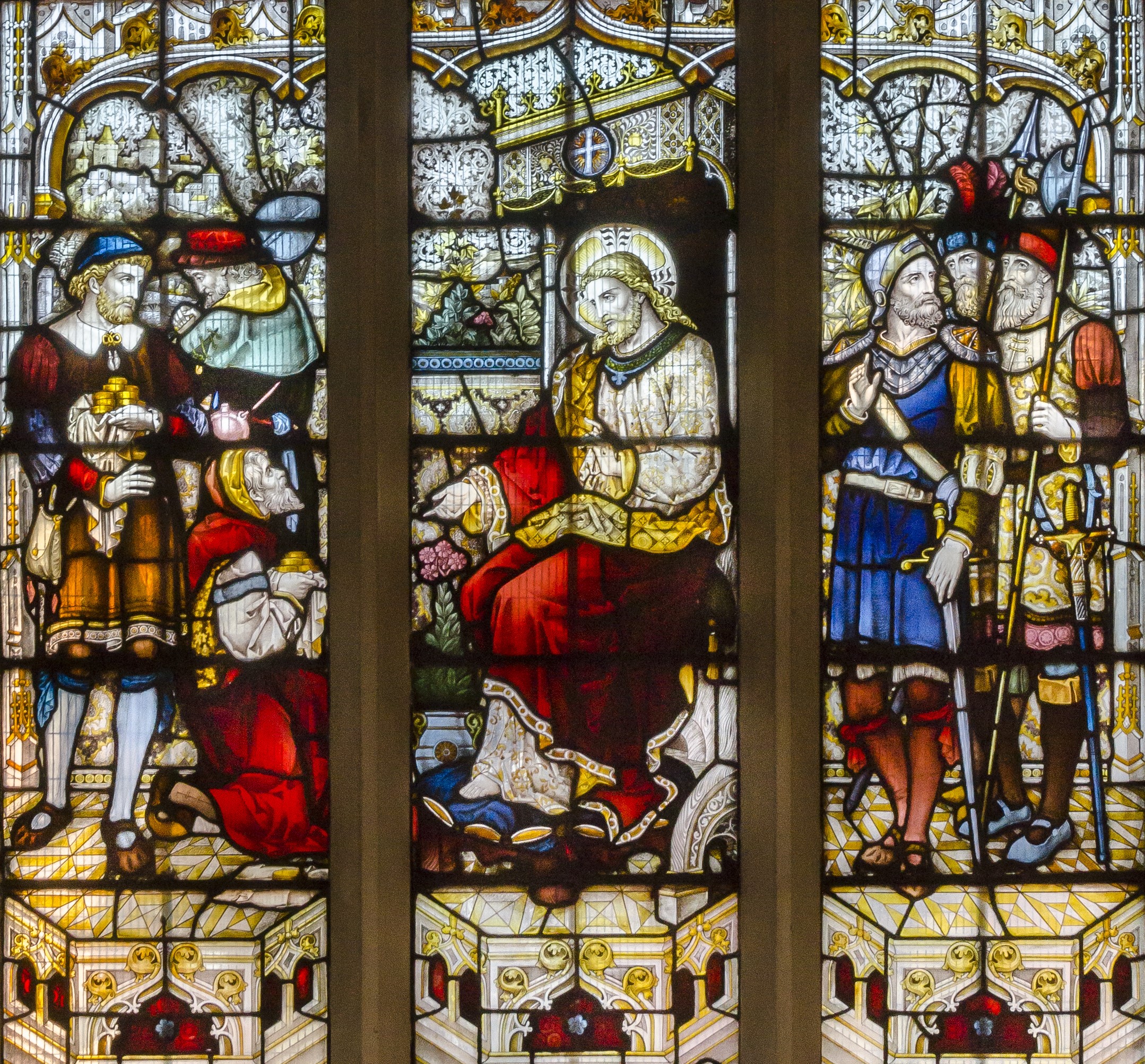
Parable of The Talents stained glass window [detail], Cathedral Church of Saint Martin, Leicester, England