“This is my commandment: love one another as I love you.”
Today’s Gospel passage is often proclaimed at Nuptial Masses. It speaks to the reality of love. It gives some concrete form to love. This concreteness is necessary when one lives—as you and I do—in a culture which equates love with warm, fuzzy feelings.
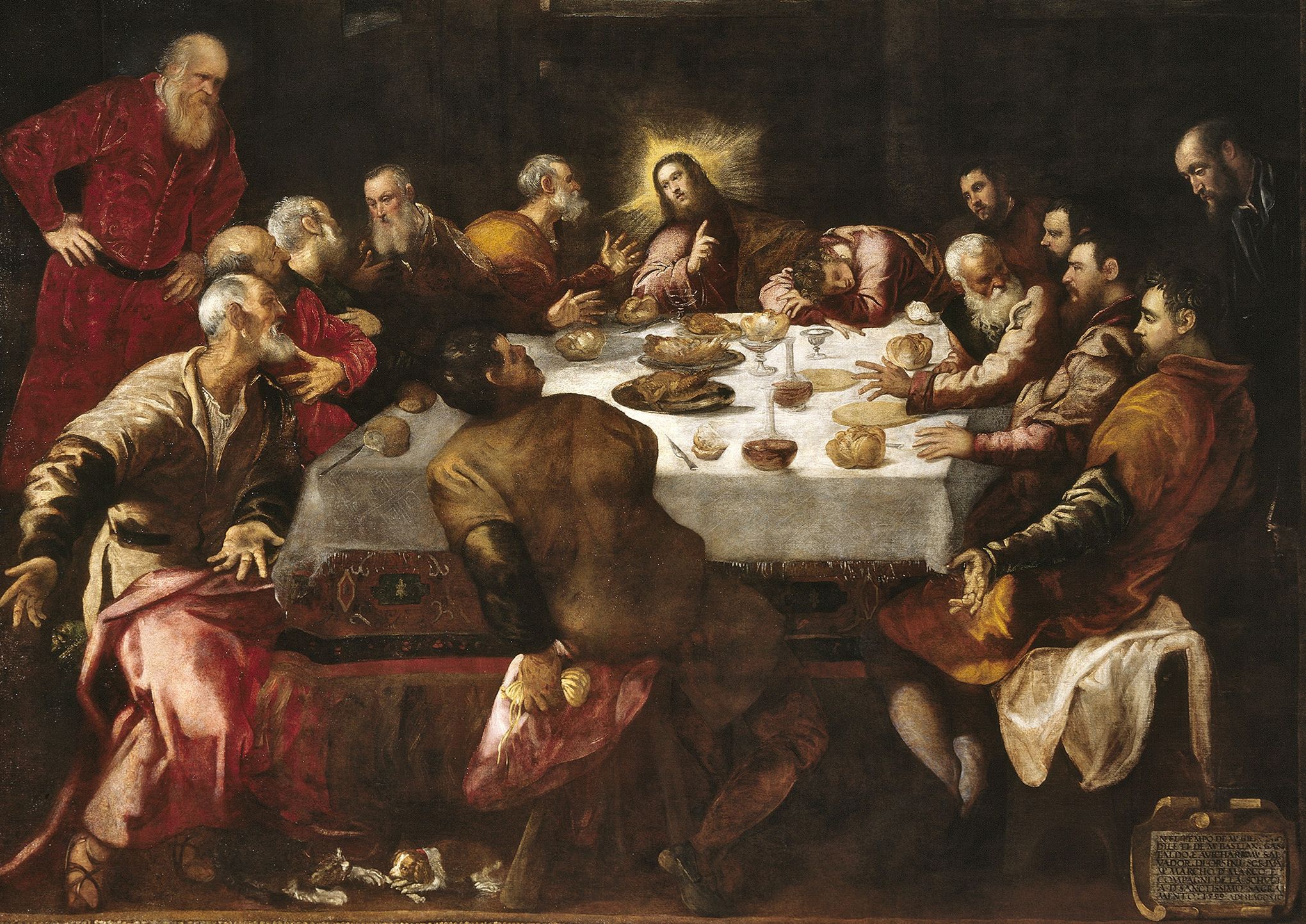
Today’s Gospel passage was written by St. John the Evangelist, who in one of his epistles tells us that “God is love” [1 John 4:8]. Today John quotes Jesus so as to give shape to the definition of God as love. In terms of the divine Person of Jesus, John quotes Christ Himself. The evangelist explains that “no one has greater love than… to lay down one’s life for one’s friends.” The setting of today’s Gospel passage is the Last Supper. As He spoke these words, Jesus knew that He would give the ultimate example of such love the next day.
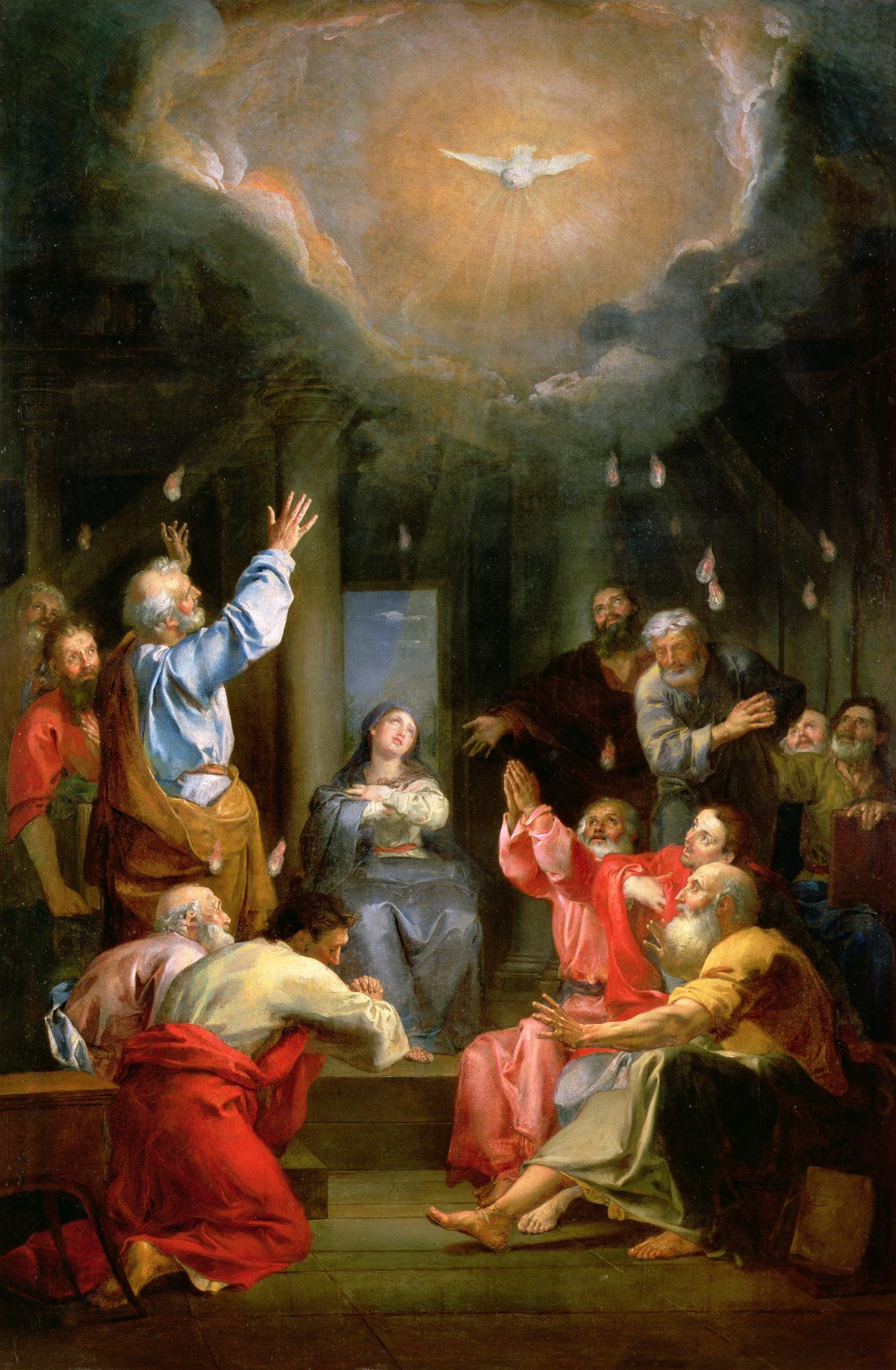
But the Church proclaims today’s Gospel passage during the midst of Easter. The reason for this is that Christ doesn’t want His disciples simply to admire His sacrifice, but to enter into it. To do what our Savior commands, we need the power of the Holy Spirit, whom the Father and Son will send at Pentecost. In the Spirit of the Father and the Son, you can find the strength to love your neighbor as Jesus has loved you.
The Sixth Sunday of Easter [B] Acts 10:25-26,34-35,44-48 + 1 John 4:7-10 + John 15:9-17
In this is love: not that we have loved God, but that He loved us, and sent His Son as expiation for our sins.
Saint John, the Beloved Disciple, in his letters and Gospel account, fleshes out his description of God as “love”. In the last sentence of today’s Second Reading, St. John does this very poignantly, telling us that “In this is love: not that we have loved God, but that He loved us, and sent His Son as expiation for our sins.”
The first part of St. John’s description here insists on the primacy of God’s love.
When St. John says that love consists in the truth that God loved us, and not that we first loved God, he’s pointing out that God doesn’t wait to love you until He determines whether you will love Him back. God doesn’t stop loving you if you stop loving Him. In every sense of the word, God’s Love is primary. Our love for Him can only be a response, and cannot diminish His love for us if our love is in some way lacking.
But we all know from experience that confusion arises here. Human beings feel at times that God does not love them. One reason for this is that love—at least, divine love—is itself not a feeling. When people expect God to make them feel good, they can easily become confused about the real meaning of God’s love. This doesn’t mean that our feelings are illusory, or that God cannot manifest Himself through emotions. It’s to say, rather, that divine Love is not identical with positive emotions. God’s love transcends feelings, and can be present amidst the worst of feelings.
The second reason that someone might believe that God no longer loves him is the fact that it’s not unusual for God to be absent from the human soul. Yet God being absent from someone’s soul does not mean that God does not love that person. In fact, there can be very different reasons for this absence, one negative and one positive.
On the one hand, the absence of God from a human soul can be the result of mortal sin. A mortal sin that’s freely and knowingly chosen destroys all the grace dwelling in that soul. What’s more, the presence of a mortal sin prevents the reception of further graces. Ironic though it may seem, it’s a sign of God’s love that He endows the human person with a free will strong enough to keep His love at bay.
On the other hand, the absence of God from someone’s soul can be a sign of growth. This might seem counter-intuitive. Many saints, in writing about the three basic stages of the spiritual life, note that God often spurs the human person towards growth by temporarily removing Himself from the person’s soul.
It’s not that this person is no longer in a state of grace, but rather that the Christian has no sense or perception of God in her soul. Only darkness appears. But God wants His disciples to transcend appearances. He does this in order to increase the human person’s longing for Him: that is, in order to teach the human person to live for God alone.
One of the saints who wrote profoundly about the spiritual life was Saint Bernard of Clairvaux. In addition to serving as one of the first abbots of the Cistercian religious order, he also wrote many commentaries on Scripture. He often wrote about divine love, and also often wrote about the connection between knowledge and divine love. In one place St. Bernard writes:
“… there are some who want knowledge for the sole purpose of knowing, and this is … curiosity. And there are some who seek knowledge in order to be known themselves; and this is … vanity … and there are … those who seek knowledge in order to sell their knowledge … for money or for honors; and this is [greed]. But there are also those who seek knowledge in order to edify [others], and this is charity.”
Charity—the love of Christ—urges us forward throughout the course of earthly life, and even to death and Heaven’s gates. It’s to convince us of this simple truth that we hear Jesus today: “I command you: love one another.” He commands us to love not as we wish to love, but as He loves: sacrificially.
“If you keep my commandments, you will remain in my love ….”
The long discourse of Jesus at the Last Supper, recorded in chapters 13-17 of John, has several themes which Jesus touches upon over and over again. Jesus weaves these themes together, as if his words on this solemn night formed a tapestry of the Good News.
Jesus’ words—“If you keep my commandments, you will remain in my love”—focus our attention on two of these themes: “my commandments” and “my love”. Sometimes in a culture that encourages us to base our actions on our feelings, and which defines love as nothing more than a feeling, “commandments” and “love” seem directly opposed. Some say, in fact, that the person who truly loves does not need commandments: in this case, we could understand Jesus saying, “If you remain in my love, you will keep my commandments.” But Jesus here says the opposite.
Jesus claims in this verse that if you keep His commandments, you will remain in His love. His commandments are a means to the end of His love. This is not to say that the opposite is not also true. But Jesus’ words today remind us of the importance of His commandments, and that all of His commandments are in fact nothing more than commands to love God fully, and to love one’s neighbor as oneself.
“I am the true vine, and my Father is the vine grower.”
Jesus today proclaims a powerful metaphor. He captures the relationships among the Vinegrower, the Vine, and the branches with their fruit. This metaphor expresses powerfully the relationship between God the Father and God the Son. Within this relationship we see our place as members of the Mystical Body of Christ.
John’s account of the Gospel is the most mystical and sublime of the four Gospel accounts. Therefore it’s also the most difficult to reach into and meditate upon. Today’s metaphor opens a window into the sacred Teaching of the Beloved Disciple.
Begin with a simple question: What is God the Father like as a Vinegrower? This is a very simple, earthly and earthy image. If you know anyone who is a gardener (or even more specifically, a vintner), you can picture some of the qualities that this image evokes. The tenderness, patience, perseverance, and dedication that flow from this image teach us about the Love of the Father for His Son, and for us who are members of His Son’s Body.
One of the blessings of the priesthood is ministering to someone laying on his deathbed. Its certainly true that there’s often grief—sometimes dramatic grief—on the faces of loved ones surrounding the dearly departing. Yet it’s rare to see someone who is dying cry.
Why would this be? It’s not likely that the dying person loves those surrounding him less than they love him. But his focus is different than the focus of those around him. Their focus in upon him: or, more specifically, losing him. His focus, on the other hand, is the mystery of death, and the many questions posed by that mystery: “Where am I going?” “What and whom will I see there?” “What has my life up to now amounted to?”
In the face of all those questions that fill the mind and heart of a dying person, that person usually experiences one of two things: either anguish, or peace. No doubt, you can find many different people to give you many different definitions of peace. But the peace of the Christian who is dying in Christ is one of Our Lord’s greatest gifts. Of course, we don’t have to wait until our deathbed to experience this peace.
Jesus speaks about this peace today. Helpfully, Jesus clarifies what this peace is not: “not as the world gives do I give it to you.” The peace that the world seeks is fleeting and based on compromise. The peace of Jesus, on the contrary, does not need to engage in compromise because it consists in what is truly best for each and all. As such, it is abiding, as we are called to abide in Christ, and as He wishes to abide within each of us.
Do we believe that this sort of peace is truly possible in this world? Through the power of the Holy Spirit, it is possible to fix our lives on this gift, and to abide in it throughout our lives. However, to do so takes a lot of cultivation of our souls through works of sacrifice and the virtues. The goal of all this is formation in the natural and supernatural virtues, that within each of us, God’s grace can take root and flower abundantly.
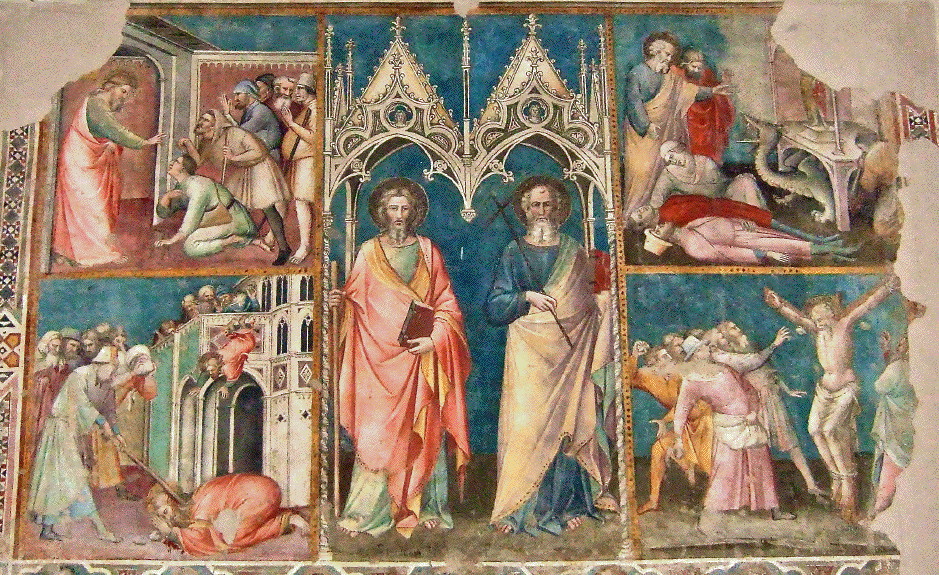
Throughout the Easter Season, the Scriptures at Holy Mass focus our attention upon several recurring themes. Examples of this are the Good Shepherd, the Bread of Life, and the unity of the Church. As is fitting for the feast of two apostles, the Scriptures for today’s feast of St. Philip and St. James highlight how the Church’s foundation is apostolic. Of course, the role of the apostles goes beyond the Church’s beginning.
Those ordained to the office of bishop continue to carry out the work first entrusted to the apostles. Each and every member of the Church has a vocation that is missionary in nature: in fact, “apostolic” in nature, inasmuch as the word “apostle” literally means “one who is sent”. Every Christian is called to “go outside himself” and share with others the natural and supernatural gifts he has received. Most Christians do this chiefly through family life, and in the secular workplace and community. We might say that the laity are apostles “ad extra”, outside the walls of the Church.
However, within the Church, those called to the office of bishop have a unique role. While laypeople proclaim the Gospel within the domestic church and in the workplace and community, bishops proclaim the Gospel to all of the Church’s members, and this chiefly through the Sacred Liturgy. The Gospel is meant—among other goals—to bring order to chaos: that is, to foster unity. Everyone who is a member of a family, a neighborhood, a parish, etc. knows how difficult it can be to cultivate unity.
Unity is the first of the Church’s four marks for a reason. Apostolicity serves her unity. For this reason, then, pray for your local bishop and for our universal bishop, His Holiness the Pope, called to preside in charity over the Church throughout the entire earth.
St. Joseph the Worker Genesis 1:26—2:3 (or Colossians 3:14-15,17,23-24) + Matthew 13:54-58
“The Father who dwells in Me is doing His works.”
On this feast of Saint Joseph the Worker, the readings from Sacred Scripture help us reflect upon the covenant between the Lord and His People. This covenant is lived out through the life and mission of the Church, which is the Mystical Body of Christ.
The Church is the fruit of the tree of Calvary. Whereas Adam in the Garden cast man down into the pit of sin by his Original Sin, Christ has raised man up on Calvary. Yet Christ has done even more than restored fallen man to his original state. Through the power of the Holy Spirit, God the Son—by incorporating us into His own Mystical Body—has made each of us a child of God the Father.
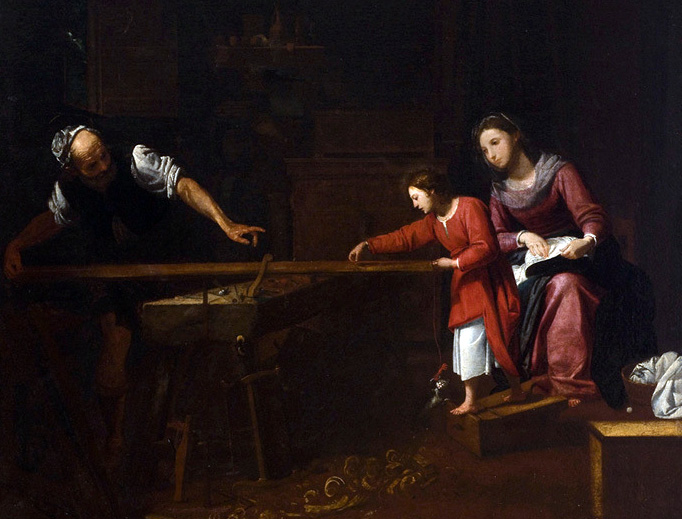
In this context of the Church, whose mission began on the day of Pentecost, and upon which mission we are reflecting throughout Eastertide, we honor today the patron of the universal Church: St. Joseph. Specifically, we honor him according to the title “St. Joseph the Worker”. We don’t speak of him as a “Wonder-worker”, as some saints are described. Joseph didn’t work wonders. He simply worked, and his simple work reminds us who are God’s adopted children of a basic lesson of the spiritual life.
In this basic lesson, St. Joseph reminds us of the Little Flower. St. Joseph does little things with great love. But more importantly, St. Joseph does little things for a great love, and in that, shares in the life of that great love.
“I am the way and the truth and the life. No one comes to the Father except through me.”
Within the Gospel account of St. John, there are two conversations between Jesus and Thomas. The more famous exchange we hear on the Second Sunday of Easter, where Thomas doubts what his fellow apostles tell him about the Resurrection. A week later he’s confronted by the Risen Jesus Himself. But today, on a weekday during the middle of Easter, we hear another form of doubt from Thomas.
Thomas expresses doubt in two ways. First, he expresses doubt about Jesus as a leader. A good leader makes sure that his followers know their goal. So when Thomas claims that “we” do not know where Jesus is going, he’s expressing doubt about Jesus.
The second expression of doubt concerns the way towards the goal. Thomas’ words hold a certain logic: it would seem foolish to set out on a journey without knowing the goal. If the pilgrim doesn’t know his goal, then each and every step is as likely to take him farther away from his goal as it is to take him closer towards it.
However, this second expression of doubt is also a doubt about Jesus as a leader. If we trust Jesus to lead us, then why do we have to know the goal? The leader is the way to stay on track: staying close to Him ensures progress towards the goal. We pray with St. John Henry Newman: “Lead Thou me on! / Keep Thou my feet; I do not ask to see / The distant scene; one step enough for me”.
The Fifth Sunday of Easter [B] Acts 9:26-31 + 1 John 3:18-24 + John 15:1-8
“Whoever remains in Me and I in him will bear much fruit.”
When a person packs his things and moves off to a new place, he expects to meet a lot of new people, and to see a lot of new things. But at the same time, it’s important for him to keep in touch with the persons and places he loves. Through technology, it’s relatively simple to keep in touch in our day and age.
God, however, has a more simple method, a more profound way, and a more abiding means to “keep in touch”: that is, for love to be shared between Him and His People, and among His People. We hear about that Way in the Scriptures today. We reflect on that Way throughout this Easter Season. The Easter Season culminates in a celebration of this Way, which is the Church.
We do ourselves a disservice if we think of the Easter Season as being only fifty days of celebrating Jesus’ Resurrection from the dead. We do God a disservice if we think that the Father would raise Jesus from the dead only for Jesus’ sake. God the Father raised Jesus from the dead for our sake. The Easter Season is not only about Jesus’ resurrection. The Easter Season is also about fallen man’s resurrection.
In other words, we need to think of the Easter Season as having two poles, just as Earth does. The first pole of the Easter Season is its first day, Easter Sunday, on which the Church gives praise for the Resurrection of Jesus. But the opposite pole of the Easter Season is its last day, Pentecost Sunday, on which the Church is given the gift that Jesus was given on Easter Sunday morn.
In between the first and last days of the Easter Season, the Risen Lord bestows His grace to many persons through the power of the Comforter. Today’s Gospel passage continues to describe that bestowal of grace.
We hear one of simplest images in the Gospel: a vine and its branches. This image is, obviously, an organic one. It makes sense to gardeners and farmers. Such an organic relationship, or set of relationships, is at the heart of the relationship between Christ and His disciples. Or to use the metaphor that St. Paul favored, the image of a vine and its branches describes the relationship between Christ and the members of His Body.
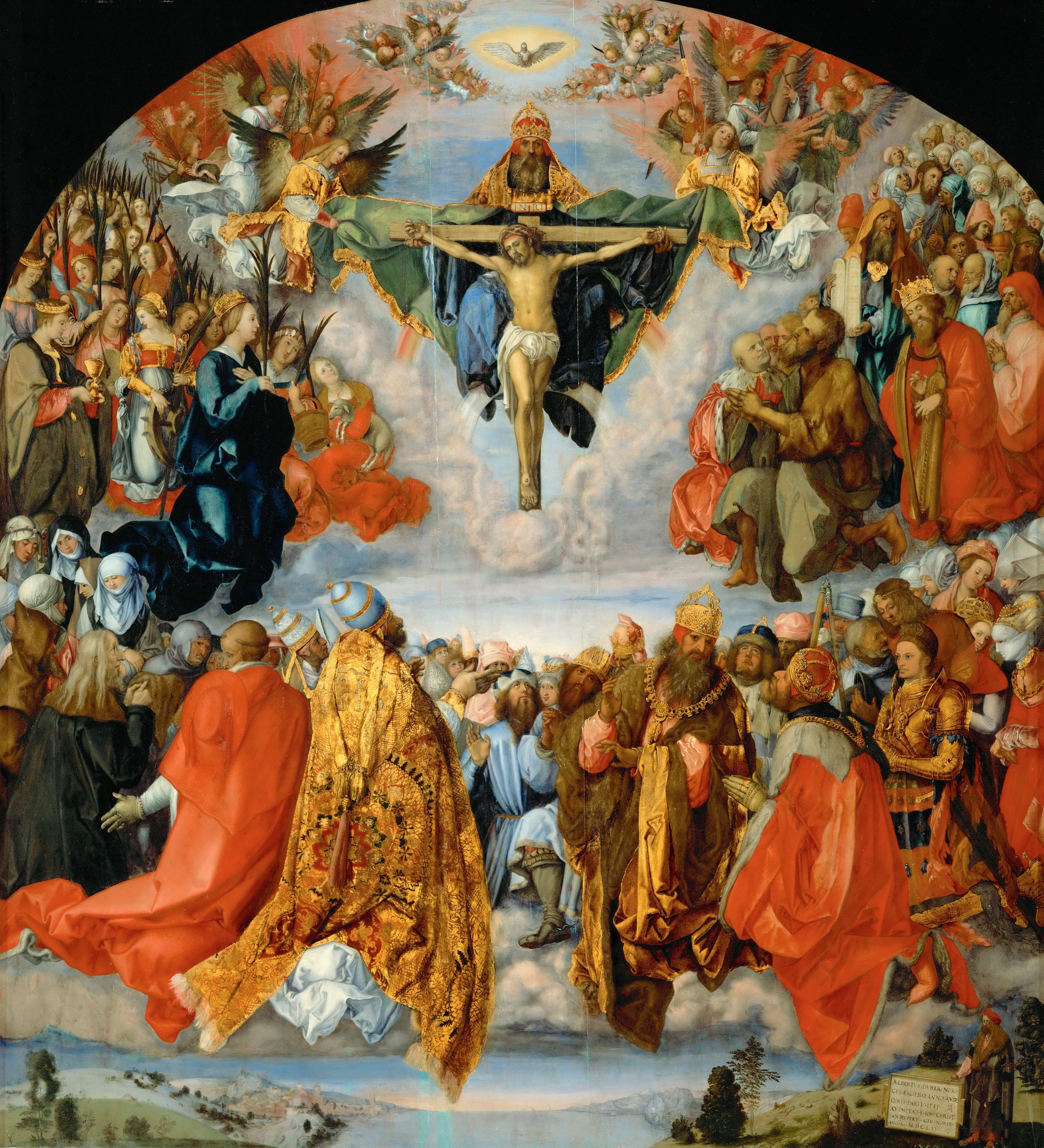
Jesus is teaching us about the nature of the Body of Christ through this agricultural image. Christ is the vine, or the head of the Body of Christ. His disciples are the branches, or the members of the Body. To describe as organic how Christ’s love is shared between Him and His People, and among His People, is not only to say that these are “living” relationships. These relationships are bound up with each other. These relationships bind together the two beams of the Cross: the vertical beam, which symbolizes man’s vocation to love God, and the horizontal beam, symbolizing man’s vocation to love his neighbor. The two are one in Jesus, whose life you and I share in through the Power of the Holy Spirit.


 Reflections on the Sacred Liturgy