Monday of the Twenty-fifth Week in Ordinary Time

Monday of the Twenty-fifth Week in Ordinary Time
Luke 8:16-18

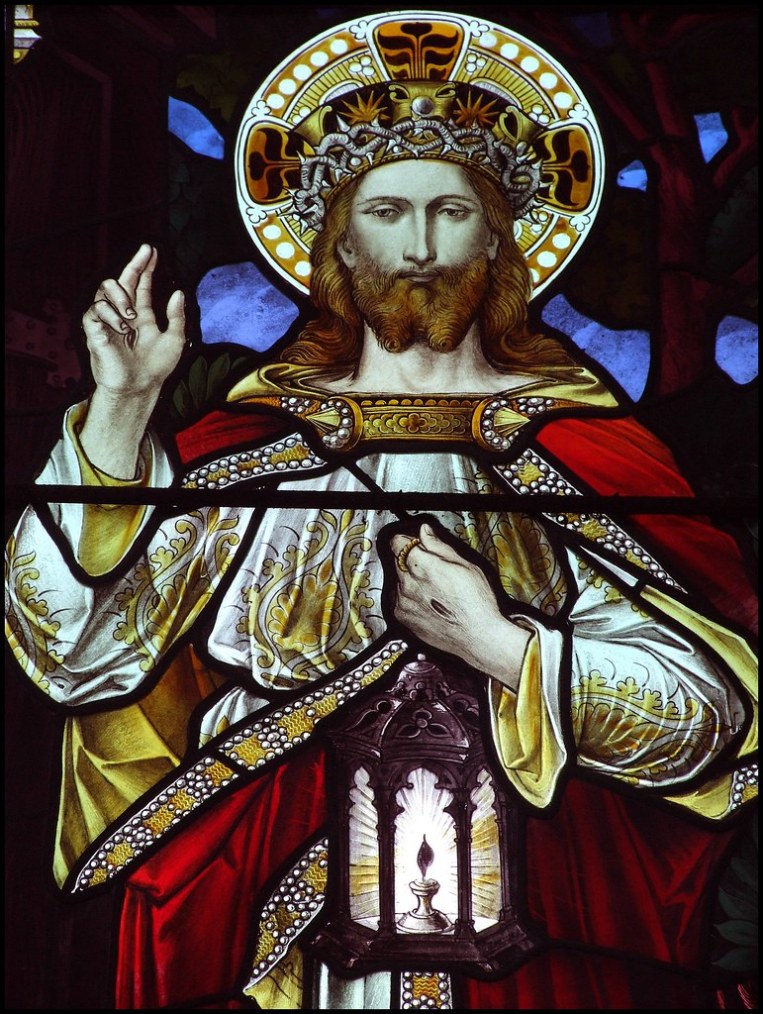
“… he places it on a lampstand so that those who enter may see the light.”

The first two-thirds of today’s Gospel passage from Chapter 8 of Luke evoke another saying of Jesus:  “I am the light of the world; he who follows me will not walk in darkness, but will have the light of life” [John 8:12].  Jesus speaks in that verse both about Himself as “the light of the world” and also about the one who follows Him.

Today’s Gospel passage also speaks about both Christ and the one who follows Him.  Yet it’s focus is upon the action that the follower ought to take:  that is, placing the light on a lampstand “so that those who enter may see the light”.

In other words, this passage is not only about Christ and His follower, but also about those with whom the followers comes into contact.  In a word, this passage focuses upon “mission”.  The follower of Christ is someone who works so that the Light of Christ reaches others, illuminating them and the world around them.

Saturday of the Twenty-fourth Week in Ordinary Time

Saturday of the Twenty-fourth Week in Ordinary Time
Luke 8:4-15

“Whoever has ears to hear ought to hear.”

The parable Jesus preaches to us today is well-known.  Its meaning is clear because Jesus Himself explains the parable:  something He rarely does.  Given this explanation, we might apply the parable to ourselves as an examination of conscience.  While Jesus describes the different elements of the parable as relating to different groups of persons, one can reflect on these elements as relating to oneself at different times in one’s life.

“The seed is the Word of God”, that is, God the Son, as St. John tells us in the prologue to his Gospel account.  Our lives as disciples are all about allowing this seed to sink into our souls:  allowing God the Son entrance into our hearts and minds, so that He might live in us.

When are we “on the path”?  When are we so shallow in giving our attention to Jesus that the devil snatches Him from our lives?  When are we “on rocky ground”?  When do we allow temptation to have the upper hand over Christ?  When are we “among thorns”, allowing our worldly concerns to choke off both God the Son and the graces He wills to bring into our lives?  In the Holy Eucharist ask the Word made Flesh to help you till the field of your life so that it might be “rich soil”.

Friday of the Twenty-fourth Week in Ordinary Time

Friday of the Twenty-fourth Week in Ordinary Time
Luke 8:1-3

Jesus journeyed from one town and village to another ….

Today’s Gospel passage doesn’t seem much like a passage!  There’s no narrative to speak of, but mostly a description of Jesus’ entourage as He journeys while preaching.  How is such a “cast of characters” meant to tell us something as it’s preached from the pulpit (or reflected upon in one’s home) on this weekday in Ordinary Time?

Perhaps we might relate this cast to what in the Apostles’ Creed we profess as the “communion of saints”.  In Heaven this cast of thousands adores God perpetually, gathered together in voice to worship the Lamb who was slain for our salvation.  But on earth, during our pilgrimage, while we do pause occasionally for worship, we also have many practical matters to attend to.  On earth, while we’re journeying to where we can enjoy “the better part” alone, we have to attend like Martha to many simple needs.

Jesus, as He’s described in today’s Gospel passage, is surrounded by three types of persons.  There are the Twelve apostles, those who had been cured by Jesus, and those who provided for the crowd.  We might reflect on this assembly as the first parish, although journeying from one town and village to another!

OT 24-5

The Twenty-fifth Sunday in Ordinary Time [B]

The Twenty-fifth Sunday in Ordinary Time [B]
Wisdom 2:12,17-20  +  James 3:16—4:3  +  Mark 9:30-37

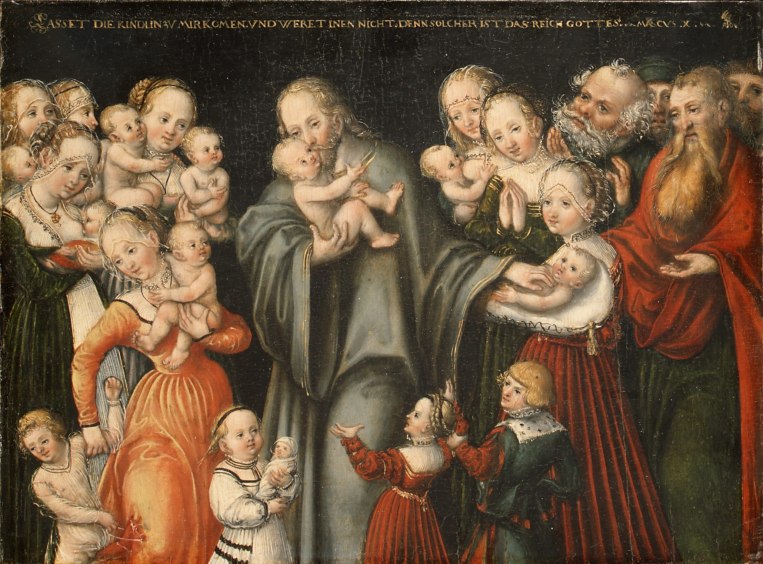
… He said to them, “Whoever receives one child such as this in My Name, receives Me ….”

A priest serving in a rural area was asked how many families were in his parish.  He jokingly responded, “Seven.”  His point was that most of his parishioners were from large, extended families, whose roots stretched back to the founding of the parish.  Sacred Scripture is similar.

There are eight “families” of books in the Bible, and each of the 73 books of Scripture belongs to one of those eight families.  To use an analogy, consider Great-uncle Ebenezer.  He and his first wife begat four children.  Then after her death, Great-uncle married again, and by his second wife begat four more children.

So in the Bible, the Old Testament is made up of four “families” of books:  the books of the Law, of history, of wisdom, and of the prophets.  These books are the fruit of the covenant between the Lord and Israel.

Likewise, in the New Testament there are four “families” of books:  the accounts of the Gospel, the Acts of the Apostles, the apostolic letters, and the Book of Revelation.  These books are the fruit of the covenant between Christ and the Church.

This background helps us appreciate the context of today’s Second Reading.  For four weeks now, the Second Reading at Sunday Mass has come from James, and this will continue through next Sunday.  James is one of the 21 books of the New Testament in the family of apostolic letters or “epistles”.  But you can further divide that family of 21 books according to which apostles wrote them.  Two-thirds of the letters were written by Saint Paul, while out of the remaining seven, only one was written by St. James.

The Letter of St. James is arguably the most practical of all the New Testament letters.  James takes a no-nonsense attitude towards following Jesus.  The focus of St. James in his letter is not some lofty—though important—matter such as how three divine Persons eternally live as one God.  Instead, St. James deals with down-to-earth questions of fallen human nature.  Given this, the Letter of James is a good resource for making a general examination of conscience, and for spiritual reading each Lent.

Listen to how plain-spoken St. James is today when he asks, “Where do the wars and where do the conflicts among you come from?  …  You covet but do not possess.  …  You do not possess because you do not ask.  You ask[,] but do not receive, because you ask wrongly, [in order] to spend it on your passions.”  That’s what you call matter of fact!

St. James focuses first upon diagnosis:  exposing the spiritual wound and underlying disease to view.  But then he directs our attention to the cure:  the divine Physician, Jesus Christ.  We receive the grace of Christ’s saving remedy through the sacraments.  Yet we need to conform our lives to the life of Christ so as to fittingly receive this gift, at least to the extent of having no more than venial sins.

That is to say that if someone were to receive the sacraments while continuing to live a life like that which St. James is preaching against—what the Church calls living in mortal sin—then Christ’s grace would not abide in him or her.  St. Paul speaks more directly to this point, explaining a further consequence:  “whoever eats the bread or drinks the cup of the Lord in an unworthy manner will be guilty of sinning against the body and blood of the Lord” [1 Cor 11:27].

If we were to consider the Gospel’s demands to be mere ideals, and deny that serious sin—whether a single mortal sin or a mortally sinful state of life—prevents one from receiving the sacraments, we would act against the apostolic teachings of the Church.  The successors of the apostles have the weighty pastoral responsibility of shepherding the wayward back to what today is called “Eucharistic coherence”.

The Gospel passage today helps us see what this process of spiritual conformity asks from us.  We need to conform ourselves to the image of the Cross, because this image consists of being “the last of all and the servant of all.”  This image consists of receiving a child in Christ’s Name, so to receive Christ Himself, and so to receive the One who sent Christ.  To receive this One—God the Father—is to allow God the Father to strengthen His likeness within us by means of His daily bread.

Thursday of the Twenty-fourth Week in Ordinary Time

Thursday of the Twenty-fourth Week in Ordinary Time
Luke 7:36-50

“So I tell you, her many sins have been forgiven; hence, she has shown great love.”

In today’s Gospel passage we witness a conflict among the “sinful woman”, Simon the Pharisee, and Jesus.  In this passage, the Lord uses the sinner’s situation to try to bring the Pharisee to Him.  For your own spiritual life, to draw from this Gospel passage, you have to put yourself in the sandals of this sinful woman.

Until we look seriously at our sins, at their effects on our souls, and at their consequences (for ourselves and for others, both in this world and in the next), our experience of prayer will be diminished, and so therefore will the benefits of our prayer.  Too often in our prayer we’re like Simon the Pharisee instead of being like the sinful woman.  The Pharisee says to himself, “If [Jesus] were a prophet, He would know who and what sort of woman this is who is touching him, that she is a sinner.”  By contrast, the sinful woman says nothing, but she acts with great love.  The Pharisee speaks to himself with doubt about whether Jesus is even a prophet.  But the woman acts with love towards Jesus, because she knows through faith that He is the Messiah who wants to wash away her sins.

If we wanted to sum up today’s Gospel passage, we could ponder just those two sentences that Jesus proclaims to Simon:  “her many sins have been forgiven because she has shown great love.  But the one to whom little is forgiven, loves little.”  In those words, Jesus teaches us two lessons.  First, the virtue of humility is the beginning of a fruitful prayer life.  Second, through that fruitful prayer the Christian finds the start of the contentment and peace of mind that remain elusive until we remain in God.

(c) Newtown Town Council; Supplied by The Public Catalogue Foundation

Our Lady of Sorrows

Our Lady of Sorrows
1 Timothy 3:14-16  +  John 19:25-27
September 15, 2021

“Woman, behold, your son.”

All our joys, all our sorrows, all our glory is only found in Christ:  that is to say, because we are members of Christ’s Body.  It is not true that you have your cross, and I have mine.  We all bear together—as individual members of Christ’s Body—the Cross of Jesus.  We all share in carrying His Cross.

Humanly speaking, sorrows tend to divide people more than joy or glory.  Loneliness and isolation are keenly felt by those who suffer.  Only in Christian faith can we find meaning even in the midst of suffering, because only God—who created everything out of nothing—can create good out of evil.

By approaching the Cross, we find Our Mother of Sorrows standing at its foot.  When we approach the Cross to take it up each day, she is there.  She remains there—at the heart of our Christian faith—to show us with a mother’s love that suffering cannot tear us from each other.

Our Lord Jesus taught us to pray the “Our Father”.  Jesus was not only teaching us that we have a Father in Heaven, because as a consequence of that truth, it’s also true that we are all brothers and sisters.  So then, it’s also true that Mary is the Mother of all of us.  We ask Our Lady of Sorrows, the Spouse of the Holy Spirit, to pray for us in all things.  Through her intercession, she helps us know that no matter what we face in life, her Son is there with us, showing us how to walk the only Way that leads to Heaven.

The Exaltation of the Holy Cross

The Exaltation of the Holy Cross
Numbers 21:4-9  +  Philippians 2:6-11  +  John 3:13-17
September 14, 2021

… He humbled Himself, becoming obedient to death, even death on a cross.

We know that silence can be deafening.  Sometimes silence is very embarrassing, as when a teacher asks a question about something that’s been studied for weeks, and no one knows the answer.

On the other hand, silence can be a very good thing.  It is in silence that the highest kind of prayer happens.  St. John of the Cross is supposed to have said that silence is God’s native language.  Regardless, there are many different ways to pray.  One of the first ways that we learn is prayers that others teach us, like the “Our Father”, the “Hail Mary” and the “Glory Be”.  Prayers like these let us pray together as a group, so that we’re praying the same thing at the same time.

Other times, though, we pray on our own, and so we make up our own words in prayer.  In this kind of prayer—which is like a conversation with God—we can say anything we want.  We don’t have to remember the right words to pray.  We just pray from our heart, and offer to God whatever is most on our mind.

But there’s another part of prayer that sometimes gets overlooked.  That is silence.  Actually, in our prayer, most of our time should be spent listening rather than speaking.  As the saying goes, this is why God gave each of us two ears, but only one mouth:  we are to listen twice as much as we talk.  This is as true of prayer as it of conversations with our fellow human beings.

It is in our silence—in listening to God—that our deepest prayer can take place.  This makes sense, if we think of it, because after all, isn’t what God wants to say to us probably more important than what we want to say to Him?

Humility is one of the virtues, and silence is one form of humility.  That’s why it’s often difficult to quiet ourselves down.  When we’re forced to be silent, we usually want to talk instead.

Even though we have lots of opportunity to grow in humility, as human beings our greatest call to be humble is when we face death:  the deaths of others whom we love, but eventually, our own death.  This is where Christ reveals to us God’s love.  This is what we celebrate today, on the Feast of the Triumph (or Exaltation) of the Holy Cross.

Picture in your mind the scene at Calvary.  Saint John was the only apostle who stood at the foot of the Cross in silence, and it was into his care that Christ, the only child of Mary, entrusted His Blessed Mother.  In turn, Christ entrusted John to the care of Mary.  In these words we hear the only teaching that is possible from the Cross:  that we must entrust ourselves to each other’s care, bound to each other by Our Father’s love.

Triumph of the Cross

St. John Chrysostom, Bishop & Doctor of the Church

St. John Chrysostom, Bishop & Doctor of the Church
1 Timothy 2:1-8  +  Luke 7:1-10
September 13, 2021

“I tell you, not even in Israel have I found such faith.”

With few exceptions, the translation of the Mass introduced in 2011 has been hailed by bishops, scholars and folk in the pews for its advances over the hurried translation made soon after Vatican II.  One of the key improvements in the translation is its greater fidelity to Sacred Scripture.  Today’s Gospel passage offers an example.

The centurion sends the message:  “Lord… I am not worthy to have you enter under my roof.  … but say the word and let my servant be healed.”  This very clearly is the origin for the invocation that each Catholic makes to Jesus shortly before Holy Communion.  Such clarity impels us today to reflect deeply on the context of these words, so that our invocation before Holy Communion is more meaningful each time we offer it.

Here, consider just one point of context.  While we might focus on the humility of the centurion, reflect by contrast on the power of the Lord.  The Lord’s power is such that physical proximity to the sick person is not necessary.  The Lord needs only to “say the word”.  This power evokes awe in the communicant because while in today’s Gospel passage Jesus did choose to heal from a distance, at Holy Mass Jesus He deigns to enter into our very person, body and soul.  This intimate indwelling is a mystery for which we cannot possibly finish giving thanks.

St. John Chrysostom,
Bishop & Doctor of the Church

Saturday of the Twenty-third Week in Ordinary Time

Saturday of the Twenty-third Week in Ordinary Time
Luke 6:43-49

“For every tree is known by its own fruit.”

The first of Jesus’ brief parables today might seem-evident.  He instructs us that a “good tree does not bear rotten fruit, nor does a rotten tree bear good fruit.”  Yet some reflection suggests an argument against this lesson.

History shows us many examples of wolves not only wearing sheep’s clothing, but acting like sheep.  History reveals many rotten trees bearing what seems good fruit.  The devil at times clothes himself in light, not in order to bear the Lord a fruitful harvest of souls, but for his own devious purposes.

Given this, how should we interpret Jesus’ words?  Perhaps the problem is in someone using His words as a tool to judge others rather than a means of one’s own conversion.  God in His all-seeing Providence certainly can act along the line of Jesus’ words as He judges his children.  But we cannot do this for many reasons, among which is that we can only judge exterior fruits, whether good or rotten.  We cannot see spiritual fruits that are visible only to God and to the consciences of others.  Nor can we see the motives of others.  Better, then, that each of us use Jesus’ words as part of an examination of one’s own conscience, asking God to conform our minds and hearts to His.