Tuesday of the Second Week in Ordinary Time [Year II]

Tuesday of the Second Week in Ordinary Time [Year II]
I Samuel 16:1-13  +  Mark 2:23-28

“The Sabbath was made for man, not man for the sabbath.”

Today’s Gospel passage focuses on “‘the Son of Man [who] is lord even of the Sabbath.’ ”  To say that this Son of Man is lord “even” of the Sabbath is to point out that the meaning of this lordship stretches back to God’s creation of the universe.  The origin of the Sabbath is not the Third Commandment, but the events described in the first chapters of Genesis.  Jesus as the Son of Man is a lord who is divine and human.

But today’s First Reading and Responsorial speak of the human lord, King David.  David, like all the rightful kings of God’s People, ruled through the anointing that came from the Lord God.  Both the First Reading and the Responsorial speak of this anointing.  The First Reading links this anointing to the Power of the Holy Spirit:  the scriptural author notes that “from that day [of David’s anointing] on, the Spirit of the Lord rushed upon David.”

In the ministry of the Old Testament kings, it was through the Holy Spirit that they acted as lords.  In the Nicene Creed we profess belief in the Holy Spirit, “who has spoken through the prophets.”  We might well also profess that this Holy Spirit has acted through the kings.  So also does He act in our own day:  ruling the Church through her ordained ministers, and ruling throughout the world in the daily lives of the lay faithful through their fidelity to their baptismal promises.

St. Anthony, Abbot

St. Anthony, Abbot
I Samuel 15:16-23  +  Mark 2:18-22
January 17, 2022

“… the days will come when the bridegroom is taken away from them ….”

Today’s Gospel passage might seem confusing to those who wish to be devout Christians.  Along with the contrast between Jesus and John, there is a contrast between feasting and fasting.  Jesus’ disciples in this passage do not fast because He is with them.  Should Christians today, then, take part in the discipline of fasting?  Or would fasting imply a denial of Jesus’ presence in our lives?

Jesus gives us the key to applying this contrast to our own lives as 21st century disciples.  He explains, “the days will come when the bridegroom is taken away from them, and then they will fast on that day.”  But what exactly is “that day”?  In one sense, we could consider “that day” to be Good Friday, when Jesus offered His life to death.

But in a broader sense, you and I need to understand “that day” as referring to the lives of all members of the Body of Christ here below in this vale of tears:  all of us who are members of the Church Militant here on earth.  It’s true that through Baptism and the other sacraments which we worthily receive, Christ dwells in our souls.  Through these sacraments He conforms us as members of His Mystical Body.  Yet as wayfaring pilgrims on earth, we are called to fast.  We fast because our share in Christ’s life is not full.  Only in Heaven may we feast fully on the life of God as members of the Church Triumphant.

OT 02-1

Saturday of the First Week in Ordinary Time [II]

Saturday of the First Week in Ordinary Time [II]
I Samuel 9:1-4,17-19; 10:1  +  Mark 2:13-17
January 15, 2022

All the crowd came to Him and He taught them.

In today’s Gospel passage from the second chapter of Mark, Jesus lays part of the foundation for his public ministry.  The events of today’s Gospel passage took place not long after Jesus’ Baptism, which inaugurated His public ministry.  The last sentence of the passage holds several clues for us about Jesus’ earthly mission.

“I did not come to call the righteous but sinners.”   If we took these words at face value, we might consider “the righteous” to be the Pharisaic scribes who provoked these words from Jesus.  Obviously the scribes considered themselves righteous.  But like Jesus’ parables and so much else in His preaching, there is a paradox at work.  Jesus turns the popular notions of who is righteous and who is a sinner on their heads.

We could certainly not say that the tax collectors and other “sinners” were made righteous simply by the act of physically dining with Jesus.  But the physical proximity, and the closeness it suggests, symbolize that neither Jesus nor the “sinner” shuns the other’s company.  We cannot receive spiritual and moral righteousness from Jesus if we don’t spend time with Him, especially in the banquet of the Eucharist.  To shun him there would be to stand like the scribes, aloof and self-righteous.

OT 01-6

Friday of the First Week in Ordinary Time [II]

Friday of the First Week in Ordinary Time [II]
I Samuel 8:4-7,10-22  +  Mark 2:1-12
January 14, 2022

Many gathered together so that there was no longer room for them ….

In today’s Gospel passage Jesus has many followers.  “Many gathered together so that there was no longer room for them”.  This might seem to make Jesus a popular person, successful in ministry.  But within today’s Gospel passage there is a confusion of aims.  The aim of the friends of the paralytic was his physical healing.  Jesus does not dismiss their effort, but he sub-ordinates it to a higher aim:  the forgiveness of sins.

Jesus could have spent His three years of public ministry only working physical cures and raising people from the dead.  Had he stuck to these aims alone, He would have remained popular.  There’s no telling how successful He might have become in the eyes of the world!

But it was not for fifteen minutes of fame that Jesus came into our world of sin and death.  It was to die that He dwelt among us.  Give thanks that Jesus shows us how to put our mission above popularity, and how to put the aim of death before that of earthly life.

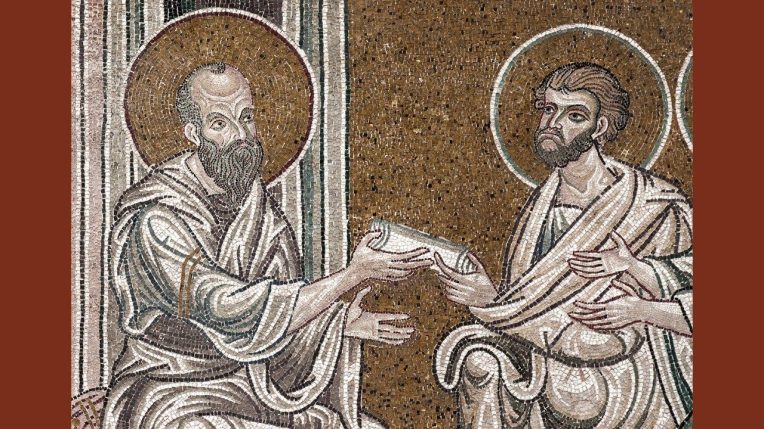
The paralytic lowered from the roof, Jesus and an apostle. Mosaic (6th)

The Second Sunday in Ordinary Time [C]

The Second Sunday in Ordinary Time [C]
Isaiah 62:1-5  +  1 Corinthians 12:4-11  +  John 2:1-11

Jesus did this as the beginning of his signs at Cana in Galilee and so revealed his glory ….

Jesus’ miracle at the wedding at Cana reveals to us many important truths.  For example, the fact that there were six ceremonial water jars, each holding about 25 gallons, tells us that Jesus produced 150 gallons of wine for this wedding celebration, which in turn tells us that this… was a Catholic wedding.

It also tells us that Jesus was not a fundamentalist.  If Jesus had believed that drinking alcohol is inherently immoral, His first public miracle would not have been to turn water into wine at a wedding.  Instead, He would have turned 150 gallons of wine into water to prevent those at the wedding from enjoying themselves.  As the 20th century essayist Hilaire Belloc declared:  “Wherever the Catholic sun doth shine, there’s always laughter and good red wine.  At least, I’ve always found it so:  Benedicamus Domino!”

However, besides this simple lesson about morality, there’s a deeper tradition revealed in this Gospel passage:  part of Tradition with a capital “T”.  It’s not a coincidence that Jesus’ first public miracle takes place at a wedding, and that this miracle teaches us about Marriage.

After all, it’s for the sake of a marriage that God the Father sent His Son to become man.  The Word became Flesh so that fallen man, by receiving this Word made Flesh, would enter into union with God.  St. Paul speaks of this union at length in his New Testament letters, describing the love of Jesus and His Church as a marriage.

Given this, it’s not a coincidence that the Fourth Commandment is about loving one’s parents.  Reflect on the Fourth Commandment’s place among the Ten in order to appreciate Jesus’ marriage to His Church, of which each of us is a member.

The Ten Commandments fall into two groups:  the first three command us to love God because God is Love.  The latter seven command us to love our neighbor as our self.  It’s not a coincidence that the first three are first, because it’s more important to love God than our neighbor.

This is so because our love has to be ordered.  If your love for God is not primary, then your love for your neighbors will be weak.  God intends, by the way He designed us, for His love to be the source of our love for our neighbors.

Similarly, our love for all our neighbors has to be ordered.  That is, there’s a reason why the Fourth Commandment is the first of the commandments to love our neighbors.  During your earthly life, as you journey among all your fellow human beings, if your love for your parents is not primary, then your love for any and all of your other neighbors—in childhood and adulthood—will be too weak to accomplish what God wishes for you to do.

What does He wish you to do?  As you strive during your earthly journey to love God and neighbor, what does He wish you to do?

“Do whatever He tells you.”  These words of our Blessed Mother are not just for servers at a wedding 2000 years ago.  If each of us listened to our Blessed Mother, our families would be strong.  Each human family would reflect the love seen in the Holy Family.  Each human family would be a school of discipleship, apprenticing its members in the love of God and neighbor.  The principle of all that Jesus tells us to do is the self-sacrifice seen on Calvary, where Jesus gave His life for His Bride, the Church.

As the family goes, so goes society.  The family that’s rooted in God strengthens society.  But the family itself is made of individuals.  Each individual within each family—excepting the Holy Family—is a fallen sinner.

As the first of the signs of Jesus’ glory that St. John records in his Gospel account, the miracle at Cana points to nothing less than the divinization of man:  that is, the capacity of the human person to abide in God’s love.  What is merely natural and of this earth—water—becomes something more, something richer and deeper.  What for human beings is ordinary is made a conduit of God’s extraordinary grace.  As the venerable wedding instruction preaches:  “Sacrifice is usually difficult and irksome.  Only love can make it easy, and perfect love can make it a joy.”

Thursday of the First Week in Ordinary Time [II]

Thursday of the First Week in Ordinary Time [II]
I Samuel 4:1-11  +  Mark 1:40-45
January 13, 2022

[Jesus] remained outside in deserted places ….

In today’s Gospel passage, we hear that Jesus “remained outside in deserted places, and people kept coming to him from everywhere.”  Jesus’ “retreat” is not that of a hermit.  Jesus’ frequent journeys to deserted places was a prudential distancing himself from those He came into this world to serve.  Jesus wanted at times simply to be in prayerful communion with His Father.

At the same time, perhaps Jesus knew that the people He was sent to serve needed a “breather”.  It’s hard for us to imagine what it was like to hear the Word of God preach the Good News, or work stupendous miracles.  We may imagine that because we’ve seen movies portraying such events, that we have an idea what it was like for those first-century folk.  If so, we underestimate the power of the Word of God made Flesh, and overestimate the power of cinema.

Often implicitly, and sometimes directly, Jesus says that the crowds are misunderstanding Him, even praising Him for the wrong reasons.  Some distance between Him and them, then, was prudent so that the crowds might reflect in their minds and hearts on the mysteries of Christ.  Of course, in the end, the crowds called for His death:  “Crucify him!  crucify him!”  So also have we ourselves cried by our sins.  But within the desert of Calvary Christ offered His life, so that throughout all ages to come, people might keep coming to Him from everywhere.

OT 01-4

Wednesday of the First Week in Ordinary Time [II]

Wednesday of the First Week in Ordinary Time [II]
I Samuel 3:1-10,19-20  +  Mark 1:29-39
January 12, 2022

Rising very early before dawn, He left and went off to a deserted place, where He prayed.

In the light of Simon’s pursuit of Jesus and his informing Jesus that “everyone” is looking for Him, two actions of Jesus stand out.  Both actions show the falsity of Simon’s claim.

The fact that this passage begins with the cure of Simon’s mother-in-law gives us a glimpse into his way of thinking.  As more persons are cured, and as word spreads, Simon is convinced that “everyone” is looking for Jesus.

But “rising very early before dawn,” Jesus prayed in a deserted place.  In that “desert” He entered into communion with His Father.  His Father is primary to Jesus in an ultimate manner.  His Father is also primary to the crowds that Simon calls “everyone”.

When Simon makes his claim to Jesus, He responds by explaining the need to “go on to the nearby villages”.  Simon is parochial in his thinking, while Jesus wants no one excluded.  At this point in His public ministry, Jesus is preaching and healing “throughout the whole of Galilee.”

As those three years continue, the effects of His ministry spread out in waves.  Ultimately, His ministry culminates in His self-sacrifice on Calvary.  Jesus’ prayer in today’s Gospel Reading foreshadows His prayer in Gethsemane after the Last Supper.  Jesus offers His self-sacrifice on Calvary for all mankind throughout all of human history.  This is the “everyone” whom Jesus was sent by His Father to serve.

OT 01-3

Tuesday of the First Week in Ordinary Time [II]

Tuesday of the First Week in Ordinary Time [II]
I Samuel 1:9-20  +  Mark 1:21-28
January 11, 2022

“What is this?  A new teaching with authority.”

Twice in today’s Gospel passage we hear the word “authority”, both times applied to Jesus.  In both cases, astonishment or surprise is evoked by the fact that Jesus teaches with authority.  Why is there this astonishment, and what does it mean for Jesus to teach with authority?

In the culture that surrounds us, every person believes himself to be his own authority.  In effect, this wide-spread belief means that no real authority exists.  In our society there is a great need for clarity about the meaning and purpose of authority.

At its most literal level, the word “authority” comes from the word “author”.  The author of a novel can create worlds of his own design from his imagination.  Laws of physics need not apply.  Strange creatures can exist, and fantastic events are commonplace.  Tolkien, Baum and Rodenberry are all authors in this sense.  They have the authority to create worlds and races of creatures, and to confer life upon individuals and to take it from them.  However, this is merely a fictional form of authority.  In reality, there is only one Author of creation.

Jesus, as God from God and Light from Light, is this divine Author.  Through His divinity He has authority.  He exercises this authority throughout the three years of His public ministry for various persons, and for all mankind on Calvary.  However, in the face of His exercise of divine authority, astonishment arises for varied reasons.

Most cannot believe that a mere man could exercise divine authority.  Jesus, of course, was not merely a man, even though He was fully so.  In our own lives, we should not be astonished by the authority of Jesus.  We should root our daily lives in His desire to grant us His grace.

OT 01-2

Monday of the First Week in Ordinary Time

Monday of the First Week in Ordinary Time
Mark 1:14-20

“Come after me, and I will make you fishers of men.”

Today is a day of beginnings.  Today as we begin the season of Ordinary Time we hear from the beginning of the Gospel account of Saint Mark.  It points us to our ultimate end:  the embrace of God the Father.

Christ sustains all things by his powerful word, whether those things recognize the source of that power or not.  But for those who recognize Christ as the Son of God, He does infinitely more.  For those who all willing to abandon everything in this world—even the earthly fathers who reared them—Christ confers the power to share everlasting life, to be sustained in the life of God the Father forever.

Such men are the apostles Andrew and Simon, James and John.  They leave everything to go off in his company, having received a commission to become “fishers of men.”  They are called to share in the life of Christ, and at this point, they have no idea what this will entail.  This is how beginnings always are:  we have no real idea of what is going to transpire in the future.  If these four men had known that each of them would share deeply in the suffering of Christ—three of them, through martyrdom, and Saint John, at the foot of the Cross—it is unlikely they ever would have left their boats.

At the beginning of this season of Ordinary Time, let us pray for the grace to be faithful to the calling which we entered into through our Baptism.

OT 01-1