Tuesday of Holy Week Isaiah 49:1-6 + John 13:21-33,36-38
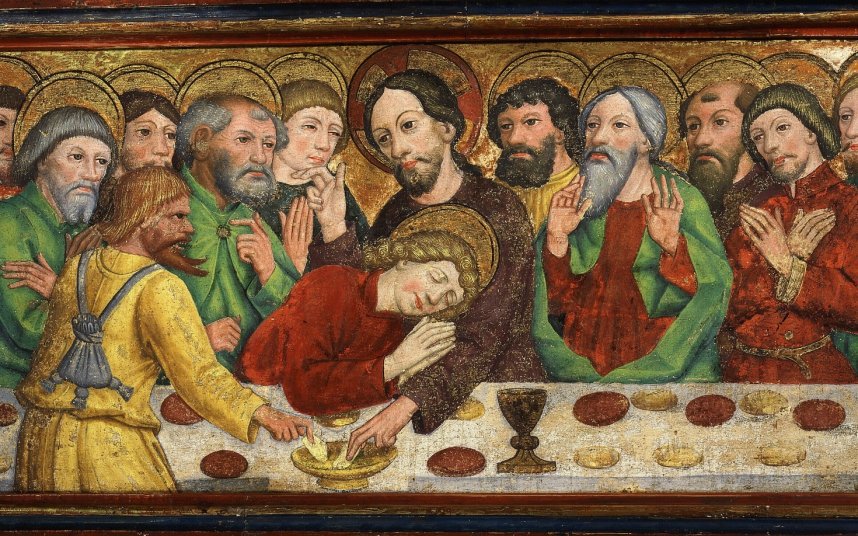
So Judas took the morsel and left at once. And it was night.
On the last two days of Lent before the Sacred Triduum starts, the Gospel Reading focuses on Judas Iscariot. Yet while tomorrow’s passage from Matthew looks solely at Judas, today’s passage from John also looks at Peter, another apostle who will betray Jesus.
Jesus is God. As a divine person, He could at any moment during Holy Week have turned away from the path leading to Calvary. Even on the afternoon of Good Friday as He hung upon the Cross, He could have miraculously escaped, transporting Himself far away to safety: indeed, even to Heaven.
All that is to say that Jesus is the primary “actor” in the drama of Holy Week. The acts that Jesus did or did not carry out during Holy Week determined man’s salvation. Any other “actor” within this drama is a second-string player.
Why, then, do the Gospel Readings today and tomorrow focus more upon those who betrayed Jesus than on Our Savior Himself? The answer is that the Church is calling you to recognize yourself in Judas and Peter.
In the sinful persons of Judas and Peter we witness two different types of betrayal: Judas by deed, Peter by word; Judas with a kiss, Peter by turning his back. Judas cries, “Hail, Rabbi!”, while Peter cries, “I do not know the man!”
There are many different ways in our lives by which we betray Jesus. But there is only one way for the chasm between our sins and God’s love to be bridged, and that is Jesus’ self-sacrifice upon the Cross.
Here is my servant whom I uphold, / my chosen one with whom I am pleased ….
The Old Testament’s Book of the Prophet Isaiah contains four brief passages called “servant songs”. Isaiah never names the servant who is described. But in the earliest years of the Church, these servant songs were sung in praise of Christ, who fulfilled during Holy Week what they proclaim.
The First Reading on Monday of Holy Week presents the first of these four servant songs. We might imagine God the Father speaking these words of His only-begotten Son, whom He sent from the paradise of Heaven into our world of sin and death.
Jesus is a servant. All the words that Jesus speaks and all that He does and bears this week reveals Him as a servant. Yet He’s a servant in a two-fold way, and we ought at the beginning of Holy Week reflect upon both of these.
Whom is Jesus serving through the sacred events of Holy Week? Secondly, He is serving us. All that He speaks, does, and suffers is for us: to bring us salvation.
First, however, Jesus is serving His heavenly Father. During Holy Week it’s easy for us to lose sight of God the Father. Our view can become myopic, focused simply upon Jesus saving us. But in saving us from the power of sin and death, Jesus is preparing us for new life. This new life is given to us even during our earthly days through the gifts, the fruits, and the grace of the Holy Spirit. But this new life in this world is only a foretaste of eternal life with our Father in Heaven. Jesus is serving His Father during Holy Week because God the Father longs for each us to enter into His company.
Saturday of the Fifth Week of Lent Ezekiel 37:21-28 + John 11:45-56
So from that day on they planned to kill him.
This morning’s Gospel Reading bears a sense of anxious anticipation. Its final verse leaves us on the edge of our pew: “They looked for Jesus and said to one another as they were in the temple area, ‘What do you think? That he will not come to the feast?’”
Just a few verses before, St. John the Evangelist explains the reason for the heightened sense of anxiety: “So from that day on they planned to kill him.” The motive for this plan of the chief priests and Pharisees is the focus of this morning’s three readings.
Both this morning’s First Reading and Responsorial Psalm come from books of Old Testament prophets: the First Reading, from Ezekiel; and the Psalm, from Jeremiah. Both look to Israel’s future, when a shepherd king would reign over a united Israel. The Responsorial is very strong in describing this shepherd
Yet the language of king is only implied, although in two ways. First, Ezekiel prophesies about Israel being restored to one kingdom. However, second and more intriguingly, Ezekiel prophesies that “there shall be one prince for them all”: not one “king”, but one “prince”. Twice in the verses that follow, Ezekiel identities David as this prince. Through the prophet the Lord declares: “My servant David shall be prince over them, and there shall be one shepherd for them all”; in the Holy Land, Israel shall dwell “with my servant David their prince forever.”
Everything that Ezekiel and Jeremiah prophesy about this shepherd king is fulfilled in the person of Jesus Christ. More specifically, Jesus fulfills His earthly mission as Christ the King upon the Cross on Good Friday. Jesus is drawing close to “His hour”. Through the New Passover—the Holy Sacrifice of the Mass—we are able to enter into Jesus’ life and saving mission.
Friday of the Fifth Week of Lent Jeremiah 20:10-13 + John 10:31-42
“If I do not perform my Father’s works, put no faith in me.”
Some disagree with the saying, “a little knowledge is a dangerous thing,” claiming that a little is better than none. They do not see that those having the “little” often self-righteously and proudly conclude they “know it all.”
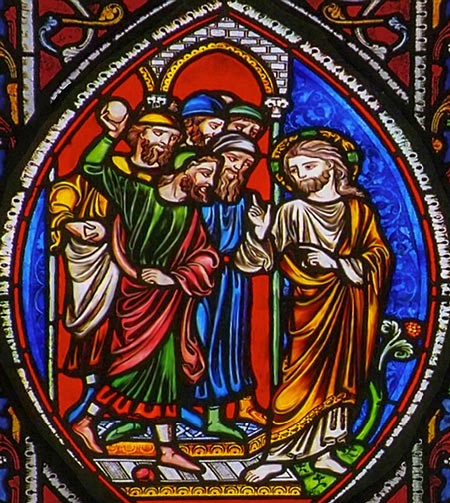
The Pharisees, purported Scripture scholars and experts in the Mosaic Law, fell into this latter category. When Christ revealed Himself to them as the Messiah, though they had well documented knowledge of the miracles He had performed, they immediately rejected the evidence, accused Him of blasphemy and prepared to stone Him.
What rendered them more dangerous than their intellectual presumption, and perhaps their fear of losing authority and position, was their faithlessness, their lack of God’s light and love. In this, Christ Jesus is their opposite, and this opposition to the Pharisees is what each of us must imitate: knowing that in God, we have everything we are, and that all we are, God calls us to give: for the sake of others, and for the greater glory of God.
Palm Sunday of the Passion of the Lord [C] Luke 19:28-40 + Isaiah 50:4-7 + Philippians 2:6-11 + Luke 22:14—23:56
… he humbled himself, / becoming obedient to the point of death, / even death on a cross.
The Roman Missal is the book from which the priest offers most of the prayers at Holy Mass. During most of Holy Mass, it rests upon the altar of sacrifice. Within this book, in the header for the Fifth Sunday of Lent, it states: “In the Dioceses of the United States, the practice of covering crosses and images throughout the church from this Sunday may be observed.”
The verb used is “may be observed”. That begs the question: ought this practice be observed? We might also question why this practice may be observed from that particular Sunday of Lent onwards. Those two questions are related.
The latter question is partly answered by the prayer that the priest prays before the ancient hymn known as the Sanctus (“Holy, Holy, Holy”). This prayer is called the Preface because it introduces the Eucharistic Prayer. The Preface changes throughout the Church year, relating the day’s season or feast to the Eucharistic Prayer.
On the weekdays following the Fifth Sunday of Lent—that is, this past week—the Roman Missal directs the priest to pray “Preface I of the Passion of the Lord”. On the weekdays between Palm Sunday and the start of the Sacred Triduum, the priest prays “Preface II of the Passion of the Lord”. This focus upon the Passion of the Christ is why these two weeks are traditionally called “Passiontide”.
Passiontide is part of Lent. We might even say that it’s a gradation of Lent. Consider: when you climb an imposing mountain, you ascend in stages. At the mountain’s base, the climb is easier. Higher up, the difficulty increases as rock formations and other obstacles present themselves. But when you reach the mountain’s tree line, an even more serious approach is required, as you cope with rarified air.
To apply that analogy to the Church’s preparation for Easter, the peak of the mountain—the goal of the climb—is the Sacred Triduum: the three days during which the Church celebrates Jesus’ Last Supper, Death, and Resurrection. The prior week and a half—Passiontide—is the last stretch of climb in rarified air. Prior to Passiontide, the majority of the climb stretches from Ash Wednesday until the Sunday before Palm Sunday. What’s more, in the calendar of the Extraordinary Form of Holy Mass, there is a period of preparation for the Sacred Triduum even before Ash Wednesday: this period starts on the ninth Sunday before Easter, and is called Septuagesima.
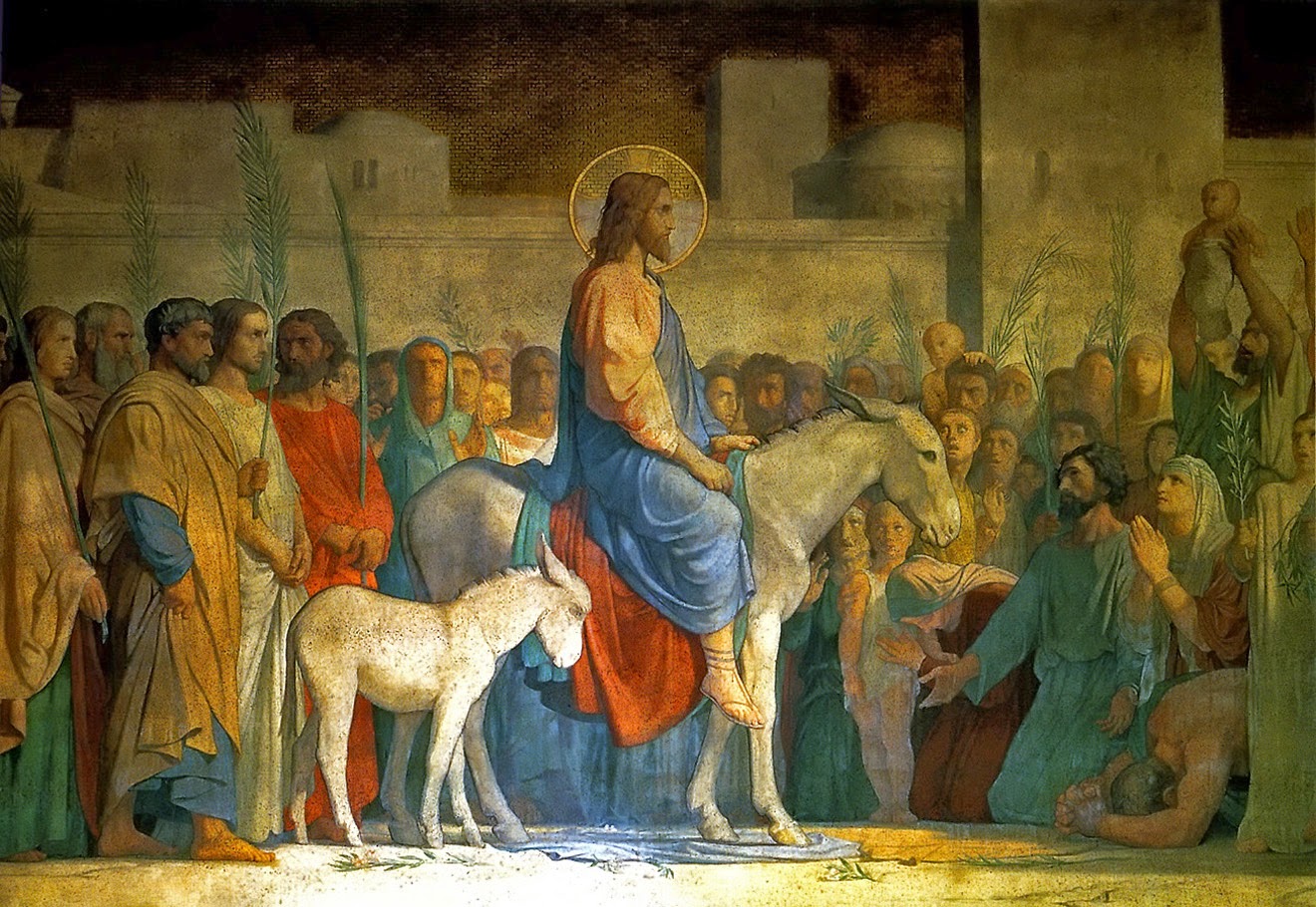
On Palm Sunday, two Gospel passages are proclaimed: one at the start of Mass and the other at the usual time of the Gospel. The first Gospel passage this Sunday is easy to hear. The crowds praise Jesus. They hail Jesus as their Messiah. All along, however, Jesus knows that their praise is hollow. He hears their words, but He knows their hearts. He knows the climb that stretches out before Him in the week to come.
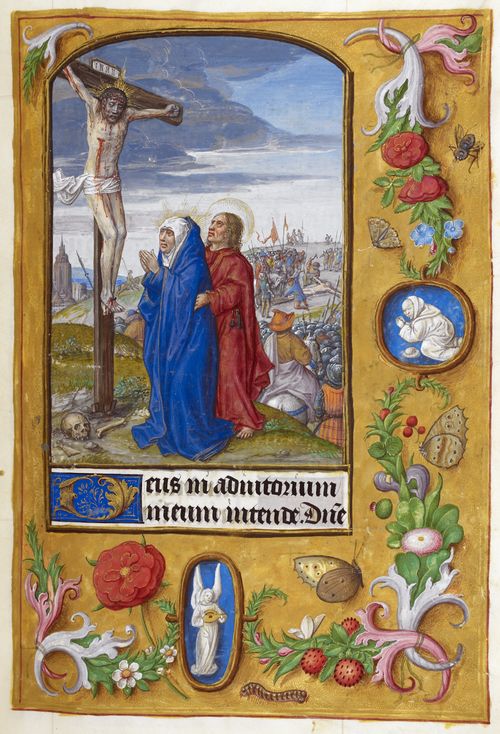
The events proclaimed in the Passion narrative are the events of Good Friday, the summit of the mount. Upon Mount Calvary, God the Father sacrifices His Son, Mary sacrifices her Son, and Jesus sacrifices His whole self: Body and Blood, soul and divinity. Few of Jesus’ disciples were both able and willing to ascend and remain with Jesus at the top of this mountain. Few of them had pure faith.
While the Passion narrative is proclaimed on Palm Sunday at the usual time of the Gospel Reading, the Church proclaims the Passion narrative a second time during Holy Week, as part of the Good Friday Liturgy. There is a difference between these two proclamations, however. On Good Friday, it is always the Passion narrative from St. John’s Gospel account that’s proclaimed. On Palm Sunday, the Passion narrative comes from one of the other three Gospel accounts. These narratives complement each other and focus our attention on different aspects of Jesus’ suffering for us.
Jesus invites you to spend this week with Him as He makes His ascent. It’s easier for you to praise Jesus this Palm Sunday. It’s more difficult to share in His self-offering on Mount Calvary, as it demands a more pure faith. God is calling us to rely solely upon the sight that comes from faith, and to keep the eyes of the soul fixed upon the glory of Christ crucified.
Thursday of the Fifth Week of Lent Genesis 17:3-9 + John 8:51-59
“Amen, amen, I say to you, before Abraham came to be, I AM.”
While yesterday’s Gospel Reading looked in part upon Abraham, today’s Scriptures double down on this focus. Today both the First Reading and Gospel Reading look at “our father in faith”. In fact, it is Abraham as father that is the specific focus.
In the First Reading, God changes Abram’s name to “Abraham”. This new name can be literally translated as “father of many”. But God’s own explanation of why he’s bestowing this new name is worth our attention: “for I am making you the father of a host of nations. I will render you exceedingly fertile; I will make nations of you; kings shall stem from you.” You could use any one of these four phrases for meditation, especially in terms of how this call from God to Abraham foreshadows the mission of Jesus Christ, who fulfills Abraham’s call in a new way.
Yet there’s another important aspect of God’s covenant with Abraham that’s not captured by these four phrases. Later in the First Reading, God vows: “I will give to you and to your descendants after you the land in which you are now staying, the whole land of Canaan, as a permanent possession”. The Holy Land for the people of the Old Testament was a geographic place upon the earth, with Jerusalem as its capital, and the Temple at the capital’s center. This is where we Christians need to understand the “Holy Land” of God’s covenant with Abraham in a new way: the Holy Land is Heaven; its capital is Christ, the Head of the Church; and the Temple is the Cross on Calvary, from which Christ’s self-sacrifice radiates throughout human history, leading the faithful of Christ’s Mystical Body into the heavenly embrace of God the Father.
Wednesday of the Fifth Week of Lent Daniel 3:14-20,91-92,95 + John 8:31-42
“… you will know the truth, and the truth will set you free.”
Historically, freedom for the Jews was based upon two figures of their past. First, descent from Abraham—their father in faith—was considered the foundation of the People of God. Second in importance was adherence to the Law of Moses, who led God’s People from slavery in Egypt to freedom in the Promised Land. Yet the Gospel accounts show that many in Jesus’ day who were living in the Holy Land were in fact slaves.
Jesus, we might say, taught that authentic and lasting freedom comes from adherence to the truth. More significant than this teaching, however, is that Jesus revealed Himself to be Truth incarnate. As we draw closer to Holy Week, we might anticipate Pontius Pilate’s feckless query: “Truth? What is truth?” In our own culture, it’s claimed that truth can be manufactured according to one’s own will, if one even wishes to bother with the idea of “truth”. The human person, in this false view of reality, is free to manipulate truth at will. Jesus reveals a much more demanding relationship between truth and freedom.
Jesus declares “to those Jews who believed in him, ‘If you remain in my word, you will truly be my disciples, and you will know the truth, and the truth will set you free.’” Each person who seeks to follow Jesus must reckon with this declaration by first believing in Jesus. Through belief—that is, through faith—the Christian disciple can remain in Jesus’ word. In all things, Jesus’ word is a call: a call to self-sacrifice for the love of God and neighbor. Living out this truth is the only means by which to find authentic and eternal freedom.
Tuesday of the Fifth Week of Lent Numbers 21:4-9 + John 8:21-30
“When you lift up the Son of Man, then you will realize that I AM ….”
“When you lift up the Son of Man, then you will realize that I AM ….” We might wonder: when Jesus spoke these words, did the Pharisees realize that Jesus was foretelling His being lifted up on the Cross? It’s possible that the Pharisees had already at this point plotted the death of Jesus in detail, and had Jesus’ crucifixion arranged.
There’s no doubt, however, that the Pharisees were unable to understand what Jesus was in these words proclaiming about Himself. Twice in today’s Gospel Reading Jesus uses the divine name of“I AM”—thedivine Name that God revealed to Moses at the burning bush—to identify Himself. But why does Jesus reveal His divine identity? He does not do this for His own sake.
At the moment of the Annunciation, Jesus took on human nature. He did this so that through His human nature, He could redeem fallen man.
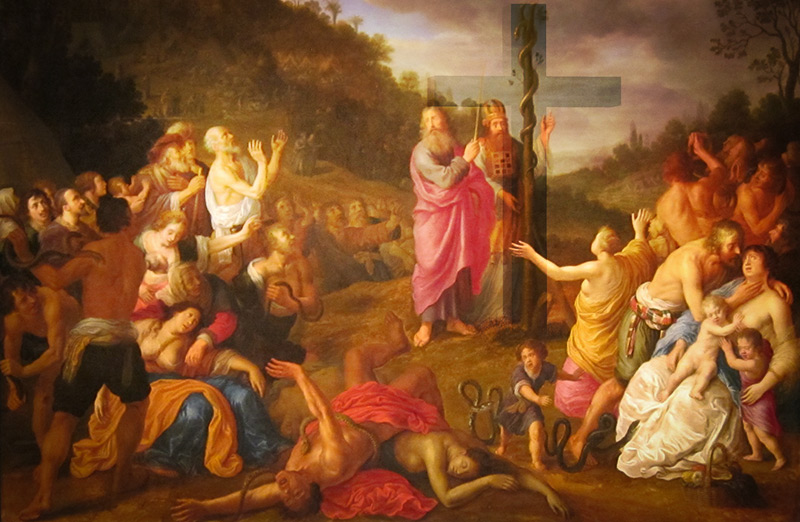
Given this, we can understand better why the Church chose today’s First Reading as a parallel to the Gospel passage. In that light, we ought to recall how Jesus’ words in today’s Gospel passage echoes what He had earlier proclaimed, recorded five chapters earlier in John 3: “‘just as Moses lifted up the serpent in the desert, so must the Son of Man be lifted up, so that everyone who believes in him may have eternal life.’”
In these words, Jesus seems to identify Himself with a serpent in the desert. If this seems an odd comparison, recall St. Paul’s words in the Second Reading on Ash Wednesday:“For our sake [God the Father] made Him to be sin who did not know sin.”
God the Father making His divine Son to be sin, as incredible as it seems, was done for a divine purpose. St. John the Evangelist explains this after Jesus makes a connection between His self-sacrifice on the Cross with Moses’ lifting up the serpent:“For God so loved the world that he gave his only Son, so that everyone who believes in him might not perish but might have eternal life” [John 3:16].
Monday of the Fifth Week of Lent Daniel 13:41-62 + John 8:12-20
“Even though I walk in the dark valley I fear no evil; for you are at my side.”
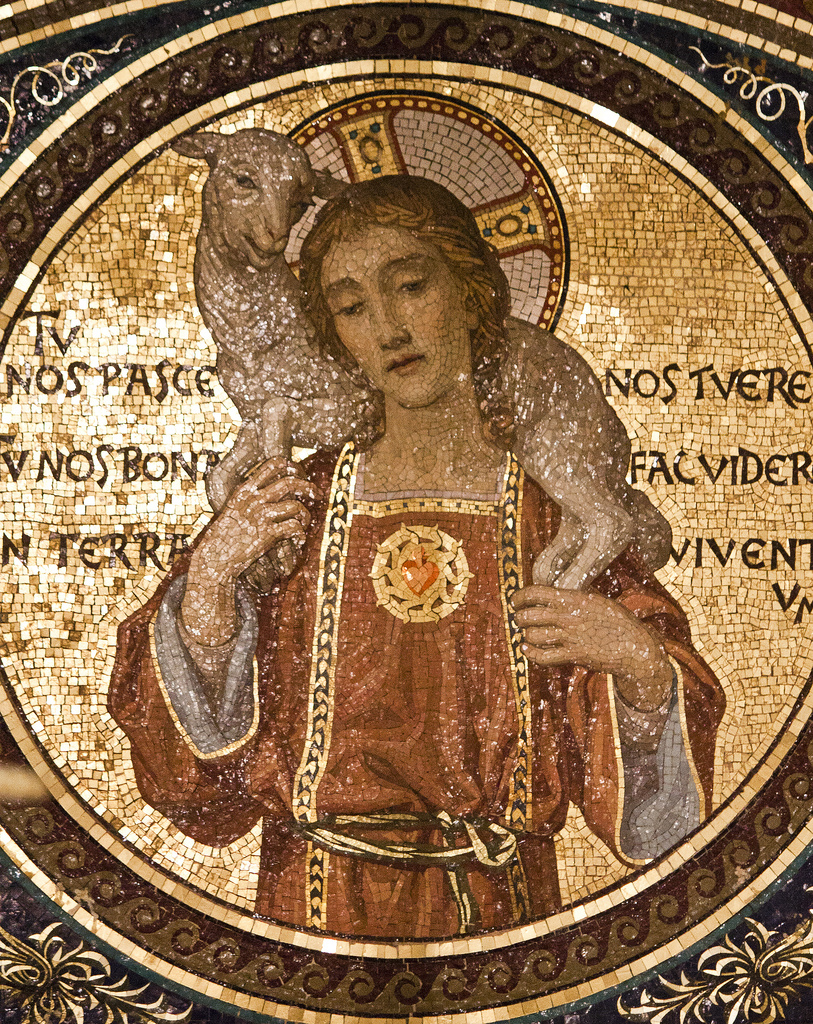
The 23rd Psalm is undoubtedly the most famous of the 150 works found in the Psalter. But those who comment upon this psalm don’t always give it its due. Instead, reflections upon the 23rd Psalm often focus upon the first verse, and the beneficence of the Good Shepherd.
As this psalm is proclaimed during the first week of Passiontide, however, the refrain of today’s Responsorial gives us a different focus. The refrain concentrates our focus upon the middle two of the four stanzas of the psalm (as it’s broken down for proclamation in the Roman Missal). These verses foreshadow Christ’s Passion, and the care that the Good Shepherd affords to one in danger.
In turn, these verses of the 23rd Psalm also help us appreciate better the danger faced by Susanna in today’s First Reading, and the care shown by Daniel, who shepherds her to legal and moral safety (in fact, to help her avoid death). In this, the First Reading’s narrative helps us appreciate that each of us is called to be not only a sheep who calls upon the Good Shepherd, but also a good shepherd to those whose safety needs our protection.


 Reflections on the Sacred Liturgy