Palm Sunday of the Passion of the Lord [A]

RSL banner

Palm Sunday of the Passion of the Lord [A]
Matthew 21:1-11  +  Isaiah 50:4-7  +  Philippians 2:6-11  +  Matthew 26:14—27:66

“Who is this?”

+     +     +

references to the Catechism of the Catholic Church cited for this Sunday by the Vatican’s Homiletic Directory:

CCC 557-560: Christ’s entry into Jerusalem
CCC 602-618: the Passion of Christ
CCC 2816: Christ’s kingship gained through his death and Resurrection
CCC 654, 1067-1068, 1085, 1362: the Paschal Mystery and the liturgy

+     +     +

The rubrics for Palm Sunday indicate that a homily need not be preached.  A period of silence may be observed after the Passion instead.  The reason for the exception on Palm Sunday isn’t directly stated in the Roman Missal.

We might guess that the reason for this exception is the sheer length of this Sunday’s Gospel texts.  Not only is the Gospel of the Passion itself extremely long.  In fact, there are two Gospel Readings proclaimed on Palm Sunday:  the first is at the start of Mass, recounting Christ’s triumphal entrance into Jerusalem.

However, we might guess that there’s an additional reason why the priest is permitted not to preach a homily on Palm Sunday.  The Gospel Reading of the Passion is the very heart of Jesus’ Good News.  What could a homilist possibly add to the proclamation of the Gospel narrative?  What more is there to say?

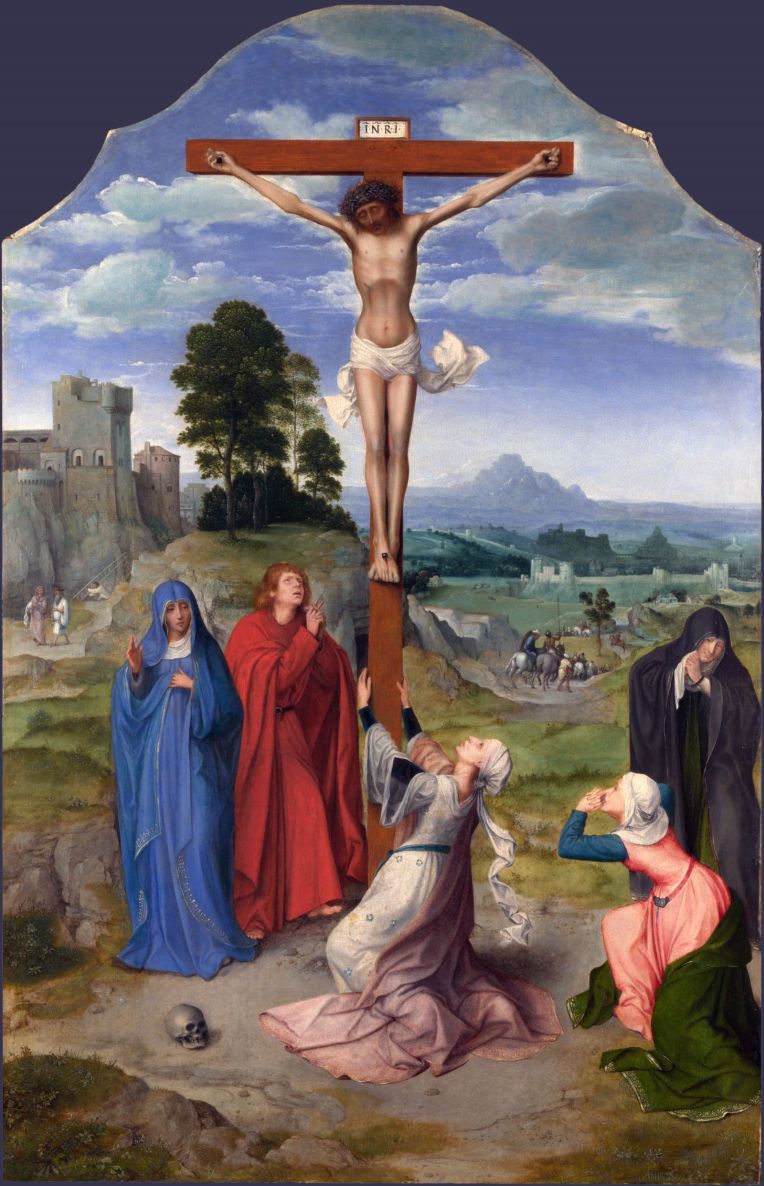
Yet this second guess ought to be challenged.  In fact, there is something more to be said, because the temptation is to admire the Gospel of the Passion without entering into it:  that is, to look up to Jesus as if His Cross were a pedestal.

The homilist on Palm Sunday, then, preaches to each member of his congregation about her need to enter personally into the Gospel of the Passion.  Each congregant needs to make the narrative of the Passion her own.  Each needs to bear the conviction that when Jesus died on the Cross, He died for that individual.  In a church like the Catholic Church, which has on earth more than one billion members (and that’s not to mention those who have gone before us marked with the sign of faith), it’s easy to feel lost in the crowd.

Each individual member of the Mystical Body of Christ is loved by Christ as if she or he were the only person He died for on the Cross.  The Church has always taught this, but in recent times St. John Paul II used the language of personalist philosophy to explore the meaning of the Gospel in general, and in particular the need for each Christian to encounter the crucified and Risen Christ as an individual rather than as an historical figure or a distant deity.

We might wonder how it’s even possible for the one single person of Jesus Christ to individually relate to, much less personally love, more than a billion individuals at the same time.  While this might seem impossible, it’s not something that you need to comprehend fully but simply to believe and experience.

It’s this relation between the individual and Christ Jesus that makes a disciple into a saint.  This connection is what makes a disciple strong enough to persevere in following Jesus all the way to the top of Calvary, with eyes fixed upon Jesus and His Cross instead of upon oneself and one’s desires.

The Second Reading for Palm Sunday helps us glimpse, if not fully comprehend, how Jesus Christ can relate to each individual member of the Church, including yourself.

In theology, the Second Reading is summed up by the Greek word “kenosis”.  In English this word is translated rather awkwardly as “self-emptying”.  We might say that it’s the virtue of humility in a complete, personalistic sense.  That is to say, kenosis is not just the performance of a humble action, but the humbling of one’s whole self in a permanent yet on-going manner.

In the case of the divine Person of Jesus, He chose not to cling to His divinity.  We see this at the Annunciation, when He took upon Himself a human nature, with all its weaknesses and vulnerabilities.  But as the following thirty years of His life passed, His kenosis continued as He put His divine Self entirely at the service of His earthly mission.

Yet the whole of Jesus’ earthly life was oriented by God towards a single hour:  the hour of Divine Mercy on the afternoon of Good Friday.  The kenosis of the Incarnation and public ministry were designed to lead individuals to Calvary:  not just the individual apostles, disciples and others who lived in the Holy Land 2000 years ago, but each individual living today as well, including yourself.

It’s at the Cross and through the Cross that Jesus Christ relates to each individual.  Through the Cross, the individual can enter into the mystery of Christ’s kenosis, sharing directly in Jesus’ Incarnation, Passion, Death, Resurrection and Ascension.  It’s not in spite of your sins that Jesus chooses to relate to you, but through your sins.  The depth of your human sins reveals the depth of His divine love.

Lent 6-0A

Saturday of the Fifth Week of Lent

RSL banner

Saturday of the Fifth Week of Lent
Ezekiel 37:21-28  +  John 11:45-56
April 4, 2020

So from that day on they planned to kill him.

This morning’s Gospel Reading bears a sense of anxious anticipation.  Its final verse leaves us on the edge of our pew:  “They looked for Jesus and said to one another as they were in the temple area, ‘What do you think?  That he will not come to the feast?’”

Just a few verses before, St. John the Evangelist explains the reason for the heightened sense of anxiety:  “So from that day on they planned to kill him.”  The motive for this plan of the chief priests and Pharisees is the focus of this morning’s three readings.

Both this morning’s First Reading and Responsorial Psalm come from books of Old Testament prophets:  the First Reading, from Ezekiel; and the Psalm, from Jeremiah.  Both look to Israel’s future, when a shepherd king would reign over a united Israel.  The Responsorial is very strong in describing this shepherd

Yet the language of king is only implied, although in two ways.  First, Ezekiel prophesies about Israel being restored to one kingdom.  However, second and more intriguingly, Ezekiel prophesies that “there shall be one prince for them all”:  not one “king”, but one “prince”.  Twice in the verses that follow, Ezekiel identities David as this prince.  Through the prophet the Lord declares:  “My servant David shall be prince over them, and there shall be one shepherd for them all”; in the Holy Land, Israel shall dwell “with my servant David their prince forever.”

Everything that Ezekiel and Jeremiah prophesy about this shepherd king is fulfilled in the person of Jesus Christ.  More specifically, Jesus fulfills His earthly mission as Christ the King upon the Cross on Good Friday.  Jesus is drawing close to “His hour”.  Through the New Passover—the Holy Sacrifice of the Mass—we are able to enter into Jesus’ life and saving mission.

Lent 5-6

Friday of the Fifth Week of Lent

RSL banner

Friday of the Fifth Week of Lent
Jeremiah 20:10-13  +  John 10:31-42
April 3, 2020

“If I do not perform my Father’s works, put no faith in me.”

Some disagree with the saying, a little knowledge is a dangerous thing, claiming that a little is better than none.  They do not see that those having the little often self-righteously and proudly conclude they know it all.

The Pharisees, purported Scripture scholars and experts in the Mosaic Law, fell into this latter category.  When Christ revealed Himself to them as the Messiah, though they had well documented knowledge of the miracles He had performed, they immediately rejected the evidence, accused Him of blasphemy and prepared to stone Him.

What rendered them more dangerous than their intellectual presumption, and perhaps their fear of losing authority and position, was their faithlessness, their lack of God’s light and love.  In this, Christ Jesus is their opposite, and this opposition to the Pharisees is what each of us must imitate:  knowing that in God, we have everything we are, and that all we are, God calls us to give:  for the sake of others, and for the greater glory of God.

Lent 5-5

Thursday of the Fifth Week of Lent

RSL banner

Thursday of the Fifth Week of Lent
Genesis 17:3-9  +  John 8:51-59
April 2, 2020

“Amen, amen, I say to you, before Abraham came to be, I AM.”

While yesterday’s Gospel Reading looked in part upon Abraham, today’s Scriptures double down on this focus.  Today both the First Reading and Gospel Reading look at “our father in faith”.  In fact, it is Abraham as father that is the specific focus.

In the First Reading, God changes Abram’s name to “Abraham”.  This new name can be literally translated as “father of many”.  But God’s own explanation of why he’s bestowing this new name is worth our attention:  “for I am making you the father of a host of nations.  I will render you exceedingly fertile; I will make nations of you; kings shall stem from you.”  You could use any one of these four phrases for meditation, especially in terms of how this call from God to Abraham foreshadows the mission of Jesus Christ, who fulfills Abraham’s call in a new way.

Yet there’s another important aspect of God’s covenant with Abraham that’s not captured by these four phrases.  Later in the First Reading, God vows:  “I will give to you and to your descendants after you the land in which you are now staying, the whole land of Canaan, as a permanent possession”.  The Holy Land for the people of the Old Testament was a geographic place upon the earth, with Jerusalem as its capital, and the Temple at the capital’s center.  This is where we Christians need to understand the “Holy Land” of God’s covenant with Abraham in a new way:  the Holy Land is Heaven; its capital is Christ, the Head of the Church; and the Temple is the Cross on Calvary, from which Christ’s self-sacrifice radiates throughout human history, leading the faithful of Christ’s Mystical Body into the heavenly embrace of God the Father.

Lent 5-4

Wednesday of the Fifth Week of Lent

RSL banner

Wednesday of the Fifth Week of Lent
Daniel 3:14-20,91-92,95  +  John 8:31-42
April 1, 2020

“…you will know the truth, and the truth will set you free.”

Historically, freedom for the Jews was based upon two figures of their past.  First, descent from Abraham—their father in faith—was considered the foundation of the People of God.  Second in importance was adherence to the Law of Moses, who led God’s People from slavery in Egypt to freedom in the Promised Land.  Yet the Gospel accounts show that many in Jesus’ day who were living in the Holy Land were in fact slaves.

Jesus, we might say, taught that authentic and lasting freedom comes from adherence to the truth.  More significant than this teaching, however, is  that Jesus revealed Himself to be Truth incarnate.  As we draw closer to Holy Week, we might anticipate Pontius Pilate’s feckless query:  “Truth?  What is truth?”  In our own culture, it’s claimed that truth can be manufactured according to one’s own will, if one even wishes to bother with the idea of “truth”.  The human person, in this false view of reality, is free to manipulate truth at will.  Jesus reveals a much more demanding relationship between truth and freedom.

Jesus declares “to those Jews who believed in him, ‘If you remain in my word, you will truly be my disciples, and you will know the truth, and the truth will set you free.’”  Each person who seeks to follow Jesus must reckon with this declaration by first believing in Jesus.  Through belief—that is, through faith—the Christian disciple can remain in Jesus’ word.  In all things, Jesus’ word is a call:  a call to self-sacrifice for the love of God and neighbor.  Living out this truth is the only means by which to find authentic and eternal freedom.

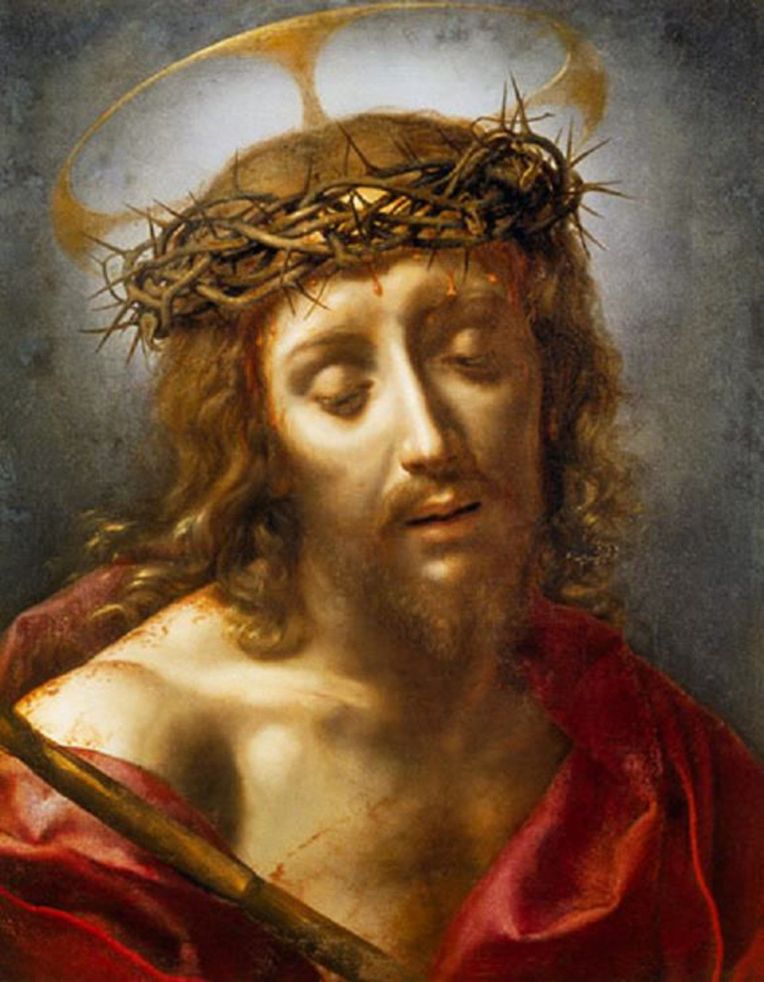
Jesus Christ - "Ecce Homo"

Tuesday of the Fifth Week of Lent

RSL banner

Tuesday of the Fifth Week of Lent
Numbers 21:4-9  +  John 8:21-30
March 31, 2020

“When you lift up the Son of Man, then you will realize that I AM….”

It’s questionable whether, when Jesus told the Pharisees that they would realize Jesus’ identity when they lifted up the Son of Man, they understood that He was foretelling His being lifted up on the Cross.  Yet perhaps the Pharisees had already at this point plotted the death of Jesus in detail.

There’s no question, however, that the Pharisees were unable to understand what Jesus on this occasion was claiming about Himself.  Twice in today’s Gospel Reading Jesus uses the divine name of “I AM”—the divine Name that God revealed to Moses at the burning bush—to identify Himself.  But Jesus does not reveal His divine identity for His own sake.

Jesus took on human nature so that through it, He could redeem fallen man.  We might wonder just how closely today’s First Reading was chosen to point to Jesus’ words in the Gospel passage.  In that light, we ought to recall what Jesus proclaimed just five chapters earlier in John 3:14-15:  “‘just as Moses lifted up the serpent in the desert, so must the Son of Man be lifted up, so that everyone who believes in him may have eternal life.’”

Jesus seems, very unflatteringly, to be identifying Himself with a serpent in the desert.  If this seems an odd comparison, recall St. Paul’s words in the Second Reading on Ash Wednesday:  “For our sake He made Him to be sin who did not know sin”

God the Father making His divine Son to be sin, as incredible as it seems, was done for a divine purpose, as the evangelist explains after Jesus connects His future self-sacrifice with Moses’ lifting up the serpent:  “For God so loved the world that he gave his only Son, so that everyone who believes in him might not perish but might have eternal life” [John 3:16].

Lent 5-2

Monday of the Fifth Week of Lent

RSL banner

Monday of the Fifth Week of Lent
Daniel 13:41-62  +  John 8:1-11
March 30, 2020

“Go, and from now on do not sin any more.”

When Jesus commands the woman caught in adultery not to “sin any more”, He has clearly judged that she is a sinner.  But He has not condemned her.  That distinction between judgment and condemnation is important in our day because some suggest that one should never judge others.

When one human person bears authority over another, she or he has the right to judge the other.  Whether it’s a parent judging her child’s actions, a courtroom judge overseeing a legal case, or a teacher judging the behavior of students, it’s part of the natural order of things for one person to judge another.

The same is true in the supernatural order of things.  For example, the word “bishop” literally means “overseer” (or alternately, “supervisor”), and a necessary part of his oversight is making judgments about those under him.  Another example is the priest in the confessional.  While it’s largely up to the penitent to “self-report” his or her sins, the priest may judge by means of discreet questions the seriousness of confessed sins and whether the penitent is truly contrite.

In the case of today’s Gospel Reading, Jesus twice judges the woman caught in adultery.  On the one hand, He judges that she is a sinner.  But on the other, He judges her to be contrite and ready to reform her life.  To that latter end, He lets her go.  He does the same for us when we also are contrite and ready to move beyond our sins.  Yet He also gives us His grace to help us in the often difficult work of moving out of and beyond our sins.

Lent 5-1

The Fifth Sunday of Lent [A]

RSL banner

The Fifth Sunday of Lent [A]
Ezekiel 37:12-14  +  Romans 8:8-11  +  John 11:1-45

So Jesus said to them, “Untie him and let him go.”

+     +     +

references to the Catechism of the Catholic Church cited for this Sunday by the Vatican’s Homiletic Directory:

CCC 992-996: the progressive revelation of resurrection
CCC 549, 640, 646: raisings a messianic sign prefiguring Christ’s Resurrection
CCC 2603-2604: the prayer of Jesus before the raising of Lazarus
CCC 1002-1004: our present experience of resurrection
CCC 1402-1405, 1524: the Eucharist and the Resurrection
CCC 989-990: the resurrection of the body

+     +     +

We often hear predictions about what the future holds for mankind.  Especially impressive seem promises of medical advances.  It’s true that we can look back at the past hundred years and marvel at how modern medicine has saved countless lives.  Some might even want to call these recent medical discoveries “modern miracles”.

But as we hear about what our future holds, we’re promised even greater “miracles”.  We hear about cures for diseases that people have said would never be cured.  One doctor has claimed that sometime in this century people will be able to live to the age of two hundred.

Don’t you wonder how many people would actually want to be two hundred years old?  In other words, doesn’t there comes a point where most people realize that death is a natural part of life?  Death ends our life on earth, but only so that we can live somewhere else.  Where we live after death is up to God and us.

By contrast, if death is not something natural, what sort of miracle did Jesus work in today’s Gospel Reading?  In other words, is Lazarus still walking around the Middle East today?  Can you go and visit him?  Obviously, Lazarus died a second time at some point after Jesus raised him from the dead.

So does the fact that Lazarus died a second time mean that Jesus’ miracle was a failure?  What was the point of Jesus’ miracle?  Was he trying to “save” Lazarus from death?  No.  Instead, this miracle is a sign:  it points beyond itself.

Lazarus, raised from the dead, points our attention to Jesus.  This miracle is a sign that reveals that Jesus is more powerful than death, and that if we believe in Him, He can guide us beyond death.  If we don’t have faith in Jesus, death is fatal.

Today’s Gospel Reading invites us to identify with Lazarus, a dead man.  This is not an exciting role.  Lazarus says nothing and does nothing but walk out of his tomb, covered with burial cloths.  The past two weeks’ Gospel Readings portrayed two other persons—the Samaritan woman, and the man born blind—meeting Jesus and being healed by Him.  But the problem of Lazarus is not thirst or blindness, but death.

Yet there’s also another difference between the narratives about the Samaritan woman and the man born blind and the narrative about Lazarus.  The Samaritan woman and the man born blind are healed and then bring others to believe in Jesus.  But in today’s Gospel Reading, it is not the person who is cured who brings others to put their faith in Jesus.  Instead, it’s the sisters of Lazarus whose actions lead others to Christ.

If it weren’t for the steps that Martha and Mary took, Lazarus most likely would never have been raised from the dead.  It’s not that Jesus wouldn’t have known of Lazarus’ death and wouldn’t have wanted to raise Lazarus from the dead.  But in the Gospel Reading, we notice a curious hesitancy on the part of Jesus, as if He’s waiting for the right circumstances to work this miracle.  The intercession of Lazarus’ sisters seem one such circumstance.

Through the intercession of Martha and Mary, Jesus teaches us a lesson in faith.  He doesn’t teach us that death and suffering will never touch us.  Rather, He teaches us that death does not have the last word.

The miracle that Jesus worked in raising Lazarus from the dead was not so much for Lazarus himself:  after all, what did he gain from it but a few more years of life in this valley of tears?  Is that really preferable to Heaven?  So then, the miracle that Jesus worked was done for the sake of those who witnessed this miracle.  It was for those who realized that Jesus is the Lord of life and death, and that if we place our faith in Jesus, the suffering we experience in this world will itself die, ending along with our lives on earth, while we ourselves—through faith in Jesus—will rise with Him to eternal life.

Saturday of the Fourth Week of Lent

RSL banner

Saturday of the Fourth Week of Lent
Jeremiah 11:18-20  +  John 7:40-53
March 28, 2020

Then each went to his own house.

This morning’s Gospel Reading is fairly unusual in that Jesus neither appears nor speaks.  The passages focuses upon the reactions of various persons to Jesus, or rather, to what He had just said.  In fact, the first sentence of today’s Gospel Reading begins, “Some in the crowd who heard these words of Jesus said….”  So to make sense of today’s passage, we need to recall yesterday’s.

In yesterday’s Gospel Reading, Jesus only spoke three sentences:  “You know me and also know where I am from.  Yet I did not come on my own, but the one who sent me, whom you do not know, is true.  I know him, because I am from him, and he sent me.”  It’s these statements that give rise to the varied responses from the persons in today’s passage.  They argue with each other about Jesus’ origin, which in turn bears on His identity.

These persons’ confusion about where Jesus is from and who He is explains the final sentence of today’s Gospel Reading:  “Then each went to his own house.”  That might well seem an anodyne statement, but it’s symbolic of a more important truth:  that only Jesus can unite God’s people in the same “house”.  While the literal meaning of the word “house” in this final sentence is certainly an earthly dwelling place, its spiritual meaning is the House of God, which is another way of speaking about the Mystical Body of Christ.  Only by agreeing upon the true identity of Christ can God’s people find their true home in the Church.

Lent 4-6